Motion, one still at a time.
Silent films, early newspaper comics, animation loops and old photographs that moved, were colored by hand or went through the mail. Each one is taken apart frame by frame, panel by panel or side by side, with the copy and the credit for every picture.
Four reelsWhere to start
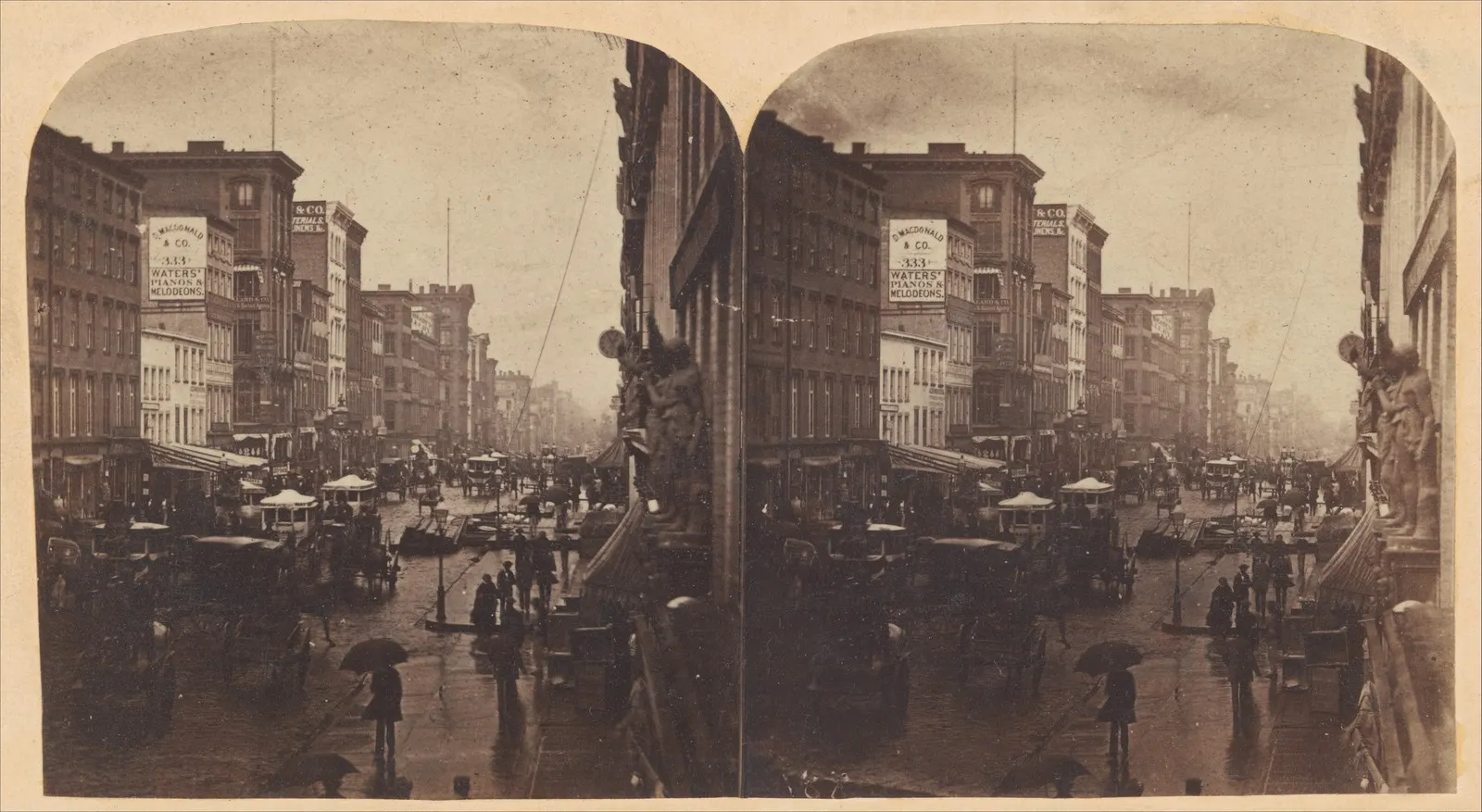
Photo Objects
Stereograph: Twin Photos Shot a Couple of Inches Apart
A stereograph is two photos of one scene taken a couple of inches apart, per an 1859 essay. On one Broadway card, the nearest pillar moves 29 px between halves.
Picture credit
"[Broadway, New York City, in the rain], stereograph, Metropolitan Museum of Art 1980.1056.3" by Edward Anthony and Henry T. Anthony — https://commons.wikimedia.org/wiki/File:-Broadway,_New_York_City,_in_the_rain-_MET_DP218027.jpg — CC0 1.0 (https://creativecommons.org/publicdomain/zero/1.0/); modified: scaled from 3871 to 1600 pixels wide; nothing else changed
 Illustration
Early Cinema
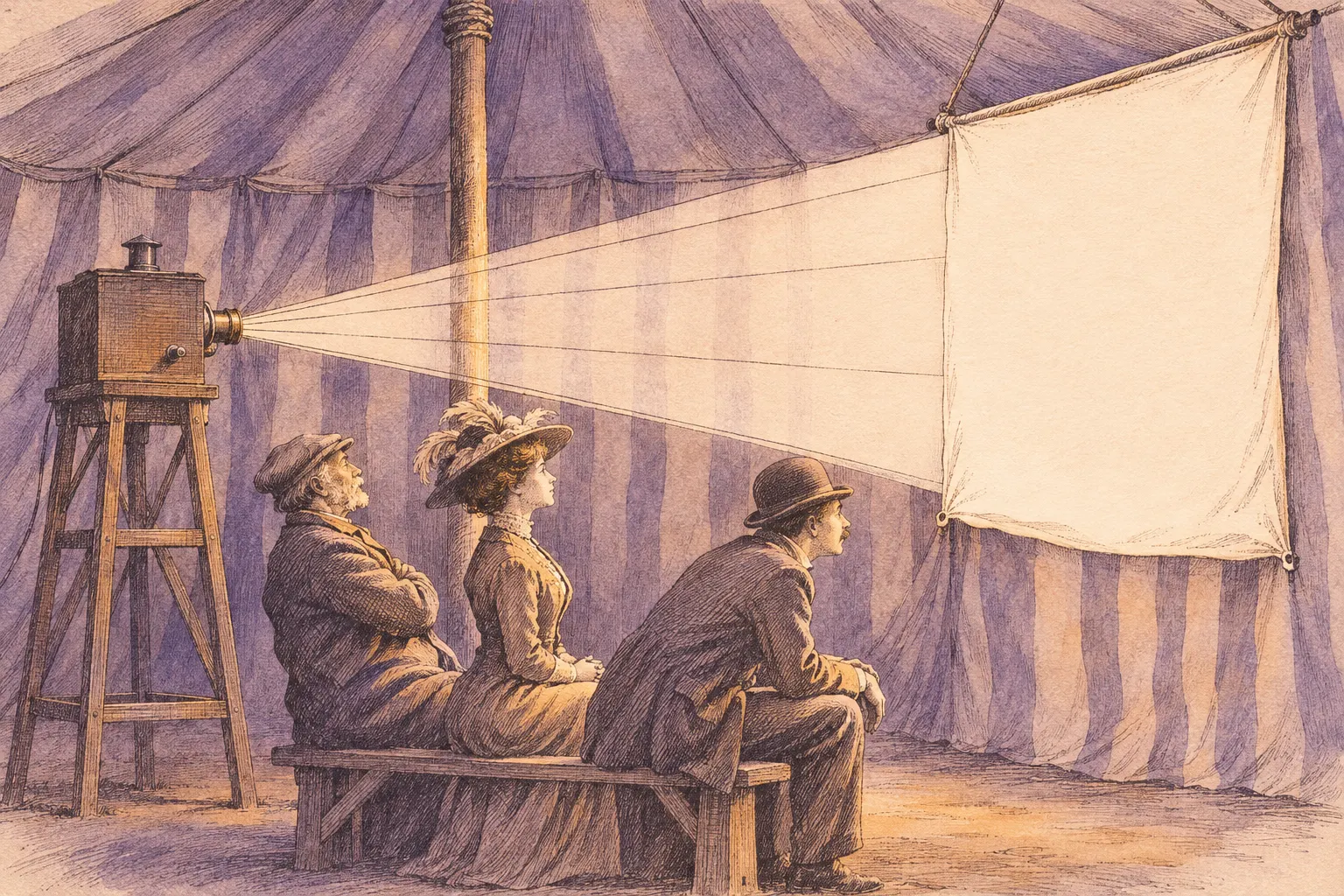
A Trip to the Moon: Méliès’s 1903 Catalog Lists 30 Scenes
Per the Star Films catalog dated 1903, A Trip to the Moon ran about 845 feet in 30 listed scenes for $130. Scene 9 reads “Landed Right in the Eye!!!”
Picture credit
Illustration: Flickers & Tintypes. Generated schematic image — not a photograph, film frame or historical record. No copyright is claimed in this generated imagery; you may reuse it, and a credit to Flickers & Tintypes is appreciated.
Animation Loops
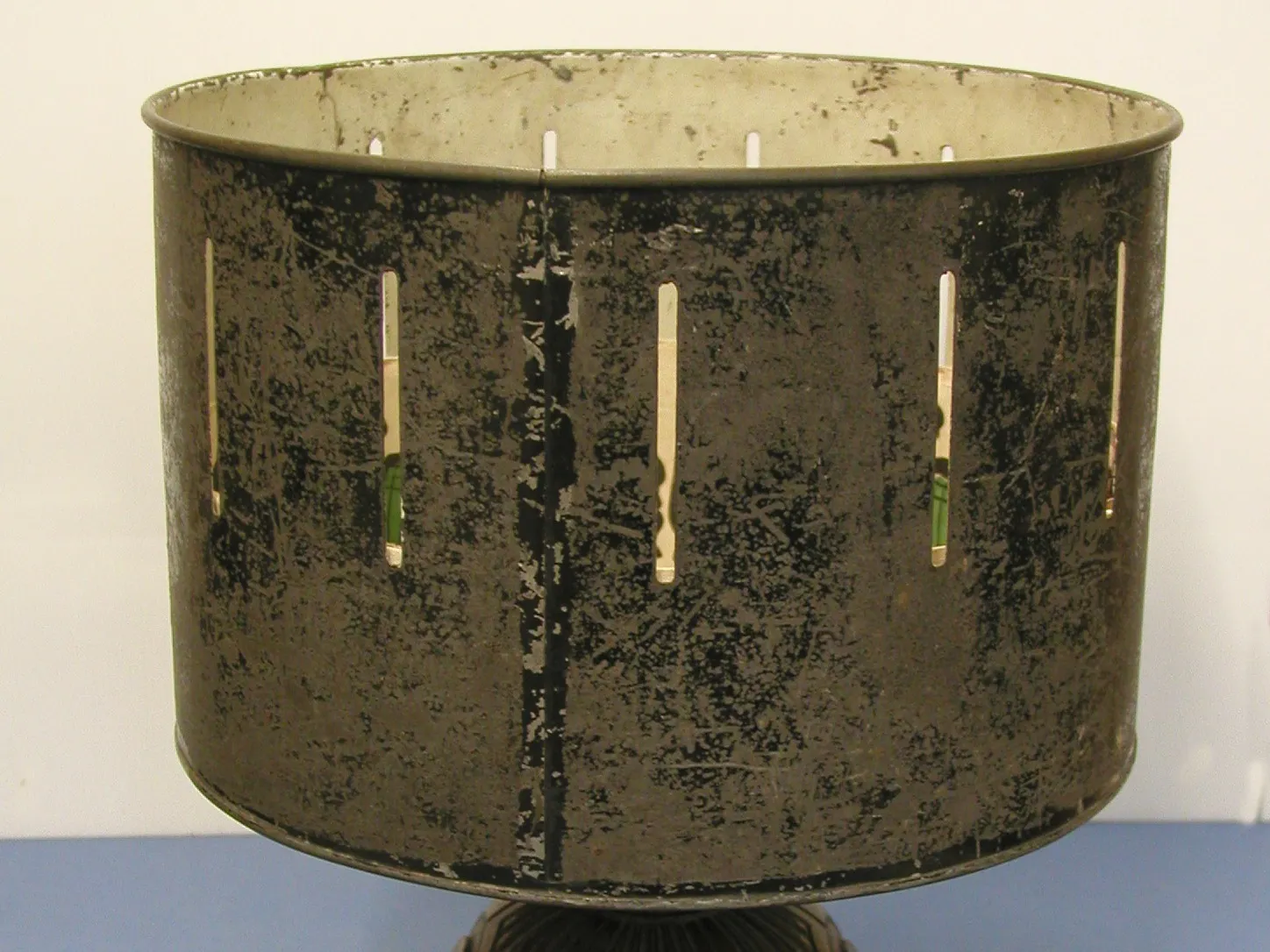
Zoetrope: An 1834 Paper Said a Whole Room Could Watch It
How a zoetrope works: slits times turns per second gives images per second. Horner named the open drum the Dædaleum in 1834; later patents are dated per Lutz.
Picture credit
"Zoetrope (wheel of life) optical toy, Auckland Museum 2001.6.1, photo AM_2001.6.1-1" by Auckland Museum — https://commons.wikimedia.org/wiki/File:Zoetrope_(AM_2001.6.1-1).jpg — CC BY 4.0 (https://creativecommons.org/licenses/by/4.0/); modified: cropped to the drum and the top of its stand, removing the measuring scale and the museum's copyright line
Comics Panels
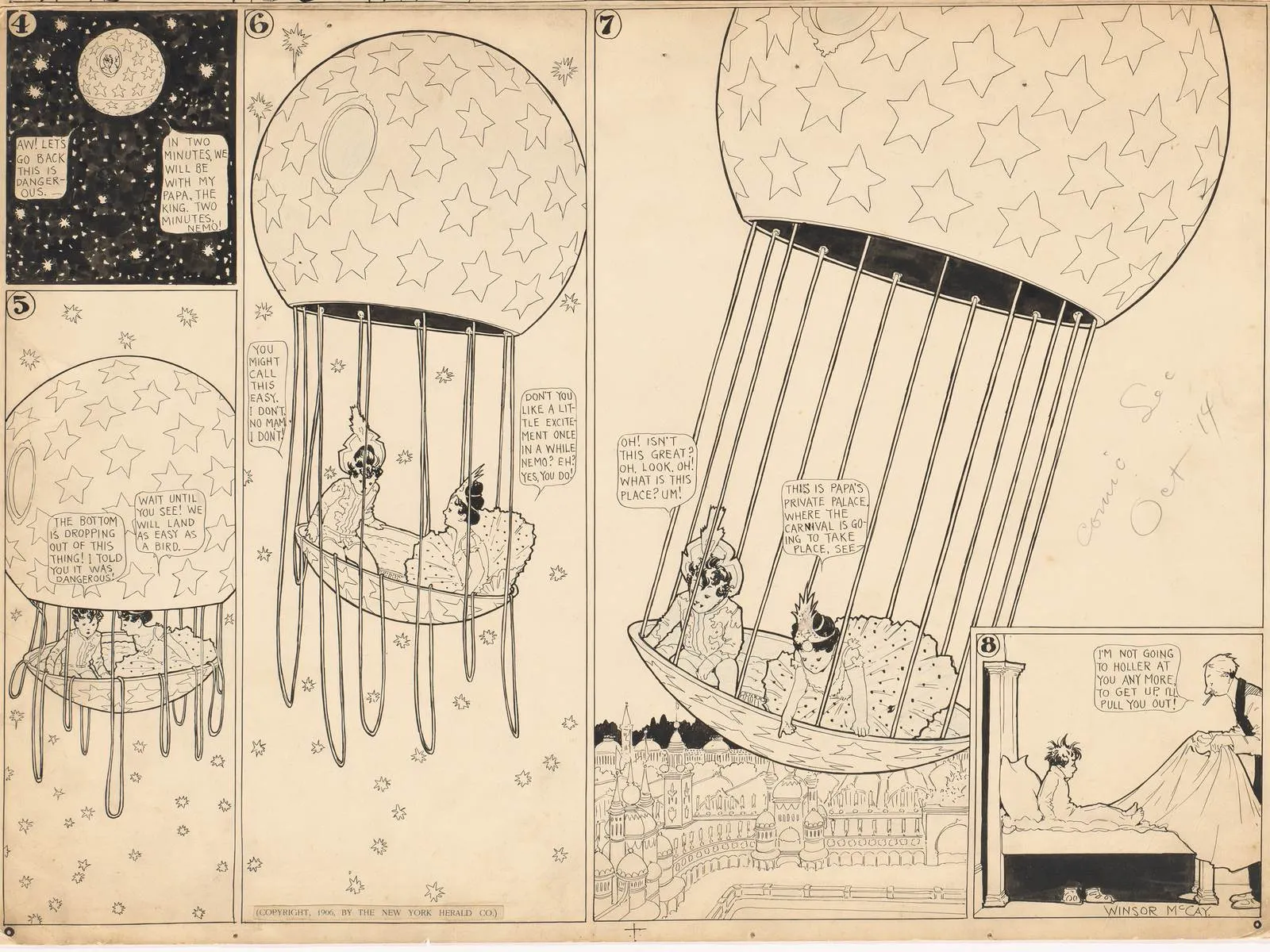
Little Nemo: A 1906 Board Numbered Out of Row Order
How to read a Little Nemo in Slumberland page: McCay’s board dated Oct. 14, 1906 numbers its 8 panels. After panel 4 they send you down to 5, not across to 6.
Picture credit
"Little Nemo in Slumberland: "I don't like this, one little tiny bit, not one tiny weenie bit", 1906 (National Gallery of Art 142153), panels 4 to 8" by Winsor McCay — https://commons.wikimedia.org/wiki/File:Winsor_McCay,_Little_Nemo_in_Slumberland_-_%22I_don%27t_like_this,_one_little_tiny_bit,_not_one_tiny_weenie_bit%22,_1906,_NGA_142153.jpg — CC0 1.0 (https://creativecommons.org/publicdomain/zero/1.0/); modified: cropped to panels 4 to 8 (the bottom tier), 4:3, and scaled from 3000 to 1600 px wide
Latest entriesNew on the site
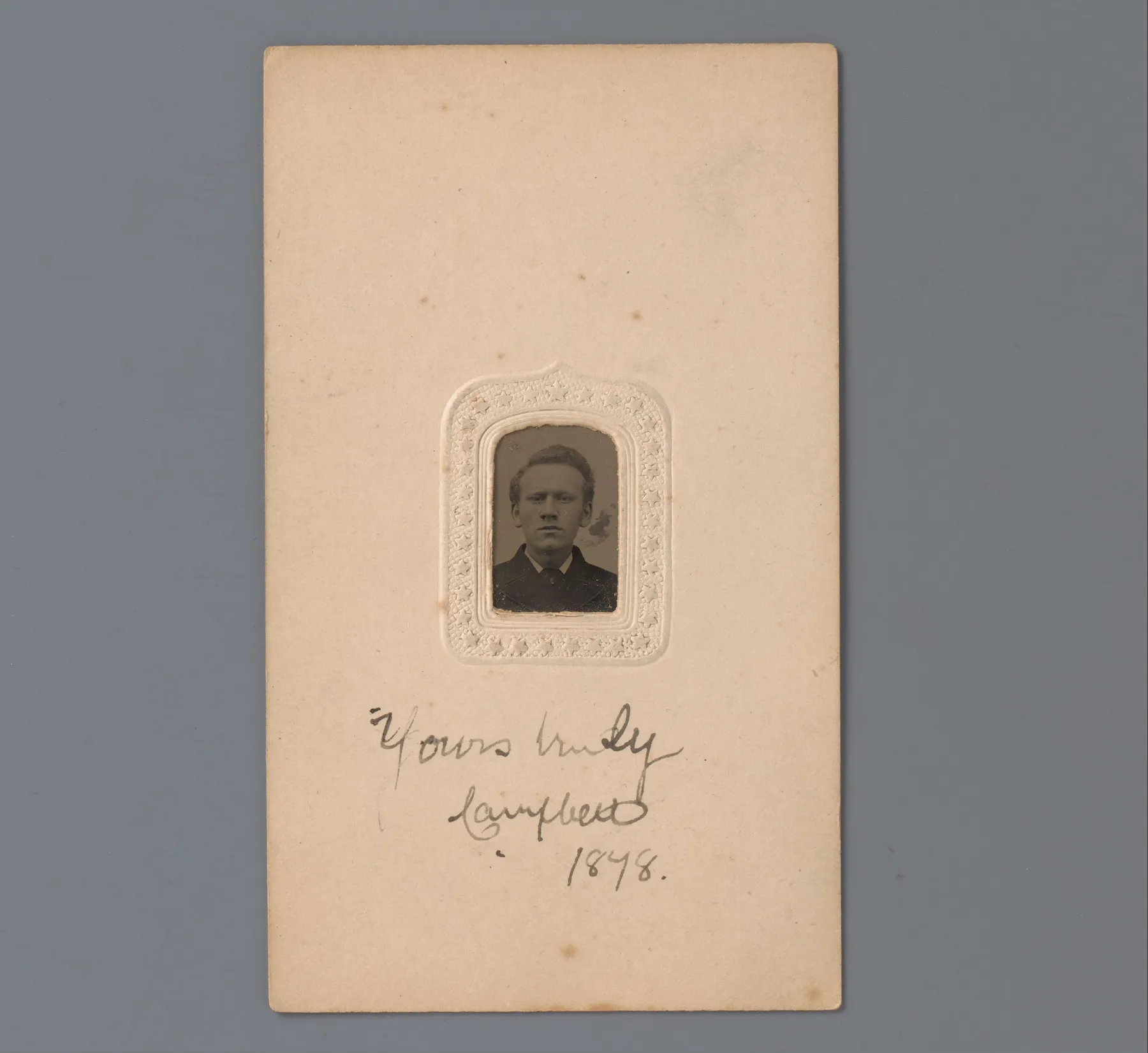
Photo Objects
Tintype: A London Label Priced 36 Tiny Portraits at 2s. 6d.
A tintype is a portrait made in the camera on black-japanned iron. Labels on the backs of museum tintypes show studios selling tiny gems by the dozen.
Picture credit
"Portret van een onbekende man (Portrait of an unknown man), RP-F-F15037" by A. Brittlebank — https://commons.wikimedia.org/wiki/File:Portret_van_een_onbekende_man,_RP-F-F15037.jpg — Public domain: Public domain in the US (made in 1878: published or not, the term has run out) and presumed public domain in the EU (Rijksmuseum Public Domain Mark; A. Brittlebank was working in London in 1878, death date not found); the Commons file is the museum’s own upload under CC0 1.0
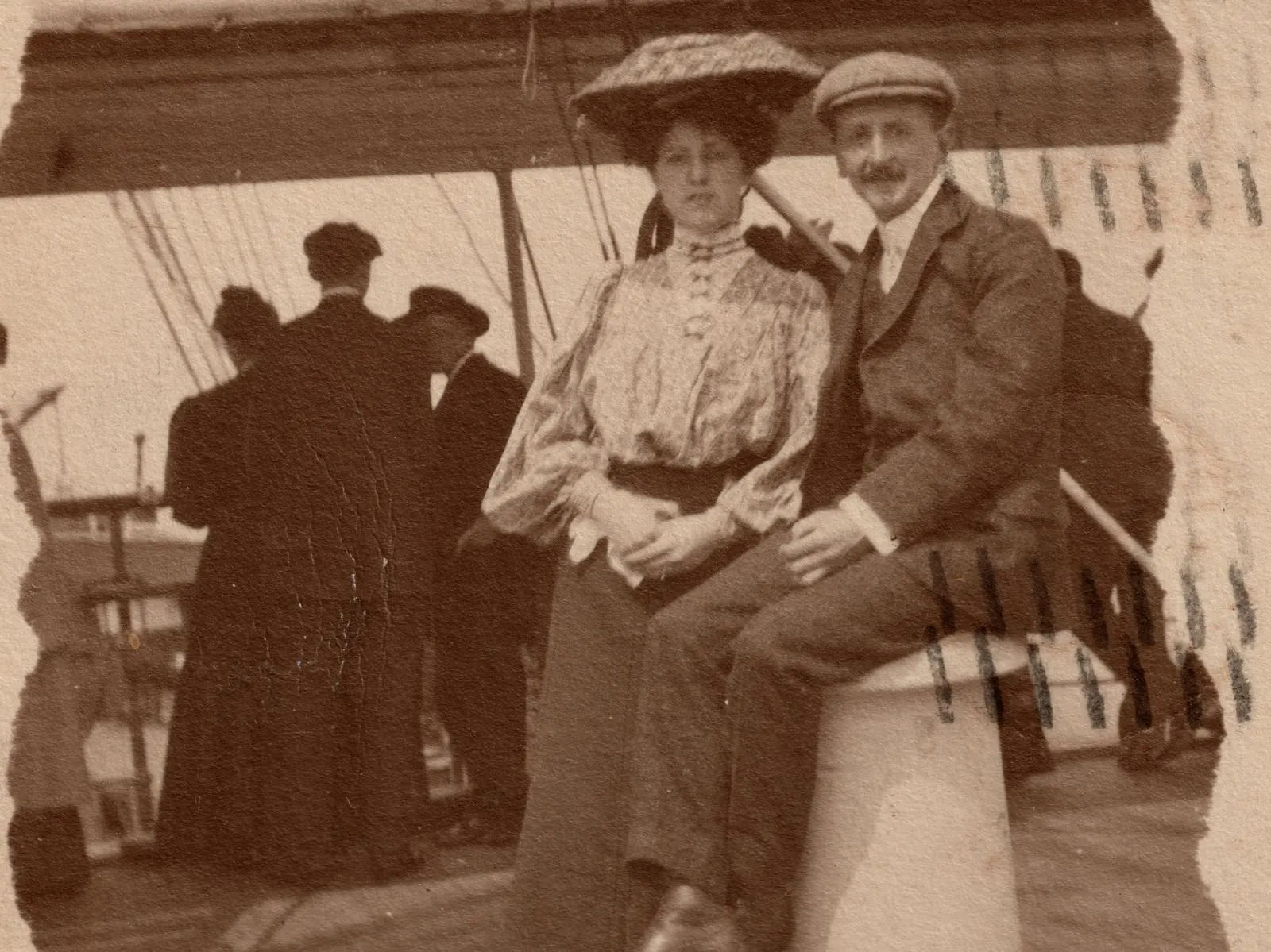
Photo Objects
Real Photo Postcard: The Back Dates the Card, Not the Photo
How to date a real photo postcard from its back: what the postmark, the stamp and a divided back can date, read against the 1907 US postal rules for post cards.
Picture credit
"Real photo postcard, December 1905: on board the SS Parisian (photograph area)" by Unknown author — https://commons.wikimedia.org/wiki/File:1905-12-22_RPPC_On_board_the_SS_Parisian_A.jpg — Public domain: Public domain in the US (anonymous work made by 1905: more than 120 years since creation, whether or not it was published; mailed December 23, 1905) and in the EU (anonymous work; 70 years from creation or from first making available have run out); modified: cropped to a 4:3 area of the photograph (box 653,3485,7516,8627 of the 8551 x 13068 original), removing the handwriting above and below; scaled to 1600 px wide
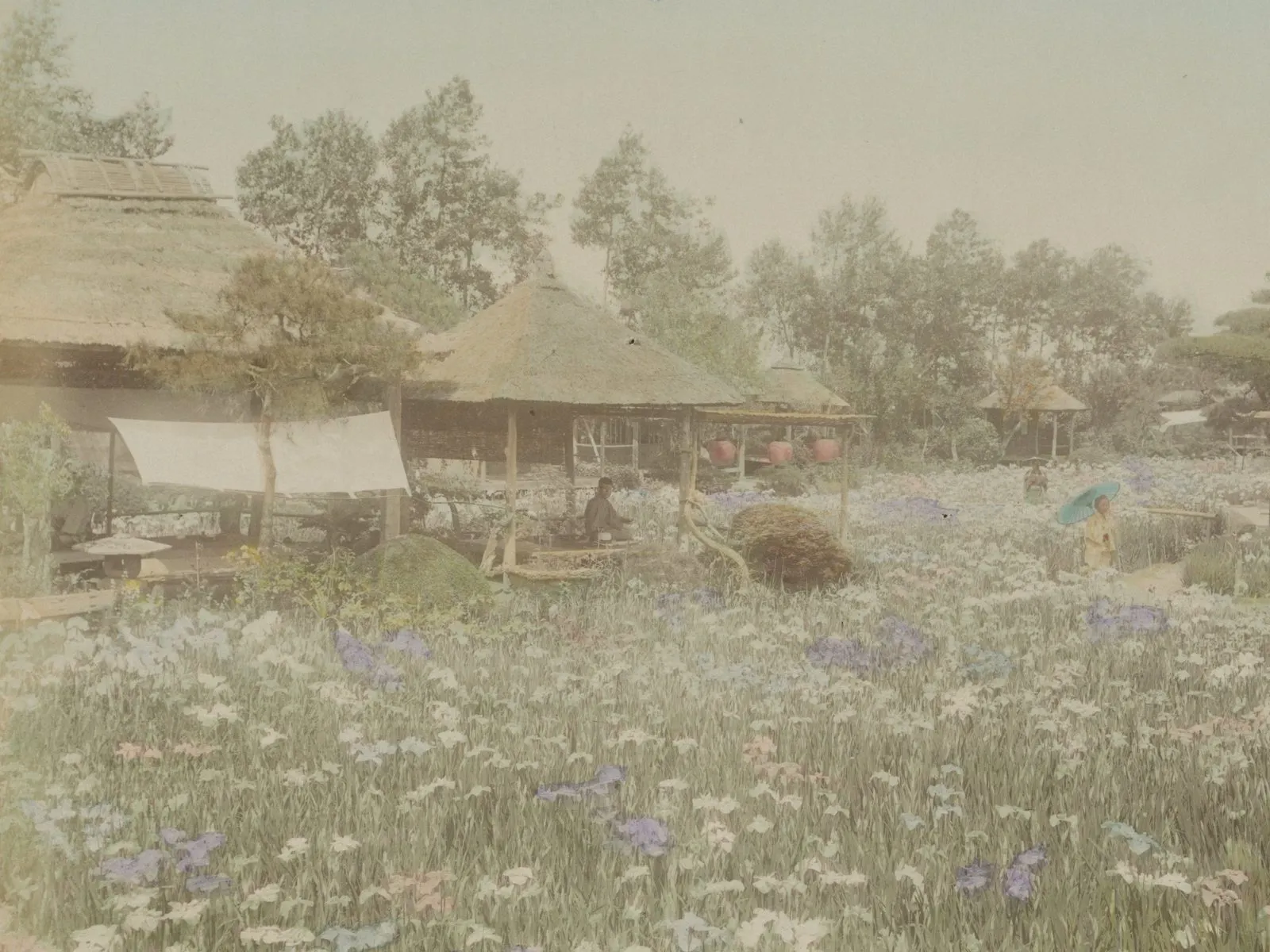
Photo Objects
Hand-Colored Photographs: The Color Came After the Picture
A hand-colored photograph is a one-color picture with color added by hand. An 1872 tintype manual says to color the plate once dry, ordinarily cheeks and lips.
Picture credit
"Mensen in een veld met irissen in Horikiri bij Tokyo (Iris Flowers Horikiri Tokio.), Rijksmuseum RP-F-F01206-H, cropped" by Unknown author — https://commons.wikimedia.org/wiki/File:Mensen_in_een_veld_met_irissen_in_Horikiri_bij_Tokyo_Iris_Flowers_Horikiri_Tokio._(titel_op_object),_RP-F-F01206-H.jpg — Public domain: Public domain in the US (made about 1870–1900: published before 1931, or if unpublished, an anonymous work more than 120 years old) and in the EU (presumed: anonymous photographer per the Rijksmuseum record, and any 70-year term from making or publication expired long ago); Rijksmuseum Public Domain Mark 1.0, Commons file CC0 1.0; modified: cropped at the top, at the left margin, at the right edge and above the printed title strip to a 4:3 view (3475 x 2606 px of the 4364 x 3462 original); scaled to 1600 px wide
Early Cinema
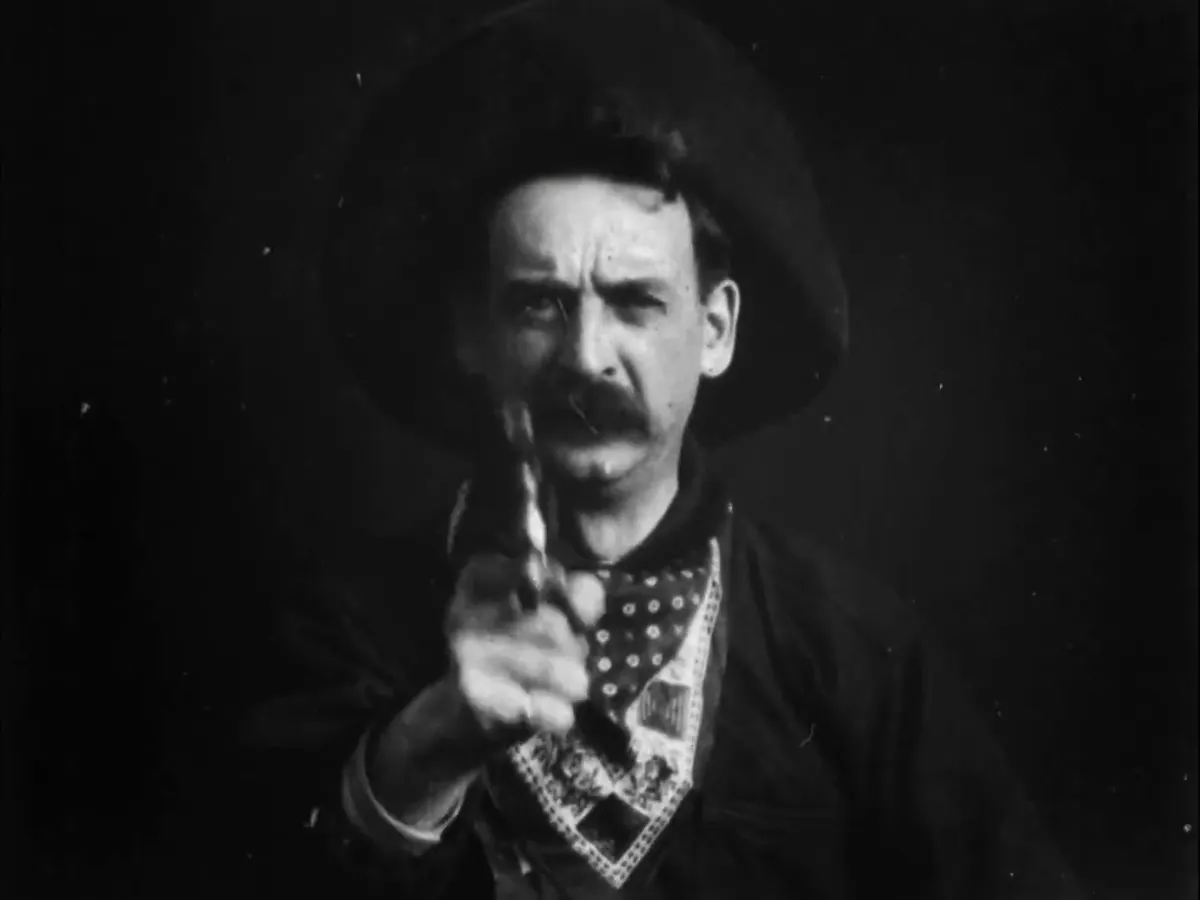
The Great Train Robbery (1903): Edison’s Movable Close-Up
Edison’s 1903 catalog let the operator put the bandit’s close-up at the start or the end. One public-domain copy, walked scene by scene with timecodes.
Picture credit
"Frame at 13:14.5 of this copy, from The Great Train Robbery (1903)" by Edison Manufacturing Company — https://commons.wikimedia.org/wiki/File:The_Great_Train_Robbery_(1903).webm — Public domain: Public domain in the US (published 1903; Edison catalog of 1903 marked Copyright 1903) and in the EU (director Edwin S. Porter died 1941, per the Commons creator record; no later-dying author identified); copy: Library of Congress 00694220, record not consulted directly; WebM conversion by the Commons uploader; modified: single frame extracted and scaled to 1200 px wide
 Illustration
Early Cinema
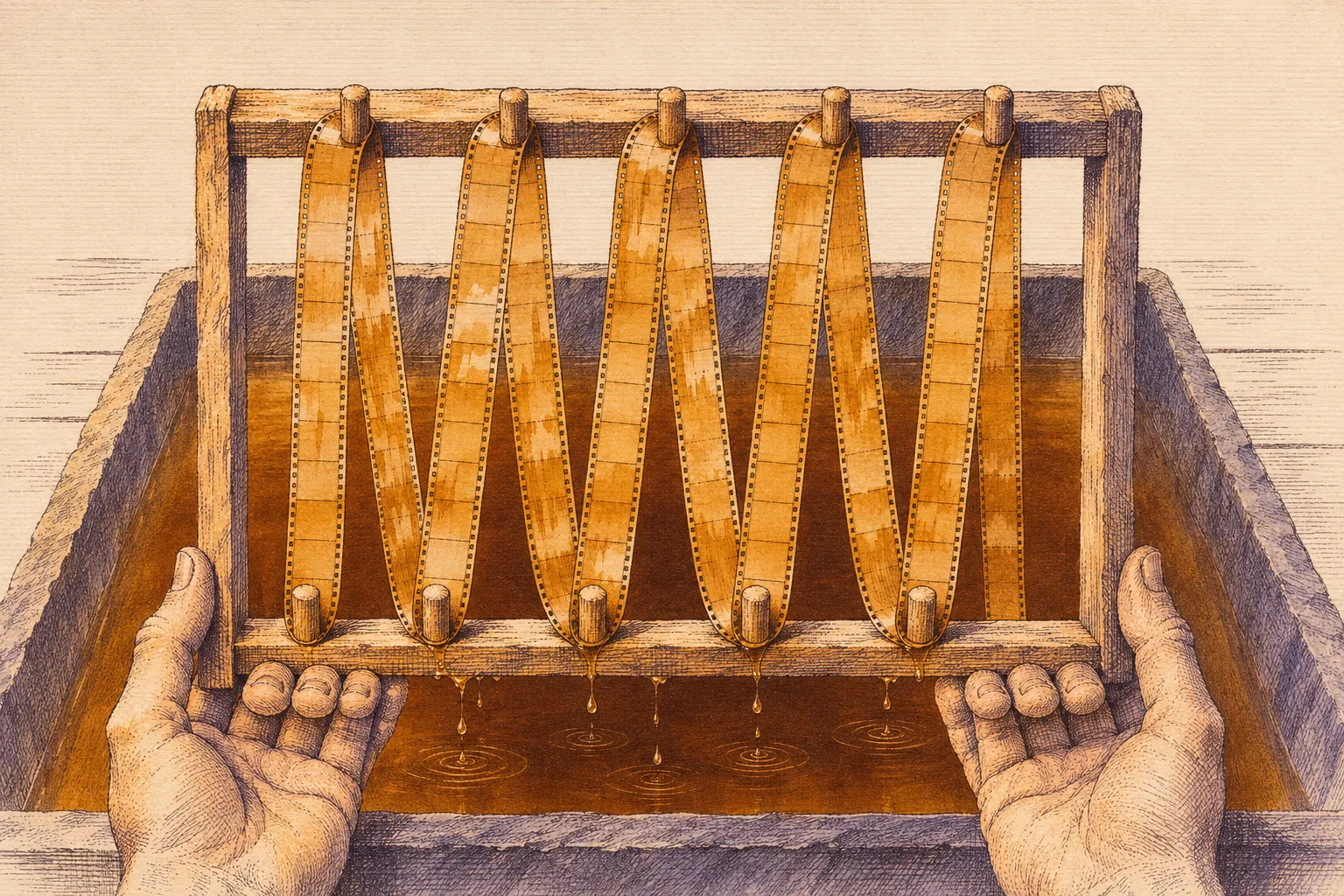
Tinting and Toning: A Tone Alone Leaves the Highlights Clear
Tinting vs toning, per Kodak’s 1918 handbook: a tint dyes the whole frame, highlights too; a tone colors only the silver image, so the highlights stay clear.
Picture credit
Illustration: Flickers & Tintypes. Generated schematic image — not a photograph, film frame or historical record. No copyright is claimed in this generated imagery; you may reuse it, and a credit to Flickers & Tintypes is appreciated.
Animation Loops
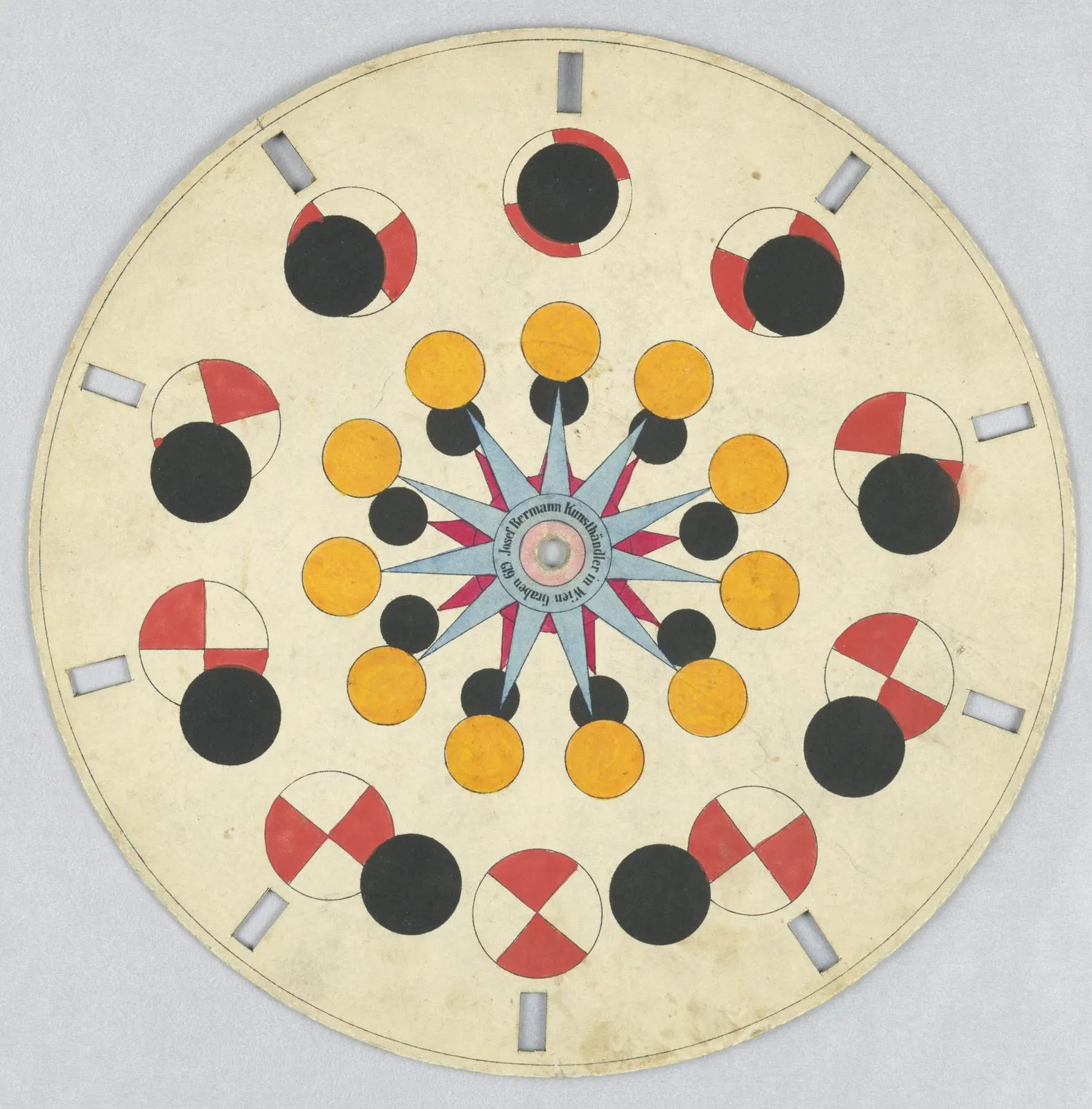
Phenakistiscope: A Spinning Disk You Watched in a Mirror
A phenakistiscope is a slotted disk spun before a mirror and watched through its slits. Count the slits and figures on a Vienna disk from about 1840.
Picture credit
"Optical Toy, Phenakistiscope Disc with Geometric Shapes, ca. 1840 (Cooper Hewitt 1948-124-4)" by Unknown author — https://commons.wikimedia.org/wiki/File:Optical_Toy,_Phenakistiscope_Disc_with_Geometric_Shapes,_ca._1840_(CH_18607983).jpg — Public domain: Public domain in the US (published about 1840) and in the EU (anonymous work published in Vienna about 1840; the 70-year term from publication expired long ago); faithful reproduction of a two-dimensional work (Commons PD-Art); modified: scaled from 3390 x 3444 to 1575 x 1600 px; whole disk, not cropped
Early Cinema
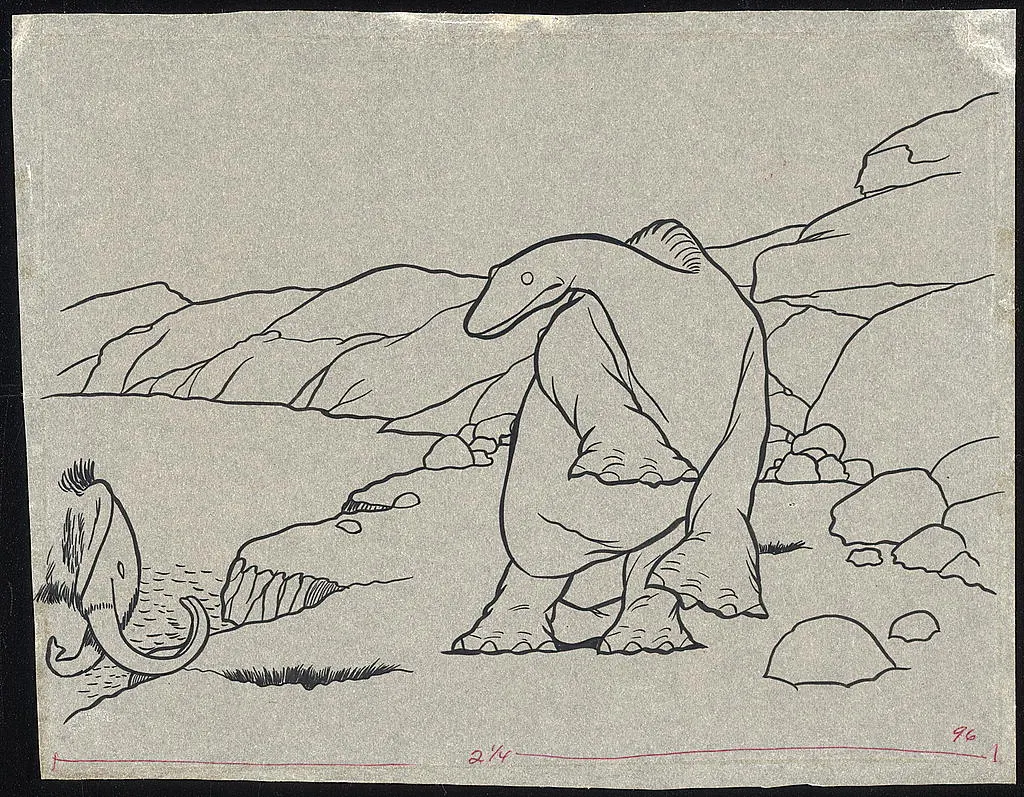
Gertie the Dinosaur: A 1914 Trade Notice Says ‘Dinosaurus’
Per Moving Picture World of November 14, 1914, Winsor McCay’s hand-drawn Gertie was to be marketed as “the Dinosaurus” and reportedly got $350 for a week.
Picture credit
"Gertie the dinosaur standing on a cliff edge looking at a mastodon (Library of Congress LCCN 2002706759)" by Winsor McCay — https://commons.wikimedia.org/wiki/File:Gertie_the_dinosaur_standing_on_a_cliff_edge_looking_at_a_mastodon_LCCN2002706759.jpg — Public domain: Public domain in the US and in the EU (Winsor McCay died in 1934, per the Commons category data; life plus 70 years ended in 2004, which covers the drawing whether or not it counts as published); the Commons file page marks it public domain (Library of Congress record not consulted directly)
Animation Loops
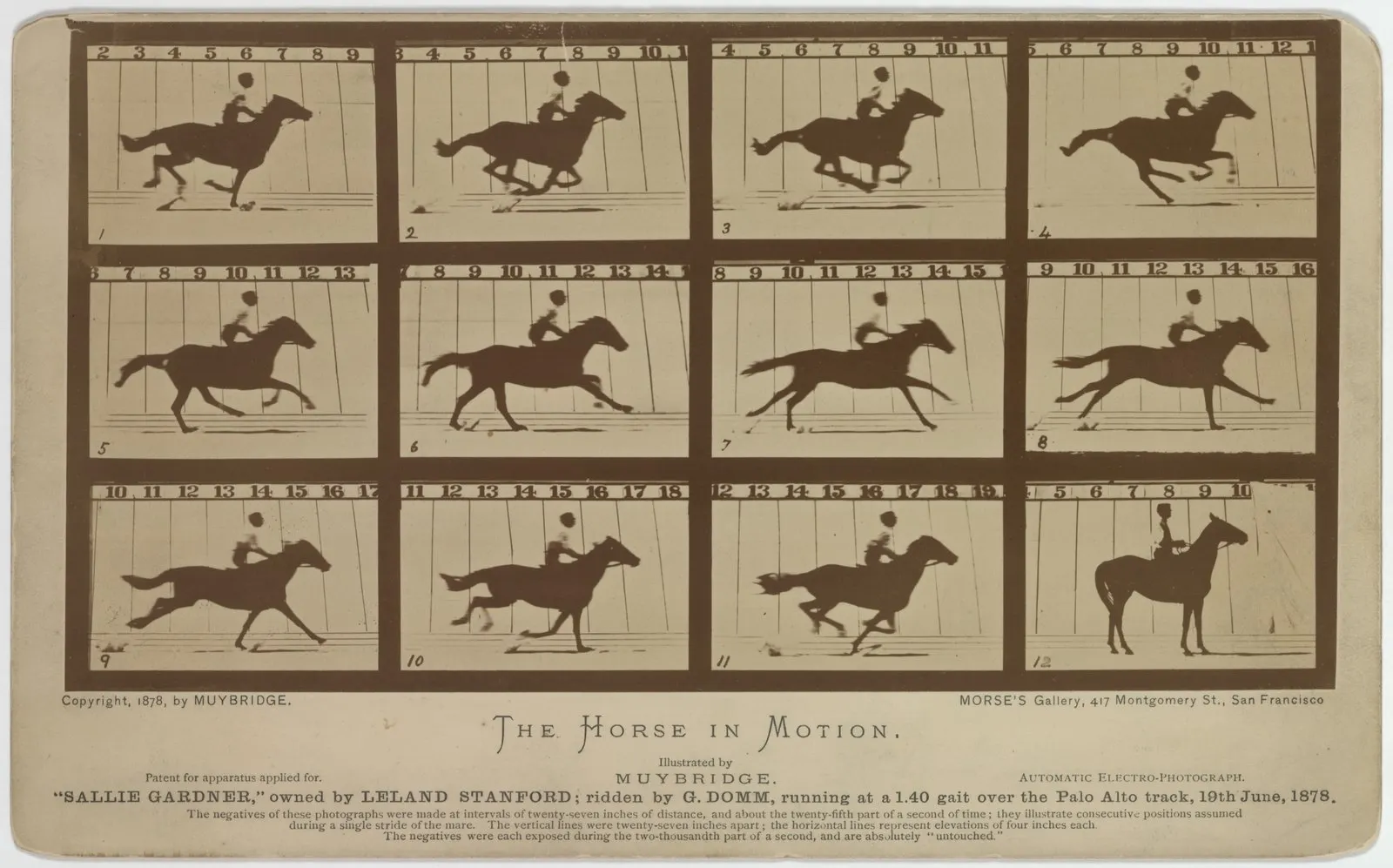
The Horse in Motion: Two Frames With No Hoof on the Track
Muybridge’s 1878 Sallie Gardner card, frame by frame: in frames 2 and 3 no hoof touches the track, and the legs are gathered under the body, not stretched out.
Picture credit
"The Horse in Motion: “Sallie Gardner,” owned by Leland Stanford, card of 12 photographs (1878)" by Eadweard Muybridge — https://commons.wikimedia.org/wiki/File:Eadweard_Muybridge-Sallie_Gardner_1878.jpg — Public domain: Public domain in the US (published 1878; card marked Copyright, 1878, by Muybridge) and in the EU (Eadweard Muybridge died 1904); copy: Library of Congress 97502309, record not consulted directly; scan as uploaded to Wikimedia Commons; modified: scaled from 4352 to 1600 px wide
Loop on the benchEvery frame of one loop
- 1top
- 2
- 3
- 4
- 5
- 6
- 7
- 8
- 9
- 10
- 11
- 12
- 13squash
- 14
- 15
- 16
- 17
- 18
- 19
- 20
- 21
- 22
- 23
- 24
Bouncing Ball Animation: In This Model, Most Frames Sit High
24 frames · 12 frames per second · 2-second loop
Four sectionsBrowse by section
-
Photo Objects4 entries
Old photographs handled as objects that moved, were colored by hand or went through the mail, read front and back, with every date given as a range, a place and a strength of evidence; never a price or an appraisal.
-
Early Cinema4 entries
How silent-era pictures learned to tell a story on screen, shown frame by frame in surviving copies whose version is recorded, and through the makers' own catalogs, original drawings and trade papers where no reliable copy survives.
-
Animation Loops5 entries
Animation principles shown as short seamless loops with their frame counts and spacing published, next to the optical toys and sequence photographs that were loops from the start.
-
Comics Panels3 entries
How early newspaper comics carry time from panel to panel and steer the eye across a page, read on public-domain original art, with any reading path marked as editorial analysis rather than eye-tracking data.
SearchFind an entry
Searches entry titles, their short descriptions and section names on this site; nothing is sent anywhere. Without scripts, use the four sections above.