Hand-Colored Photographs: The Color Came After the Picture
Frame card
In one line A hand-colored photograph is a one-color photograph with color added afterward by hand. An 1872 ferrotype manual says the plate was colored once dry, ordinarily only on the cheeks and lips.
Source, Year, Format, Length or Size, Access, License
- Source
- Rijksmuseum, Amsterdam, object RP-F-F01206-H, “Iris Flowers Horikiri Tokio.” (title on the print)
- Year
- about 1870 to about 1900, Tokyo, in the museum’s dating (a collection record: strong evidence on this site’s scale)
- Format
- hand-colored albumen print from an album of 50 photographs of sights in Japan; photographer anonymous, Tokyo
- Length or Size
- 205 × 265 mm
- Access
- https://id.rijksmuseum.nl/200345859
- License
- Public domain (Public Domain Mark 1.0 from the Rijksmuseum; the Wikimedia Commons file is CC0 1.0); cropped
Card data (CSV) hand-colored-photographs-frame-card.csv Source and license notes
Entry fields
- Name
- Hand-colored photograph; also hand-tinted. Estabrooke writes “colored or tinted”
- Date range and evidence
- In this site’s Rijksmuseum count, 55 of 72 are albumen prints made in Japan, dated 1851–c. 1900 or c. 1870–c. 1900; the earliest narrowly dated record is a daguerreotype of 1852–1858, the latest a gelatin silver print of c. 1965–1975, both made in the United States; all dates as catalogued by the museum (strong evidence on this site’s scale)
- Size or running time
- Varies with the photograph underneath; RP-F-F01206-H is 205 × 265 mm
- Process or material
- Color added by hand after the photograph was made: dry color by brush on ferrotypes, per an 1872 manual; paint or ink on some paper prints, per museum records
- How to recognize it
- Clues, not proof: color in flat patches that does not follow outlines; photographic detail showing through the color. The evidence is a museum record that says colored
- Often confused with
- Color photography, where the color is recorded in the camera; machine colorization of a scan, which adds nothing to the object
- Where to see one
- Rijksmuseum RP-F-F01206-H; 59 albumen prints among 72 records in this site’s count
Card data (CSV) hand-colored-photographs-entry.csv Source and license notes
Shot list · 5 sections
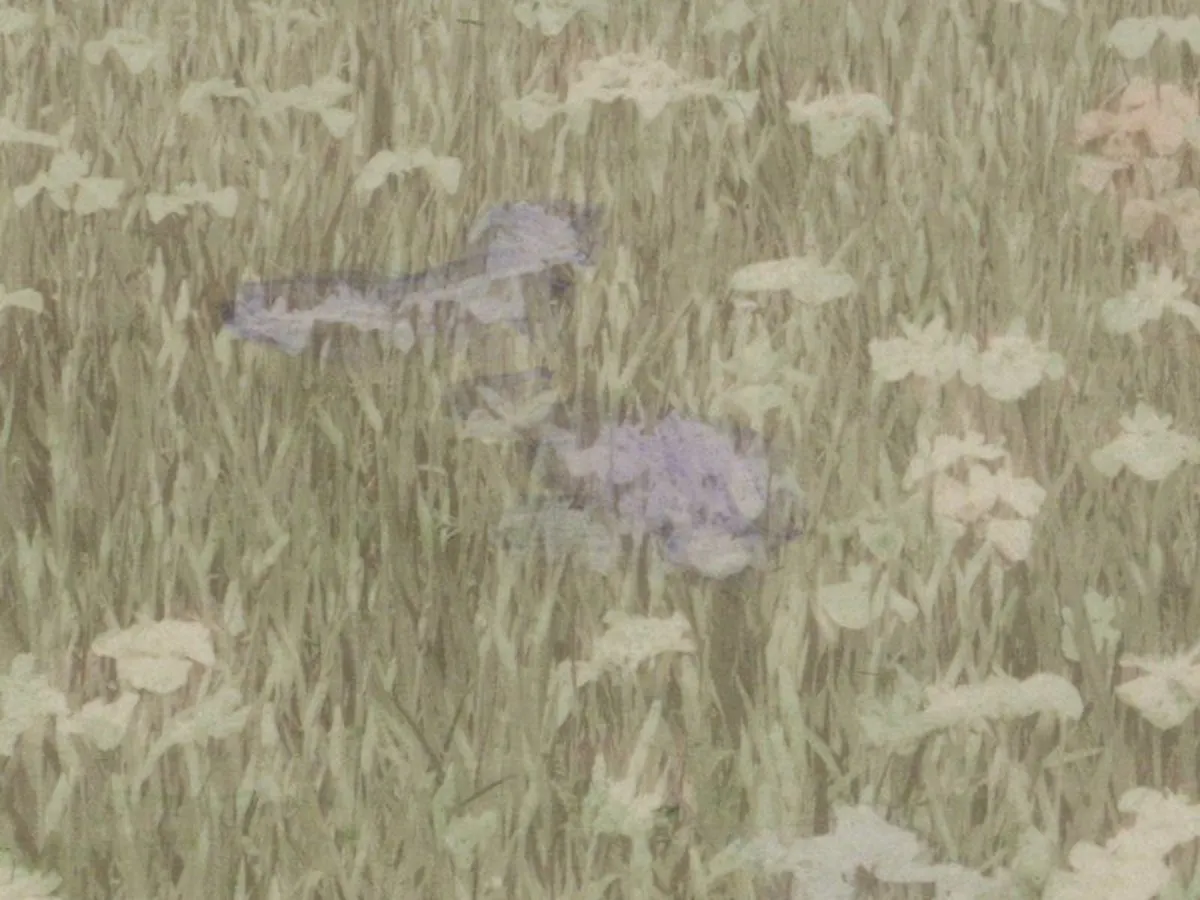
Rijksmuseum RP-F-F01206-H, detail from the lower left of the iris beds: one violet stroke runs sideways across the leaves, beside a violet flower.
“Mensen in een veld met irissen in Horikiri bij Tokyo (Iris Flowers Horikiri Tokio.), Rijksmuseum RP-F-F01206-H, detail of the iris beds” — Unknown author — public domain full credit
"Mensen in een veld met irissen in Horikiri bij Tokyo (Iris Flowers Horikiri Tokio.), Rijksmuseum RP-F-F01206-H, detail of the iris beds" by Unknown author — https://commons.wikimedia.org/wiki/File:Mensen_in_een_veld_met_irissen_in_Horikiri_bij_Tokyo_Iris_Flowers_Horikiri_Tokio._(titel_op_object),_RP-F-F01206-H.jpg — Public domain: Public domain in the US (made about 1870–1900: published before 1931, or if unpublished, an anonymous work more than 120 years old) and in the EU (presumed: anonymous photographer per the Rijksmuseum record, and any 70-year term from making or publication expired long ago); Rijksmuseum Public Domain Mark 1.0, Commons file CC0 1.0; modified: cropped to an 800 x 600 px detail of the iris beds and enlarged to 1200 px wide
In this corner of a Rijksmuseum album print, a stroke of violet trails sideways across the leaves. The camera did not put it there. Someone added it by hand to the finished photograph. The stroke follows the outline of no flower.
That is what a hand-colored photograph is: a picture made in one color, with color added afterward by hand. It is not color photography. An 1872 manual for tintype makers says the plate was colored once it was dry, and that ordinarily only the cheeks and lips were tinted.
What is a hand-colored photograph?
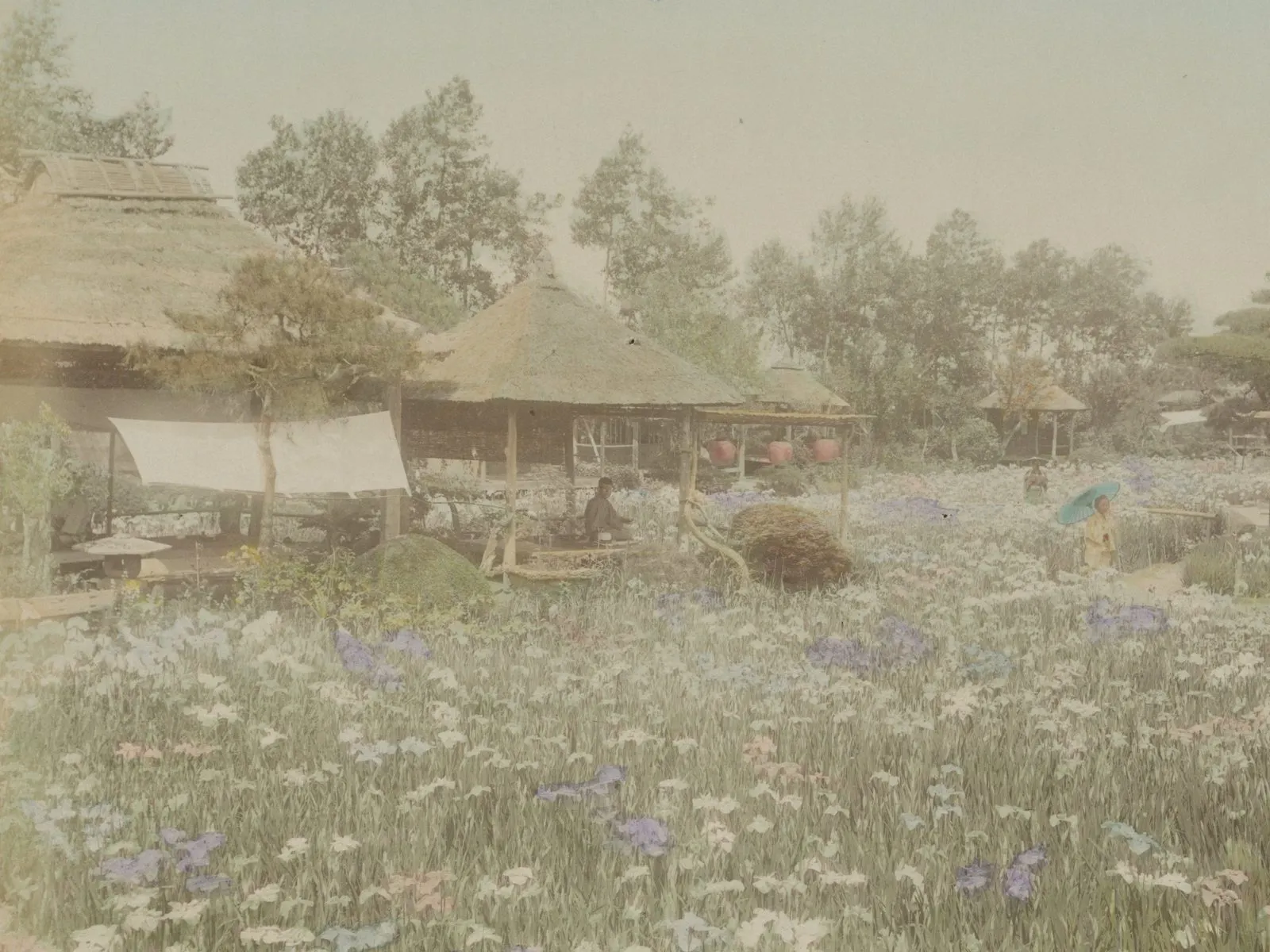
Rijksmuseum RP-F-F01206-H, cropped at the right and above the printed title: violet and pink washes on the iris beds, a blue parasol, red lanterns.
“Mensen in een veld met irissen in Horikiri bij Tokyo (Iris Flowers Horikiri Tokio.), Rijksmuseum RP-F-F01206-H, cropped” — Unknown author — public domain full credit
"Mensen in een veld met irissen in Horikiri bij Tokyo (Iris Flowers Horikiri Tokio.), Rijksmuseum RP-F-F01206-H, cropped" by Unknown author — https://commons.wikimedia.org/wiki/File:Mensen_in_een_veld_met_irissen_in_Horikiri_bij_Tokyo_Iris_Flowers_Horikiri_Tokio._(titel_op_object),_RP-F-F01206-H.jpg — Public domain: Public domain in the US (made about 1870–1900: published before 1931, or if unpublished, an anonymous work more than 120 years old) and in the EU (presumed: anonymous photographer per the Rijksmuseum record, and any 70-year term from making or publication expired long ago); Rijksmuseum Public Domain Mark 1.0, Commons file CC0 1.0; modified: cropped at the top, at the left margin, at the right edge and above the printed title strip to a 4:3 view (3475 x 2606 px of the 4364 x 3462 original); scaled to 1600 px wide
The whole print shows an iris garden at Horikiri in Tokyo, titled on the print “Iris Flowers Horikiri Tokio.” The Rijksmuseum dates it about 1870 to about 1900 and names the photographer only as anonymous, Tokyo. It is one of 50 photographs of sights in Japan in a single album. The museum’s record calls the technique an albumen print and describes the object as an “ingekleurde albuminedruk”: a colored albumen print, in this site’s translation.
Look how little of it carries strong color. The sky has a pale wash and the leaves a thin green; the lanterns are red, the parasol is blue, and the violet sits in patches on the flower beds. Where no wash lies, you see the brownish tone of the photograph underneath. The color is a second layer, laid over a picture that already existed.
Color in this sense is a finish, like varnish. An 1872 manual describes tintypes the same way: the plate came out of the camera in one color, and coloring was a later job at a work table. The tintype entry shows one of those plates, a hand-colored portrait from a Boston studio.
What did an 1872 manual say about coloring?
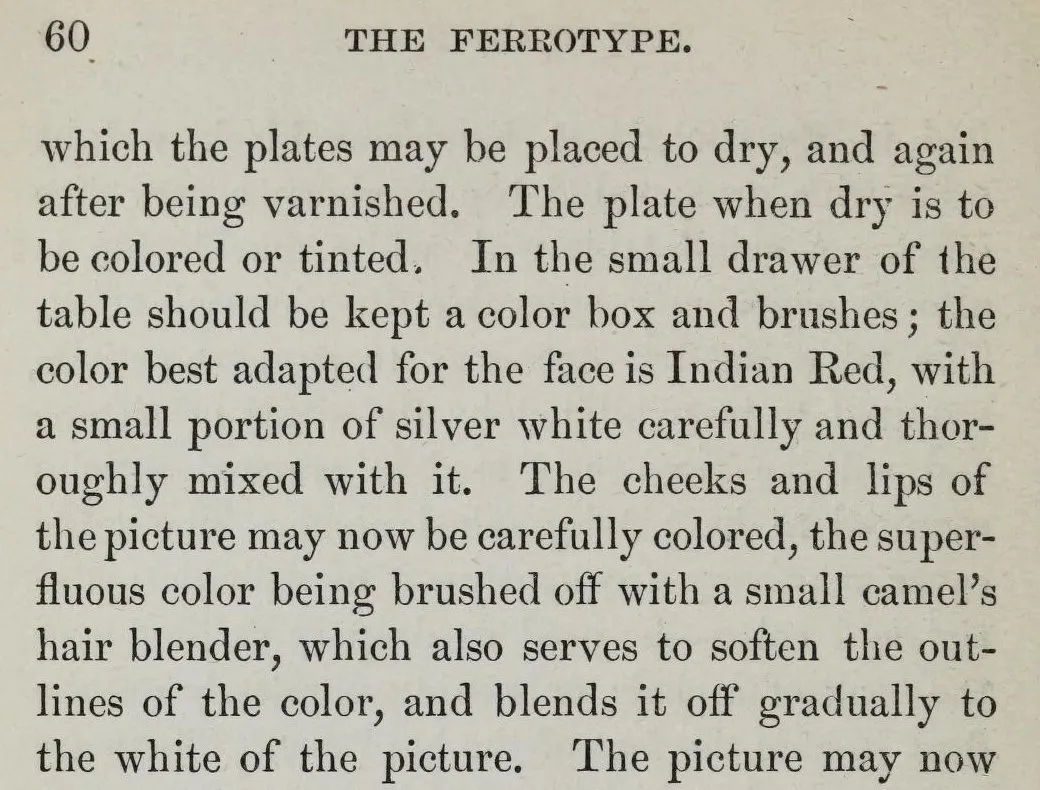
Estabrooke 1872, p. 60, top of the page: the paragraph on the work table, from drying the plate to blending the color off.
“The Ferrotype, and How to Make It (1872), page 60” — Edward M. Estabrooke — public domain full credit
"The Ferrotype, and How to Make It (1872), page 60" by Edward M. Estabrooke — https://archive.org/details/ferrotypehowtoma00esta_1 — Public domain: Public domain in the US (published 1872) and in the EU (published 1872 by an adult author; his death date is unverified, but he would have had to live past 100 for life+70 to still run; presumed); modified: cropped to the running head and the first twelve lines of the page
Edward M. Estabrooke’s The Ferrotype, and How to Make It (1872) was written for people who made tintypes, which he calls ferrotypes. On p. 60 it describes a work table by a stove, where plates were dried, colored and varnished. His order is plain: “The plate when dry is to be colored or tinted” (p. 60).
He names one color for faces: “the color best adapted for the face is Indian Red,” with “a small portion of silver white” mixed in. Then the cheeks and lips were colored, and a soft brush called a blender took off the extra color, softened its outlines and blended it off “to the white of the picture.”
About a hundred pages later he repeats the point more strongly (p. 159). “All Ferrotypes are, or should be, colored or tinted,” he says, and the color was a dry powder put on with a soft brush. “Ordinarily only the cheeks and lips are tinted,” and that “takes but a few moments.” Only after the coloring were the pictures varnished.
Keep the scope in mind. These are one manual’s instructions for one kind of photograph, written for working tintype makers. They show what one 1872 handbook expected a finished ferrotype to look like, but they do not tell you how any particular studio, in Tokyo or anywhere else, colored its prints.
How can you tell a photograph was colored by hand?
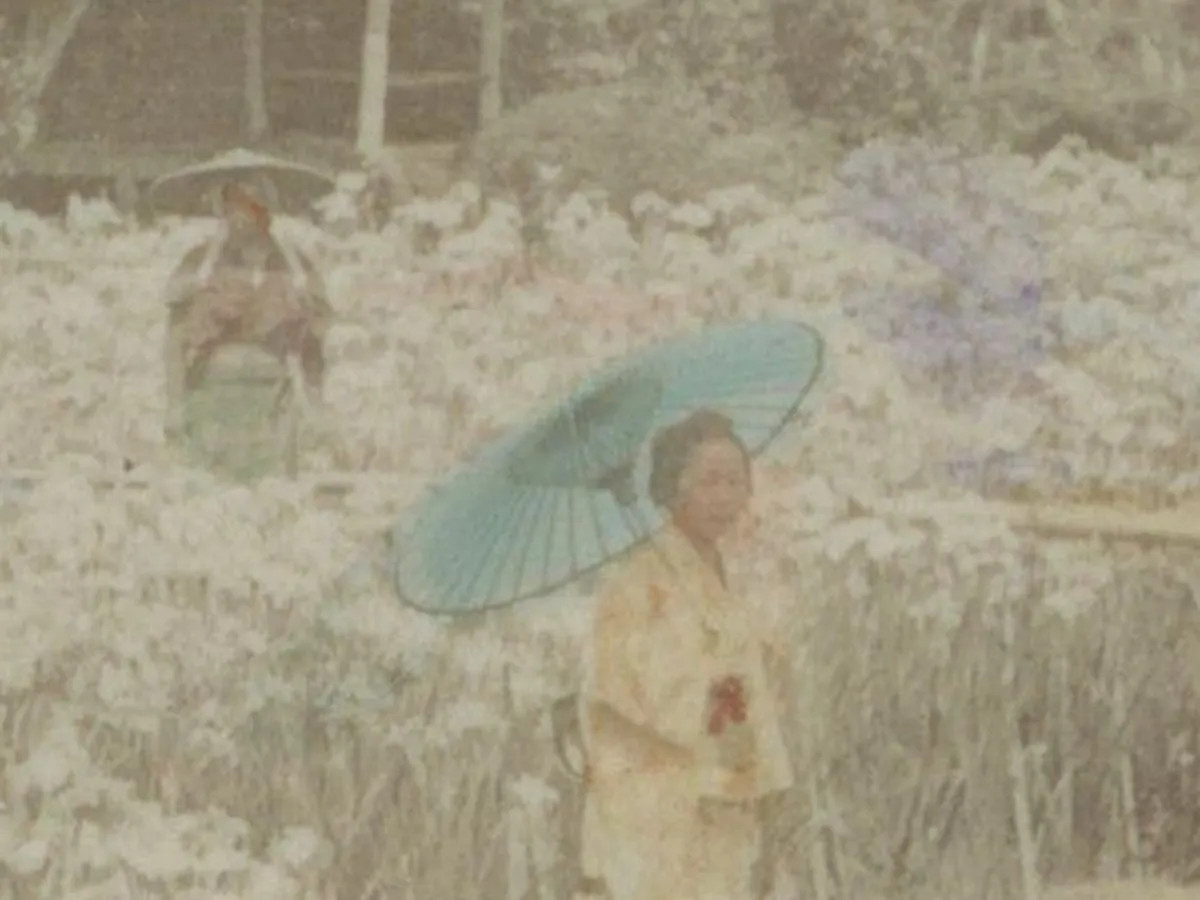
Rijksmuseum RP-F-F01206-H, detail at the center right: the parasol’s ribs and shadows show through the blue.
“Mensen in een veld met irissen in Horikiri bij Tokyo (Iris Flowers Horikiri Tokio.), Rijksmuseum RP-F-F01206-H, detail of the parasol” — Unknown author — public domain full credit
"Mensen in een veld met irissen in Horikiri bij Tokyo (Iris Flowers Horikiri Tokio.), Rijksmuseum RP-F-F01206-H, detail of the parasol" by Unknown author — https://commons.wikimedia.org/wiki/File:Mensen_in_een_veld_met_irissen_in_Horikiri_bij_Tokyo_Iris_Flowers_Horikiri_Tokio._(titel_op_object),_RP-F-F01206-H.jpg — Public domain: Public domain in the US (made about 1870–1900: published before 1931, or if unpublished, an anonymous work more than 120 years old) and in the EU (presumed: anonymous photographer per the Rijksmuseum record, and any 70-year term from making or publication expired long ago); Rijksmuseum Public Domain Mark 1.0, Commons file CC0 1.0; modified: cropped to a 480 x 360 px detail around the parasol and enlarged to 1200 px wide
Hold the print up to the light and check three things. Each one is only a clue.
- Color that ignores outlines. The violet stroke in the opening detail runs sideways over the leaves instead of following a flower’s outline. A brush can miss an edge, so a stroke that follows no outline hints that the color came later.
- Detail showing through the color. On the parasol, the dark ribs and the shading of the canopy are part of the photograph. The blue lies on top of them, thin enough to see through.
- A few flat colors. Here the blue, the violet, the pink and the red each sit in even patches, with no shading of their own beyond what the photograph already had.
None of these settles the question alone: a faded print or a later reproduction can fool the eye, and this site does not judge a process from looks. The record is the evidence. For this print, the museum’s own description says colored. The same caution holds for the backs of cards, from the stereograph to the real photo postcard: each clue dates only what it can show, and color shows that someone worked on the print, not when the picture was taken.
How many hand-colored photographs does the Rijksmuseum list?
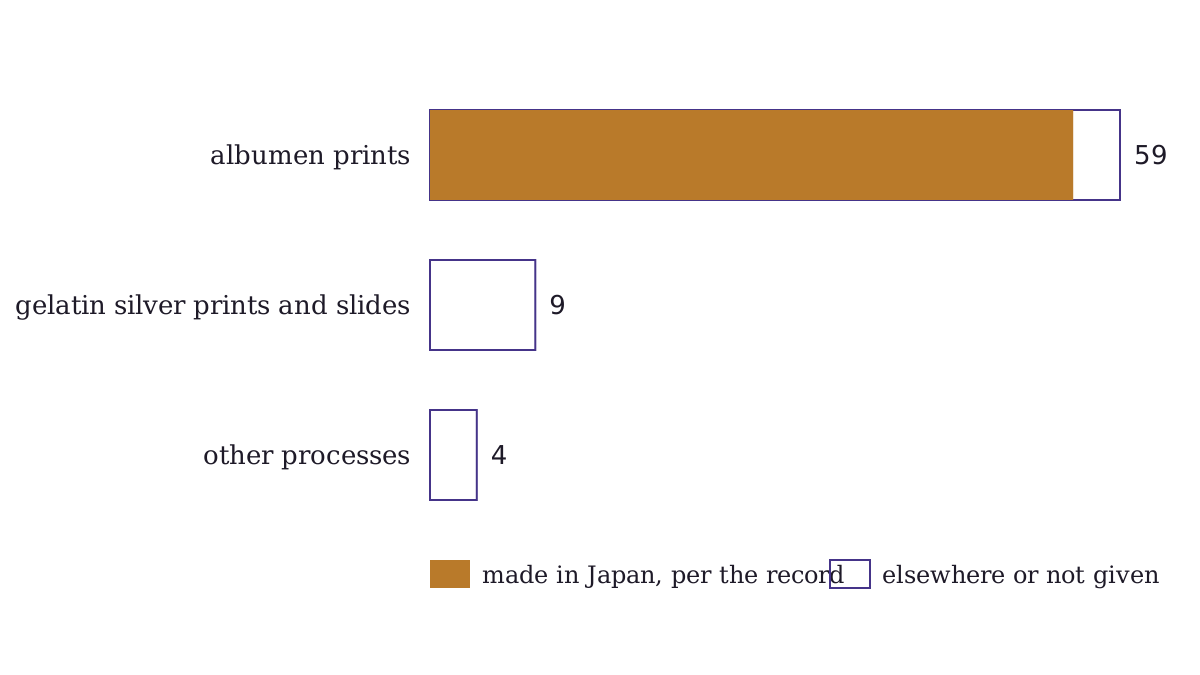
Rijksmuseum records typed photograph with coloring (inkleuren) in the technique field, as of November 12, 2026, by base process.
"Colored photographs in the Rijksmuseum catalogue by base process, as of 2026-11-12" by Flickers & Tintypes, https://flickersandtintypes.com/photo-objects/hand-colored-photographs/ — CC BY 4.0, https://creativecommons.org/licenses/by/4.0/
A search of the Rijksmuseum’s collection data for photographs whose technique includes inkleuren (coloring) returned 72 records on November 12, 2026. This site’s count read every one.
| Base process, as catalogued | Records | Made in Japan, per the record |
|---|---|---|
| Albumen prints | 59 | 55 |
| Gelatin silver prints and slides | 9 | 0 |
| Other processes | 4 | 0 |
| All records in the November 12, 2026 search | 72 | 55 |
The 55 from Japan are all albumen prints, catalogued as 1851 to about 1900 or about 1870 to about 1900, and 50 of them are numbered RP-F-00-5372-1 to RP-F-00-5372-50. So one numbered group makes up most of the count. Among records with a narrow date, the earliest is a colored daguerreotype of 1852–1858 and the latest a gelatin silver print of about 1965–1975, both from the United States.
The other 17 records show how widely the practice turns up in this one collection. They include a colored stereo card from France, dated about 1855 to 1865, and three albumen prints from Rotterdam and Amsterdam, made between 1858 and about 1875. There are glass slides of about 1907 to 1935 from Switzerland, Sweden and Schaumburg, and a carte de visite of 1899 published by H. Hollenkamp & Co. in Amsterdam. Two gelatin silver prints from Germany, dated 1890 to 1920, are described as colored with yellow paint.
Treat 72 as a floor, not a total. RP-F-F01206-H, the print at the top of this page, is not among them: its technique field says only albumen print, and the coloring is mentioned in the description. Three other prints with the same number stem, RP-F-F01206-AB, -AF and -W, are in the set.
Download the Rijksmuseum colored-photograph counts (CSV) source and license notes
Is machine colorization the same thing?
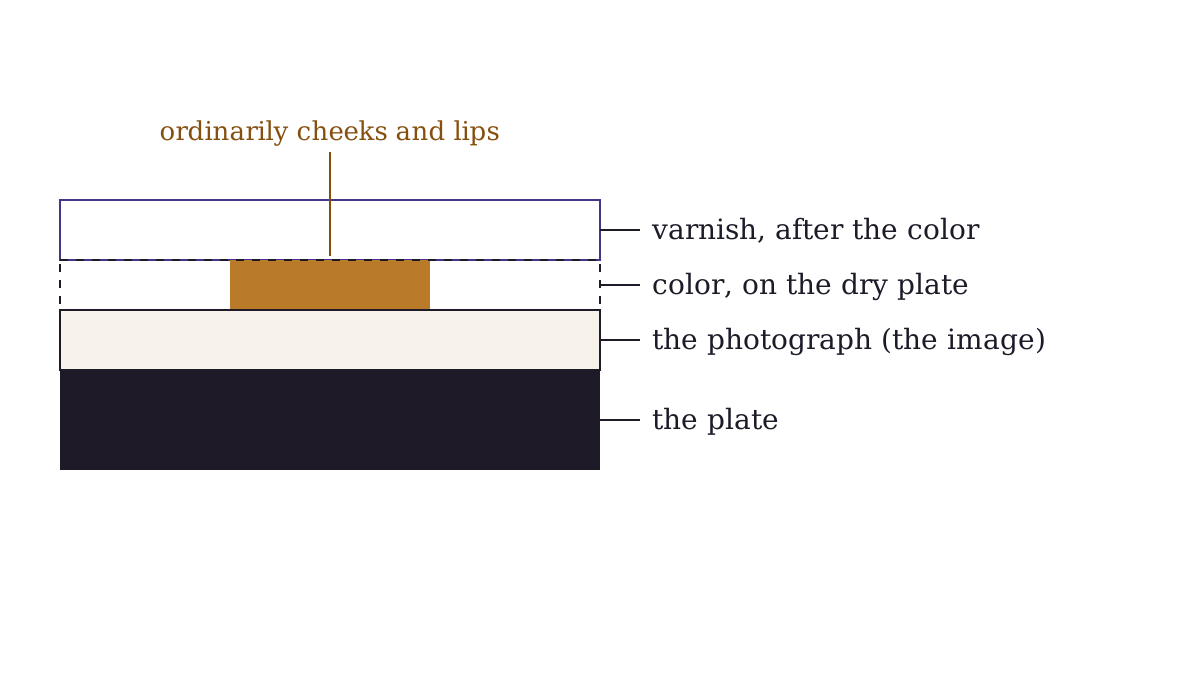
A colored ferrotype in section, after Estabrooke 1872, p. 60: the image first, then color on the dry plate, then varnish; not to scale.
"Where the color sits on a colored ferrotype, after Estabrooke 1872" by Flickers & Tintypes, https://flickersandtintypes.com/photo-objects/hand-colored-photographs/ — CC BY 4.0, https://creativecommons.org/licenses/by/4.0/
No. Hand coloring is part of the object. On a tintype it sits between the picture and the varnish, put there by someone working on that plate. It can fade or rub off, but it belongs to the object’s history, and a museum can describe it.
Machine colorization of a scan adds nothing to the object. The colors appear on a screen copy. They are the software’s guesses about what was there. This site treats that as a rewrite of the picture, not a restoration: it covers the physical evidence of a print with a guess.
Film had its own hand color. Kodak’s 1918 handbook on tinting and toning notes that toned film could also be tinted in places, the color applied “either by hand with a brush, or by stencilling” (p. 29). Most of the handbook covers something else, film run through dye baths and toning baths in tanks and racks: that is the subject of tinting and toning.
Prints consulted
- 1Edward M. Estabrooke, The Ferrotype, and How to Make It. Cincinnati and Louisville: Gatchel & Hyatt, 1872. https://archive.org/details/ferrotypehowtoma00esta_1Read: pages 20–21, 31–35, 53, 60, 72–75, 82–83, 97, 159–160 and 197, checked against the page images
- 2Rijksmuseum, Amsterdam, RP-F-F01206-H, Mensen in een veld met irissen in Horikiri bij Tokyo (Iris Flowers Horikiri Tokio.), photographer anonymous, Tokyo, c. 1870–1900. https://id.rijksmuseum.nl/200345859Read: catalog record
- 3Rijksmuseum, RP-F-F01206-H, image file on Wikimedia Commons (CC0). https://commons.wikimedia.org/wiki/File:Mensen_in_een_veld_met_irissen_in_Horikiri_bij_Tokyo_Iris_Flowers_Horikiri_Tokio._(titel_op_object),_RP-F-F01206-H.jpgRead: file page and original image
- 4Rijksmuseum, collection search, technique "inkleuren" (coloring), object type photograph (72 records as of 2026-11-12). https://data.rijksmuseum.nl/search/collection?technique=inkleuren&type=fotoRead: catalog records, all 72 as of 2026-11-12
- 5Eastman Kodak Company, Tinting and Toning of Eastman Positive Motion Picture Film, second edition, revised. Rochester, N. Y.: Eastman Kodak Company, 1918. https://www.gutenberg.org/ebooks/70417Read: full text and the three sample sheets, both sides; quoted passages checked against the page images

Next reel:
- Tintype: the plate that Estabrooke’s manual was written for, and what the label on its back can date.
- Stereograph: two photographs on one card, read for the small differences between them.
- Public-domain original to view: Rijksmuseum RP-F-F01206-H
Cite this page
Flickers & Tintypes. “Hand-Colored Photographs: The Color Came After the Picture.” Flickers & Tintypes. Published November 12, 2026. https://flickersandtintypes.com/photo-objects/hand-colored-photographs/. Accessed [the date you read it].
Same sectionAlso in Photo Objects
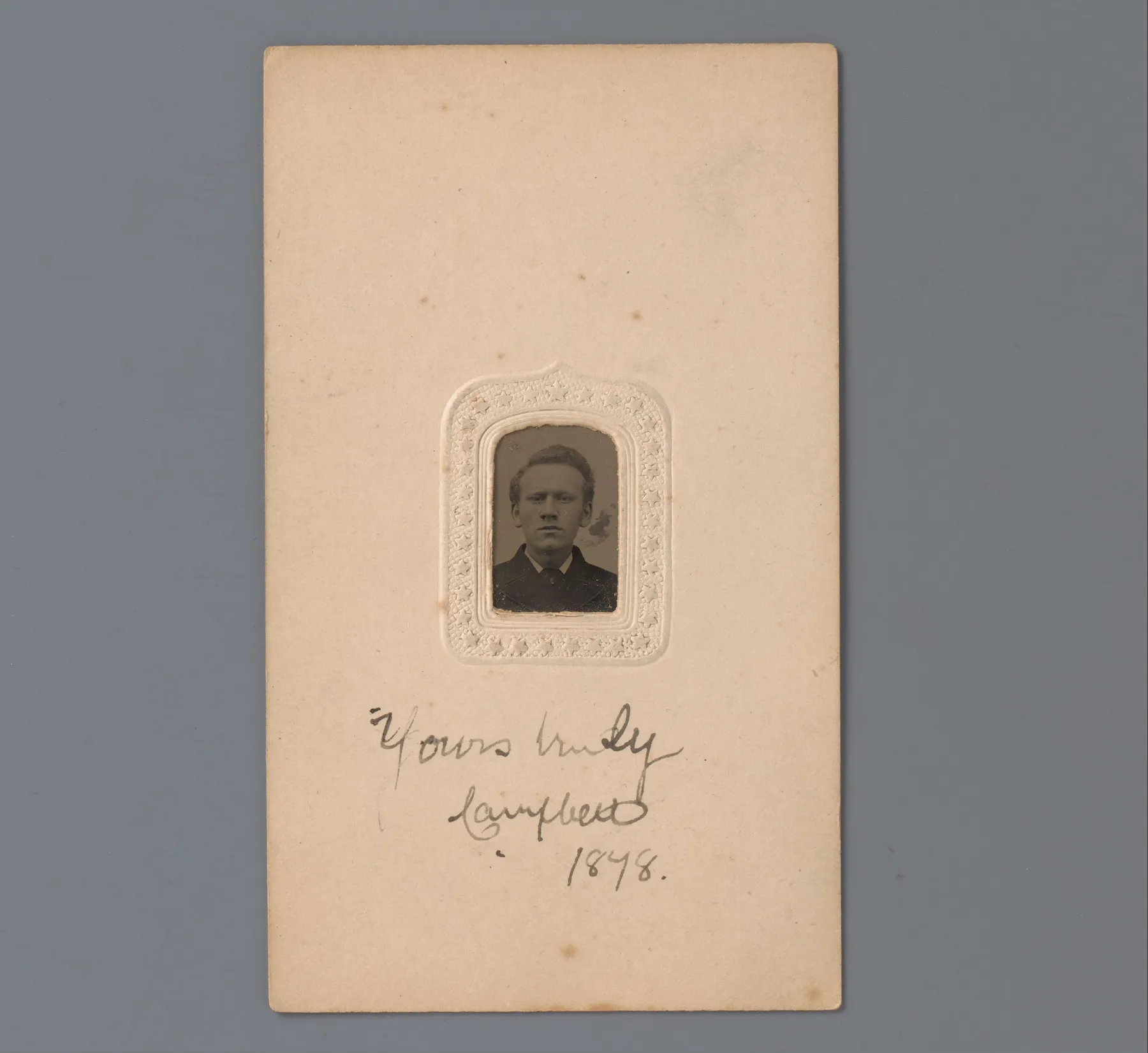
Photo Objects
Tintype: A London Label Priced 36 Tiny Portraits at 2s. 6d.
A tintype is a portrait made in the camera on black-japanned iron. Labels on the backs of museum tintypes show studios selling tiny gems by the dozen.
Picture credit
"Portret van een onbekende man (Portrait of an unknown man), RP-F-F15037" by A. Brittlebank — https://commons.wikimedia.org/wiki/File:Portret_van_een_onbekende_man,_RP-F-F15037.jpg — Public domain: Public domain in the US (made in 1878: published or not, the term has run out) and presumed public domain in the EU (Rijksmuseum Public Domain Mark; A. Brittlebank was working in London in 1878, death date not found); the Commons file is the museum’s own upload under CC0 1.0
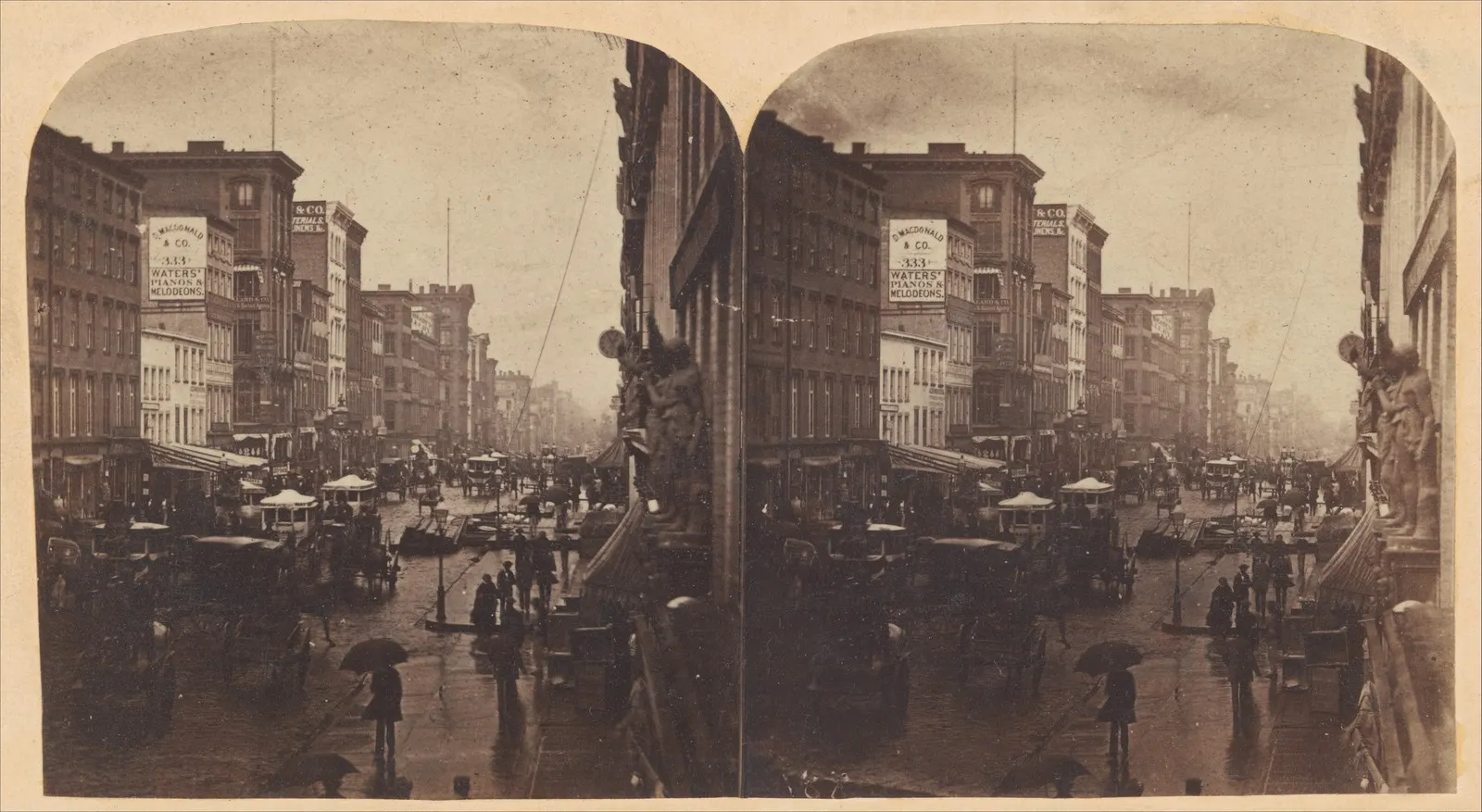
Photo Objects
Stereograph: Twin Photos Shot a Couple of Inches Apart
A stereograph is two photos of one scene taken a couple of inches apart, per an 1859 essay. On one Broadway card, the nearest pillar moves 29 px between halves.
Picture credit
"[Broadway, New York City, in the rain], stereograph, Metropolitan Museum of Art 1980.1056.3" by Edward Anthony and Henry T. Anthony — https://commons.wikimedia.org/wiki/File:-Broadway,_New_York_City,_in_the_rain-_MET_DP218027.jpg — CC0 1.0 (https://creativecommons.org/publicdomain/zero/1.0/); modified: scaled from 3871 to 1600 pixels wide; nothing else changed
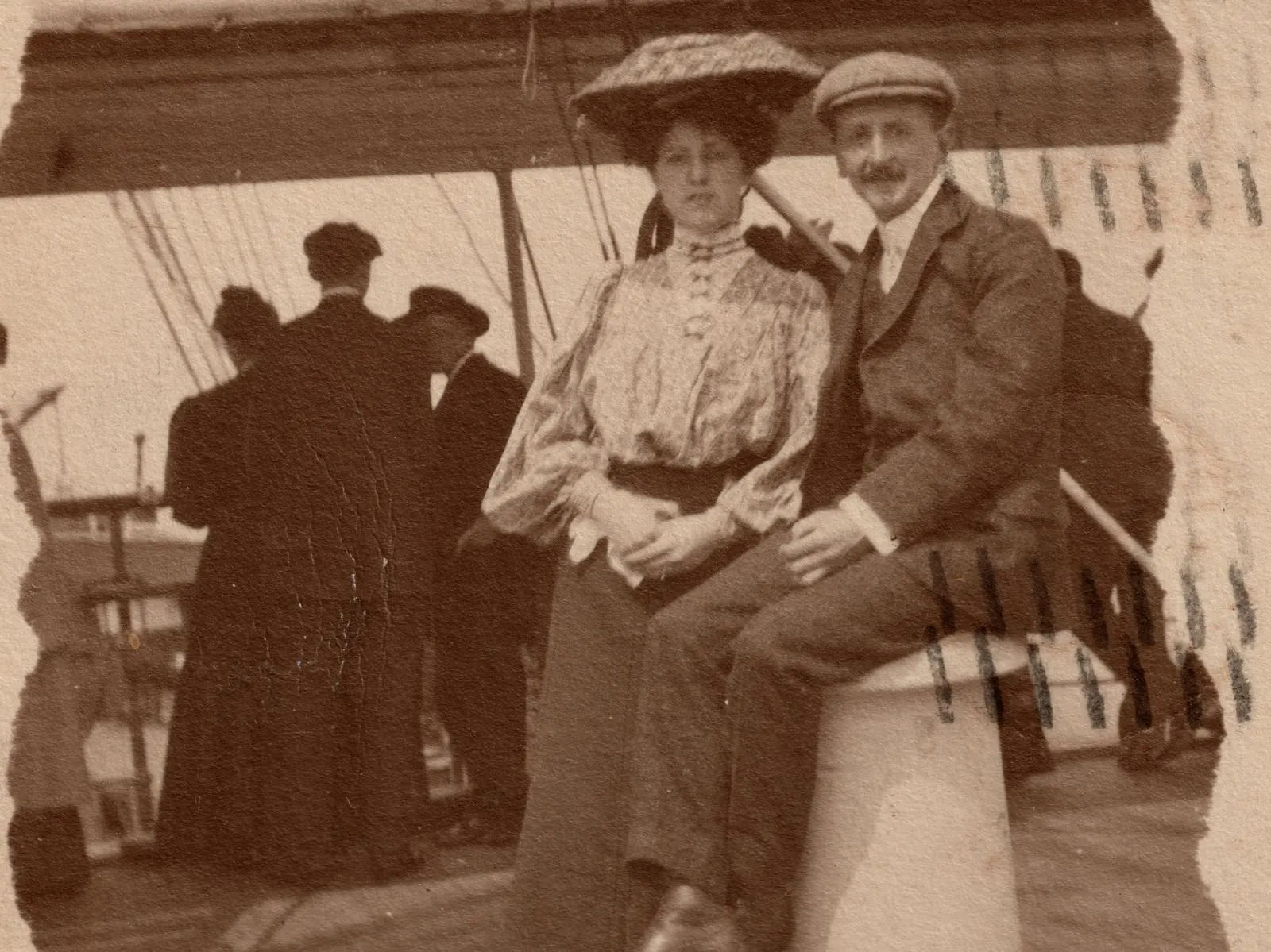
Photo Objects
Real Photo Postcard: The Back Dates the Card, Not the Photo
How to date a real photo postcard from its back: what the postmark, the stamp and a divided back can date, read against the 1907 US postal rules for post cards.
Picture credit
"Real photo postcard, December 1905: on board the SS Parisian (photograph area)" by Unknown author — https://commons.wikimedia.org/wiki/File:1905-12-22_RPPC_On_board_the_SS_Parisian_A.jpg — Public domain: Public domain in the US (anonymous work made by 1905: more than 120 years since creation, whether or not it was published; mailed December 23, 1905) and in the EU (anonymous work; 70 years from creation or from first making available have run out); modified: cropped to a 4:3 area of the photograph (box 653,3485,7516,8627 of the 8551 x 13068 original), removing the handwriting above and below; scaled to 1600 px wide