Tintype: A London Label Priced 36 Tiny Portraits at 2s. 6d.
Frame card
In one line A tintype is a photograph made directly in the camera on a thin plate of black-japanned iron. Small ones called gems sold by the dozen: a London label offers 36 for 2s. 6d., and an 1872 manual gives 10 to 50 cents a dozen.
Source, Year, Format, Length or Size, Access, License
- Source
- Rijksmuseum, Amsterdam, object RP-F-F15037, “Portret van een onbekende man” (Portrait of an unknown man)
- Year
- 1878 in the museum’s dating; a note on the front reads “Yours truly / Campbell / 1878.”
- Format
- tintype pasted behind an embossed card mount; maker named on the object: A. Brittlebank, 2 Aldgate High St., London
- Length or Size
- window 20 × 13 mm; card 102 × 61 mm
- Access
- https://id.rijksmuseum.nl/200322001
- License
- Public domain in the US (made in 1878); presumed public domain in the EU (Rijksmuseum Public Domain Mark; A. Brittlebank was working in London in 1878, death date not found); the Wikimedia Commons file uploaded by the museum is CC0 1.0
Card data (CSV) tintype-frame-card.csv Source and license notes
Shot list · 6 sections
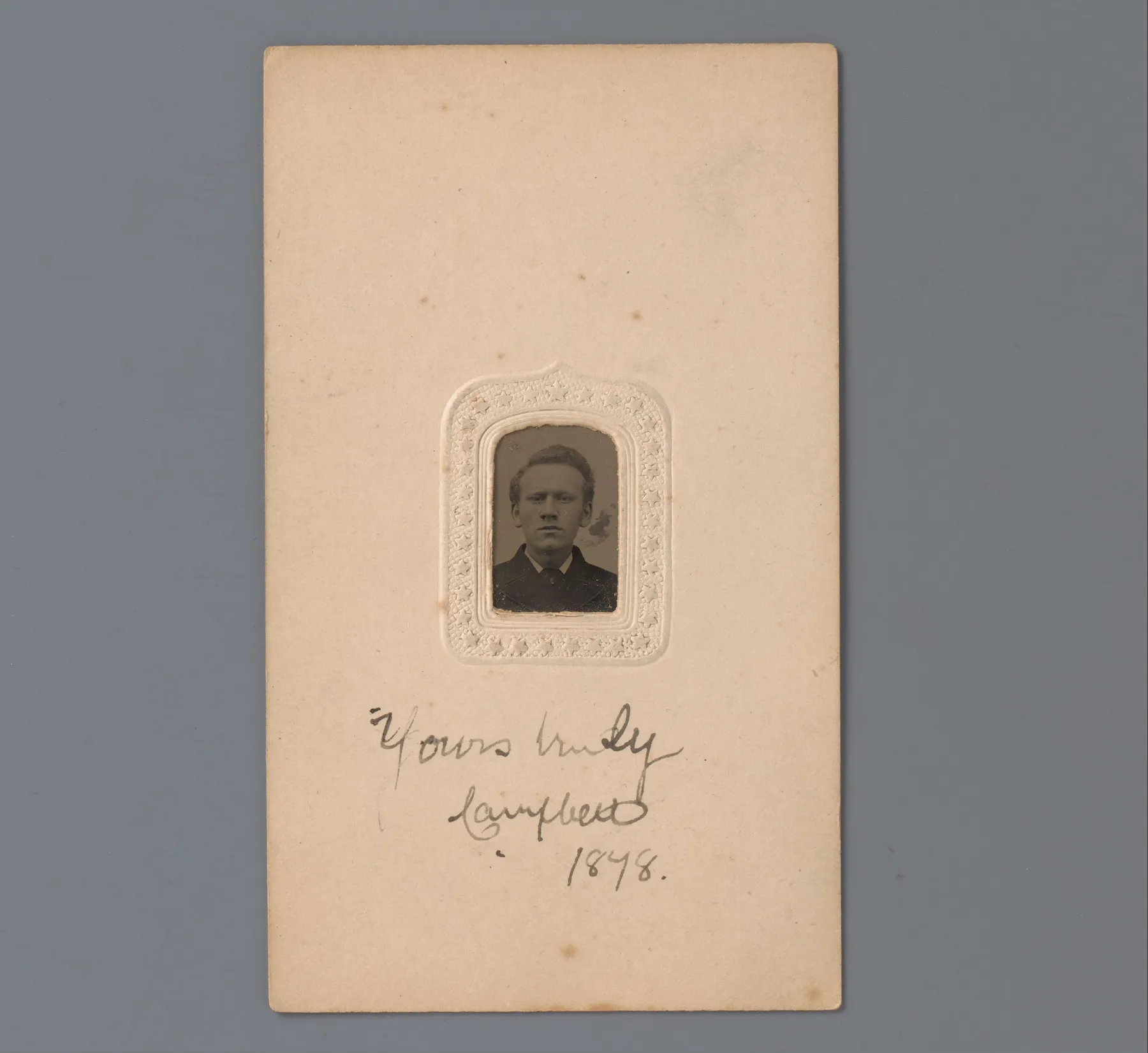
Rijksmuseum RP-F-F15037, recto: a gem tintype behind an embossed card window, with an inked signature and the year 1878 below it.
“Portret van een onbekende man (Portrait of an unknown man), RP-F-F15037” — A. Brittlebank — public domain full credit
"Portret van een onbekende man (Portrait of an unknown man), RP-F-F15037" by A. Brittlebank — https://commons.wikimedia.org/wiki/File:Portret_van_een_onbekende_man,_RP-F-F15037.jpg — Public domain: Public domain in the US (made in 1878: published or not, the term has run out) and presumed public domain in the EU (Rijksmuseum Public Domain Mark; A. Brittlebank was working in London in 1878, death date not found); the Commons file is the museum’s own upload under CC0 1.0
Rijksmuseum object RP-F-F15037 is a tintype portrait of a man, seen through a window 20 millimeters tall. A label on the back of its card offers “36 GEMS 2s. 6d.”
Both surprises in this entry sit on that object. A tintype is a one-of-a-kind photograph made in the camera on a thin sheet of black-japanned iron. The process was quick and cheap, and studios sold the smallest ones, called gems, by the dozen.
Hamilton L. Smith's patent for the process is dated February 19, 1856, and Edward M. Estabrooke's 1872 manual dates the plate's introduction to “the years 1856–57.” That 20 mm window is under a third of the height of a US banknote, which has measured 2.61 inches (66.3 mm) since 1929.
What is a tintype made of?
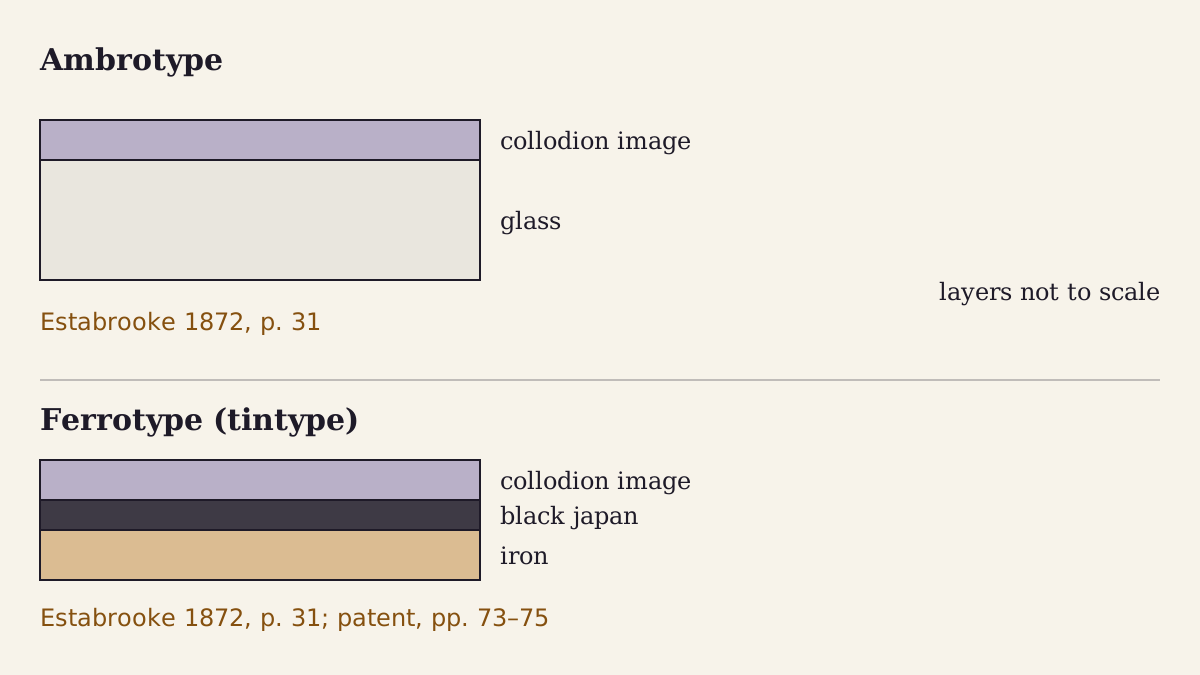
Two plates in section, after Estabrooke 1872, p. 31, and the patent he reprints on pp. 73–75; layer thicknesses are not to scale.
"Ambrotype and ferrotype in section" by Flickers & Tintypes, https://flickersandtintypes.com/photo-objects/tintype/ — CC BY 4.0, https://creativecommons.org/licenses/by/4.0/
The support is thin iron with a black varnish called japan. Smith, of Gambier, Ohio, described pictures on “a black japanned surface” prepared on “iron or any other metallic plates or sheets,” and wrote that he preferred iron. Estabrooke reprinted the whole patent in his manual (pp. 72–75). Ferrotype and melanotype are other names for it; Estabrooke uses both.
The nearest relative was made the same way on another base. In Estabrooke's words, the ambrotype and the ferrotype are both made by the collodion process, “the first on glass, the latter on Japanned iron” (p. 31). He describes the daguerreotype as taken “on a copper plate with a silvered surface.”
| Popular claim | What the sources show |
|---|---|
| Tintypes are made of tin. | Smith's patent names a black japanned surface on iron, and Estabrooke says the ferrotype is made “on Japanned iron.” |
| A tintype is a positive print. | Nothing was printed. Estabrooke sets pictures “made directly in the camera” apart from prints made through a negative. |
| If it looks old, it is old. | The Rijksmuseum holds a tintype signed “© 07” on the back, which the museum dates to 2007. |
Why does a tintype look positive if it is a negative?
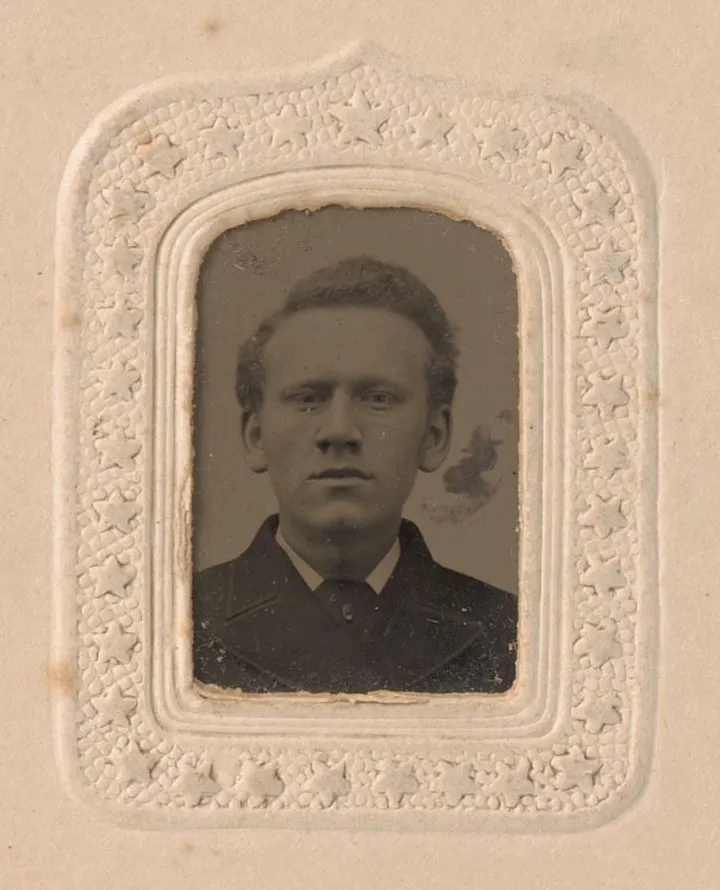
Rijksmuseum RP-F-F15037, detail: the 20 × 13 mm window, where the light parts are the image and the dark parts are the plate.
“Portret van een onbekende man (Portrait of an unknown man), RP-F-F15037, detail” — A. Brittlebank — public domain full credit
"Portret van een onbekende man (Portrait of an unknown man), RP-F-F15037, detail" by A. Brittlebank — https://commons.wikimedia.org/wiki/File:Portret_van_een_onbekende_man,_RP-F-F15037.jpg — Public domain: Public domain in the US (made in 1878: published or not, the term has run out) and presumed public domain in the EU (Rijksmuseum Public Domain Mark; A. Brittlebank was working in London in 1878, death date not found); the Commons file is the museum’s own upload under CC0 1.0; modified: cropped to the embossed window and the tintype inside it (pixels 1090–1810 x 900–1790 of the 2988 x 2740 original)
Look at the light parts of the face first. They are the image itself, a silver picture made on the plate. Smith's patent describes the japanned surface as “forming the back-ground of the picture,” so the light parts read against a dark ground.
Estabrooke drew the line between positive and negative by exposure. A negative, he wrote, “is, after all, only an Ambrotype over-timed and over-developed” (p. 21), and the ferrotype comes out of the same collodion process. No print was made from the plate, so each tintype is unique. The ordinary picture was also reversed left to right: the sample pictures bound into Estabrooke’s book were “Non-reversed” ferrotypes, which he explained are “not laterally transposed” and show sitters in their exact positions (p. 20).
Why are tintypes so small?
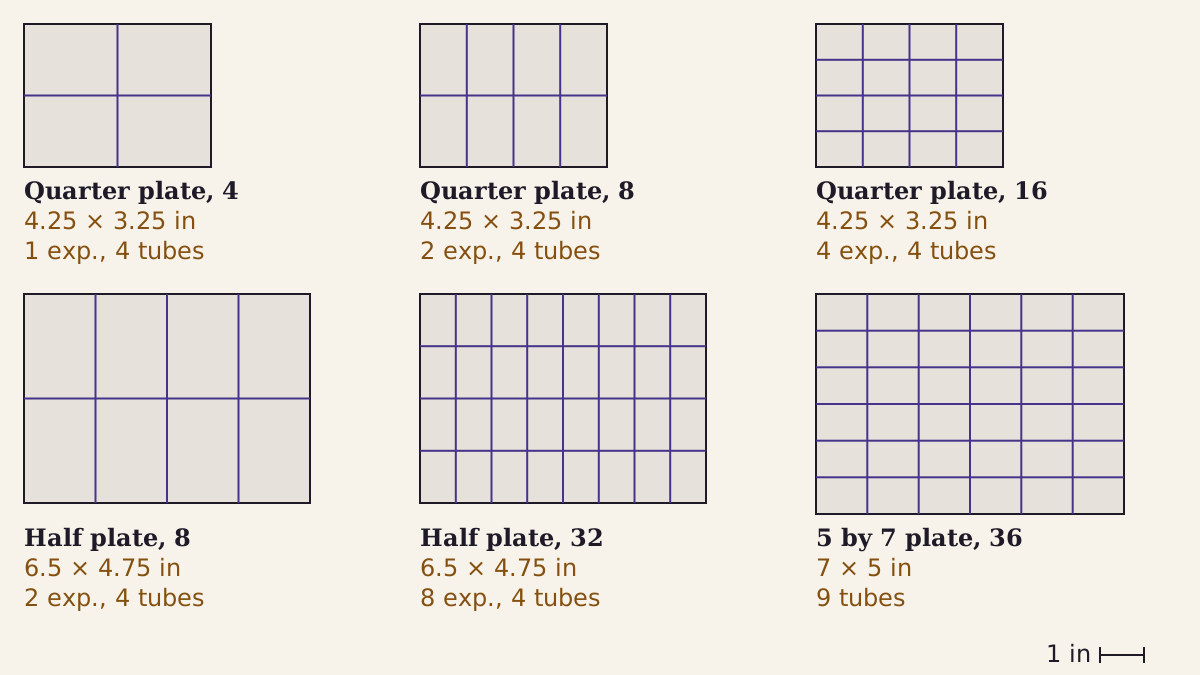
Chart 2. Counts per plate and the 5 by 7 plate from Estabrooke 1872, p. 53; quarter and half plate sizes from his table on p. 197; drawn as even grids, which the manual does not specify.
"Pictures per plate in Estabrooke’s 1872 manual, drawn to one scale" by Flickers & Tintypes, https://flickersandtintypes.com/photo-objects/tintype/ — CC BY 4.0, https://creativecommons.org/licenses/by/4.0/
Data: Estabrooke, The Ferrotype, and How to Make It (1872), pp. 53 and 197; public domain in the US (published 1872), presumed public domain in the EU (published 1872; the author’s death date not verified)
Many were made several to a plate. Estabrooke says gems were made “by the multiplying camera with four or more lenses, and two or more consecutive exposures” (p. 35). One label in the Rijksmuseum set, from Jordan Bro's Ferrotype Rooms in Syracuse, New York, advertises “CARD FERROTYPES, Taken with PATENT MULTIPLYING CAMERA.”
Estabrooke's chapter on the glass room gives the counts and names the 5 by 7 plate (p. 53), and his table of plate sizes gives the quarter and half plates (p. 197):
| Plate | Pictures per plate | Exposures | Lenses (tubes) |
|---|---|---|---|
| Quarter plate, 4¼ × 3¼ in | 4 | 1 | 4 |
| Quarter plate | 8 | 2 | 4 |
| Quarter plate | 16 “gems” | 4 | 4 |
| Half plate, 6½ × 4¾ in | 8 | 2 | 4 |
| Half plate | 32 | 8 | 4 |
| 5 by 7 plate | 36 | not stated | 9 |
Sixteen gems on a quarter plate, cut as an even grid, leave each about 1.06 × 0.81 inches before trimming (Chart 2). Estabrooke tells the operator to cut the edges straight and clip the corners neatly (p. 160).
Download the plate counts from Estabrooke 1872 (CSV) source and license notes Data: Estabrooke, The Ferrotype, and How to Make It (1872), pp. 53 and 197; public domain in the US (published 1872), presumed public domain in the EU (published 1872; the author’s death date not verified)
How much did a tintype cost?
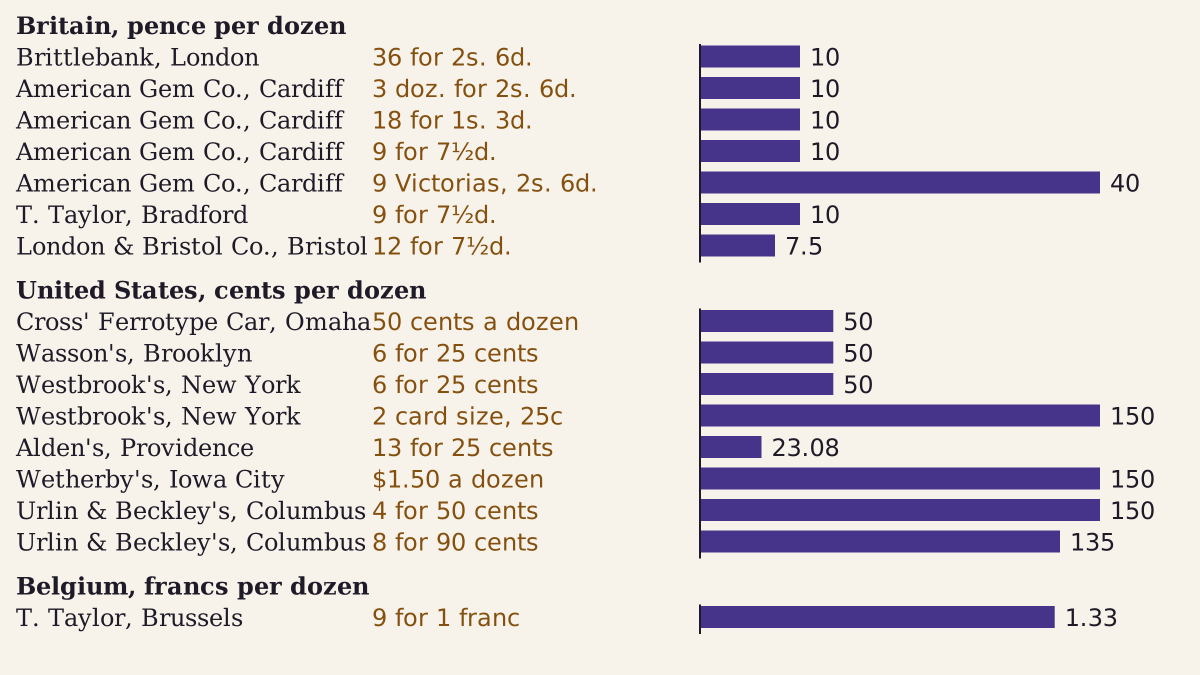
Chart 1. Each printed offer worked out to a price per 12 portraits (d = pence); offers left out are listed in the CSV; no currency conversion.
"Priced by the dozen: offers printed on tintype backs" by Flickers & Tintypes, https://flickersandtintypes.com/photo-objects/tintype/ — CC BY 4.0, https://creativecommons.org/licenses/by/4.0/
Data: Rijksmuseum collection data, CC0 1.0, retrieved 2026-10-07
The backs answer this better than any front. On October 7, 2026, the Rijksmuseum's online catalog returned 547 records for the technique ferrotype (ferrotypie). Of those, 91 transcribe text or marks on the back, and 19 print a price, by this site's count. Chart 1 works each readable offer out to a price per dozen.
Five British offers from three firms come to exactly 10 pence a dozen: Brittlebank's 36 for 2s. 6d. in London, three from the American Gem Victoria and Ferrotype Co. in Cardiff (36 for 2s. 6d., 18 for 1s. 3d., 9 for 7½d.), and T. Taylor's 9 for 7½d. in Bradford. A Bristol firm offered 12 gems for 7½d.
In the United States, Cross' Ferrotype Car in Omaha, Wasson's in Brooklyn and Westbrook's in New York all work out to 50 cents a dozen. Westbrook's card-size ferrotypes cost three times as much.
These are printed offers, mostly undated, from one museum's holdings. They show how small portraits were sold, not what a typical customer paid. For gems in general, Estabrooke's 1872 manual gives a range: “ranging from ten cents the dozen, unmounted, to fifty cents with paper mounts” (p. 35).
Download the printed price offers (CSV) source and license notes Data: Rijksmuseum collection data, CC0 1.0, retrieved 2026-10-07
What can the back of a tintype tell you?
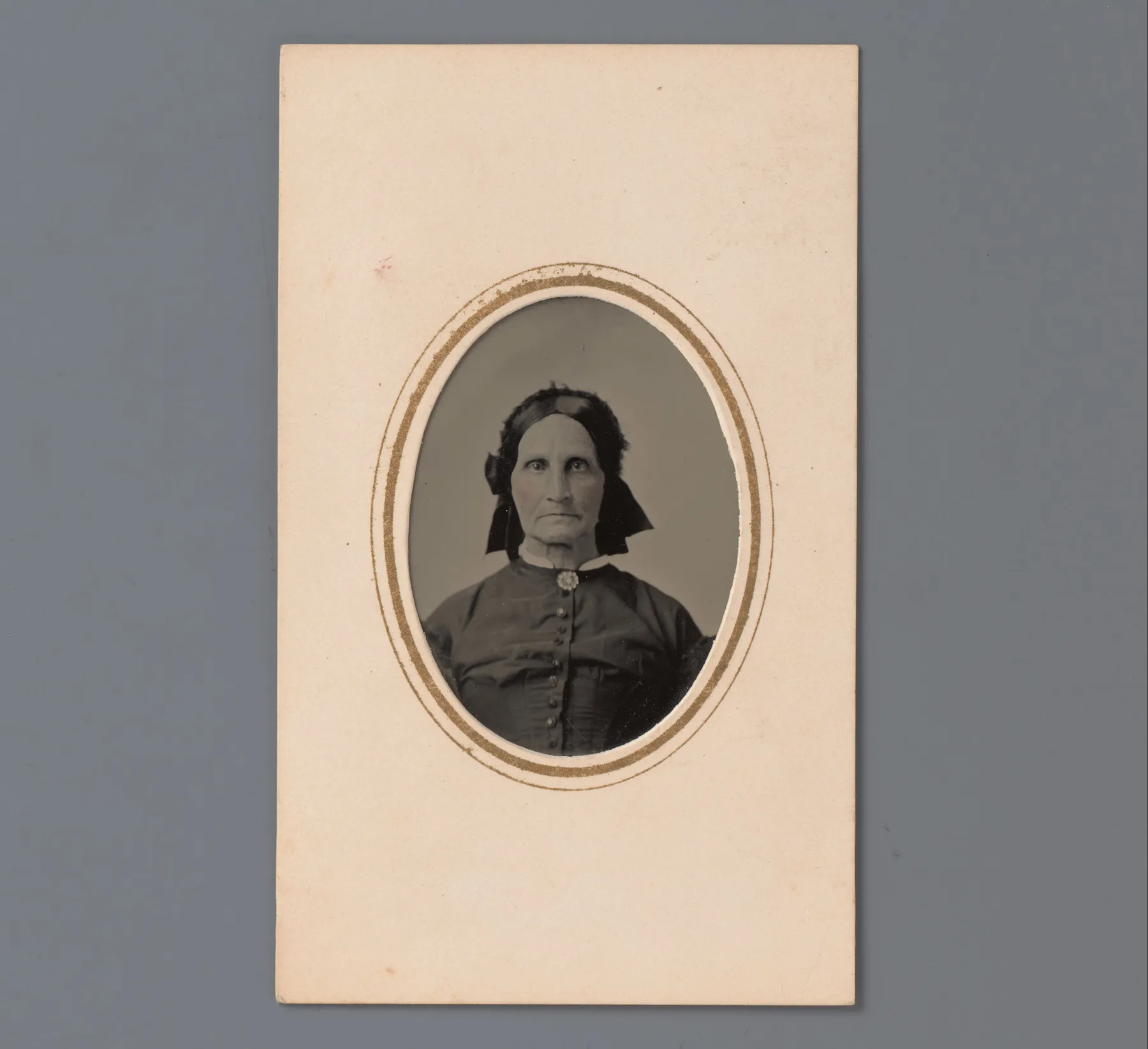
Rijksmuseum RP-F-F15043, recto: the stamp and label described below are on the back, known here from the museum’s transcription.
“Portret van een onbekende vrouw (Portrait of an unknown woman), RP-F-F15043” — G. P. Lasselle — public domain full credit
"Portret van een onbekende vrouw (Portrait of an unknown woman), RP-F-F15043" by G. P. Lasselle — https://commons.wikimedia.org/wiki/File:Portret_van_een_onbekende_vrouw,_RP-F-F15043.jpg — Public domain: Public domain in the US (made no later than 1900 in the museum dating: published or not, the term has run out) and presumed public domain in the EU (Rijksmuseum Public Domain Mark; G. P. Lasselle was working in Boston within the museum dating 1855–1900, death date not found); the Commons file is the museum’s own upload under CC0 1.0
Verso evidence is the set of stamps, printed backs and notes on the back of a photograph, each tagged with what it can actually date. A studio label dates the studio at that address. A handwritten note dates the writing. The back is often the most overlooked part of an old photograph, and the tintypes in this set show why.
Take Rijksmuseum RP-F-F15043, a hand-colored tintype from G. P. Lasselle's “Excelsior Ferrotypes” at 4 Summer Street, Boston, dated by the museum 1855–1900; its back carries a stamp transcribed as “U.S. INTER.RE[L] PROPRIETARY TWO CENTS.” If that is a US internal revenue stamp, as its wording suggests, the revenue law of the time gives it a window. The act approved June 30, 1864 put a stamp duty on “photographs, ambrotypes, daguerreotypes, or any sun pictures”: two cents on each picture retailing at no more than twenty-five cents (Dresser's 1864 edition, p. 94). George S. Boutwell's 1866 compilation of the law, with the amendments of July 13, 1866, taxes photographs at five percent ad valorem, and its stamp schedule no longer lists a duty on them (pp. 56–57, 99).
That narrowing still has to be held up to the light. This page's estimate: 1864–1866, Boston, weak evidence, since it rests on a single stamp read through a catalog transcription, not the object itself.
Two firms, one address
Labels can also link makers. Three Taylor & Co labels in the set give 105 Fulton Avenue, Brooklyn. A label for Estabrooke's ferrotypes gives 833 Broadway “AND No 105 Fulton Avenue BROOKLYN.” A city directory could show who was at that address and when; none was checked for this page.
The catalog names that last maker Edward M. Estabrooke, the name on the title page of The Ferrotype, and How to Make It (1872). Whether the label and the book are the same man is not settled here. The manual is plain about color: “All Ferrotypes are, or should be, colored or tinted,” usually only on the cheeks and lips, with dry color applied by brush (p. 159). Color added by hand is the subject of hand-colored photographs, and color laid over a single-color image is a problem silent film solved its own way: tinting and toning.
“American” on European labels
Some labels sell a nationality. Thirteen records carry the word American, in English or French, on the back (this site's count), from “Photographie Américaine” (American photography, this site's translation) in Brussels to T. Taylor, “American Gem Photographer,” in Bradford. The places printed on these labels are Antwerp, Paris, Brussels, Cardiff, Gloucester, Swansea, Bradford, Liverpool and London. The labels do not say why.
The other Rijksmuseum records counted on this page (the two remaining Taylor & Co labels, the remaining “American” labels and the other priced labels) are in the verso transcriptions file, with their persistent URLs.
Download the verso transcriptions (CSV) source and license notes Data: Rijksmuseum collection data, CC0 1.0, retrieved 2026-10-07
The same habit of reading the back applies to the other card photographs on this site, from the stereograph to the real photo postcard.
How old is my tintype?
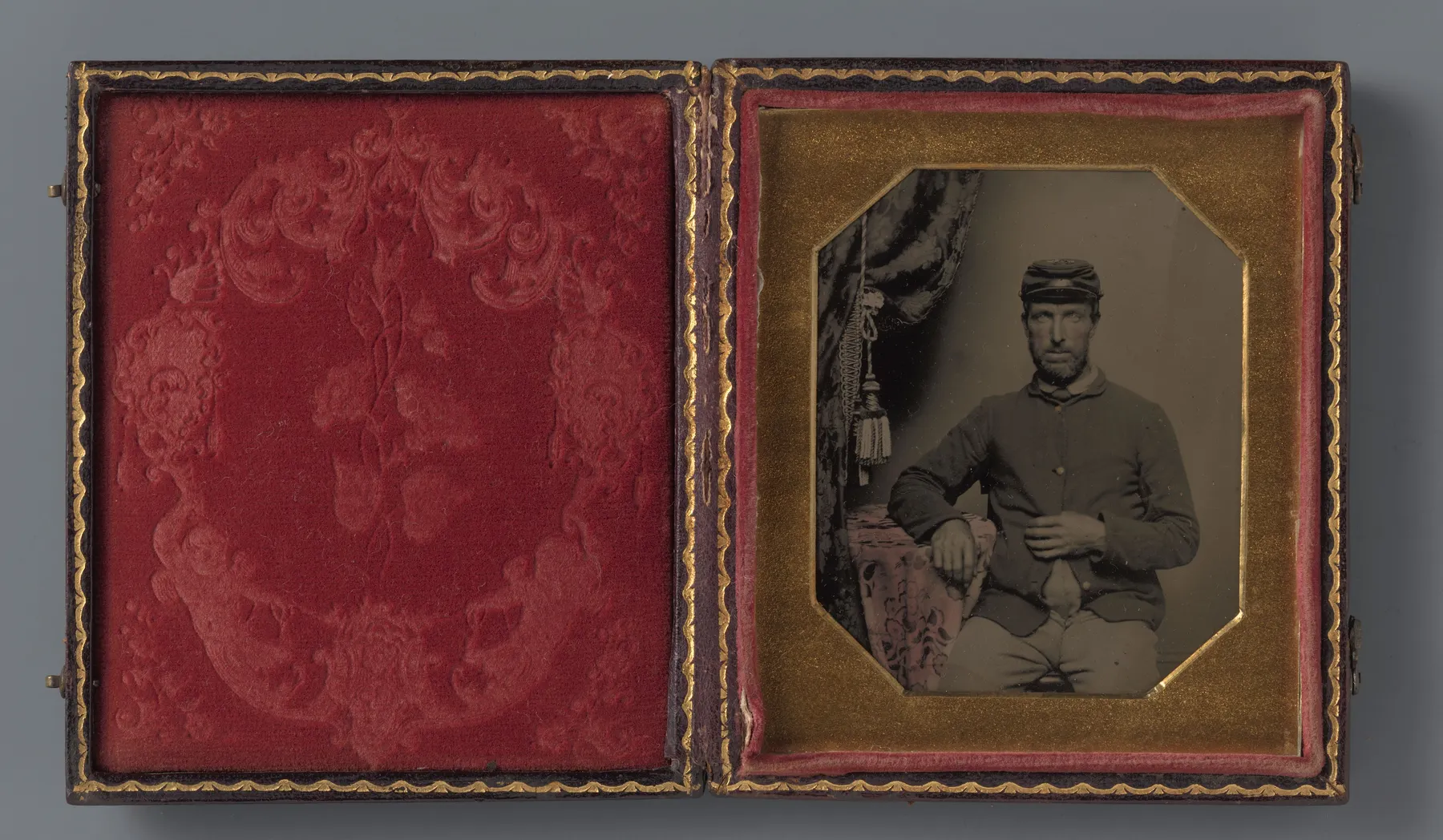
Rijksmuseum RP-F-F15012-A: a cased tintype the museum titles as a portrait of a soldier in the American Civil War and dates 1861–1865.
“Portret van een soldaat tijdens de Amerikaanse Burgeroorlog (Portrait of a soldier during the American Civil War), RP-F-F15012-A” — Unknown author — public domain full credit
"Portret van een soldaat tijdens de Amerikaanse Burgeroorlog (Portrait of a soldier during the American Civil War), RP-F-F15012-A" by Unknown author — https://commons.wikimedia.org/wiki/File:Portret_van_een_soldaat_tijdens_de_Amerikaanse_Burgeroorlog,_RP-F-F15012-A.jpg — Public domain: Public domain in the US (anonymous, made 1861–1865 in the museum dating: published or not, the term has run out) and in the EU (anonymous work made more than 70 years ago); Rijksmuseum marks it public domain and its Commons upload is CC0 1.0
Start with the range, then narrow it with the object. Estabrooke dates the introduction of the “Melanotype or Ferrotype plate” to “the years 1856–57” (p. 32). He writes that the first ferrotypes were fitted “in cases and frames” just like ambrotypes, and that a demand soon grew for plates carried without cases, mailed as “Letter-types,” or set in lockets (p. 34). Brown “Chocolate” plates were patented on March 1, 1870 and, by his account, then became “all the rage” (p. 97).
The end date is soft. The Rijksmuseum set includes a plate from the Automatic Photograph Machine Co. in New York, with a handwritten note dated July 10, 1896, and a printed promise of “A COMPLETE PHOTOGRAPH IN ONE MINUTE.” It also includes the plate signed “© 07.” A tintype can look old and not be.
| Clue | What it dates | Window | Where | Evidence strength |
|---|---|---|---|---|
| The process itself | the start of use | from 1856–57 (Estabrooke); no end date in the sources read | United States | weak: start only |
| Chocolate-brown plate | a plate style | patented March 1, 1870 (per Estabrooke); tinted plates were made as early as 1857 but did not sell (an account he prints) | United States | weak |
| US revenue stamp on the back | the stamping | 1864–1866 (1864 act; 1866 compilation) | United States | weak alone: a single feature |
| Studio label with an address | the studio at that address | as narrow as directories allow | the city on the label | strong once checked in a directory |
| Handwritten date or name | the writing | the date written | unknown | dates the note, not the exposure |
Frequently asked questions
Are tintypes made of tin?
No. In Hamilton L. Smith's 1856 patent the picture is made on a black japanned surface on iron or another metal, and he wrote that he preferred iron. Estabrooke's 1872 manual describes the ferrotype as made “on Japanned iron.”
Why is my tintype backwards?
A tintype is made directly in the camera and no print was made from it, so the ordinary picture is reversed left to right. Estabrooke singled out “Non-reversed” ferrotypes, “not laterally transposed,” as a special kind.
How can I tell how old my tintype is?
Start with the process: Estabrooke dates the plate's introduction to 1856–57. Then look for narrower clues; a US revenue stamp on the back points to the 1864–1866 stamp duty on photographs. Note what each clue dates, because a label, a stamp and a handwritten note can each date something different.
How should you handle a tintype?
Estabrooke praised the plate for its toughness: varnish alone, he wrote, let the finished picture “resist the effects of light, of dampness, and of friction” (p. 34). That line is a seller's claim about new plates. Don't read it as a care guide. This page gives no cleaning, flattening or uncasing steps; a plate that is flaking or rusting is work for a photograph conservator at a museum or archive.
Prints consulted
- 1Edward M. Estabrooke, The Ferrotype, and How to Make It. Cincinnati and Louisville: Gatchel & Hyatt, 1872. https://archive.org/details/ferrotypehowtoma00esta_1Read: pages 20–21, 31–35, 53, 60, 72–75, 82–83, 97, 159–160 and 197, checked against the page images
- 2Horace E. Dresser (comp.), The New Internal Revenue Law, Approved June 30, 1864. New York: D. Appleton, 1864. https://archive.org/details/newinternalreven00dresRead: pages 81 and 94, checked against the page images
- 3George S. Boutwell, The Tax-Payer's Manual: Containing the Entire Internal Revenue Laws. Boston: Little, Brown, and Company, 1866. https://archive.org/details/cu31924020876516Read: preface and pages 56–57 and 99, checked against the page images
- 4U.S. Currency Education Program, "History." https://www.uscurrency.gov/historyRead: full page
- 5Rijksmuseum, collection search, technique "ferrotypie" (547 records as of 2026-10-07). https://data.rijksmuseum.nl/search/collection?technique=ferrotypieRead: catalog records, all 547 as of 2026-10-07
- 6Rijksmuseum, Amsterdam, RP-F-F15037, A. Brittlebank, London, 1878. https://id.rijksmuseum.nl/200322001Read: catalog record (transcriptions as of 2026-10-07)
- 7Rijksmuseum, Amsterdam, RP-F-F15028, American Gem Victoria and Ferrotype Co., Cardiff. https://id.rijksmuseum.nl/200321992Read: catalog record (transcriptions as of 2026-10-07)
- 8Rijksmuseum, Amsterdam, RP-F-00-5373-5, T. Taylor, Bradford. https://id.rijksmuseum.nl/200746682Read: catalog record (transcriptions as of 2026-10-07)
- 9Rijksmuseum, Amsterdam, RP-F-F15032, London & Bristol Photography Company, Bristol. https://id.rijksmuseum.nl/200321996Read: catalog record (transcriptions as of 2026-10-07)
- 10Rijksmuseum, Amsterdam, RP-F-F15030, Cross' Ferrotype Car, Omaha. https://id.rijksmuseum.nl/200321994Read: catalog record (transcriptions as of 2026-10-07)
- 11Rijksmuseum, Amsterdam, RP-F-F15038, Wasson's Ferrotypes, Brooklyn. https://id.rijksmuseum.nl/200322002Read: catalog record (transcriptions as of 2026-10-07)
- 12Rijksmuseum, Amsterdam, RP-F-2007-181, Urlin & Beckley's Picture Gallery, Columbus, Ohio. https://id.rijksmuseum.nl/200488536Read: catalog record (transcriptions as of 2026-10-07)
- 13Rijksmuseum, Amsterdam, RP-F-2007-180, T. Taylor, Brussels. https://id.rijksmuseum.nl/200488535Read: catalog record (transcriptions as of 2026-10-07)
- 14Rijksmuseum, Amsterdam, RP-F-2007-182, Jordan Bro's Ferrotype Rooms, Syracuse. https://id.rijksmuseum.nl/200488537Read: catalog record (transcriptions as of 2026-10-07)
- 15Rijksmuseum, Amsterdam, RP-F-F15043, G. P. Lasselle, Boston. https://id.rijksmuseum.nl/200322007Read: catalog record (transcriptions as of 2026-10-07)
- 16Rijksmuseum, Amsterdam, RP-F-F14907, Taylor & Co, Brooklyn. https://id.rijksmuseum.nl/200321876Read: catalog record (transcriptions as of 2026-10-07)
- 17Rijksmuseum, Amsterdam, RP-F-F15039, Edward M. Estabrooke, New York. https://id.rijksmuseum.nl/200322003Read: catalog record (transcriptions as of 2026-10-07)
- 18Rijksmuseum, Amsterdam, RP-F-F15114, Automatic Photograph Machine Co., New York, 1896. https://id.rijksmuseum.nl/200322079Read: catalog record (transcriptions as of 2026-10-07)
- 19Rijksmuseum, Amsterdam, RP-F-2008-68, tintype signed "DECKER © 07," 2007. https://id.rijksmuseum.nl/200512009Read: catalog record (transcriptions as of 2026-10-07)
- 20Rijksmuseum, Amsterdam, RP-F-2008-149, American Gem Victoria and Ferrotype Co., Cardiff (the same price label, with "2s. 6d." legible). https://id.rijksmuseum.nl/200515838Read: catalog record (transcriptions as of 2026-10-07)
- 21Rijksmuseum, Amsterdam, RP-F-2008-80, Westbrook's Studio, New York. https://id.rijksmuseum.nl/200512093Read: catalog record (transcriptions as of 2026-10-07)
- 22Rijksmuseum, Amsterdam, RP-F-2008-150, J. Jewell, American Gem Photographer, Liverpool and London. https://id.rijksmuseum.nl/200515839Read: catalog record (transcriptions as of 2026-10-07)
- 23Rijksmuseum, Amsterdam, RP-F-F15012-A, portrait of a soldier during the American Civil War; museum data as given on the Wikimedia Commons file page. https://commons.wikimedia.org/wiki/File:Portret_van_een_soldaat_tijdens_de_Amerikaanse_Burgeroorlog,_RP-F-F15012-A.jpgRead: file page and original image

Next reel:
- Real photo postcards: another kind of back, with its own printed lines and stamps to read clue by clue.
- Hand-colored photographs: color added by brush to a single-color picture, and what it can and cannot date.
- Public-domain original to view: Rijksmuseum RP-F-F15037
Cite this page
Flickers & Tintypes. “Tintype: A London Label Priced 36 Tiny Portraits at 2s. 6d..” Flickers & Tintypes. Published November 12, 2026. https://flickersandtintypes.com/photo-objects/tintype/. Accessed [the date you read it].
Same sectionAlso in Photo Objects
Photo Objects
Stereograph: Twin Photos Shot a Couple of Inches Apart
A stereograph is two photos of one scene taken a couple of inches apart, per an 1859 essay. On one Broadway card, the nearest pillar moves 29 px between halves.
Picture credit
"[Broadway, New York City, in the rain], stereograph, Metropolitan Museum of Art 1980.1056.3" by Edward Anthony and Henry T. Anthony — https://commons.wikimedia.org/wiki/File:-Broadway,_New_York_City,_in_the_rain-_MET_DP218027.jpg — CC0 1.0 (https://creativecommons.org/publicdomain/zero/1.0/); modified: scaled from 3871 to 1600 pixels wide; nothing else changed
Photo Objects
Real Photo Postcard: The Back Dates the Card, Not the Photo
How to date a real photo postcard from its back: what the postmark, the stamp and a divided back can date, read against the 1907 US postal rules for post cards.
Picture credit
"Real photo postcard, December 1905: on board the SS Parisian (photograph area)" by Unknown author — https://commons.wikimedia.org/wiki/File:1905-12-22_RPPC_On_board_the_SS_Parisian_A.jpg — Public domain: Public domain in the US (anonymous work made by 1905: more than 120 years since creation, whether or not it was published; mailed December 23, 1905) and in the EU (anonymous work; 70 years from creation or from first making available have run out); modified: cropped to a 4:3 area of the photograph (box 653,3485,7516,8627 of the 8551 x 13068 original), removing the handwriting above and below; scaled to 1600 px wide
Photo Objects
Hand-Colored Photographs: The Color Came After the Picture
A hand-colored photograph is a one-color picture with color added by hand. An 1872 tintype manual says to color the plate once dry, ordinarily cheeks and lips.
Picture credit
"Mensen in een veld met irissen in Horikiri bij Tokyo (Iris Flowers Horikiri Tokio.), Rijksmuseum RP-F-F01206-H, cropped" by Unknown author — https://commons.wikimedia.org/wiki/File:Mensen_in_een_veld_met_irissen_in_Horikiri_bij_Tokyo_Iris_Flowers_Horikiri_Tokio._(titel_op_object),_RP-F-F01206-H.jpg — Public domain: Public domain in the US (made about 1870–1900: published before 1931, or if unpublished, an anonymous work more than 120 years old) and in the EU (presumed: anonymous photographer per the Rijksmuseum record, and any 70-year term from making or publication expired long ago); Rijksmuseum Public Domain Mark 1.0, Commons file CC0 1.0; modified: cropped at the top, at the left margin, at the right edge and above the printed title strip to a 4:3 view (3475 x 2606 px of the 4364 x 3462 original); scaled to 1600 px wide