Real Photo Postcard: The Back Dates the Card, Not the Photo
Frame card
In one line The back of a real photo postcard dates the card and its mailing, not the photograph. On this card the stamp names its 1902 series, the note says December 22, 1905, and the postmark December 23; the picture itself carries no date.
Source, Year, Format, Length or Size, Access, License
- Source
- Real photo postcard, both sides, unknown author; files 1905-12-22 RPPC On board the SS Parisian A and B
- Year
- Note dated Dec. 22, 1905; postmarked Dec. 23, 1905; photograph undated
- Format
- Photograph printed on postcard stock; undivided address side printed POST CARD
- Length or Size
- Not measured; rules in effect March 4, 1907 allowed 7 x 10 cm to 9 x 14 cm
- Access
- Both sides on Wikimedia Commons, from a personal postcard collection
- License
- Public domain (anonymous, made by 1905)
Card data (CSV) real-photo-postcards-frame-card.csv Source and license notes
Shot list · 6 sections
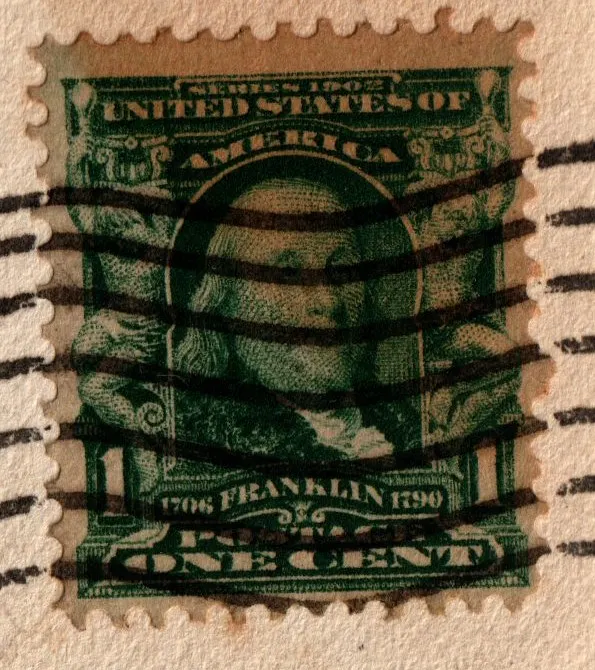
Card 1905-12-22 B, upper right corner of the address side: a one-cent Franklin stamp printed SERIES 1902, under machine-cancel lines.
“Real photo postcard, December 1905, address side: the stamp corner” — Unknown author — public domain full credit
"Real photo postcard, December 1905, address side: the stamp corner" by Unknown author — https://commons.wikimedia.org/wiki/File:1905-12-22_RPPC_On_board_the_SS_Parisian_B.jpg — Public domain: Public domain in the US (anonymous work made by 1905: more than 120 years since creation, whether or not it was published; mailed December 23, 1905) and in the EU (anonymous work; 70 years from creation or from first making available have run out); modified: cropped to the stamp and cancel lines (box 2640,90,3235,760 of the 3281 x 2124 original)
Two small words sit above Benjamin Franklin's portrait on this stamp: SERIES 1902. The card it is stuck to went through the post office at Erie, Pennsylvania, on December 23, 1905, and its picture side carries a note dated the day before.
None of those three dates records the day the photograph was taken. That holds for any real photo postcard, which is a photograph printed on card stock that has a printed postcard back. The back dates the card and its trip through the mail, and about the picture it can only say that the print existed by the time the card was mailed.
What does each mark on the back date?
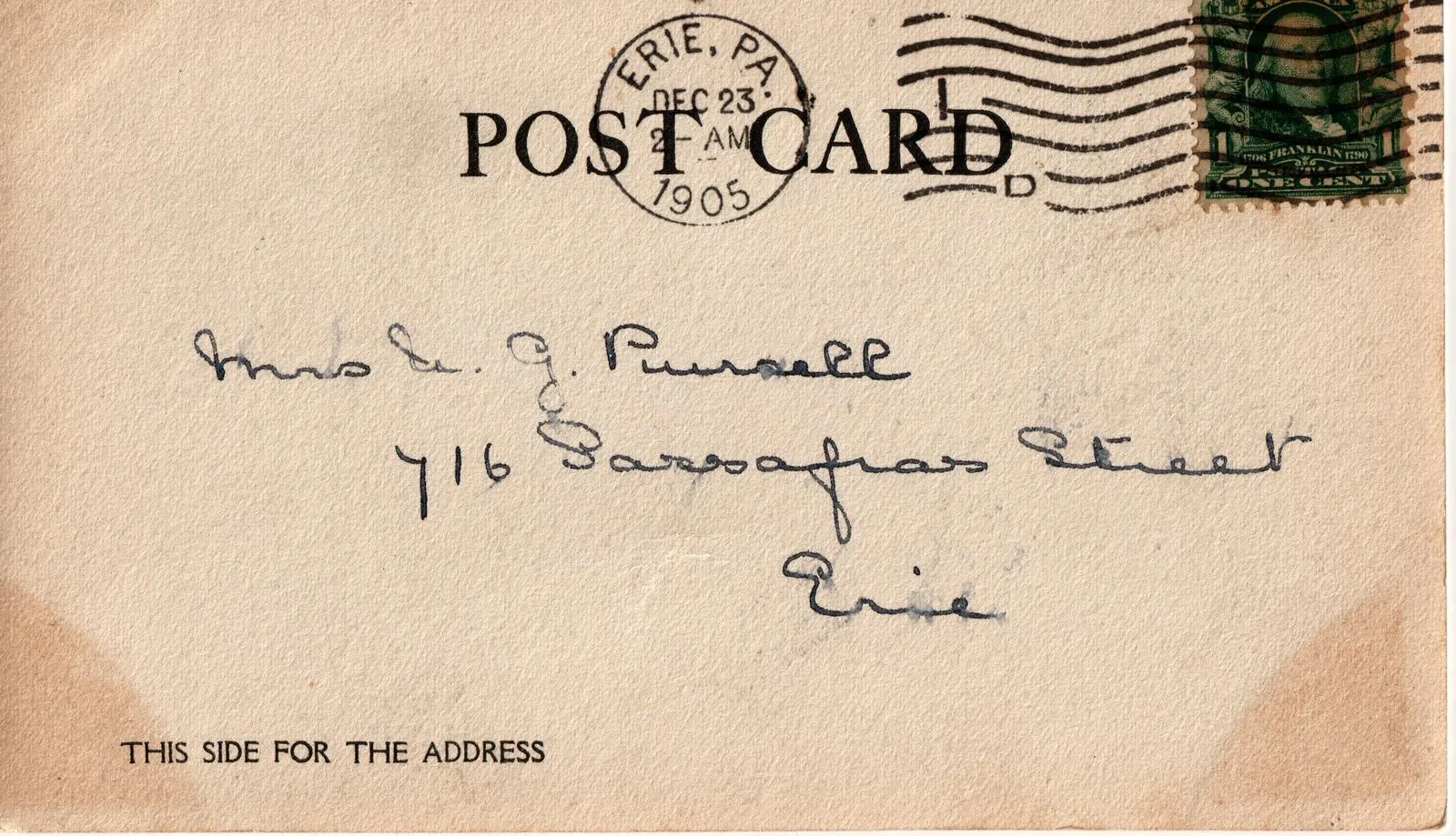
Card 1905-12-22 B, the address side: POST CARD across the top, THIS SIDE FOR THE ADDRESS at lower left, the Erie postmark and the stamp.
“Real photo postcard, December 1905, address side” — Unknown author — public domain full credit
"Real photo postcard, December 1905, address side" by Unknown author — https://commons.wikimedia.org/wiki/File:1905-12-22_RPPC_On_board_the_SS_Parisian_B.jpg — Public domain: Public domain in the US (anonymous work made by 1905: more than 120 years since creation, whether or not it was published; mailed December 23, 1905) and in the EU (anonymous work; 70 years from creation or from first making available have run out); modified: cropped to remove a strip along the top edge (box 0,240,3281,2124 of the 3281 x 2124 original); scaled to 1600 px wide
Read the back as verso evidence: the set of stamps, printed backs and notes on the back of a photograph, each tagged with what it can actually date. A postcard back carries three kinds of mark to sort: a postmark, a postage stamp, and a layout printed to fit the postal rules of its day.
Start with the postmark, the round date stamp applied at the post office. On this card it reads ERIE, PA. and DEC 23 1905, with wavy cancel lines running across the stamp beside it. A postmark dates the day the post office handled the card, and on this card it is the strongest date there is.
The stamp comes next. It is weaker than it looks. SERIES 1902 is the name of the stamp design, printed on the stamp itself, and this page did not read when that series was first issued. The same design turns up on a card postmarked less than three years later, further down this page.
The printed words on the card stock carry no date at all. What they do carry is a layout, and a layout can be read against the rules that the post office printed for cards like this one.
What did the 1907 postal rules say about the back?
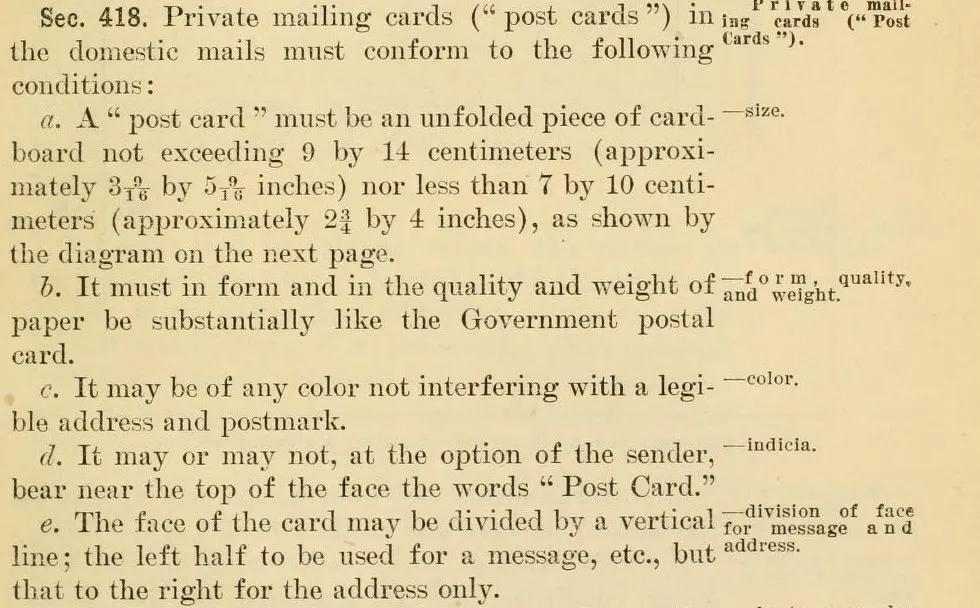
Page 65 of the Supplement to the Postal Laws and Regulations, 1907: Sec. 418, the conditions for private mailing cards, paragraphs a to e.
“Supplement to the Postal Laws and Regulations (1907), page 65, Sec. 418” — United States Post Office Department — public domain full credit
"Supplement to the Postal Laws and Regulations (1907), page 65, Sec. 418" by United States Post Office Department — https://archive.org/details/supplementtopost00unit — Public domain: Public domain in the US (work of the US government, Post Office Department, published 1907) and in the EU (published 1907 with no personal author; 70 years from publication expired); modified: cropped to Sec. 418, paragraphs a to e (box 30,802,1010,1410 of page image n70)
The rules a card had to meet are in print. Order No. 195, signed in Washington by Postmaster-General Geo. B. Cortelyou on March 4, 1907, put the “Supplement of 1907” into effect. It collected the amendments made to the 1902 edition of the Postal Laws and Regulations since April 1, 1902.
Section 418 covers “Private mailing cards (‘post cards’)” in the domestic mails. A card could be no larger than 9 by 14 centimeters and no smaller than 7 by 10 centimeters, and the words “Post Card” at the top were left to the sender. The page gives the sizes in inches as well, about 3 9/16 by 5 9/16 inches for the largest card and 2 3/4 by 4 inches for the smallest. Then comes the paragraph behind what is now called a divided back: “The face of the card may be divided by a vertical line; the left half to be used for a message, etc., but that to the right for the address only.”
The other conditions are practical ones. The card had to be substantially like the Government postal card “in form and in the quality and weight of paper,” and it could be any color that did not get in the way of a legible address and postmark. Cards that met the conditions went for 1 cent each in the domestic mails.
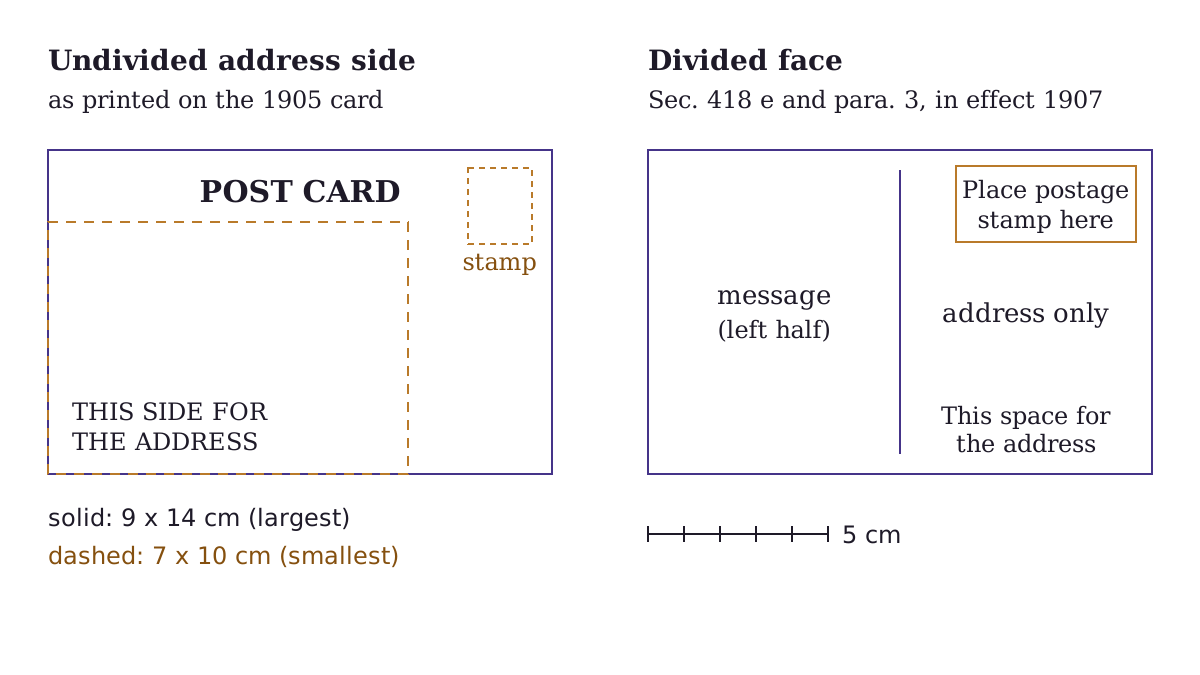
Two address sides drawn at the largest size in the 1907 rules, 9 × 14 cm: undivided as on the 1905 card, and divided as Sec. 418 describes.
"Undivided and divided postcard address sides at the 1907 size limits" by Flickers & Tintypes, https://flickersandtintypes.com/photo-objects/real-photo-postcards/ — CC BY 4.0, https://creativecommons.org/licenses/by/4.0/
A card that missed a condition was not simply refused. Paragraph 4 says it was charged by the character of its message, at the letter rate if it was written on in whole or in part, or at the third-class rate if it was entirely in print. Cards bearing particles of glass, metal, mica, sand or tinsel could be sent only inside envelopes.
Notice the wording. It runs the other way from everyday speech. In the rule book the address side is the face, and paragraph g says “Advertisements and illustrations may appear on the back of the card and on the left half of the face.” By postal usage, then, a real photo postcard carries its picture on the back, although this page keeps the everyday usage, where the back is the address side.
The Supplement has a limit. Its explanatory note says it prints only the paragraphs that were amended, and it never says when the dividing-line paragraph first took effect. So 1907 marks a year when the rule was in force, not the date it began. The Postmaster-General's annual reports might say more, but this page found no copy of them that it could read.
The next section of the Supplement, Sec. 418½, points the same way from abroad. Post cards mailed in foreign countries with a written message “upon the left half of the front,” the right half kept for the address and postmark, were to be delivered in the United States without extra postage if they were fully prepaid and followed the Rome convention.
Undivided and divided backs, side by side
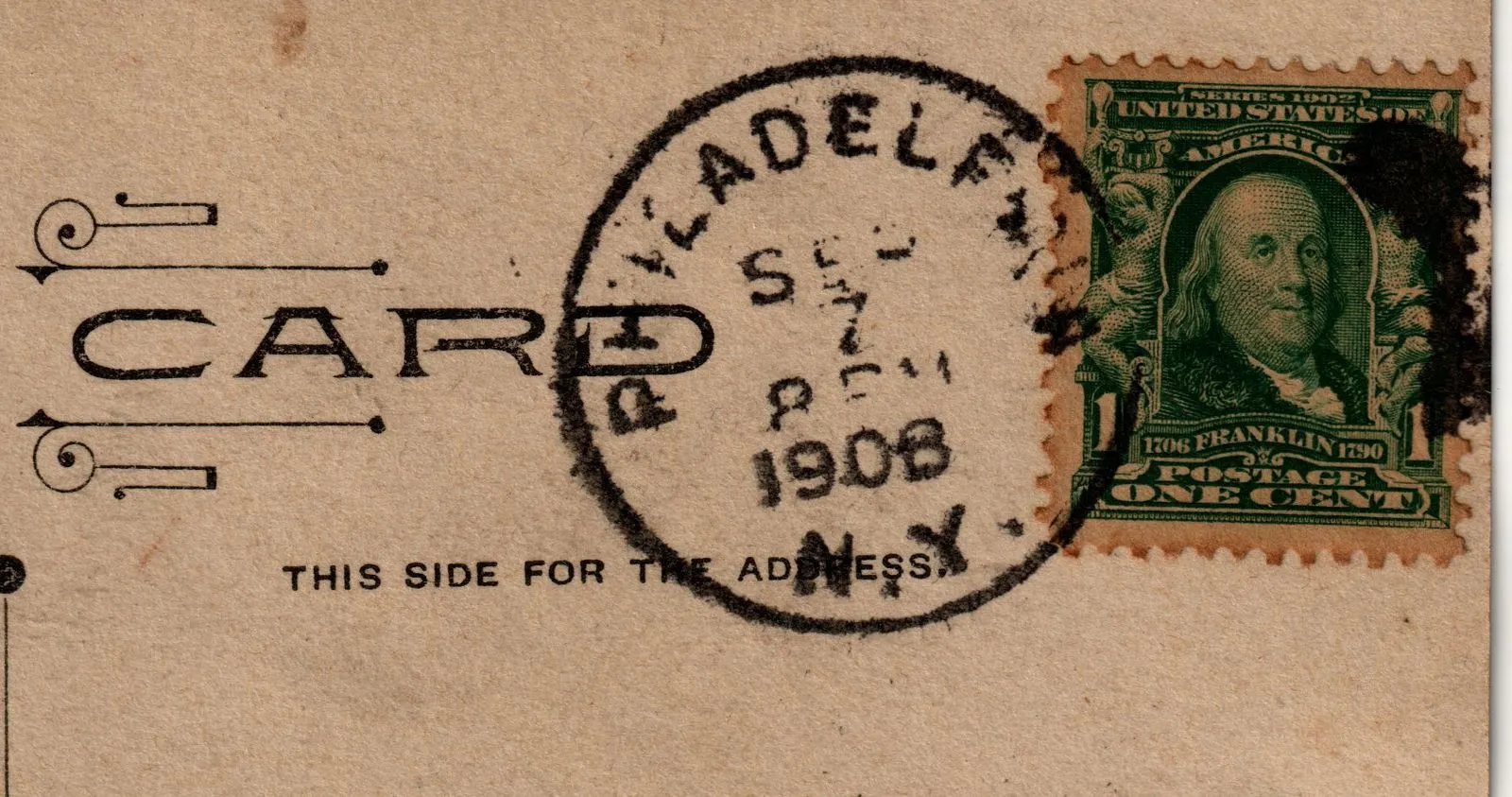
Card 1908-09-08 B, right half of the address side: the printed dividing line at the left edge, THIS SIDE FOR THE ADDRESS, a postmark whose year reads 1908, and the stamp.
“Real photo postcard, 1908, address side (divided back), printed right half” — Unknown author — public domain full credit
"Real photo postcard, 1908, address side (divided back), printed right half" by Unknown author — https://commons.wikimedia.org/wiki/File:1908-09-08_Town_house_and_school_building,_Rutland,_Mass_B.jpg — Public domain: Public domain in the US (printed card stock published by 1908, before 1931; postmark and stamp are US government work) and in the EU (anonymous printed matter, more than 70 years since publication); the handwritten message and address are cropped out; modified: cropped to the printed right half of the address side (box 1545,60,3330,1000 of the 3330 x 2089 original), removing the handwritten message and address; scaled to 1600 px wide
Here is the divided layout in use on a later card. A printed line splits the back, with SPACE FOR CORRESPONDENCE on the left half and THIS SIDE FOR THE ADDRESS on the right. The full scan on Commons shows a handwritten message on the left and the address on the right, and only the printed right half is shown here.
The circular postmark names a place ending in “N.Y.” Its month starts with an S, which only September does, and its year reads 1908, though the day is unclear in this scan. The stamp is again a one-cent Franklin printed SERIES 1902, so the two cards on this page share a stamp design while their postmarks sit less than three years apart.
The 1905 card has no line. Its whole back reads THIS SIDE FOR THE ADDRESS, and the sender wrote the greeting on the picture side instead, in the space around the photograph.
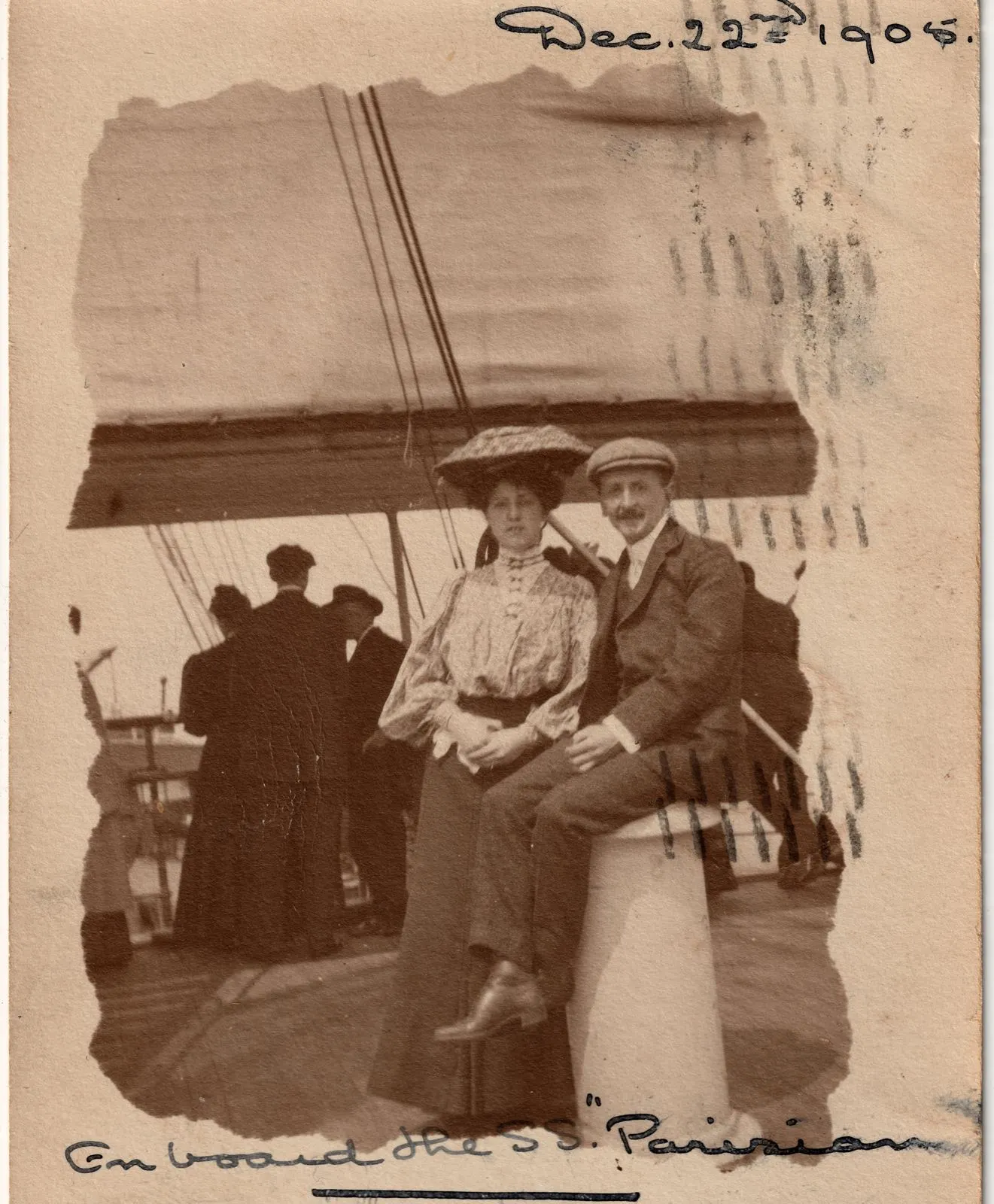
Card 1905-12-22 A, the picture side: “Dec. 22nd 1905” at the top and “On board the S.S. ‘Parisian’” under the print; the Christmas greeting written below that is cropped out.
“Real photo postcard, December 1905, picture side: on board the SS Parisian” — Unknown author — public domain full credit
"Real photo postcard, December 1905, picture side: on board the SS Parisian" by Unknown author — https://commons.wikimedia.org/wiki/File:1905-12-22_RPPC_On_board_the_SS_Parisian_A.jpg — Public domain: Public domain in the US (anonymous work made by 1905: more than 120 years since creation, whether or not it was published; mailed December 23, 1905) and in the EU (anonymous photograph; 70 years from creation or from first making available have run out); the handwritten date and ship name are short factual notes, and the signed greeting below them is cropped out; modified: cropped above the handwritten greeting and signature (box 0,0,8551,10360 of the 8551 x 13068 original); scaled to 1600 px tall
That fits a back kept for the address, but it does not prove which rule the sender followed, because the rule text in force before the 1907 Supplement was not read for this page. A printed layout can also stay in use after a rule changes, as long as old card stock is still on hand.
What about the stamp box?
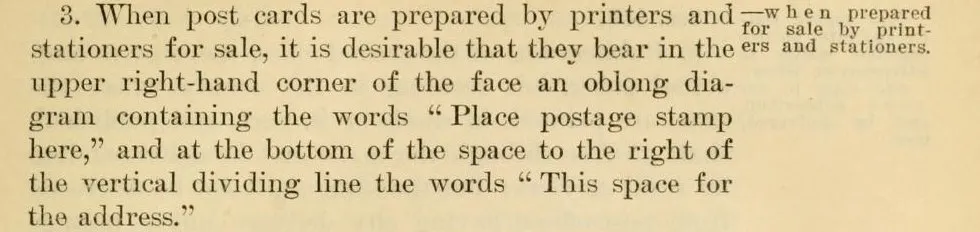
Page 67 of the 1907 Supplement, Sec. 418, paragraph 3: the oblong stamp box and the address line, described as desirable for cards printed for sale.
“Supplement to the Postal Laws and Regulations (1907), page 67, Sec. 418 para. 3” — United States Post Office Department — public domain full credit
"Supplement to the Postal Laws and Regulations (1907), page 67, Sec. 418 para. 3" by United States Post Office Department — https://archive.org/details/supplementtopost00unit — Public domain: Public domain in the US (work of the US government, Post Office Department, published 1907) and in the EU (published 1907 with no personal author; 70 years from publication expired); modified: cropped to paragraph 3 (box 30,90,1010,322 of page image n72)
Paragraph 3 of Sec. 418 describes the stamp box. When printers and stationers made post cards for sale, “it is desirable that they bear in the upper right-hand corner of the face an oblong diagram containing the words ‘Place postage stamp here.’” The word is desirable, not must. On both cards on this page the stamp covers that corner anyway.
This page found no maker's record or postal record that dates a photographic paper maker's name printed inside that box. It treats such a mark as a clue to look up elsewhere, with no window of its own.
What can the photograph side date?
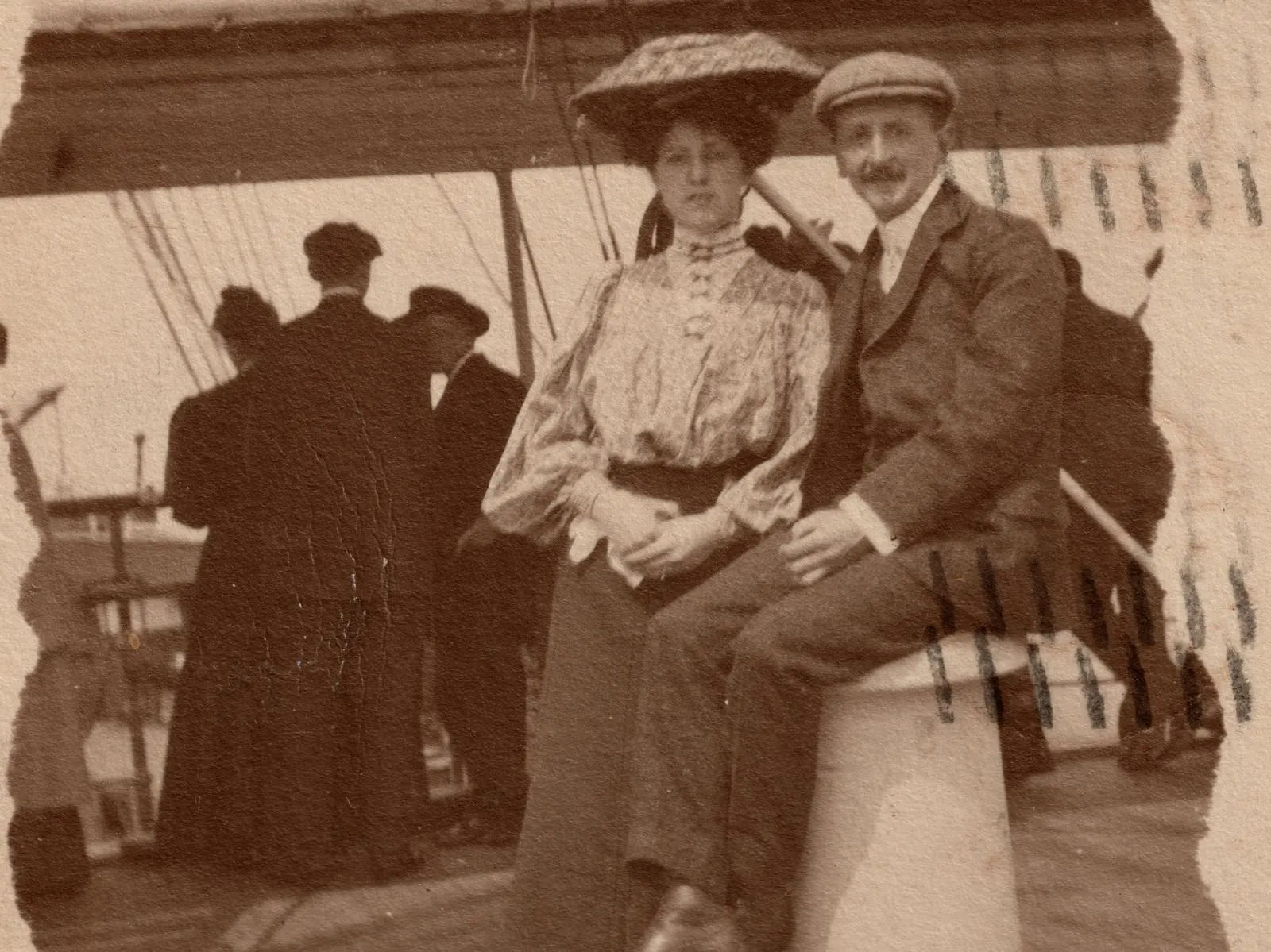
Card 1905-12-22 A, the photograph only: a couple posed by a white post on deck, with rigging and other passengers behind them; the handwriting above and below is cropped out.
“Real photo postcard, December 1905: on board the SS Parisian (photograph area)” — Unknown author — public domain full credit
"Real photo postcard, December 1905: on board the SS Parisian (photograph area)" by Unknown author — https://commons.wikimedia.org/wiki/File:1905-12-22_RPPC_On_board_the_SS_Parisian_A.jpg — Public domain: Public domain in the US (anonymous work made by 1905: more than 120 years since creation, whether or not it was published; mailed December 23, 1905) and in the EU (anonymous work; 70 years from creation or from first making available have run out); modified: cropped to a 4:3 area of the photograph (box 653,3485,7516,8627 of the 8551 x 13068 original), removing the handwriting above and below; scaled to 1600 px wide
Look at the print itself. A woman in a wide hat and a man in a cap pose together by a white post on deck, with rigging and other passengers behind them. Nothing in the print is a date, and the ink note under it names a ship, the S.S. Parisian, without saying when the shot was taken.
The card gives one hard edge, because the photograph was printed on this card before it was mailed on December 23, 1905. This page's estimate for the exposure is on or before December 23, 1905, on a ship the note names as the Parisian, with the card mailed from Erie, Pennsylvania. The evidence is medium for the end date, because the postmark and the note dated the day before agree, and there is none for the start. Narrowing the start would need a record from outside the card, such as a dated letter, a family paper or a record of the voyage, and this page did not look for one.
The same gap between a date on an object and the date of what it shows turns up elsewhere on this site, on a newspaper comics page in Little Nemo and in trade-paper reports on Gertie the Dinosaur.
How to date a real photo postcard, clue by clue
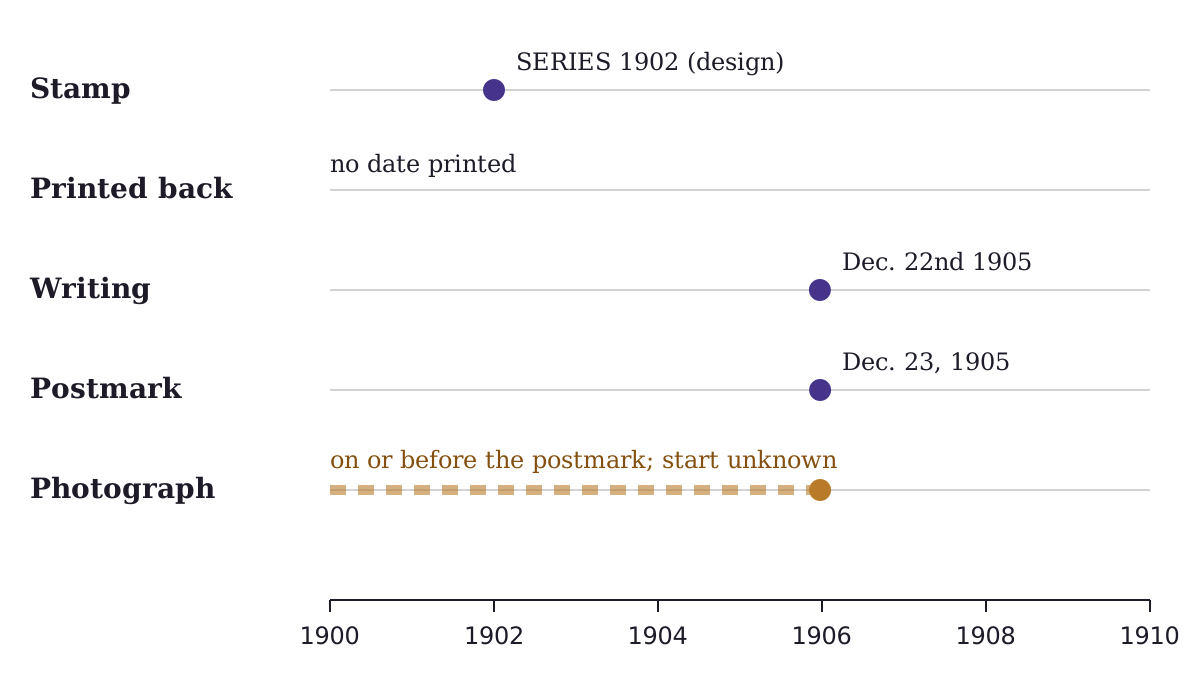
The 1905 card, one row per kind of evidence: the stamp names 1902, the printed back has no date, the note and postmark fall in December 1905, and the photograph only ends there.
"What each mark on a 1905 real photo postcard can date" by Flickers & Tintypes, https://flickersandtintypes.com/photo-objects/real-photo-postcards/ — CC BY 4.0, https://creativecommons.org/licenses/by/4.0/
Work from the strongest mark to the weakest, and write down what each one dates before moving on:
- Find the postmark. It dates the day the post office handled the card, and the photograph was printed on the card no later than that day.
- Read any handwritten date. It is the writer's own date for the note, which can come at any time after the card was printed.
- Check the layout of the back. A dividing line matches the rules in force by March 4, 1907, without giving the day those rules began.
- Read the stamp. Its series name dates the design, not the day the stamp was used.
- Look at the stamp box last. A paper maker's mark is a lead to check in other records, not a date.
- Report a range, a place and a strength, and never a single year for the photograph.
| Clue | What it dates | On the 1905 card |
|---|---|---|
| Postmark | the mailing | Erie, Pa., Dec. 23, 1905 |
| Handwritten date | the note, as the writer dated it | Dec. 22nd 1905 |
| Stamp printed SERIES 1902 | the stamp design | names 1902; also on the 1908 card |
| Undivided address side | the card stock's layout | no window from the sources read |
| The photograph | the exposure | on or before Dec. 23, 1905, on the S.S. Parisian per the note; end date medium, no start date |
The full list of eight clues, each row with its window, region, strength and source, is in the data file. The habit of reading the card before the picture also applies to the stereograph, another photograph mounted on a card.
Download the back clues for real photo postcards (CSV) source and license notes
Questions about real photo postcard backs
How old is my real photo postcard?
Start with the postmark, if there is one. It gives the day the post office handled the card, and the photograph was printed on the card no later than that day. The back gives no start date for the picture, so a careful answer is a range that ends at the postmark.
What does a divided back mean?
A divided back has a printed vertical line on the address side, with the message on the left and the address on the right. The US postal rules in effect on March 4, 1907 allowed this for domestic post cards (Sec. 418 e), but the 1907 Supplement does not say when that paragraph first took effect.
Does the stamp date the card?
Not by itself. The one-cent Franklin stamps on both cards here are printed SERIES 1902, yet one card was mailed in 1905 and the other carries a 1908 postmark.
Prints consulted
- 1United States Post Office Department, Supplement to the Postal Laws and Regulations of the United States of America, Edition of 1902, in effect March 4, 1907. Washington: Government Printing Office, 1907. https://archive.org/details/supplementtopost00unitRead: pages 5, 6 and 65–67, checked against the page images
- 2Unknown author, real photo postcard, picture side, inscribed “Dec. 22nd 1905” and “On board the S.S. ‘Parisian’”; personal postcard collection, as given on the Wikimedia Commons file page. https://commons.wikimedia.org/wiki/File:1905-12-22_RPPC_On_board_the_SS_Parisian_A.jpgRead: file page and original image
- 3Unknown author, real photo postcard, address side, postmarked Erie, Pa., December 23, 1905; personal postcard collection, as given on the Wikimedia Commons file page. https://commons.wikimedia.org/wiki/File:1905-12-22_RPPC_On_board_the_SS_Parisian_B.jpgRead: file page and original image
- 4Unknown author, real photo postcard, address side (divided back), postmarked 1908; personal postcard collection, as given on the Wikimedia Commons file page. https://commons.wikimedia.org/wiki/File:1908-09-08_Town_house_and_school_building,_Rutland,_Mass_B.jpgRead: file page and original image


Next reel:
- Tintype: where verso evidence is defined, with studio labels and a revenue stamp read one clue at a time.
- Stereograph: two photographs mounted side by side on one card.
- Public-domain original to view: Real photo postcard, December 22, 1905, on Wikimedia Commons
Cite this page
Flickers & Tintypes. “Real Photo Postcard: The Back Dates the Card, Not the Photo.” Flickers & Tintypes. Published November 12, 2026. https://flickersandtintypes.com/photo-objects/real-photo-postcards/. Accessed [the date you read it].
Same sectionAlso in Photo Objects
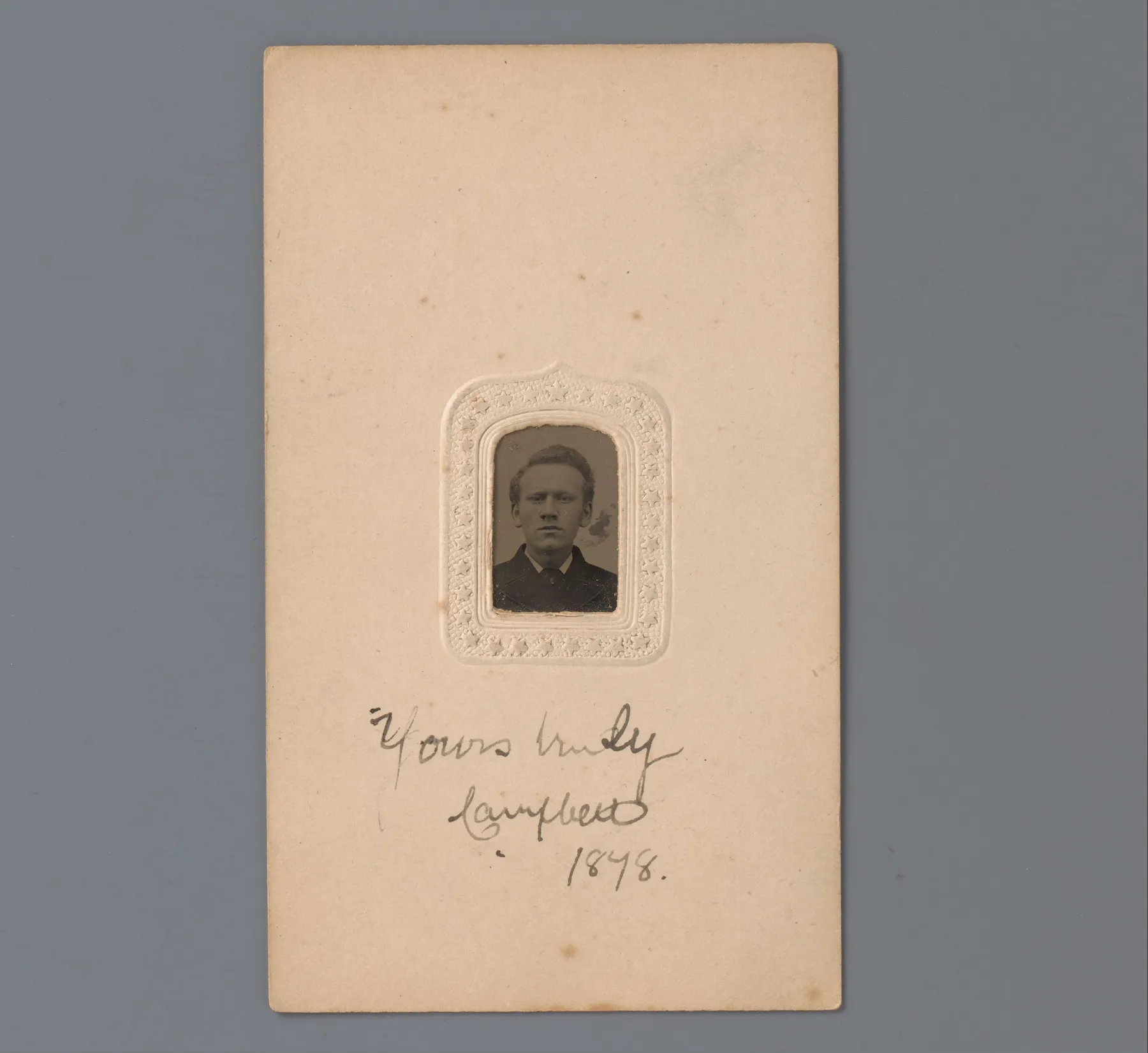
Photo Objects
Tintype: A London Label Priced 36 Tiny Portraits at 2s. 6d.
A tintype is a portrait made in the camera on black-japanned iron. Labels on the backs of museum tintypes show studios selling tiny gems by the dozen.
Picture credit
"Portret van een onbekende man (Portrait of an unknown man), RP-F-F15037" by A. Brittlebank — https://commons.wikimedia.org/wiki/File:Portret_van_een_onbekende_man,_RP-F-F15037.jpg — Public domain: Public domain in the US (made in 1878: published or not, the term has run out) and presumed public domain in the EU (Rijksmuseum Public Domain Mark; A. Brittlebank was working in London in 1878, death date not found); the Commons file is the museum’s own upload under CC0 1.0
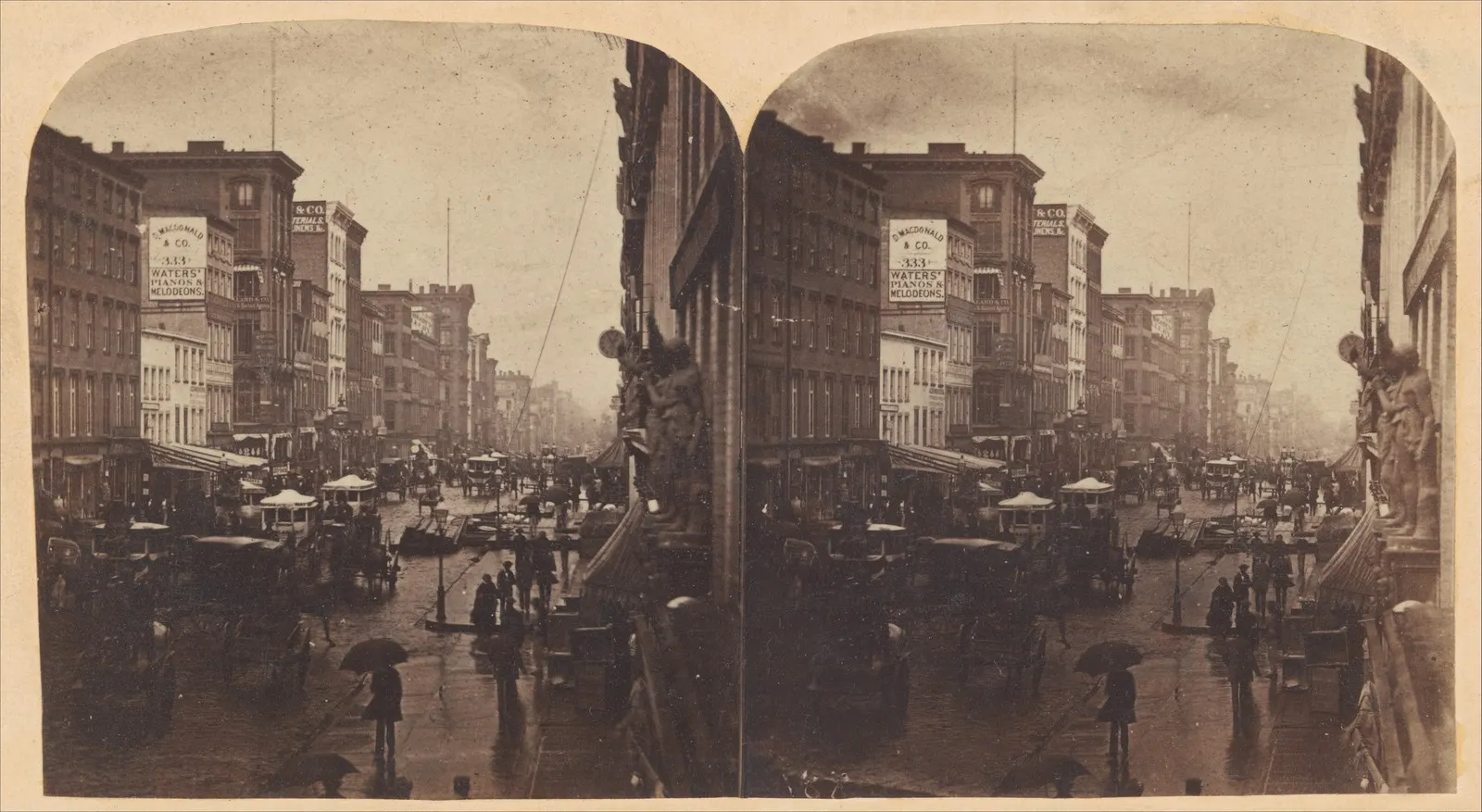
Photo Objects
Stereograph: Twin Photos Shot a Couple of Inches Apart
A stereograph is two photos of one scene taken a couple of inches apart, per an 1859 essay. On one Broadway card, the nearest pillar moves 29 px between halves.
Picture credit
"[Broadway, New York City, in the rain], stereograph, Metropolitan Museum of Art 1980.1056.3" by Edward Anthony and Henry T. Anthony — https://commons.wikimedia.org/wiki/File:-Broadway,_New_York_City,_in_the_rain-_MET_DP218027.jpg — CC0 1.0 (https://creativecommons.org/publicdomain/zero/1.0/); modified: scaled from 3871 to 1600 pixels wide; nothing else changed
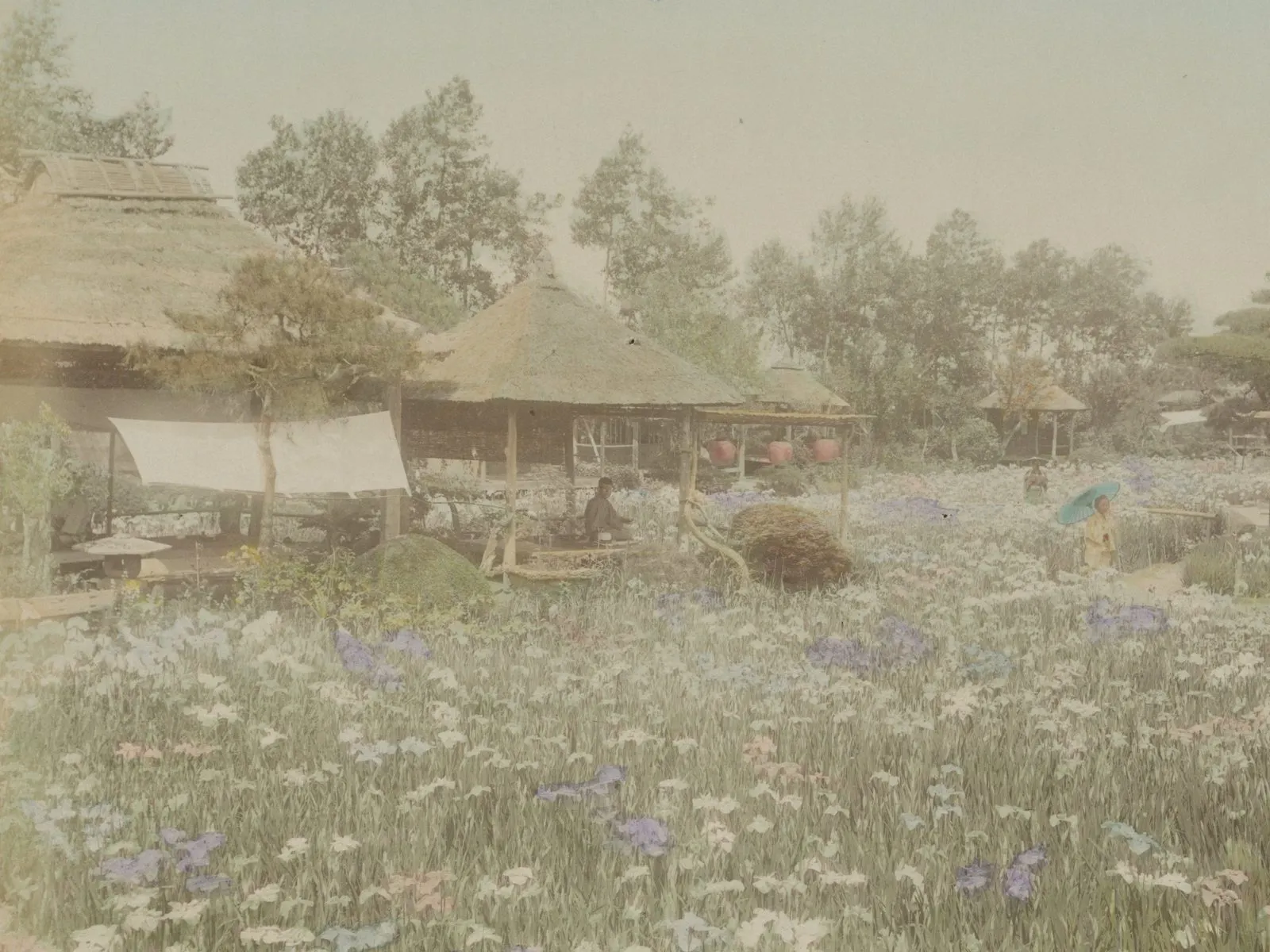
Photo Objects
Hand-Colored Photographs: The Color Came After the Picture
A hand-colored photograph is a one-color picture with color added by hand. An 1872 tintype manual says to color the plate once dry, ordinarily cheeks and lips.
Picture credit
"Mensen in een veld met irissen in Horikiri bij Tokyo (Iris Flowers Horikiri Tokio.), Rijksmuseum RP-F-F01206-H, cropped" by Unknown author — https://commons.wikimedia.org/wiki/File:Mensen_in_een_veld_met_irissen_in_Horikiri_bij_Tokyo_Iris_Flowers_Horikiri_Tokio._(titel_op_object),_RP-F-F01206-H.jpg — Public domain: Public domain in the US (made about 1870–1900: published before 1931, or if unpublished, an anonymous work more than 120 years old) and in the EU (presumed: anonymous photographer per the Rijksmuseum record, and any 70-year term from making or publication expired long ago); Rijksmuseum Public Domain Mark 1.0, Commons file CC0 1.0; modified: cropped at the top, at the left margin, at the right edge and above the printed title strip to a 4:3 view (3475 x 2606 px of the 4364 x 3462 original); scaled to 1600 px wide