Little Nemo: A 1906 Board Numbered Out of Row Order
Frame card
In one line This Little Nemo board, dated October 14, 1906, numbers its 8 panels in circles. The numbers settle the biggest choice on the page: after panel 4, read down to panel 5, not across to panel 6.
Source, Year, Format, Length or Size, Access, License
- Source
- National Gallery of Art 142153 (accession 2009.28.1), original drawing for a Little Nemo in Slumberland page
- Year
- 1906: handwritten “Oct. 14, 1906” and a pasted printed slip “(COPYRIGHT, 1906, BY THE NEW YORK HERALD CO.)” on the board
- Format
- Pen and brush and black ink over graphite on two joined sheets of paperboard; 8 numbered panels in 3 tiers
- Length or Size
- Image 70.49 x 54.61 cm (27 3/4 x 21 1/2 in); sheet 72.39 x 56.2 cm
- Access
- Full-size image on Wikimedia Commons, uploaded by the National Gallery of Art
- License
- CC0 1.0, National Gallery of Art; cropped for this page
Card data (CSV) little-nemo-frame-card.csv Source and license notes
Shot list · 7 sections
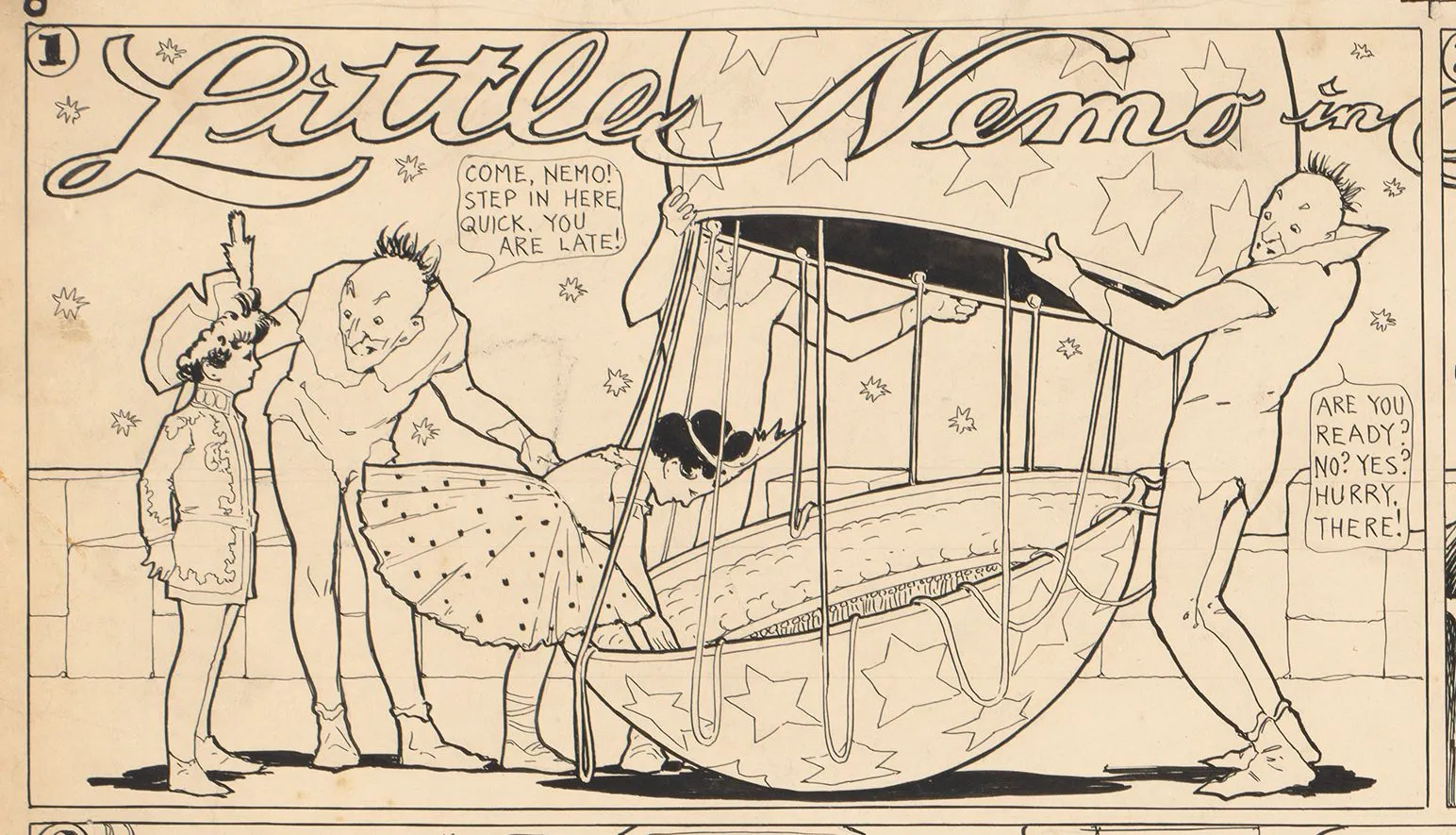
Panel 1, top left of NGA 142153: the circled 1 sits against the title, and Nemo stands at the far left in a plumed hat.
"Little Nemo in Slumberland: "I don't like this, one little tiny bit, not one tiny weenie bit", 1906 (National Gallery of Art 142153), panel 1" by Winsor McCay — https://commons.wikimedia.org/wiki/File:Winsor_McCay,_Little_Nemo_in_Slumberland_-_%22I_don%27t_like_this,_one_little_tiny_bit,_not_one_tiny_weenie_bit%22,_1906,_NGA_142153.jpg — CC0 1.0 (https://creativecommons.org/publicdomain/zero/1.0/); modified: cropped to panel 1 with its circled numeral and the start of the title
A circled number 1 sits in the top-left corner of this drawing, right against the looping title. Every panel on the page has one, from 1 to 8. Those numbers are a reading path drawn onto the board itself, and they settle the biggest choice on the page: after panel 4, you read down to panel 5, not across to panel 6.
The board is an original pen-and-ink drawing for a Little Nemo in Slumberland newspaper page, signed WINSOR McCAY in the lower right corner. The National Gallery of Art holds it as object 142153, accession 2009.28.1, and has released the image under CC0. Someone wrote “Oct. 14, 1906” in blue up the right margin, and a calendar puts that date on a Sunday.
What happens on this page, panel by panel?
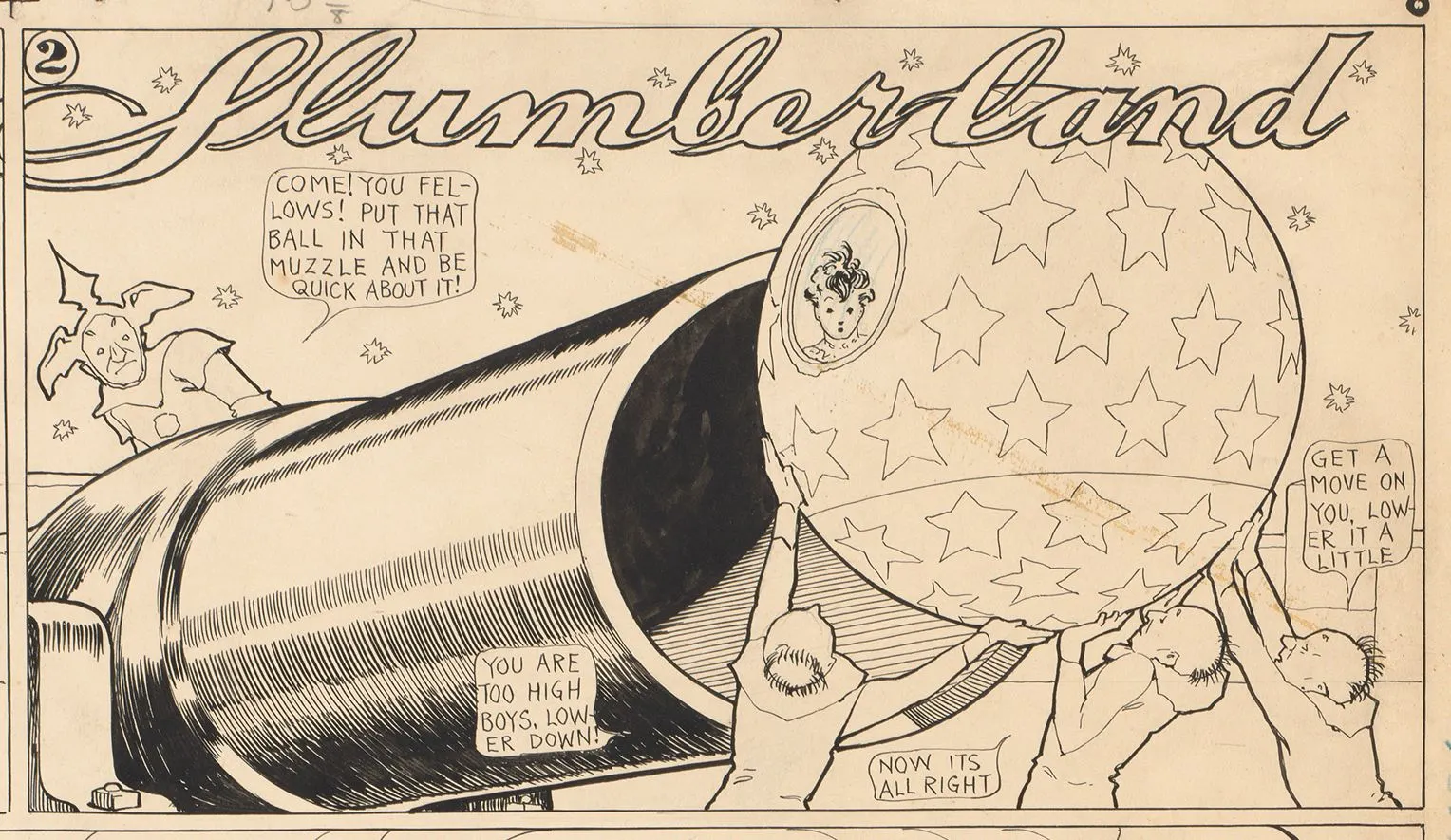
Panel 2 of NGA 142153: the starry ball, with Nemo’s face in its porthole, goes into the cannon’s muzzle.
"Little Nemo in Slumberland: "I don't like this, one little tiny bit, not one tiny weenie bit", 1906 (National Gallery of Art 142153), panel 2" by Winsor McCay — https://commons.wikimedia.org/wiki/File:Winsor_McCay,_Little_Nemo_in_Slumberland_-_%22I_don%27t_like_this,_one_little_tiny_bit,_not_one_tiny_weenie_bit%22,_1906,_NGA_142153.jpg — CC0 1.0 (https://creativecommons.org/publicdomain/zero/1.0/); modified: cropped to panel 2 with its circled numeral and the end of the title
Read in numbered order, the page tells one short, complete adventure. In panel 1, Nemo arrives in a plumed hat while two lanky figures hold open a starry half-shell on ropes, and a balloon calls, “COME, NEMO! STEP IN HERE QUICK. YOU ARE LATE!” In panel 2, three figures push the closed ball, with Nemo’s face showing in a round porthole, into the mouth of a huge cannon, while a fourth gives orders from the left.
Panel 3 fires the gun. The crew clap their hands over their ears, and the ball sails off to the right in a bank of smoke. Panel 4 is a small square of black night sky, with the ball now tiny among the stars and two voices arguing about whether to turn back.
In panel 5 the bottom half of the ball drops away and becomes a basket hanging on ropes, so the shell turns into a balloon. Panels 6 and 7 follow that balloon down until it hangs over the domes and towers of a city, which the girl beside Nemo calls “PAPA’S PRIVATE PALACE.” Panel 8 is the last turn of the plot: Nemo sits up in bed while a man with a cigar pulls back the covers.
That arc, from a call to adventure to a bed, is the order the numbers give. The strict row-by-row order described below would show the shell turning into a balloon only after the balloon had already reached the city.
How do you read a Little Nemo page?
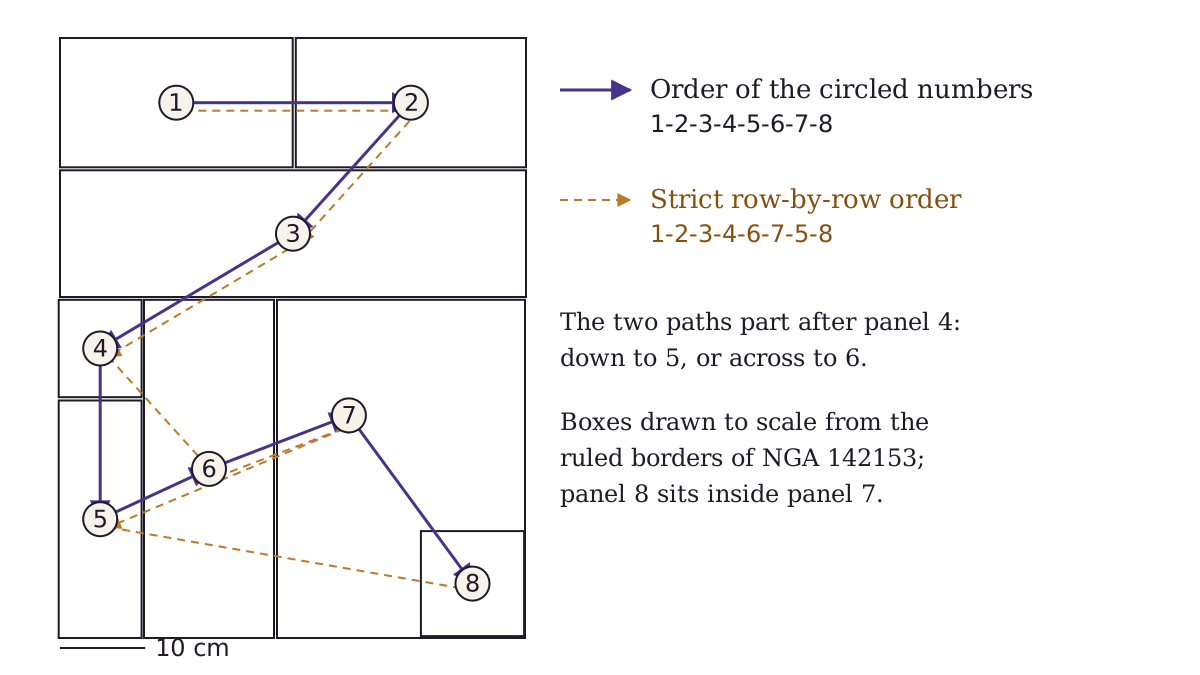
Suggested reading path — editorial analysis, not eye-tracking data: solid arrows follow the circled numbers 1 to 8; dashed arrows show a strict row-by-row order, 1-2-3-4-6-7-5-8.
"Suggested reading path through NGA 142153, panel borders to scale" by Flickers & Tintypes, https://flickersandtintypes.com/comics-panels/little-nemo/ — CC BY 4.0, https://creativecommons.org/licenses/by/4.0/
Start with the habit you bring from text: left to right, then down. Neil Cohn, a researcher at the University of California, San Diego, calls this the Z-path in a 2013 paper, describing it as “the left-to-right and downward reading orders used in written language.” On this board the Z-path works without any trouble for the first two tiers, the horizontal rows of panels across the page.
The top tier holds panels 1 and 2, each about 27 cm wide and 15.2 cm tall; the second tier is a single panel, number 3, which runs the full 54.7 cm width of the drawing. Between the panels runs the gutter, the narrow blank strip that separates one panel from the next, and nothing in those two tiers asks you to choose.
The bottom tier is different. Panels 4, 6 and 7 all start at the same height, so a reader who goes strictly row by row would read 4, then 6, then 7, and only then come back for 5. Panel 8 sits inside the lower right corner of panel 7, like a small picture set into a wall.
The circled numbers overrule that row habit: they run 4, then 5 down the left column, and then 6, 7 and 8 across the rest of the tier.
This page’s path is built from three kinds of evidence on the board: the circled numbers, the positions of the balloons, and whether the words make sense in that order. It is not a record of where anyone’s eyes went. The diagram draws only the panel borders, to scale, and copies nothing else from the artwork.
Download the panel measurements and reading orders (CSV) source and license notes
Where the path splits: panels 4, 5 and 6
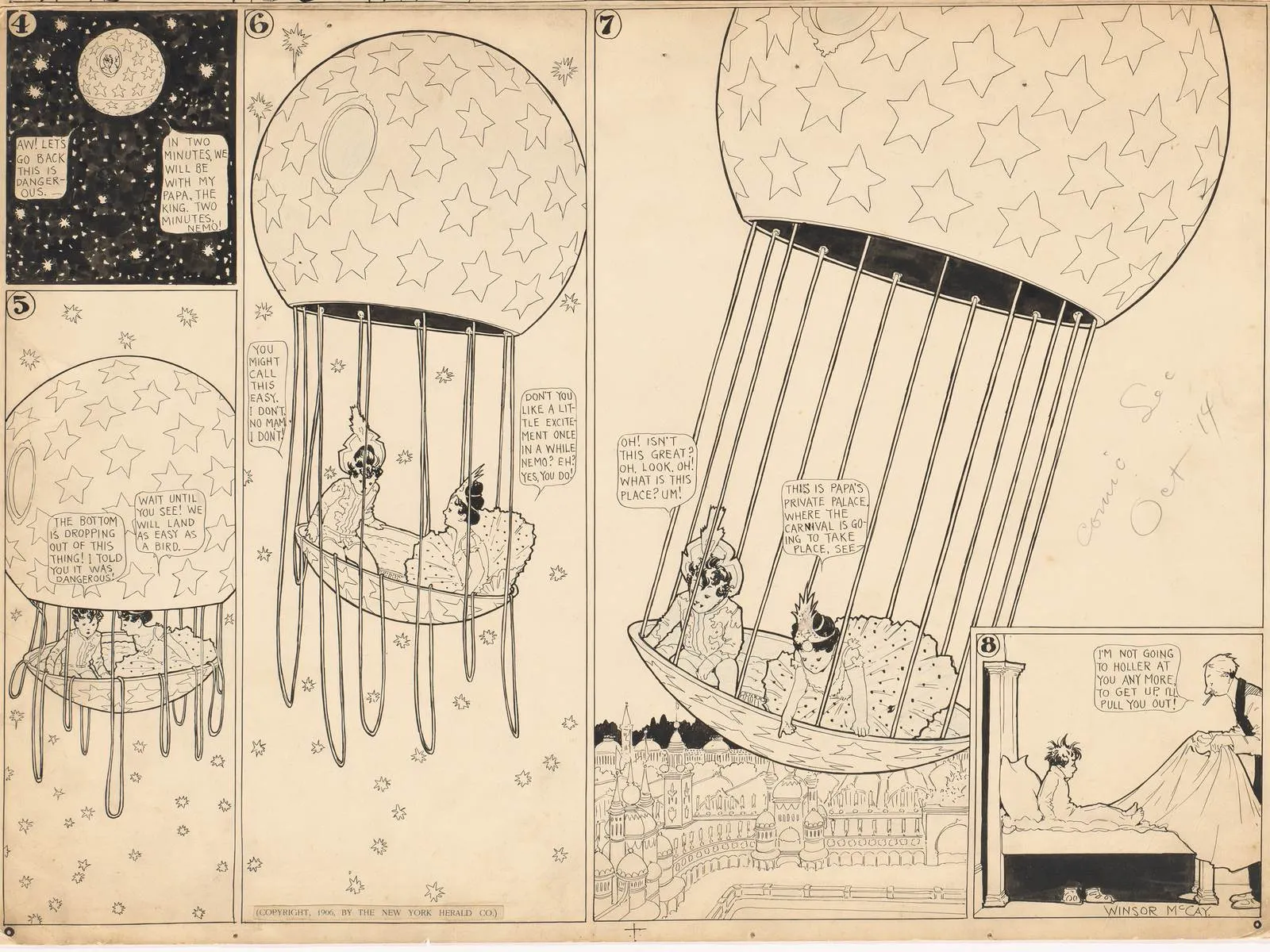
Panels 4 to 8 of NGA 142153: panels 4 and 5 stack in the left column beside the tall panel 6, and panel 8 is set into the corner of panel 7.
"Little Nemo in Slumberland: "I don't like this, one little tiny bit, not one tiny weenie bit", 1906 (National Gallery of Art 142153), panels 4 to 8" by Winsor McCay — https://commons.wikimedia.org/wiki/File:Winsor_McCay,_Little_Nemo_in_Slumberland_-_%22I_don%27t_like_this,_one_little_tiny_bit,_not_one_tiny_weenie_bit%22,_1906,_NGA_142153.jpg — CC0 1.0 (https://creativecommons.org/publicdomain/zero/1.0/); modified: cropped to panels 4 to 8 (the bottom tier), 4:3, and scaled from 3000 to 1600 px wide
Comics research has a name for this layout. In Cohn’s words, blockage “occurs when panels are stacked vertically next to a panel that runs the distance of the vertical panels.” On this board, panels 4 and 5 are the stack, and panel 6 is the tall panel that blocks the row.
Cohn tested how readers handle that situation. He gave 145 people at the 2004 Comic-Con International in San Diego booklets of comic pages with empty panels and asked them to number the panels in the order they would read them. Faced with blockage, 91 of the 145 moved down to the stacked panel first, while 40 moved across.
McCay’s numbers ask for the order most of those readers chose. Those readers never saw this particular page, though. An empty grid of borders is not a story.
Eye tracking points the other way. Cohn reports a 2004 study by Omori, Ishii and Kurata that recorded eye movements on comic pages and found that readers often skipped the stacked panels in blockage layouts. That paper was not read for this page, so its result appears here only as Cohn summarizes it. Cohn suggests that reading experience may explain part of the gap between the two studies.
The words on this board give a third check. In panel 4, one balloon says, “AW! LET’S GO BACK THIS IS DANGEROUS.” Down in panel 5, as the ball opens beneath the riders, the next complaint is “THE BOTTOM IS DROPPING OUT OF THIS THING! I TOLD YOU IT WAS DANGEROUS!”
Read 4 and then 5, and the “I told you” lands right after the warning it refers back to. Jump to panel 6 first and you meet “YOU MIGHT CALL THIS EASY” before you have seen the bottom drop out.
Why do the bottom panels stand so tall?
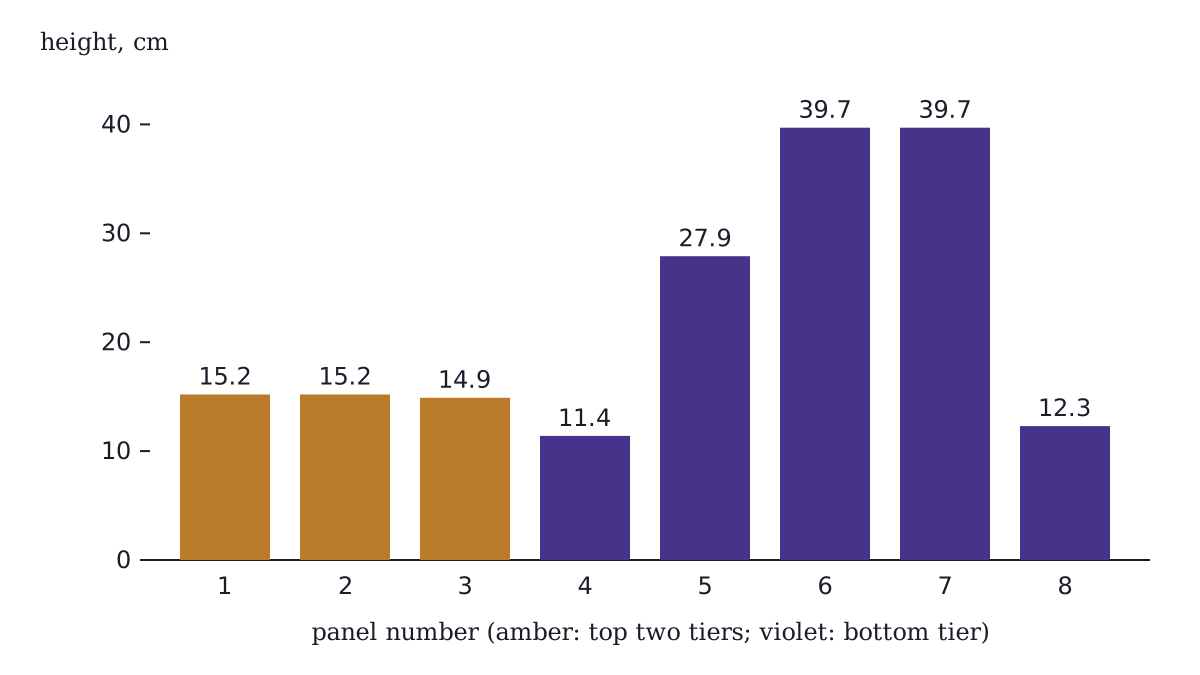
Panel heights on NGA 142153, measured from the ruled borders and scaled to the museum’s image size of 70.49 × 54.61 cm.
"Panel heights on NGA 142153, in centimeters" by Flickers & Tintypes, https://flickersandtintypes.com/comics-panels/little-nemo/ — CC BY 4.0, https://creativecommons.org/licenses/by/4.0/
Measured from their ruled borders, the panels fall into two very different kinds of tier. The top two tiers are each about 15 cm tall. The bottom tier is 39.7 cm tall, which is 56 percent of the drawing’s height, and it holds five of the eight panels.
| Panel | Width (cm) | Height (cm) | Balloons (this site’s count) |
|---|---|---|---|
| 1 | 27.3 | 15.2 | 2 |
| 2 | 27.0 | 15.2 | 4 |
| 3 | 54.7 | 14.9 | 6 |
| 4 | 9.7 | 11.4 | 2 |
| 5 | 9.7 | 27.9 | 2 |
| 6 | 15.3 | 39.7 | 2 |
| 7 (outer box) | 29.1 | 39.7 | 2 |
| 8 | 12.1 | 12.3 | 1 |
The sizes follow the action. The cannon scene is wide and short, and the shot travels sideways across it. Once the ball is in the air, the panels turn taller than they are wide, and in panels 5 to 7 the balloon hangs near the top with its ropes trailing down.
Panel 7 is the widest panel in the bottom tier and, with panel 6, the tallest, and its basket comes down over the roofs and domes of a city. That is this page’s reading of the shapes, not a statement McCay left behind.
The museum’s own figures give a check. It lists the image as 70.49 × 54.61 cm, a height-to-width ratio of 1.291, and the ruled border on the scan gives 1.288. The scan and the museum’s figures agree to within a fraction of a percent.
Each edge is located to within about 15 pixels, roughly 0.3 cm. The table still lists sizes to a tenth of a centimeter, a finer step than that margin, so read each size as give or take a few tenths. One average scale serves both directions, so panel 3 comes out at 54.7 cm against the museum’s 54.61 cm, inside that margin.
The shapes matter for the reading path, too. Panel 5 is 27.9 cm tall but only 9.7 cm wide, more a column than a box, and its long side runs downward, the same direction the numbers point.
Reading inside a panel: who speaks first?
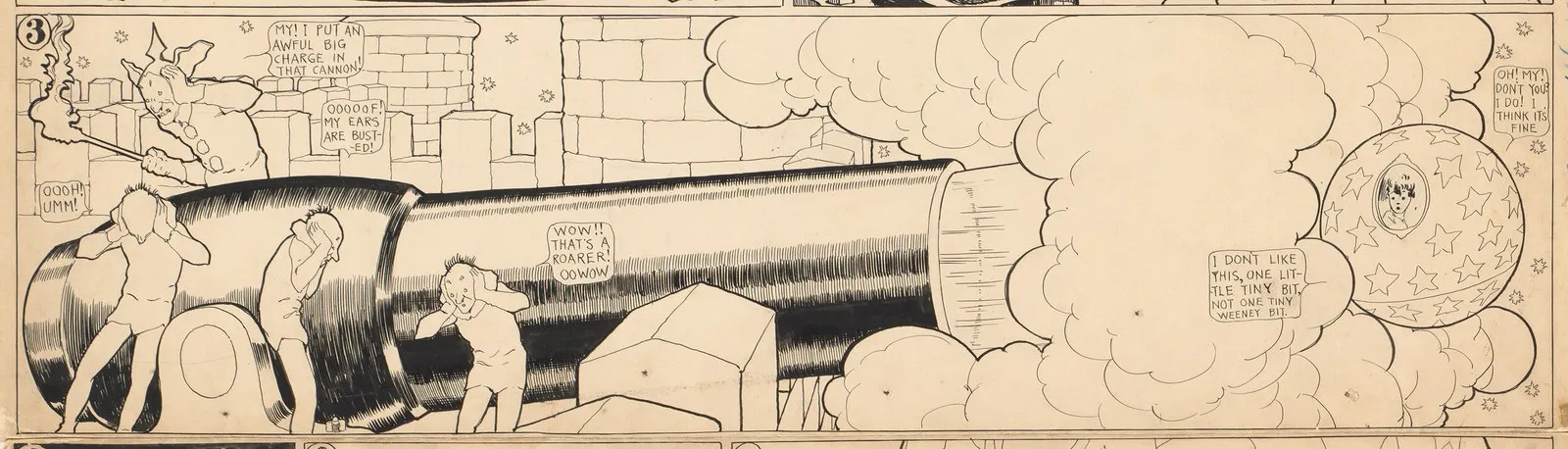
Panel 3 of NGA 142153: six balloons by this site’s count, across one full-width panel, with Nemo’s complaint just left of the ball.
"Little Nemo in Slumberland: "I don't like this, one little tiny bit, not one tiny weenie bit", 1906 (National Gallery of Art 142153), panel 3" by Winsor McCay — https://commons.wikimedia.org/wiki/File:Winsor_McCay,_Little_Nemo_in_Slumberland_-_%22I_don%27t_like_this,_one_little_tiny_bit,_not_one_tiny_weenie_bit%22,_1906,_NGA_142153.jpg — CC0 1.0 (https://creativecommons.org/publicdomain/zero/1.0/); modified: cropped to panel 3 and scaled from 3032 to 1600 px wide
The numbers fix the order of the panels, but not the order of the balloons inside each panel. By this site’s count, the board has 21 balloons across its 8 panels, and panel 3 alone has 6. The speakers there are the cannon crew holding their ears, the figure who fired the gun, and Nemo, whose face looks out of the porthole in the ball.
Some of that order is fixed by the words themselves. Near the right end of panel 3, Nemo says, “I DONT LIKE THIS, ONE LITTLE TINY BIT, NOT ONE TINY WEENEY BIT.” Farther right, someone answers him, “OH! MY! DON’T YOU? I DO! I THINK ITS FINE.” The reply only makes sense after the complaint, so left to right is the reading here. For the balloon as a device, and how a tail picks out a speaker, see Speech Bubbles.
Panel 6 is less settled. On the left, Nemo says, “YOU MIGHT CALL THIS EASY. I DON’T. NO MAM I DON’T!” On the right, the girl beside him asks, “DON’T YOU LIKE A LITTLE EXCITEMENT ONCE IN A WHILE NEMO? EH? YES, YOU DO!”
Read the left balloon first and she is teasing his complaint. Read the right balloon first and his “no mam” answers her question. Both orders make sense, so the CSV records both rather than picking one.
What do the marks on the board date?
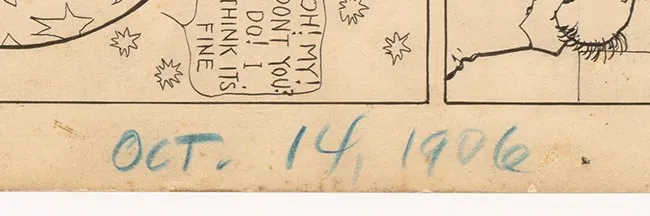
Right margin beside panel 3 of NGA 142153, turned to read left to right: “Oct. 14, 1906” in blue.
"Little Nemo in Slumberland: "I don't like this, one little tiny bit, not one tiny weenie bit", 1906 (National Gallery of Art 142153), right margin with the handwritten date" by Winsor McCay — https://commons.wikimedia.org/wiki/File:Winsor_McCay,_Little_Nemo_in_Slumberland_-_%22I_don%27t_like_this,_one_little_tiny_bit,_not_one_tiny_weenie_bit%22,_1906,_NGA_142153.jpg — CC0 1.0 (https://creativecommons.org/publicdomain/zero/1.0/); modified: cropped to the right margin beside panel 3 and turned 90 degrees to read left to right
The handwritten date in the right margin, “Oct. 14, 1906,” fell on a Sunday. Inside the empty sky of panel 7, a pencil note repeats the day as “Oct 14,” with two words above it that seem to read “Comic Sec.” A third note at the top edge reads “15 1/8,” and since the board does not say what that number was for, this page does not guess.
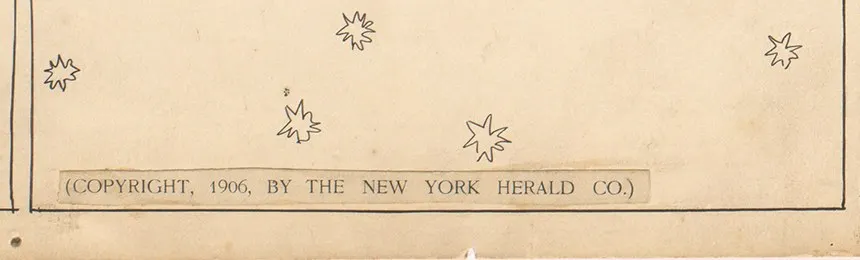
Foot of panel 6 on NGA 142153: the printed copyright line is a separate slip pasted onto the board.
"Little Nemo in Slumberland: "I don't like this, one little tiny bit, not one tiny weenie bit", 1906 (National Gallery of Art 142153), copyright slip at the foot of panel 6" by Winsor McCay — https://commons.wikimedia.org/wiki/File:Winsor_McCay,_Little_Nemo_in_Slumberland_-_%22I_don%27t_like_this,_one_little_tiny_bit,_not_one_tiny_weenie_bit%22,_1906,_NGA_142153.jpg — CC0 1.0 (https://creativecommons.org/publicdomain/zero/1.0/); modified: cropped to the foot of panel 6
The copyright line is printed type, not hand lettering. It sits on a small pasted slip at the foot of panel 6 and reads “(COPYRIGHT, 1906, BY THE NEW YORK HERALD CO.)”
Each mark dates something different. The slip names a year and the company that claimed the page, while the handwriting names a single day. Neither one shows the page in print, because the 1906 newspaper itself was not read for this page.
The museum’s catalog data add one more physical fact: the drawing is on two joined sheets of paperboard. The join runs across the board just under panel 3, so the top two tiers and the bottom tier sit on separate sheets.
The artist’s name is on the board, and it also turns up in the trade press. A notice in Moving Picture World in 1914 called him “Winsor McCay, creator of ‘Little Nemo,’” and said he had “set a new pace with his hand-drawn film” of a dinosaur he called “Gertie.” That film has its own page: Gertie the Dinosaur. A numbered list also sits behind A Trip to the Moon: its 1903 catalog sets out the scenes one by one.
A grid page for comparison
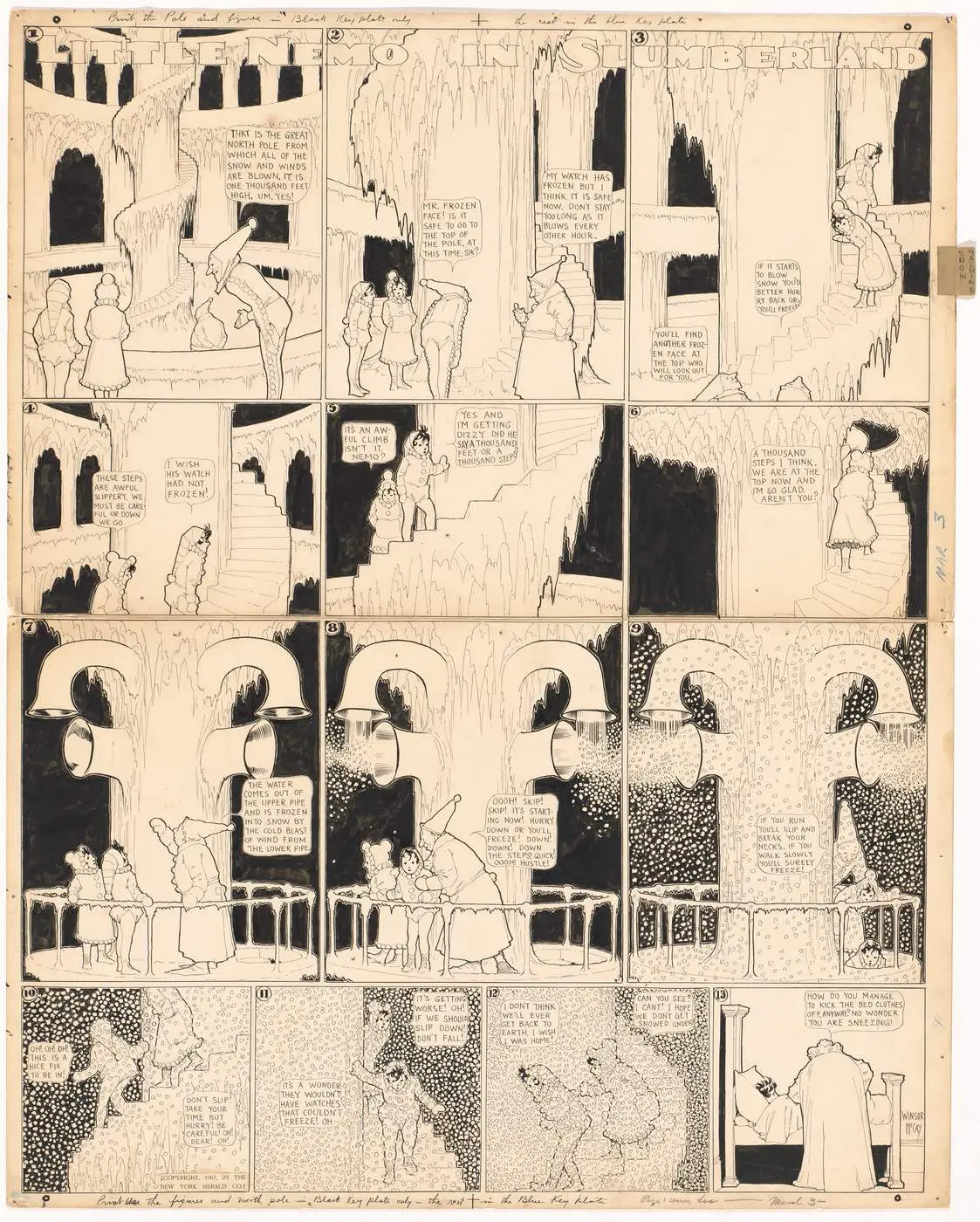
NGA 142154, Climbing the Great North Pole, 1907: 13 circled numbers in rows of 3, 3, 3 and 4, with pencil notes in the top and bottom margins.
"Little Nemo in Slumberland: Climbing the Great North Pole, 1907 (National Gallery of Art 142154)" by Winsor McCay — https://commons.wikimedia.org/wiki/File:Winsor_McCay,_Little_Nemo_in_Slumberland_-_Climbing_the_Great_North_Pole,_1907,_NGA_142154.jpg — CC0 1.0 (https://creativecommons.org/publicdomain/zero/1.0/); modified: scaled from 3208 x 4000 to 1123 x 1400 px
A second board at the National Gallery, object 142154, shows what happens when there are no stacked panels. Its 13 panels sit in four rows of three, three, three and four. The circled numbers run straight along each row, so the numbers and the Z-path give exactly the same order.
Cohn’s study included the plainest version of that layout, a grid of 2 by 3 panels. On the grid, his readers “did choose the Z-path almost all the time,” with a mean score of 0.941. A grid gives a reader little to choose between. The 1906 board offers one real choice, and that one place is where its numbers do their work.
The 1907 board also carries working notes in pencil. Along the top, one appears to read “Print the Pole and figures in Black Key plate only,” with “the rest in the blue Key plate” farther right. Along the bottom, a note seems to read “Page 1 comic sec,” beside “March 3,” and March 3, 1907, was also a Sunday.
Like the 1906 board, this one ends in a bed. The same artist made Dream of the Rarebit Fiend, which Moving Picture World listed, as “Dreams of a Rarebit Fiend,” right after Little Nemo in that 1914 notice.
Prints consulted
- 1Winsor McCay, Little Nemo in Slumberland: "I don't like this, one little tiny bit, not one tiny weenie bit", 1906, pen and ink on paperboard, National Gallery of Art, Washington, accession 2009.28.1 (object 142153); museum data as given on the Wikimedia Commons file page. https://commons.wikimedia.org/wiki/File:Winsor_McCay,_Little_Nemo_in_Slumberland_-_%22I_don%27t_like_this,_one_little_tiny_bit,_not_one_tiny_weenie_bit%22,_1906,_NGA_142153.jpgRead: file page and full-size original image
- 2Neil Cohn, “Navigating Comics: An Empirical and Theoretical Approach to Strategies of Reading Comic Page Layouts,” Frontiers in Psychology 4 (2013): 186, doi:10.3389/fpsyg.2013.00186. https://doi.org/10.3389/fpsyg.2013.00186Read: full text (introduction, method, results for the grid and blockage layouts)
- 3Winsor McCay, Little Nemo in Slumberland: Climbing the Great North Pole, 1907, pen and ink on paperboard, National Gallery of Art, Washington, accession 2009.28.2 (object 142154); museum data as given on the Wikimedia Commons file page. https://commons.wikimedia.org/wiki/File:Winsor_McCay,_Little_Nemo_in_Slumberland_-_Climbing_the_Great_North_Pole,_1907,_NGA_142154.jpgRead: file page and full-size original image
- 4“Box Office Has a Winsor M’Cay Novelty,” The Moving Picture World 22, no. 7 (November 14, 1914): 914. https://archive.org/details/movingpicturewor22newyRead: page 914, with the cover and the date line on page 901 of the same issue, checked against the page images


Next reel:
- Speech Bubbles: the balloon itself, how its tail picks a speaker, and how far back the device goes.
- Dream of the Rarebit Fiend: another McCay newspaper strip, named beside Little Nemo in the same 1914 trade notice.
- Public-domain original to view: Little Nemo in Slumberland board, NGA 142153 (Wikimedia Commons)
Cite this page
Flickers & Tintypes. “Little Nemo: A 1906 Board Numbered Out of Row Order.” Flickers & Tintypes. Published November 12, 2026. https://flickersandtintypes.com/comics-panels/little-nemo/. Accessed [the date you read it].
Same sectionAlso in Comics Panels
Comics Panels
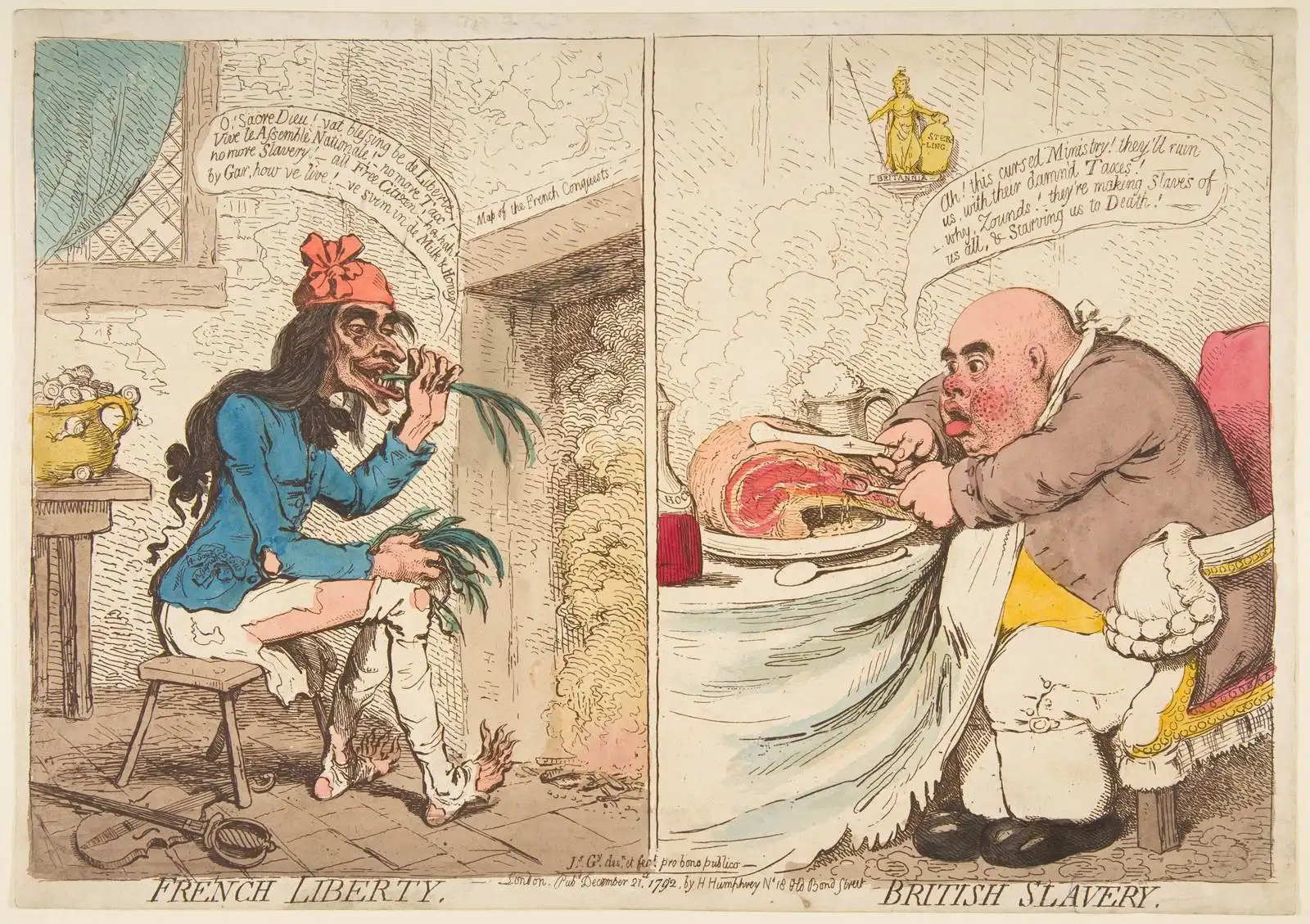
Speech Bubbles: Gillray Was Drawing Them in 1792
A speech bubble holds spoken words in an outline that points to the speaker. A Gillray print of 21 December 1792 has two by this site’s count, one per panel.
Picture credit
"French Liberty – British Slavery, hand-colored etching, published 21 December 1792 (Metropolitan Museum of Art 1976.602.27)" by James Gillray — https://commons.wikimedia.org/wiki/File:French_Liberty_%E2%80%93_British_Slavery_MET_DP818494.jpg — CC0 1.0 (https://creativecommons.org/publicdomain/zero/1.0/); modified: scaled from 3645 to 1600 px wide; nothing else changed
Comics Panels
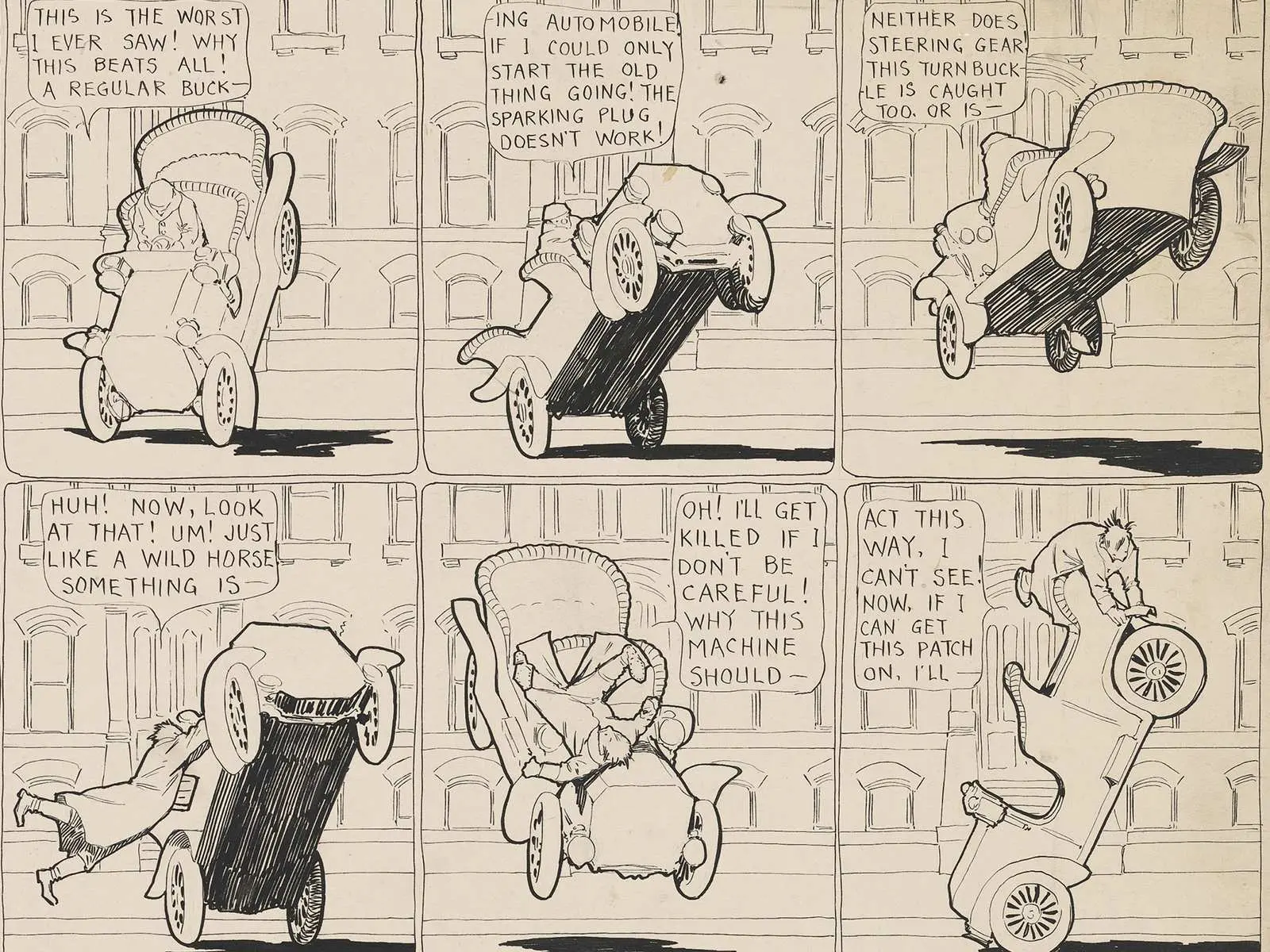
Dream of the Rarebit Fiend: 18 Panels of One Bucking Car
A 1907 Dream of the Rarebit Fiend board, read panel by panel: signed Silas, a McCay pseudonym per a Library of Congress note, with a street that barely shifts.
Picture credit
"Dream of the Rarebit Fiend: Bucking Automobile, 1907 (National Gallery of Art 142155), panels 4 to 6 and 10 to 12" by Winsor McCay — https://commons.wikimedia.org/wiki/File:Winsor_McCay,_Dream_of_the_Rarebit_Fiend_-_Bucking_Automobile,_1907,_NGA_142155.jpg — CC0 1.0 (https://creativecommons.org/publicdomain/zero/1.0/); modified: cropped to panels 4 to 6 and 10 to 12, 4:3, trimming the foot of panels 10 to 12, and scaled from 1916 to 1600 px wide