Speech Bubbles: Gillray Was Drawing Them in 1792
Frame card
In one line A speech bubble, or balloon, is an outline that holds a character’s spoken words and points to the speaker. James Gillray’s print French Liberty – British Slavery, published 21 December 1792, already has two by this site’s count, one in each panel.
Source, Year, Format, Length or Size, Access, License
- Source
- Met 1976.602.27, French Liberty – British Slavery; Metropolitan Museum of Art upload on Wikimedia Commons (DP818494)
- Year
- Published 21 December 1792 by H. Humphrey, No. 18 Old Bond Street, London, per the imprint on the print
- Format
- Hand-colored etching in two panels, one speech balloon in each by this site’s count
- Length or Size
- Sheet 24.9 x 35.2 cm per the museum data; scan 3645 x 2573 px
- Access
- Wikimedia Commons file page, Metropolitan Museum of Art upload
- License
- CC0 1.0 (Metropolitan Museum of Art Open Access upload)
Card data (CSV) speech-bubbles-frame-card.csv Source and license notes
Entry fields
- Name
- Speech bubble (speech balloon; “balloons” in Lutz 1920)
- Date range and evidence
- Seen on this page in a print published in 1792, on comic boards of 1906 and 1907, and in a 1920 animation handbook; earlier uses not checked here
- Size or running time
- On screen, held as long as it takes someone to read it, per Lutz 1920
- Process or material
- Etched with the picture in the 1792 print; inked on the 1906 and 1907 boards; in 1920 animation, lettered on a separate piece of paper laid over the drawing, per Lutz
- How to recognize it
- An outline around spoken words, with a tail or point that leads toward the speaker’s head
- Often confused with
- A title or caption: words outside the scene with no tail to a speaker
- Where to see one
- Met 1976.602.27 (1792); NGA 142153 (1906); NGA 142155 (1907)
Card data (CSV) speech-bubbles-entry.csv Source and license notes
Shot list · 6 sections
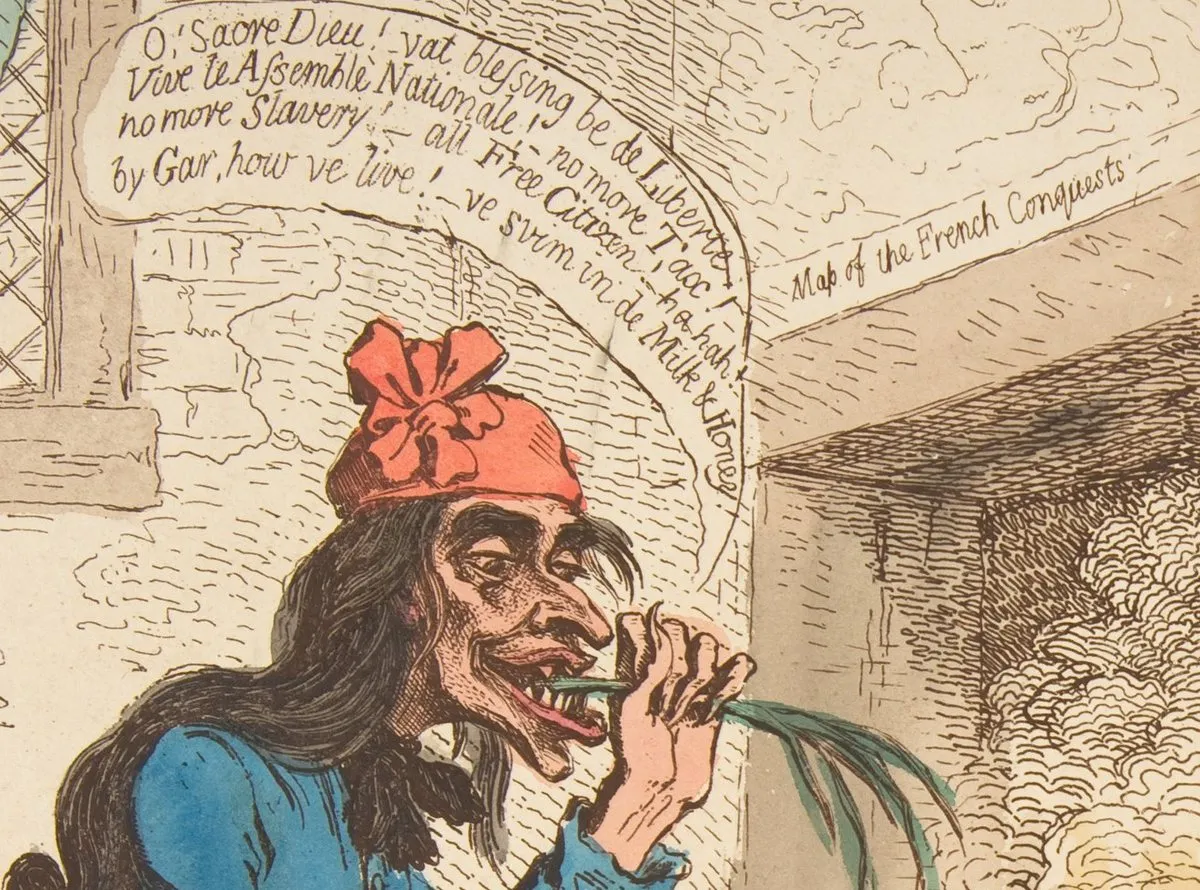
Left panel, top left of Met 1976.602.27: the balloon opens with “O! Sacre Dieu!” and its tail runs down the wall toward the speaker.
"French Liberty – British Slavery, hand-colored etching, published 21 December 1792 (Metropolitan Museum of Art 1976.602.27), left panel balloon" by James Gillray — https://commons.wikimedia.org/wiki/File:French_Liberty_%E2%80%93_British_Slavery_MET_DP818494.jpg — CC0 1.0 (https://creativecommons.org/publicdomain/zero/1.0/); modified: cropped to the left panel’s balloon and the speaker’s head, scaled from 1322 to 1200 px wide
The left-hand balloon opens with “O! Sacre Dieu!”, etched in a looping hand above a man in a red cap. The French means “Oh! Holy God!” in this site’s translation. That is a speech bubble at work: an outline that holds a character’s spoken words and points to whoever says them. This one belongs to French Liberty – British Slavery, a hand-colored etching by James Gillray, and the imprint along its bottom edge dates it to December 21st, 1792.
By this site’s count, the print has two panels and two balloons, one for each speaker. So a working speech bubble appears in a print published in London about 114 years before the 1906 board behind this site’s Little Nemo page. The print does not show who started the idea, and this page does not try to name anyone.
Two balloons in one 1792 print
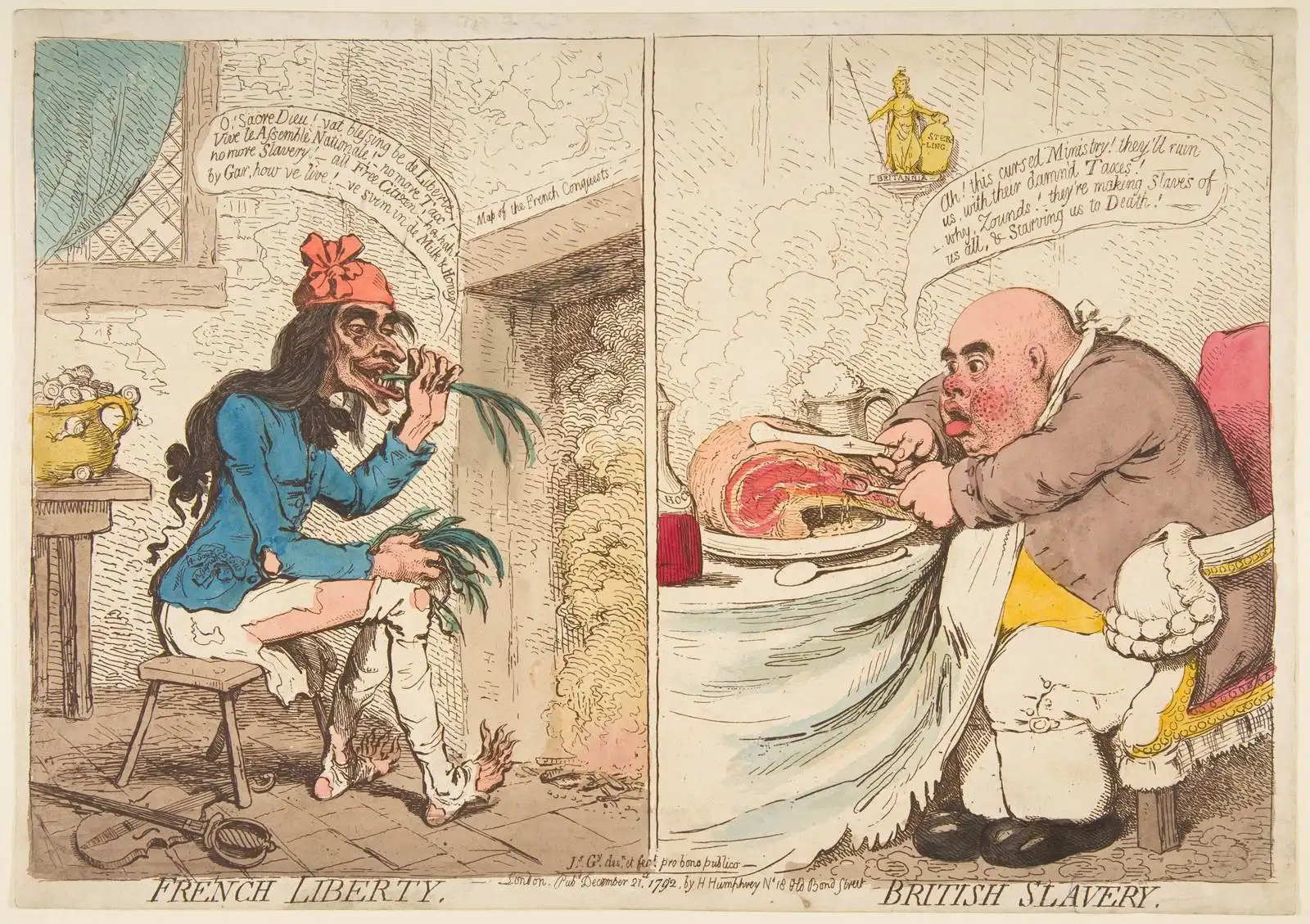
Met 1976.602.27, French Liberty – British Slavery, published 21 December 1792: a London political satire that mocks both sides, a ragged French citizen and a well-fed Englishman; two panels, one balloon in each by this site’s count.
"French Liberty – British Slavery, hand-colored etching, published 21 December 1792 (Metropolitan Museum of Art 1976.602.27)" by James Gillray — https://commons.wikimedia.org/wiki/File:French_Liberty_%E2%80%93_British_Slavery_MET_DP818494.jpg — CC0 1.0 (https://creativecommons.org/publicdomain/zero/1.0/); modified: scaled from 3645 to 1600 px wide; nothing else changed
Gillray split the sheet down the middle. On the left, above the title FRENCH LIBERTY, a thin man in a red cap chews green stalks on a stool beside a smoky fireplace. On the right, above BRITISH SLAVERY, a heavy man in an armchair carves a huge joint of meat.
A line between the two titles reads “London. Pub.d December 21st 1792, by H Humphrey No 18 Old Bond Street.” Hannah Humphrey was the printseller who published it, and the Commons record lists her beside Gillray. Just above that line, small letters read “Js Gy. desn et fect.,” Gillray’s initials and a Latin abbreviation that this site translates as designed and made.
The Metropolitan Museum of Art holds the sheet as 1976.602.27 and has released the image under CC0. The museum data gives the sheet as 24.9 by 35.2 centimeters, so its long side is about a quarter longer than that of a sheet of letter paper.
How Gillray’s balloons point to the speaker
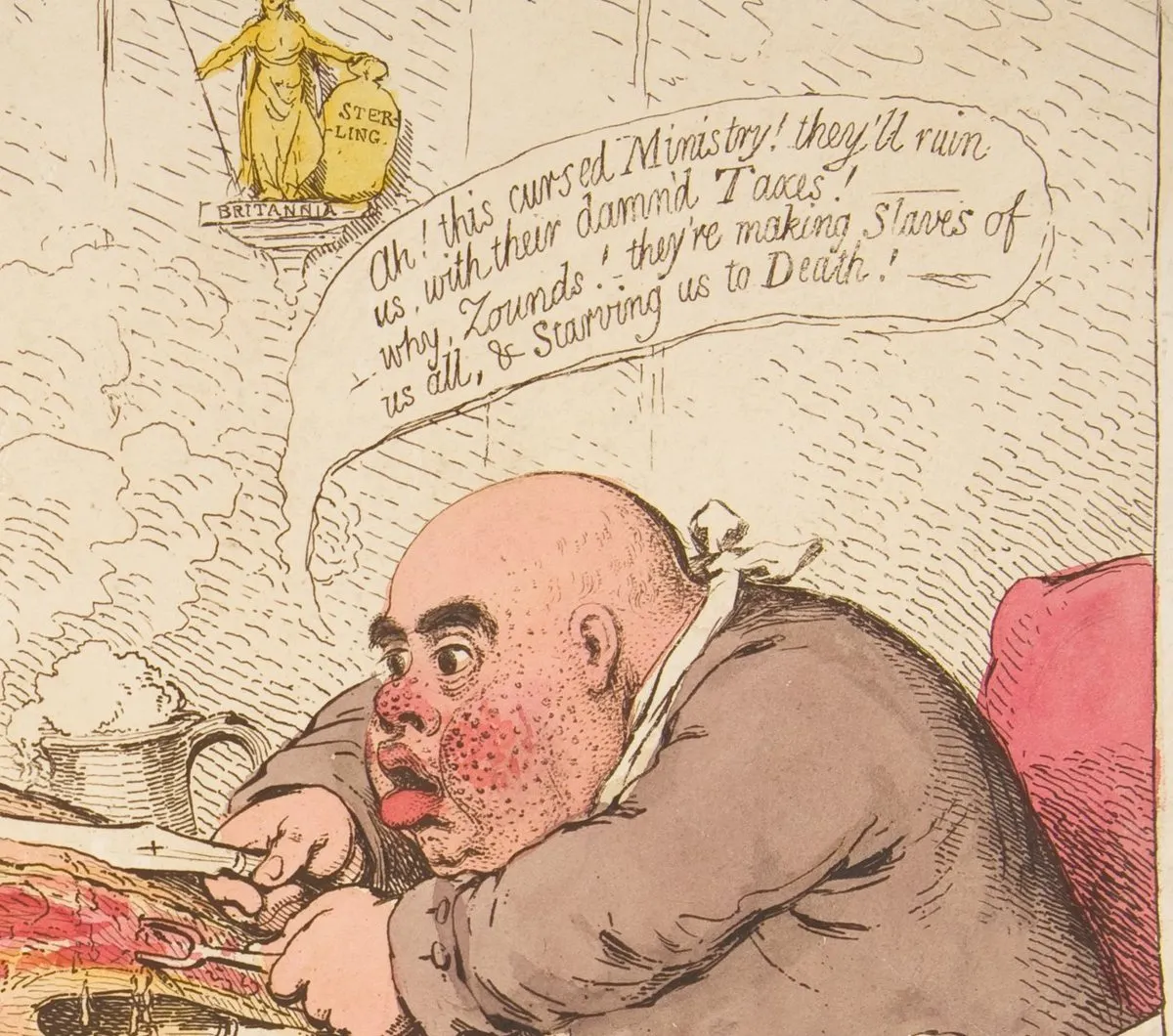
Right panel of Met 1976.602.27: the balloon’s tail curves down and ends at the speaker’s forehead.
"French Liberty – British Slavery, hand-colored etching, published 21 December 1792 (Metropolitan Museum of Art 1976.602.27), right panel balloon" by James Gillray — https://commons.wikimedia.org/wiki/File:French_Liberty_%E2%80%93_British_Slavery_MET_DP818494.jpg — CC0 1.0 (https://creativecommons.org/publicdomain/zero/1.0/); modified: cropped to the right panel’s balloon and the speaker’s head, scaled from 1367 to 1200 px wide
Each balloon does two jobs at once. Its outline fences the words off from the rest of the picture, and its tail tells you who is talking. In the right panel the outline is a long rounded shape, and its lower edge narrows into a curving tail that ends at the bald man’s forehead, just above his eyebrow.
The words inside are a complaint about “this cursed Ministry” and its “damn’d Taxes.” The left balloon works the same way, but its tail runs down the wall, and the last line of lettering bends into it. Neither tail touches a mouth. Each one ends near the head.
The joke needs the balloons. Each speaker agrees with the title under him, and the picture says the opposite. The ragged man praises liberty and “no more Slavery,” while the well-fed man complains that the Ministry is “Starving us to Death.”
Parts of a speech bubble
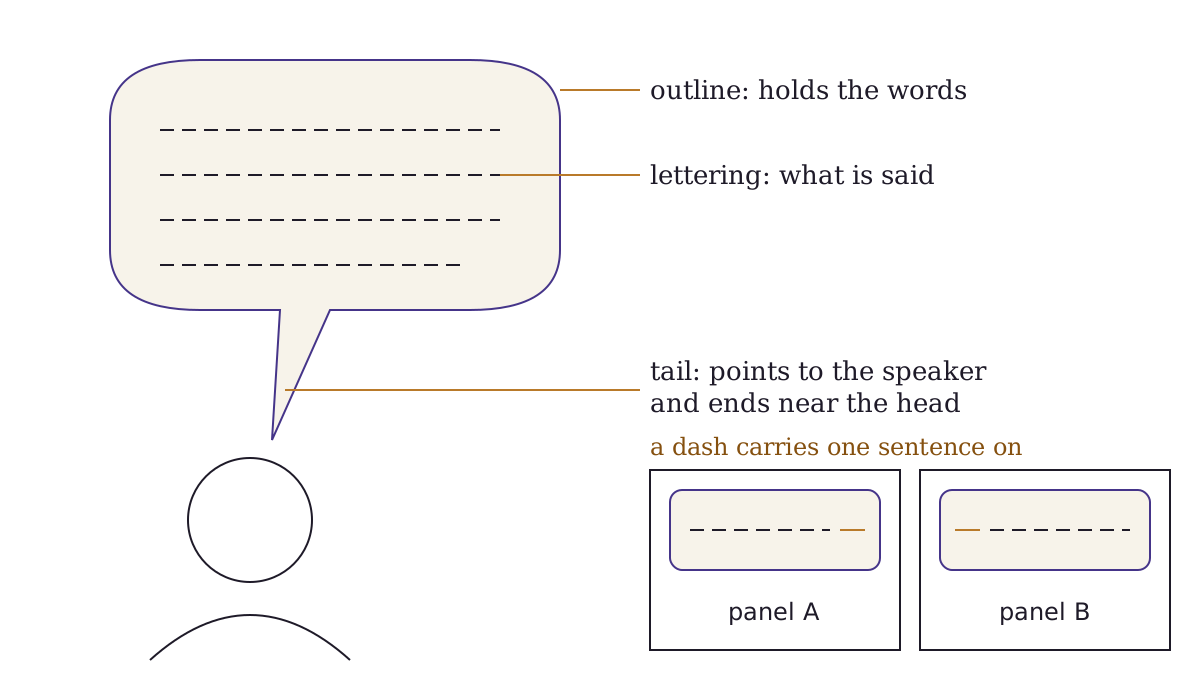
Schematic, not drawn from any one artwork: outline, lettering and tail, and a dash that carries a sentence into the next panel.
"Parts of a speech balloon" by Flickers & Tintypes, https://flickersandtintypes.com/comics-panels/speech-bubbles/ — CC BY 4.0, https://creativecommons.org/licenses/by/4.0/
The diagram names the parts that the works on this page share. The same parts in a table:
| Part | What it does | Where this page shows it |
|---|---|---|
| Outline | Fences the spoken words off from the picture | Both panels of the 1792 print |
| Lettering | The words themselves, written by hand | Etched in 1792; inked on the 1906 and 1907 boards |
| Tail or point | Leads toward the speaker’s head | Long curving tails in 1792; short points in 1906 and 1907 |
| Run-on dash | Carries one sentence into the next panel | Panels 4 and 5 of the 1907 Rarebit board |
The tail matters most when several people share a panel. Without it, you would have to guess the speaker from where the words happen to sit.
“Balloons, they are called”: a 1920 animation handbook
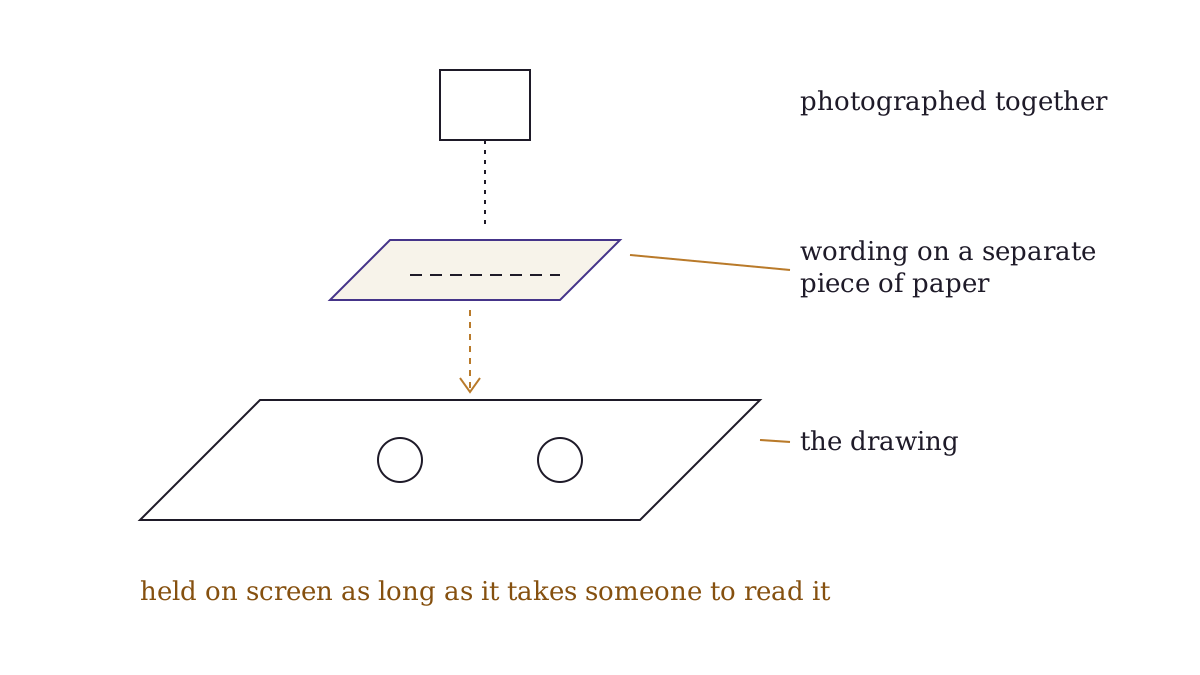
Schematic of the method Lutz describes in 1920: the wording on its own piece of paper, laid over the drawing and filmed with it.
"Wording on a separate piece of paper laid over the drawing, after Lutz 1920" by Flickers & Tintypes, https://flickersandtintypes.com/comics-panels/speech-bubbles/ — CC BY 4.0, https://creativecommons.org/licenses/by/4.0/
An animation handbook of 1920 still called the device a balloon. E. G. Lutz’s Animated Cartoons, published in New York that year, explains how dialogue got into a cartoon. On page 78 it is done “by putting the wording on a separate piece of paper—balloons, they are called—for each case and placing it over the design.”
On page 174 Lutz calls balloons “the mouthpieces” for the characters’ dialogue, with an outline that hovers over the speakers’ heads. Gillray’s two balloons sit the same way, above and beside the heads. In the pages read here, Lutz never uses the word bubble.
Film added a problem that paper never had: the viewer cannot set the pace. Lutz ties the length of film for a balloon to how long an average viewer needs to read it. On page 175 he says each studio had its own rule for how many frames to allow per word, and the only way to judge was to have someone read the sentence and time it.
He treats a sentence on a title the same way. A title is wording shown on screen with no tail to any speaker. The 1903 catalog behind A Trip to the Moon is a different kind of title list: thirty scene names printed for buyers, with no sign of whether they reached the screen as words.
Lutz also describes a change in his own field. Early on, he writes, a speaking figure with a balloon simply stood still; by 1920 a careful artist moved the lips and arms while the lettering appeared. For how the same handbook places drawings between two poses, see 12 Principles of Animation.
A century later, on McCay’s boards
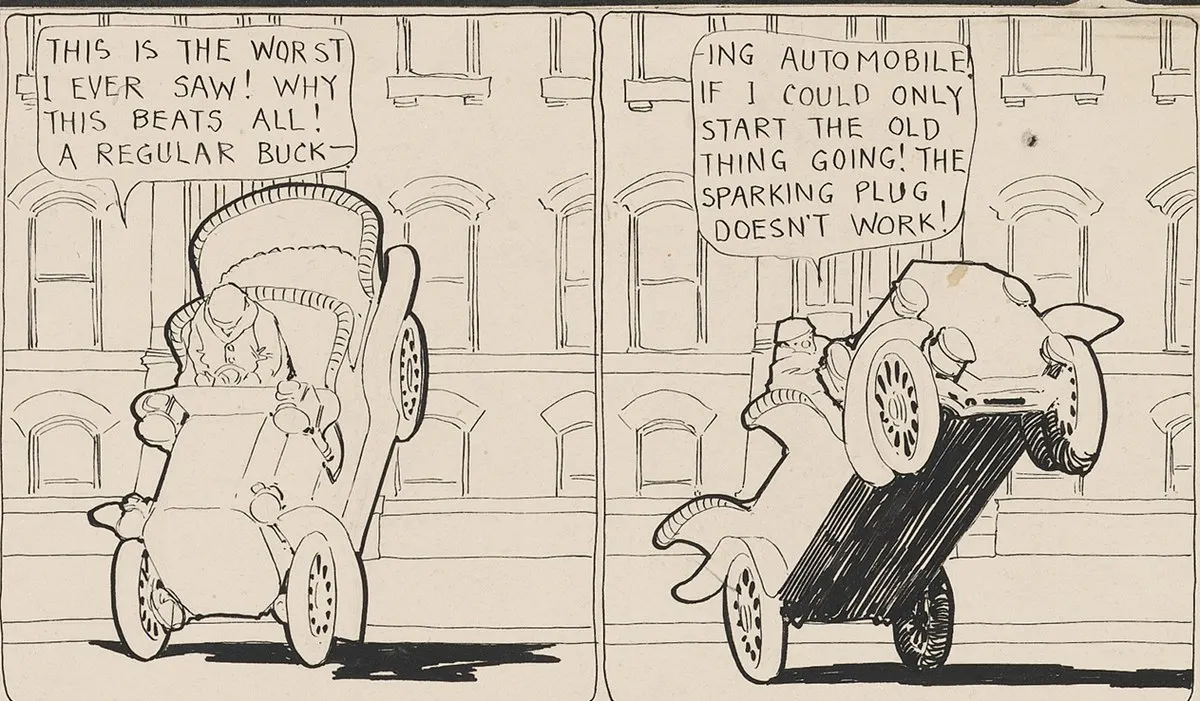
Panels 4 and 5 of NGA 142155, Dream of the Rarebit Fiend, 1907: “A REGULAR BUCK-” runs on as “-ING AUTOMOBILE!”
"Dream of the Rarebit Fiend: Bucking Automobile, 1907 (National Gallery of Art 142155), panels 4 and 5" by Winsor McCay (signed Silas) — https://commons.wikimedia.org/wiki/File:Winsor_McCay,_Dream_of_the_Rarebit_Fiend_-_Bucking_Automobile,_1907,_NGA_142155.jpg — CC0 1.0 (https://creativecommons.org/publicdomain/zero/1.0/); modified: cropped to panels 4 and 5 of the top row, scaled from 1263 to 1200 px wide
Two original comic drawings from 1906 and 1907, now in the National Gallery of Art, show balloons doing the same job on much larger boards. The 1907 board, Dream of the Rarebit Fiend: Bucking Automobile, has 18 panels and 18 balloons, one in each, by this site’s count. They are rounded boxes with a short point toward the driver, who talks to himself all the way through.
The board is signed Silas and carries the line “COPYRIGHT, 1907. BY THE NEW YORK EVENING TELEGRAM. (NEW YORK HERALD CO.).” The museum record on Commons gives the artist as Winsor McCay. The Dream of the Rarebit Fiend page reads this board on its own terms.
Panels 4 and 5, counted from the top left, show something Gillray’s two speakers never needed. The remark “A REGULAR BUCK-” breaks off at the end of panel 4 and finishes as “-ING AUTOMOBILE!” in panel 5, while the car rears up. The balloon carries one voice across the gutter, the strip of blank paper between panels.
Set beside the 1792 print, these balloons look tidier. Gillray’s outlines wander across the wall and taper into long tails, and his slanting script bends with them. On the 1906 and 1907 boards the lettering runs in straight lines of capitals inside rounded boxes, and the points are short.
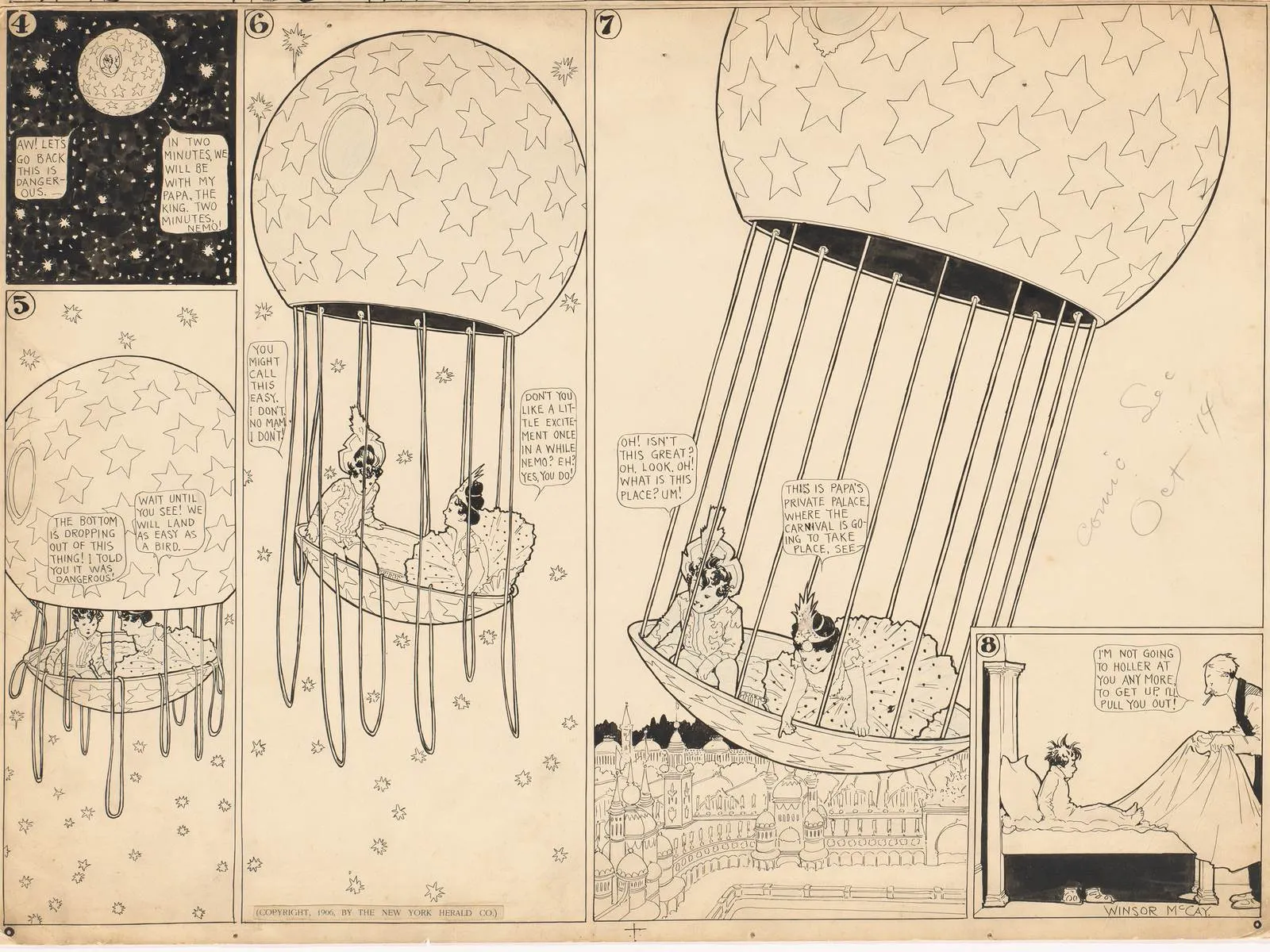
The 1906 Little Nemo board is busier. This site counts 21 balloons across its 8 panels, with 6 in panel 3 alone. Its circled panel numbers fix the order of the panels, but not the order of the balloons inside each one.
Speech bubbles from 1792 to 1920
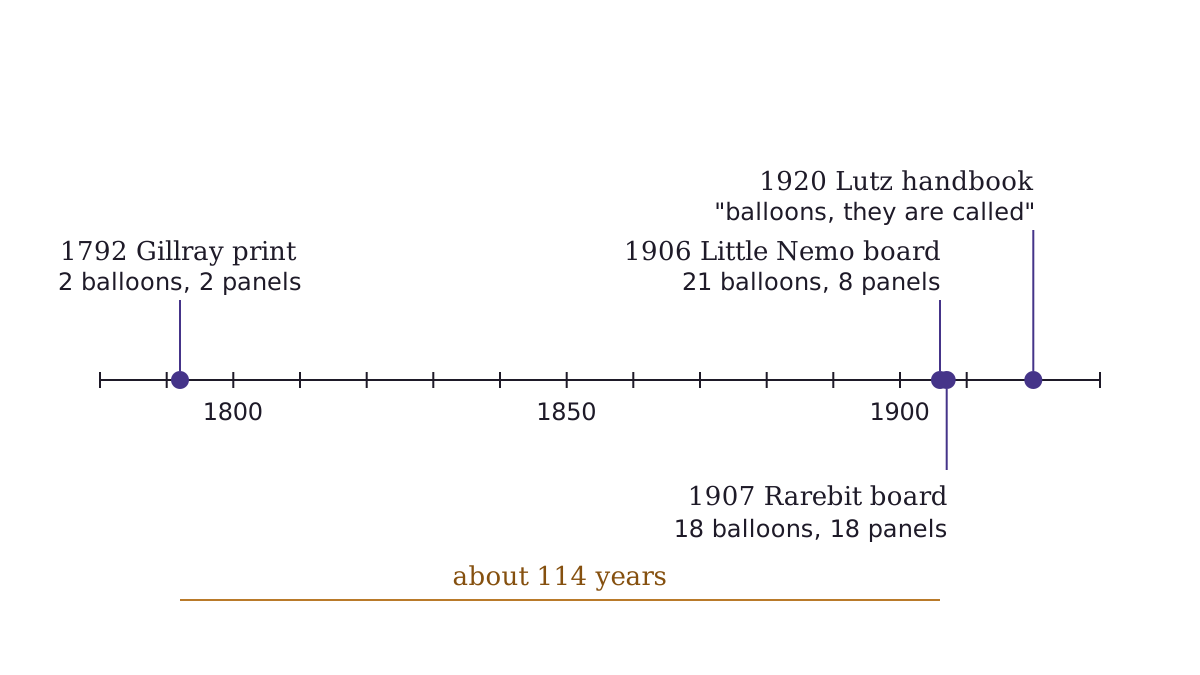
The four works counted on this page, by year: about 114 years separate the Gillray print from the Little Nemo board.
"Four works with speech balloons, 1792 to 1920" by Flickers & Tintypes, https://flickersandtintypes.com/comics-panels/speech-bubbles/ — CC BY 4.0, https://creativecommons.org/licenses/by/4.0/
On the timeline, the dates show a long gap rather than a starting line. Gillray’s print is about 114 years older than the Little Nemo board and about 128 years older than Lutz’s handbook. Only four works are counted here, so the chart says nothing about how common balloons were in between.
| Year | Work | Panels (this site’s count) | Balloons (this site’s count) |
|---|---|---|---|
| 1792 | French Liberty – British Slavery, James Gillray, Met 1976.602.27 | 2 | 2 |
| 1906 | Little Nemo in Slumberland board, Winsor McCay, NGA 142153 | 8 | 21 |
| 1907 | Dream of the Rarebit Fiend: Bucking Automobile, signed Silas, NGA 142155 | 18 | 18 |
| 1920 | Figure captioned BALLOONS. in Lutz, Animated Cartoons, page 78 | 2 drawings | 2 |
Download the balloon counts for these four works (CSV) source and license notes
Prints consulted
- 1James Gillray, French Liberty – British Slavery, hand-colored etching, published London, 21 December 1792, by H. Humphrey; Metropolitan Museum of Art, New York, accession 1976.602.27 (image DP818494); museum data as given on the Wikimedia Commons file page. https://commons.wikimedia.org/wiki/File:French_Liberty_%E2%80%93_British_Slavery_MET_DP818494.jpgRead: file page and full-size original image
- 2E. G. Lutz, Animated Cartoons: How They Are Made, Their Origin and Development. New York: Charles Scribner's Sons, 1920. https://archive.org/details/cu31924075701304Read: pages 15, 20–26, 44, 52, 58, 68–69, 76–78, 174–175, 179–181 and 256, checked against the page images
- 3Winsor McCay (signed Silas), Dream of the Rarebit Fiend: Bucking Automobile, 1907, pen and ink over graphite with printed overlay on paperboard, National Gallery of Art, Washington, accession 2008.128.1 (object 142155); museum data as given on the Wikimedia Commons file page. https://commons.wikimedia.org/wiki/File:Winsor_McCay,_Dream_of_the_Rarebit_Fiend_-_Bucking_Automobile,_1907,_NGA_142155.jpgRead: file page and full-size original image
- 4Winsor McCay, Little Nemo in Slumberland: "I don't like this, one little tiny bit, not one tiny weenie bit", 1906, pen and ink on paperboard, National Gallery of Art, Washington, accession 2009.28.1 (object 142153); museum data as given on the Wikimedia Commons file page. https://commons.wikimedia.org/wiki/File:Winsor_McCay,_Little_Nemo_in_Slumberland_-_%22I_don%27t_like_this,_one_little_tiny_bit,_not_one_tiny_weenie_bit%22,_1906,_NGA_142153.jpgRead: file page and full-size original image


Next reel:
- Little Nemo: 21 balloons by this site’s count on one 1906 board, and a suggested path for reading the panels in order.
- Dream of the Rarebit Fiend: the 1907 Bucking Automobile board, with its 18 balloons (this site’s count) in their panels.
- Public-domain original to view: French Liberty – British Slavery, Met 1976.602.27 (Wikimedia Commons)
Cite this page
Flickers & Tintypes. “Speech Bubbles: Gillray Was Drawing Them in 1792.” Flickers & Tintypes. Published November 12, 2026. https://flickersandtintypes.com/comics-panels/speech-bubbles/. Accessed [the date you read it].
Same sectionAlso in Comics Panels
Comics Panels
Little Nemo: A 1906 Board Numbered Out of Row Order
How to read a Little Nemo in Slumberland page: McCay’s board dated Oct. 14, 1906 numbers its 8 panels. After panel 4 they send you down to 5, not across to 6.
Picture credit
"Little Nemo in Slumberland: "I don't like this, one little tiny bit, not one tiny weenie bit", 1906 (National Gallery of Art 142153), panels 4 to 8" by Winsor McCay — https://commons.wikimedia.org/wiki/File:Winsor_McCay,_Little_Nemo_in_Slumberland_-_%22I_don%27t_like_this,_one_little_tiny_bit,_not_one_tiny_weenie_bit%22,_1906,_NGA_142153.jpg — CC0 1.0 (https://creativecommons.org/publicdomain/zero/1.0/); modified: cropped to panels 4 to 8 (the bottom tier), 4:3, and scaled from 3000 to 1600 px wide
Comics Panels
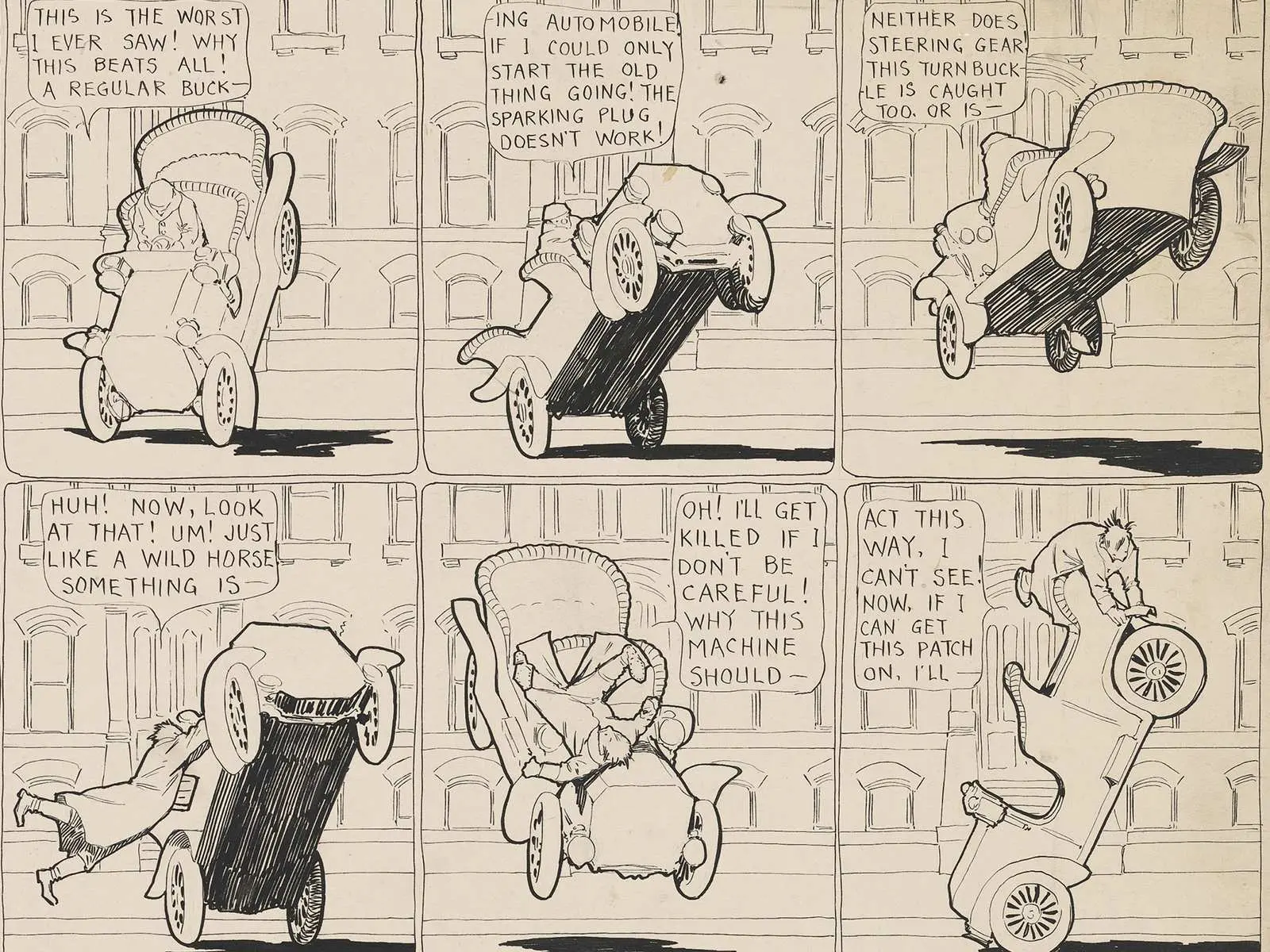
Dream of the Rarebit Fiend: 18 Panels of One Bucking Car
A 1907 Dream of the Rarebit Fiend board, read panel by panel: signed Silas, a McCay pseudonym per a Library of Congress note, with a street that barely shifts.
Picture credit
"Dream of the Rarebit Fiend: Bucking Automobile, 1907 (National Gallery of Art 142155), panels 4 to 6 and 10 to 12" by Winsor McCay — https://commons.wikimedia.org/wiki/File:Winsor_McCay,_Dream_of_the_Rarebit_Fiend_-_Bucking_Automobile,_1907,_NGA_142155.jpg — CC0 1.0 (https://creativecommons.org/publicdomain/zero/1.0/); modified: cropped to panels 4 to 6 and 10 to 12, 4:3, trimming the foot of panels 10 to 12, and scaled from 1916 to 1600 px wide