Section · 5 entries
Animation Loops
Animation principles shown as short seamless loops with their frame counts and spacing published, next to the optical toys and sequence photographs that were loops from the start.
Animation Loops
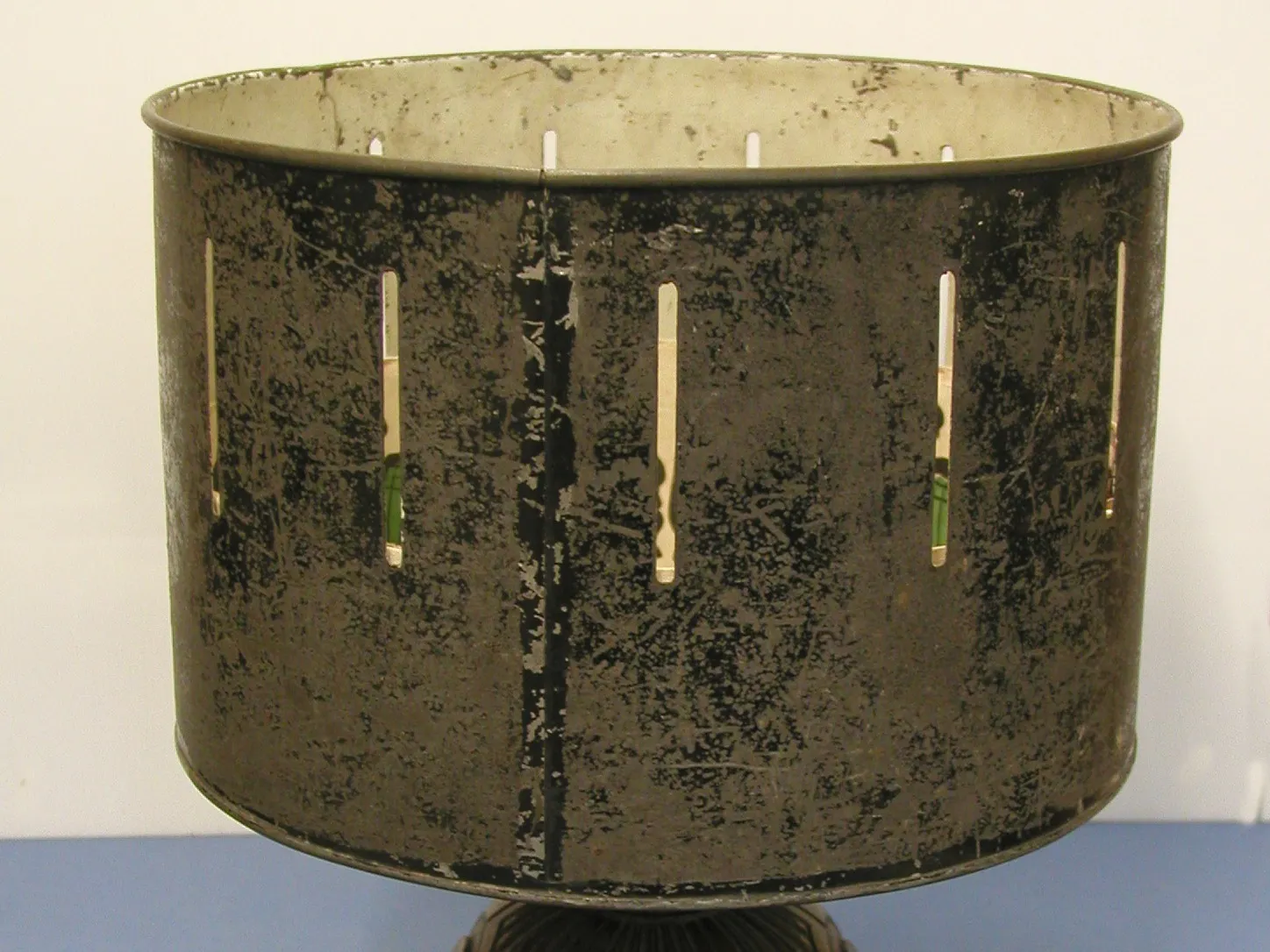
Zoetrope: An 1834 Paper Said a Whole Room Could Watch It
How a zoetrope works: slits times turns per second gives images per second. Horner named the open drum the Dædaleum in 1834; later patents are dated per Lutz.
Picture credit
"Zoetrope (wheel of life) optical toy, Auckland Museum 2001.6.1, photo AM_2001.6.1-1" by Auckland Museum — https://commons.wikimedia.org/wiki/File:Zoetrope_(AM_2001.6.1-1).jpg — CC BY 4.0 (https://creativecommons.org/licenses/by/4.0/); modified: cropped to the drum and the top of its stand, removing the measuring scale and the museum's copyright line
Animation Loops
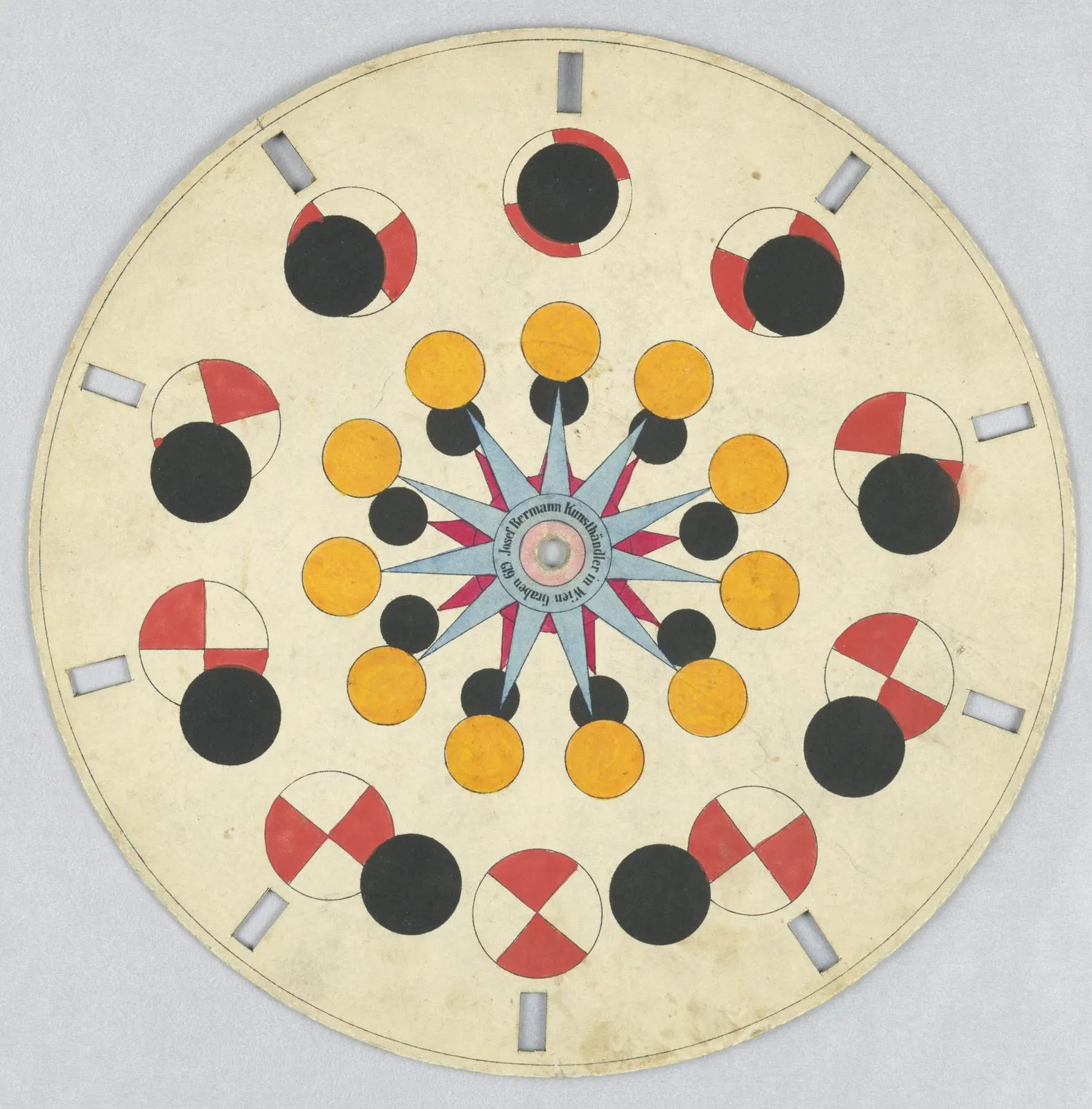
Phenakistiscope: A Spinning Disk You Watched in a Mirror
A phenakistiscope is a slotted disk spun before a mirror and watched through its slits. Count the slits and figures on a Vienna disk from about 1840.
Picture credit
"Optical Toy, Phenakistiscope Disc with Geometric Shapes, ca. 1840 (Cooper Hewitt 1948-124-4)" by Unknown author — https://commons.wikimedia.org/wiki/File:Optical_Toy,_Phenakistiscope_Disc_with_Geometric_Shapes,_ca._1840_(CH_18607983).jpg — Public domain: Public domain in the US (published about 1840) and in the EU (anonymous work published in Vienna about 1840; the 70-year term from publication expired long ago); faithful reproduction of a two-dimensional work (Commons PD-Art); modified: scaled from 3390 x 3444 to 1575 x 1600 px; whole disk, not cropped
Animation Loops
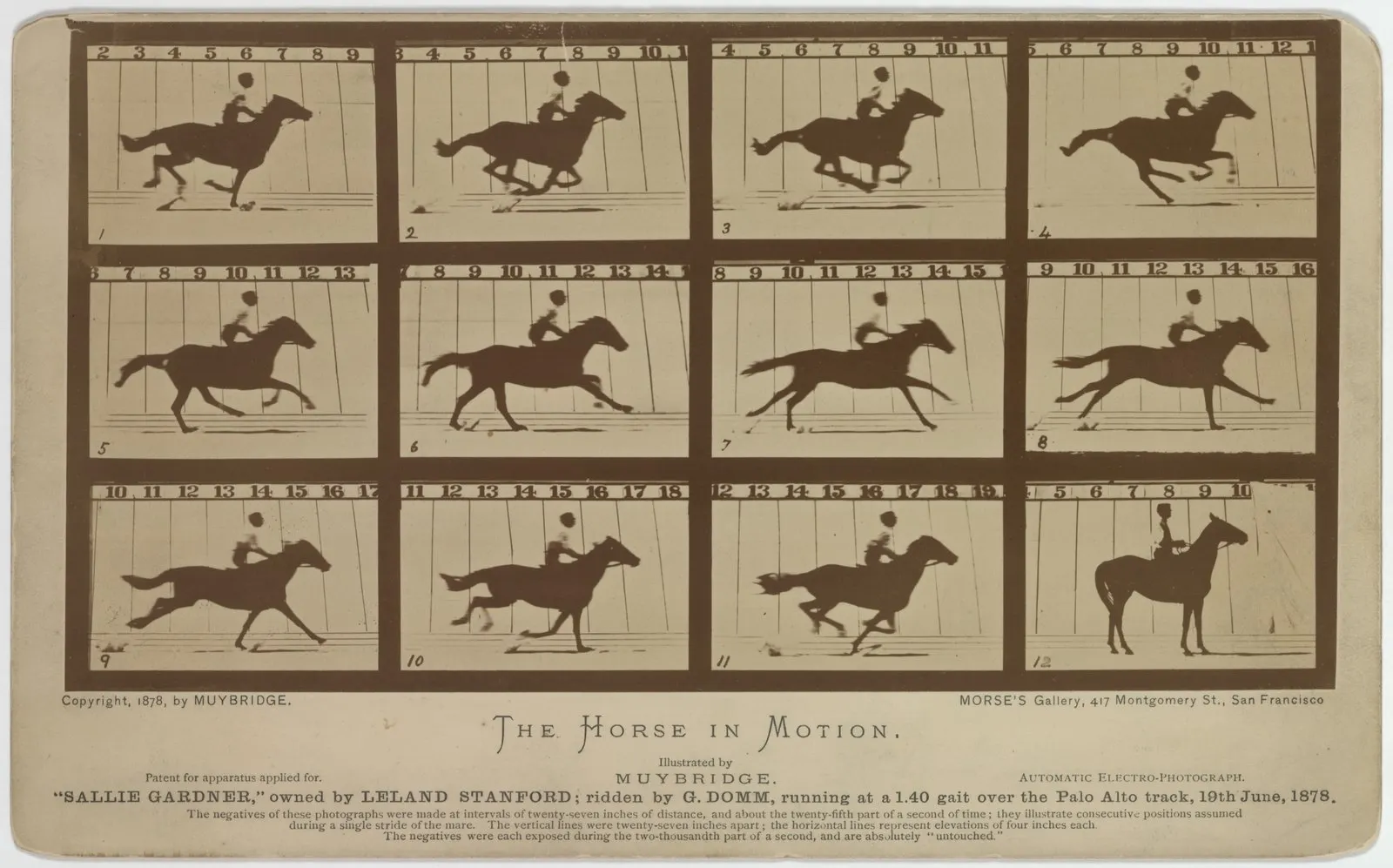
The Horse in Motion: Two Frames With No Hoof on the Track
Muybridge’s 1878 Sallie Gardner card, frame by frame: in frames 2 and 3 no hoof touches the track, and the legs are gathered under the body, not stretched out.
Picture credit
"The Horse in Motion: “Sallie Gardner,” owned by Leland Stanford, card of 12 photographs (1878)" by Eadweard Muybridge — https://commons.wikimedia.org/wiki/File:Eadweard_Muybridge-Sallie_Gardner_1878.jpg — Public domain: Public domain in the US (published 1878; card marked Copyright, 1878, by Muybridge) and in the EU (Eadweard Muybridge died 1904); copy: Library of Congress 97502309, record not consulted directly; scan as uploaded to Wikimedia Commons; modified: scaled from 4352 to 1600 px wide
 Illustration
Animation Loops
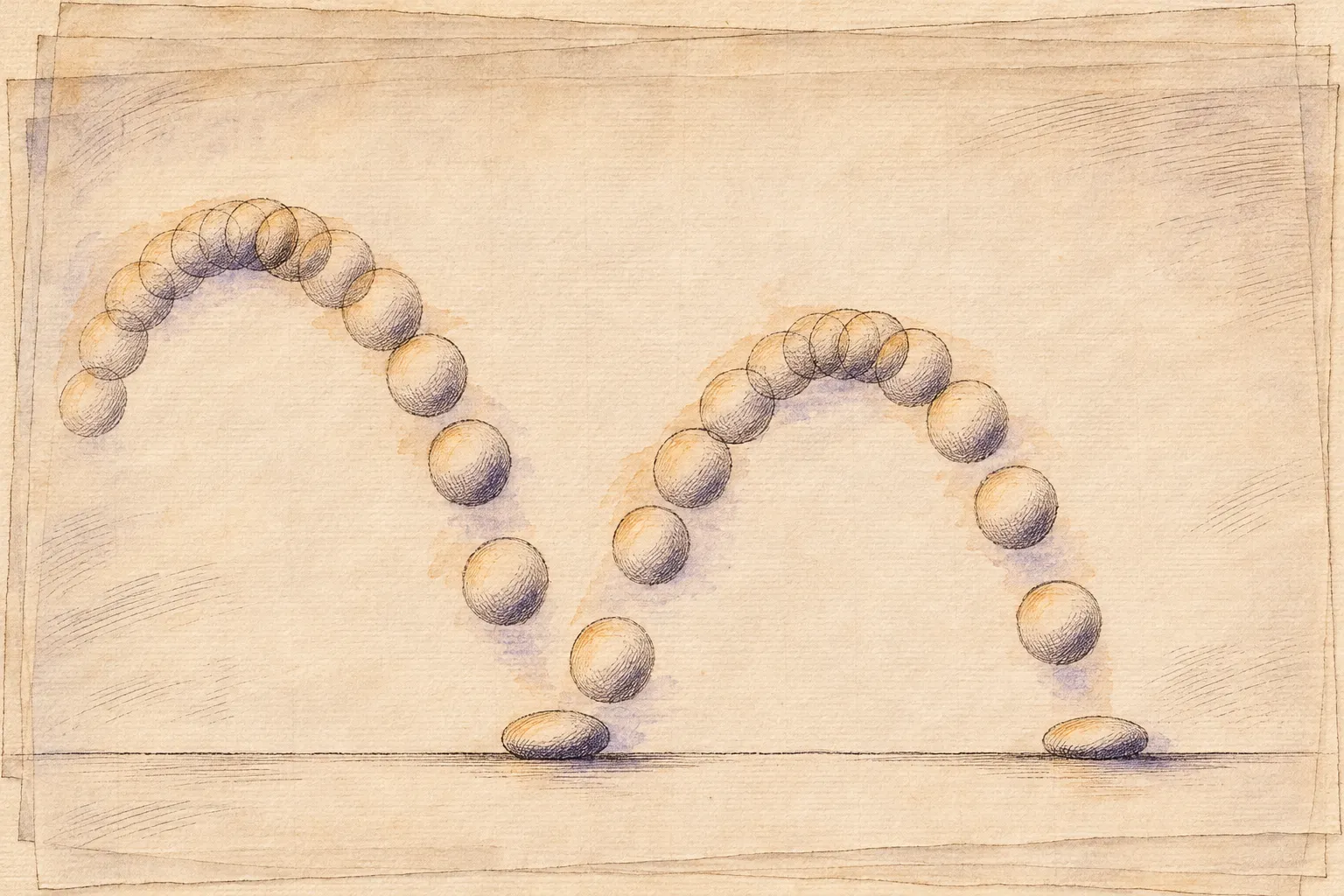
Bouncing Ball Animation: In This Model, Most Frames Sit High
How to space a bouncing ball animation: in this free-fall model, 9 of 12 falling frames sit above halfway and the gaps grow from 2 to 42 pixels.
Picture credit
Illustration: Flickers & Tintypes. Generated schematic image — not a photograph, film frame or historical record. No copyright is claimed in this generated imagery; you may reuse it, and a credit to Flickers & Tintypes is appreciated.
 Illustration
Animation Loops
12 Principles of Animation: Lutz’s 1920 Rule for In-Betweens
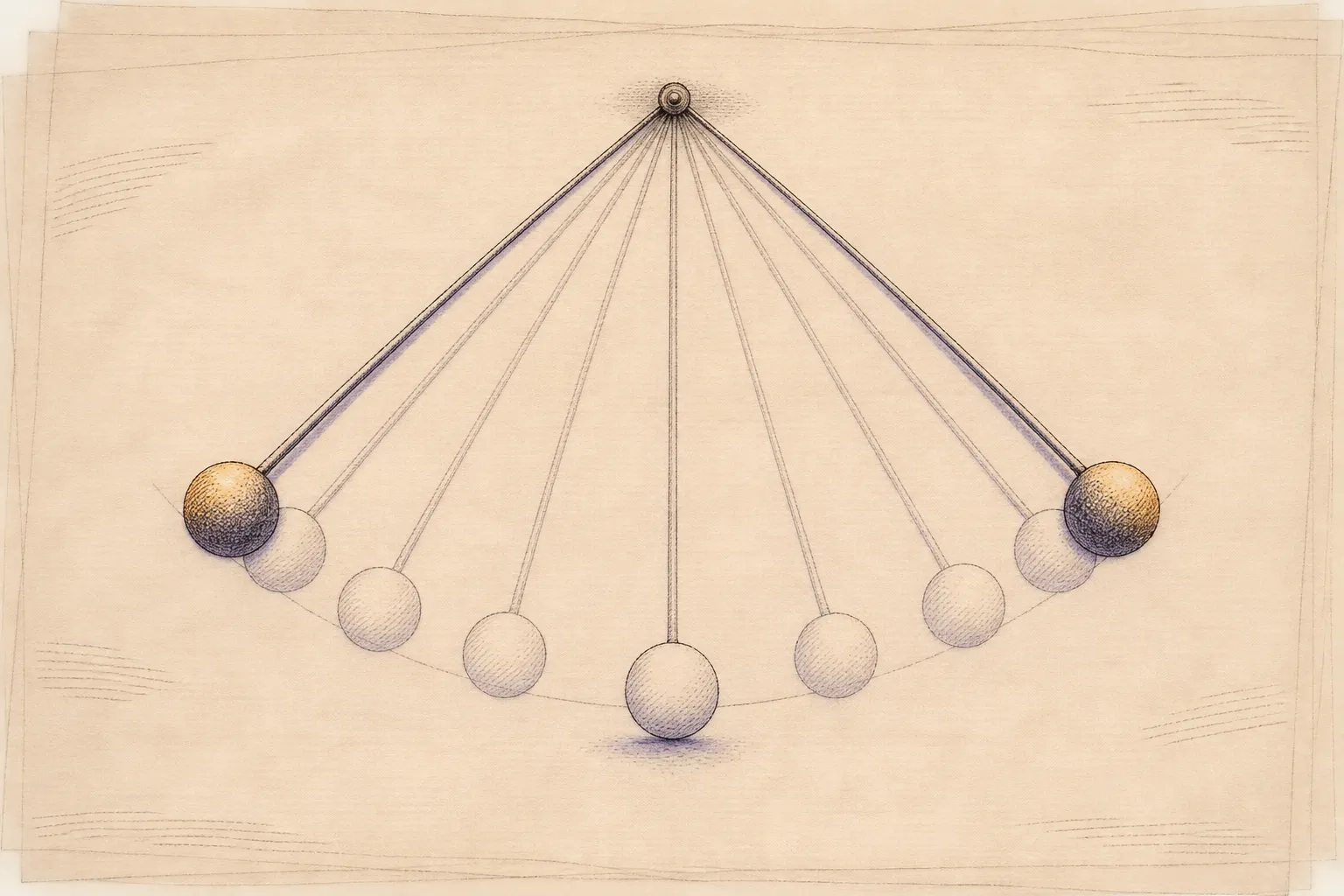
The 12 principles of animation, with slow in and slow out shown as a 30-frame loop, and the 1920 rule that a slower move needs at least three in-betweens.
Picture credit
Illustration: Flickers & Tintypes. Generated schematic image — not a photograph, film frame or historical record. No copyright is claimed in this generated imagery; you may reuse it, and a credit to Flickers & Tintypes is appreciated.