Zoetrope: An 1834 Paper Said a Whole Room Could Watch It
Frame card
In one line A zoetrope is a spinning drum with slits around its wall and a strip of drawings inside. Looking through the slits, you see one drawing after another in the same spot: 12 slits turning once a second give 12 images a second.
Source, Year, Format, Length or Size, Access, License
- Source
- Auckland Museum 2001.6.1, photo AM_2001.6.1-1
- Year
- 19th century (museum record); the drum form was described in print in 1834
- Format
- Slotted drum on a footed stand; drawings on a paper strip inside
- Length or Size
- Drum size not given on the file page; example strip 8.5 x 84.3 cm (museum record), with 12 drawings by this site's count
- Access
- Photo on Wikimedia Commons, released by Auckland Museum
- License
- CC BY 4.0, Auckland Museum; cropped
Card data (CSV) zoetrope-frame-card.csv Source and license notes
Entry fields
- Name
- Zoetrope; also zootrope or wheel of life; called the Dædaleum by W. G. Horner in 1834
- Date range and evidence
- Described 1834; English patent 1860 and US patent 1867, both per Lutz 1920; sold as a toy for many years
- Size or running time
- One turn shows the whole strip once; images per second = slits x turns per second
- Process or material
- Optical toy: a strip of drawings inside an open drum, watched through slits in the wall while the drum spins
- How to recognize it
- Open-topped drum on a spindle, with evenly spaced vertical slits around the upper wall; no mirrors
- Often confused with
- Phenakistiscope: a slotted disk spun before a mirror. Praxinoscope: a drum with mirrors set halfway between centre and rim
- Where to see one
- Auckland Museum 2001.6.1 (drum); Cooper Hewitt 1958-46-1-b (Dancers strip, ca. 1860)
Card data (CSV) zoetrope-entry.csv Source and license notes
Shot list · 5 sections
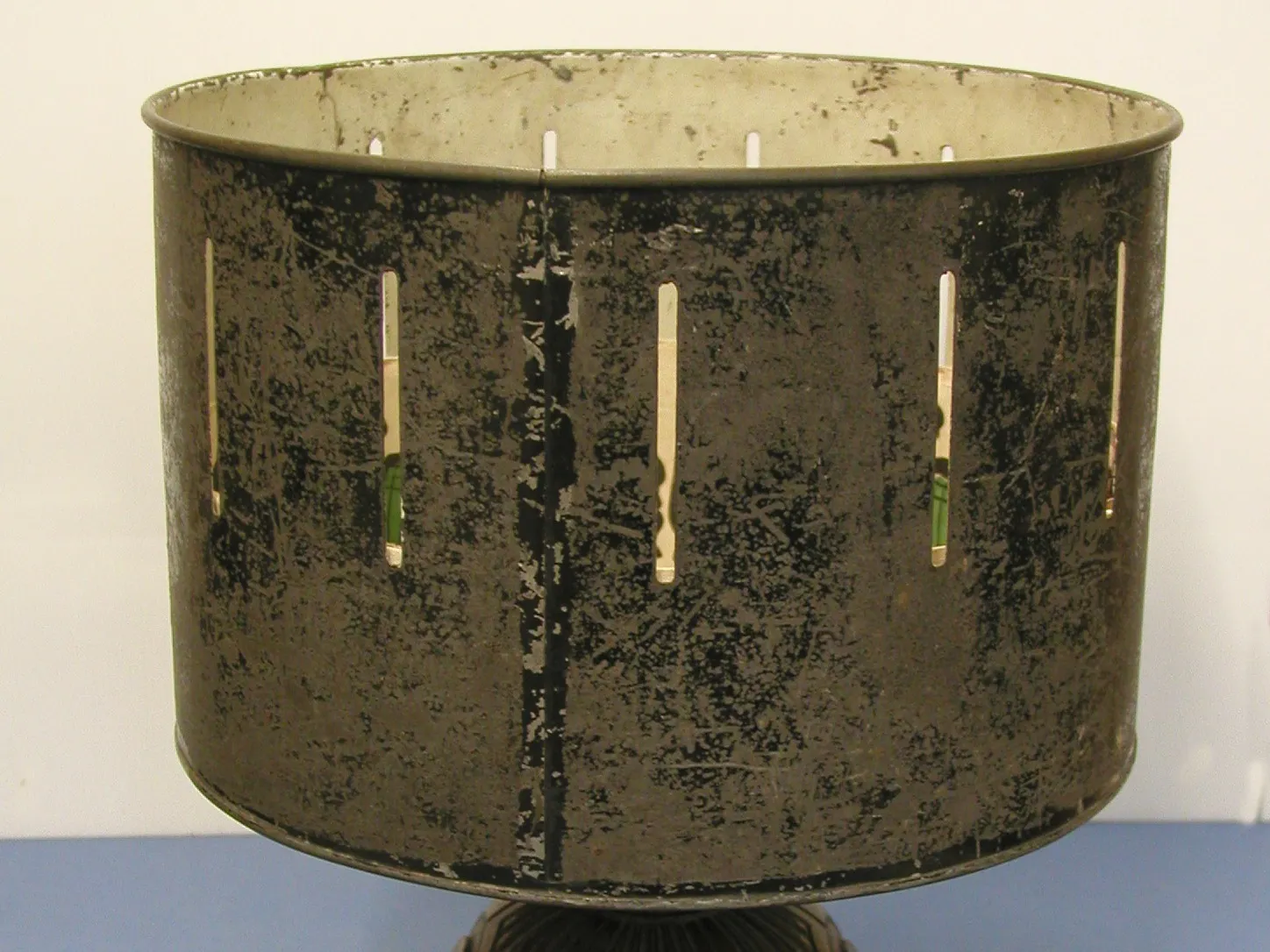
Auckland Museum 2001.6.1, photo AM_2001.6.1-1: by this site’s count, five slits face the camera and four more show on the far side of the rim.
"Zoetrope (wheel of life) optical toy, Auckland Museum 2001.6.1, photo AM_2001.6.1-1" by Auckland Museum — https://commons.wikimedia.org/wiki/File:Zoetrope_(AM_2001.6.1-1).jpg — CC BY 4.0 (https://creativecommons.org/licenses/by/4.0/); modified: cropped to the drum and the top of its stand, removing the measuring scale and the museum's copyright line
Count the slits on this Auckland Museum drum, multiply by its turns per second, and you get pictures per second. That one line of arithmetic is how a zoetrope works. A strip of drawings sits inside the drum, and each slit gives you a short look at one drawing, in the same spot as the drawing before it. On a drum with 12 slits and one turn a second, you see 12 images a second: a new one about every 83 milliseconds.
The museum dates this drum only to the 19th century, but the form itself was in print by 1834. In 1834 W. G. Horner described “a hollow cylinder” with “apertures at equal distances” in the Philosophical Magazine, and he gave it a name of his own: the Dædaleum.
How does a zoetrope work?
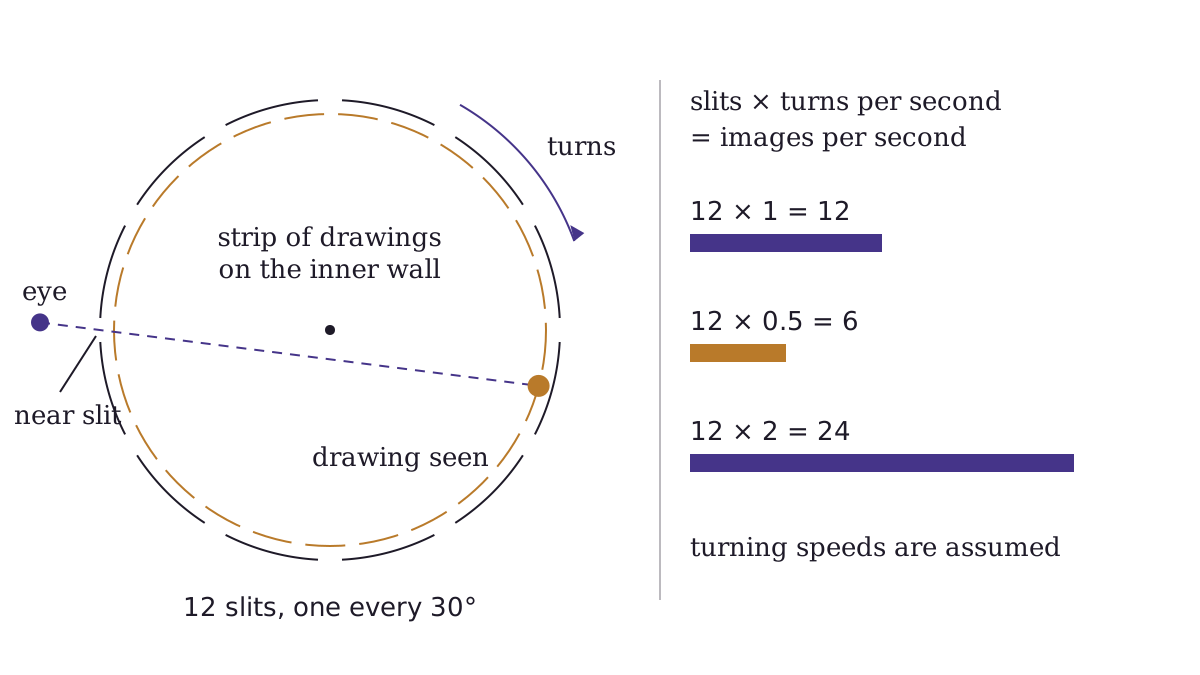
Top view of a 12-slit drum: the line of sight crosses the drum to a drawing on the far wall; the turning speeds in the table are assumed.
"Zoetrope sight line and the slits-times-turns arithmetic" by Flickers & Tintypes, https://flickersandtintypes.com/animation-loops/zoetrope/ — CC BY 4.0, https://creativecommons.org/licenses/by/4.0/
Hold the drum at eye level and look through one slit, and your line of sight skips the near wall entirely, crossing the empty middle to the far wall, where the strip sits. Horner put it plainly: drawings made on the inside, between the openings, “will be visible through the opposite apertures.”
Lutz’s 1920 handbook, Animated Cartoons, describes the toy. It was “like a cylindrical lidless box of cardboard,” balanced on a vertical rod so that, he says, it could turn very fast. The slots ran around the upper rim, and long paper strips of drawings fitted inside.
Now spin it. The wall between two slits blocks your view, and the next slit opens it again a moment later. Lutz lists this among four elementary features of nearly all the apparatus built while the art was developing: “Some means by which light—or the vision—is shut off while the change from one picture to another is taking place.” In a zoetrope the solid strips of wall do that job, while the slits only control when you get to look.
Go back to the Auckland drum with that in mind. Flecks of color show through two of its slits. Those flecks sit inside the drum, on the far side, because a slit is a window across the drum, not into the near wall.
Two neighbors are easy to mix up with it. The phenakistiscope is a flat disk with slits, spun in front of a mirror. The praxinoscope keeps the drum but, in Lutz’s words, “made use of the reflective property of a mirror”: a ring of mirrors set halfway between the center and the wall. An open drum with slits and no mirrors is a zoetrope.
Slits times turns: how many pictures a second?
Every number in the table below comes from one multiplication. The slit count is fixed by the drum, and the turning speed is up to the hand that spins it. Neither Horner nor Lutz gives a speed, so the speeds here are assumptions, not measurements.
| Slits | Turns per second (assumed) | Images per second | Time between images |
|---|---|---|---|
| 12 | 0.5 | 6 | about 167 milliseconds |
| 12 | 1 | 12 | about 83 milliseconds |
| 12 | 2 | 24 | about 42 milliseconds |
The loop below runs the middle row. It is a model drum, not a real strip: 12 drawings of a dot, each placed 30 degrees further around a circle, shown for two full turns. One turn shows all 12 drawings once, so the two-second loop holds each drawing twice. Between frames the dot moves the same distance every time, including from the last drawing back to the first.
A 12-slit drum at one turn per second, two turns
Every frame, side by side
- 1drawing 1, turn 1
- 2
- 3
- 4
- 5
- 6
- 7
- 8
- 9
- 10
- 11
- 12
- 13drawing 1, turn 2
- 14
- 15
- 16
- 17
- 18
- 19
- 20
- 21
- 22
- 23
- 24
24 frames at 12 frames per second: a 2-second loop.
Frame data (CSV) zoetrope-turning-loop.csv Source and license notes
Credits for this loop
- "A 12-slit drum at one turn per second, two turns" by Flickers & Tintypes, https://flickersandtintypes.com/animation-loops/zoetrope/ — CC BY 4.0, https://creativecommons.org/licenses/by/4.0/
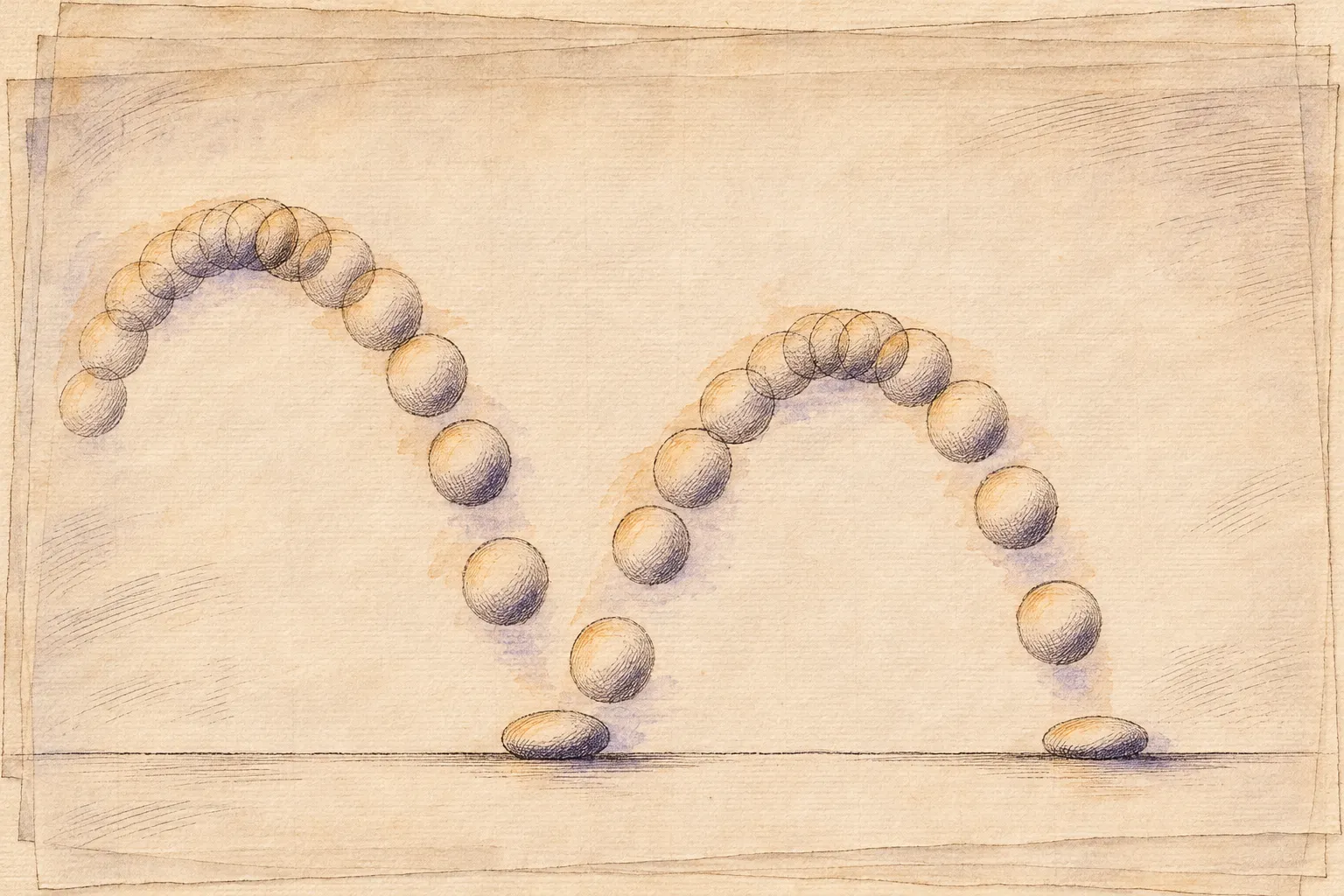
At 6 images a second the same 12 drawings take two seconds to go round, and the steps start to show. Spacing works the same way when the drawings change instead of the speed, which is the whole subject of bouncing ball animation: closer drawings read as slow, wider gaps read as fast.
Download the zoetrope names and timing table (CSV) source and license notes
Why did Horner say a whole room could watch?
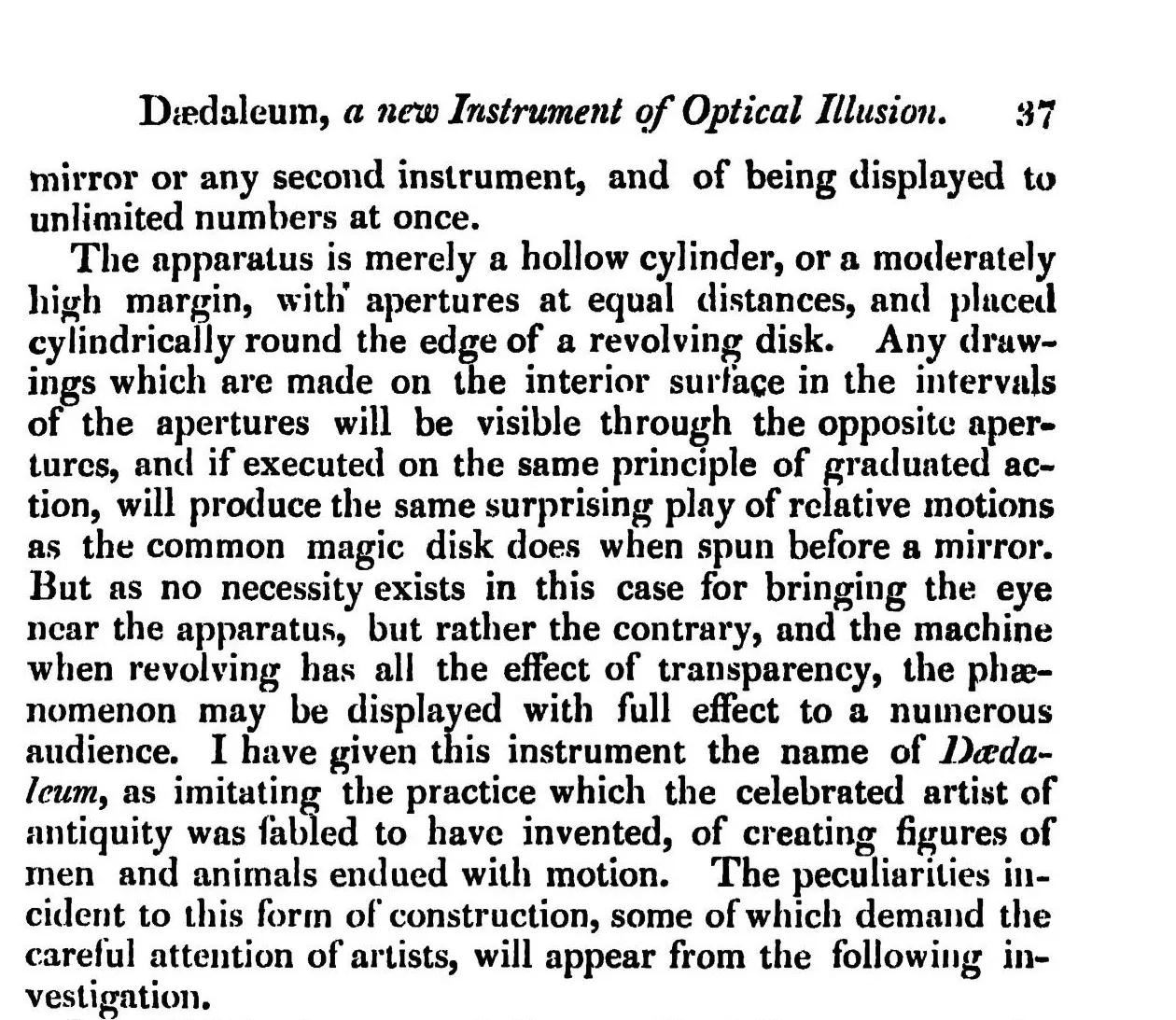
Philosophical Magazine, vol. 4 (1834), p. 37: Horner’s paragraph on the open drum, where he names it the Dædaleum.
“On the Properties of the Dædaleum, The London and Edinburgh Philosophical Magazine, vol. 4 (1834), page 37” — W. G. Horner — public domain full credit
"On the Properties of the Dædaleum, The London and Edinburgh Philosophical Magazine, vol. 4 (1834), page 37" by W. G. Horner — https://archive.org/details/in.ernet.dli.2015.21327 — Public domain: Public domain in the US (published 1834) and in the EU (published in London in 1834; the author's death date was not checked, but life+70 has expired on any realistic lifespan for an author publishing in 1834); modified: cropped to the running head and the paragraph that names the Dædaleum
Horner opened his paper by crediting “the ingenious and amusing invention of M. Plateau,” the slotted disk you spin in front of a mirror. That disk is the phenakistiscope, which you hold close to your face, watching the drawings in the glass.
The open drum dropped the mirror. Horner wrote that it could be performed “without a mirror or any second instrument,” and that there was no need “for bringing the eye near the apparatus.” Because of that, he said, it could be shown “to unlimited numbers at once” and “with full effect to a numerous audience.” Those are Horner’s claims about his design; his paper does not record a showing, so this page treats the whole-room point as what Horner said the drum allowed, not as a crowd anyone counted.
The drum belongs with the other parlor optics that build something from flat pictures. The stereograph makes depth from two photographs; the zoetrope makes motion from a strip of drawings.
Who invented the zoetrope?
Three dates sit on the record, and each stands for a different kind of claim.
| Year | Name used | What happened | Source |
|---|---|---|---|
| 1834 | Dædaleum | W. G. Horner describes and names the open slotted drum in print | Horner, Philosophical Magazine, pp. 36–37 |
| 1860 | not given | Desvignes obtains a patent for it in England | per Lutz 1920, pp. 24–25 |
| 1867 | zoetrope | A United States patent for a similar instrument is issued to William Lincoln of Providence, R.I., who called his device the zoetrope | per Lutz 1920, p. 25 |
Lutz wrote that the toy, “as a matter of priority, is associated with the name of Desvignes”. He spells the general device zootrope, also calls it the wheel of life, and does not mention Horner in these pages. He adds that the drum “was sold as a toy for many years,” with paper bands of comic and entertaining subjects made to fit it.
Horner, for his part, credited Plateau for the disk and Faraday and Roget for the principles behind it. Neither patent was read for this page; the 1860 and 1867 dates are Lutz’s.
In a later chapter Lutz hedges his own priority line. There he credits Desvignes with inventing one form of the zootrope. He also records that Desvignes made a series for it as far back as 1860, showing a steam engine at work. One form among several is a fair way to read the whole record.
So the honest answer is a range, 1834 to 1867, with three claims side by side: a published description and name, an English patent, and a US patent for a device its owner called the zoetrope. A single inventor and a single year would claim more than these pages show. The museum record for the strip below also dates it to about 1860, years before the US patent.

Cooper Hewitt 1958-46-1-b, Dancers, about 1860: a lithographed strip 84.3 cm long; by this site’s count, twelve couples in one turn of a dance.
"Print, Zoetrope Strip, Dancers, ca. 1860 (Cooper Hewitt 1958-46-1-b)" by Unknown author — https://commons.wikimedia.org/wiki/File:Print,_Zoetrope_Strip,_Dancers,_ca._1860_(CH_18760339).jpg — Public domain: Public domain in the US (published about 1860) and in the EU (anonymous work published about 1860; the 70-year term from publication expired long ago); faithful reproduction of a two-dimensional work (Commons PD-Art); modified: scaled from 4094 to 1600 px wide
Reading a strip: twelve couples, one turn
Count the couples on the Cooper Hewitt strip and you get 12 (this site’s count). Spread over 84.3 cm, that puts a drawing about every 7 cm (84.3 ÷ 12 = 7.025), assuming even spacing along the whole length.
In drawing 1 the man’s back is toward you, by drawing 7 the woman’s back has come round, and by drawing 12 the man’s back is turning toward you again, so drawing 1 can follow drawing 12 with no break.
The loop below cuts the strip into those 12 drawings and plays them at 6 a second. That is the slow row of the table: 12 slits at an assumed half turn per second, so one turn of the dance takes two seconds.
Dancers strip, one turn at 6 images a second
Every frame, side by side
- 1drawing 1, start of the turn
- 2
- 3
- 4
- 5
- 6
- 7
- 8
- 9
- 10
- 11
- 12drawing 12, then back to 1
12 frames at 6 frames per second.
Frame list (CSV) zoetrope-dancers-loop.csv Source and license notes
Credits for this loop
- "Dancers strip, one turn at 6 images a second" by Flickers & Tintypes, https://flickersandtintypes.com/animation-loops/zoetrope/ — CC BY 4.0, https://creativecommons.org/licenses/by/4.0/
- "Print, Zoetrope Strip, Dancers, ca. 1860 (Cooper Hewitt 1958-46-1-b), its 12 drawings cut apart" by Unknown author — https://commons.wikimedia.org/wiki/File:Print,_Zoetrope_Strip,_Dancers,_ca._1860_(CH_18760339).jpg — Public domain: Public domain in the US (published about 1860) and in the EU (anonymous work published about 1860; the 70-year term from publication expired long ago); faithful reproduction of a two-dimensional work (Commons PD-Art); modified: cut into 12 cells at even spacing between the paper edges, each cell scaled down to 270 x 320 px and set in a grid of 3 columns and 4 rows, for the loop
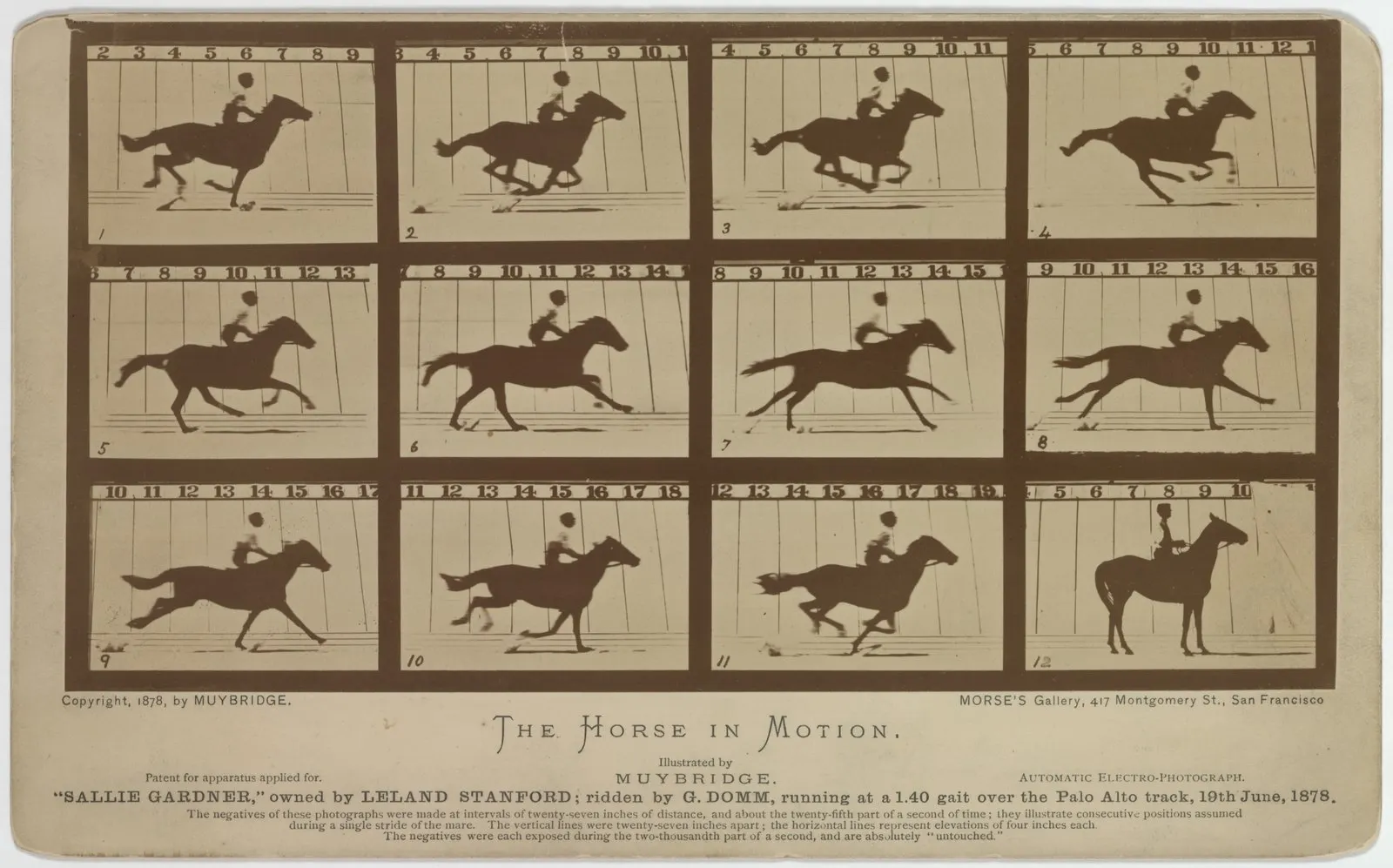
The drawings were designed as a cycle, so the last one hands back to the first. The twelve frames of The Horse in Motion were photographed instead of drawn, and their loop has to come from the horse’s own stride.
Prints consulted
- 1W. G. Horner, “On the Properties of the Dædaleum, a new Instrument of Optical Illusion,” The London and Edinburgh Philosophical Magazine and Journal of Science, 3rd series, vol. 4 (January–June 1834), pp. 36–40. https://archive.org/details/in.ernet.dli.2015.21327Read: pages 36–37, checked against the page images
- 2E. G. Lutz, Animated Cartoons: How They Are Made, Their Origin and Development. New York: Charles Scribner's Sons, 1920. https://archive.org/details/cu31924075701304Read: pages 15, 20–26, 44, 52, 58, 68–69, 76–78, 174–175, 179–181 and 256, checked against the page images
- 3Cooper Hewitt, Smithsonian Design Museum, Print, Zoetrope Strip, Dancers, ca. 1860, accession 1958-46-1-b; museum data as given on the Wikimedia Commons file page. https://commons.wikimedia.org/wiki/File:Print,_Zoetrope_Strip,_Dancers,_ca._1860_(CH_18760339).jpgRead: file page and original image
- 4Auckland War Memorial Museum Tāmaki Paenga Hira, Zoetrope (wheel of life) optical toy, accession 2001.6.1, photo AM_2001.6.1-1; museum data as given on the Wikimedia Commons file page. https://commons.wikimedia.org/wiki/File:Zoetrope_(AM_2001.6.1-1).jpgRead: file page and original image


Next reel:
- The Horse in Motion: twelve photographs instead of twelve drawings, and a question the drawings never had to answer.
- Bouncing ball animation: the same slits-and-turns arithmetic, with the spacing between drawings doing the work.
- Public-domain original to view: Cooper Hewitt zoetrope strip, Dancers, about 1860 (Wikimedia Commons)

Cite this page
Flickers & Tintypes. “Zoetrope: An 1834 Paper Said a Whole Room Could Watch It.” Flickers & Tintypes. Published November 12, 2026. https://flickersandtintypes.com/animation-loops/zoetrope/. Accessed [the date you read it].
Same sectionAlso in Animation Loops
Animation Loops
Phenakistiscope: A Spinning Disk You Watched in a Mirror
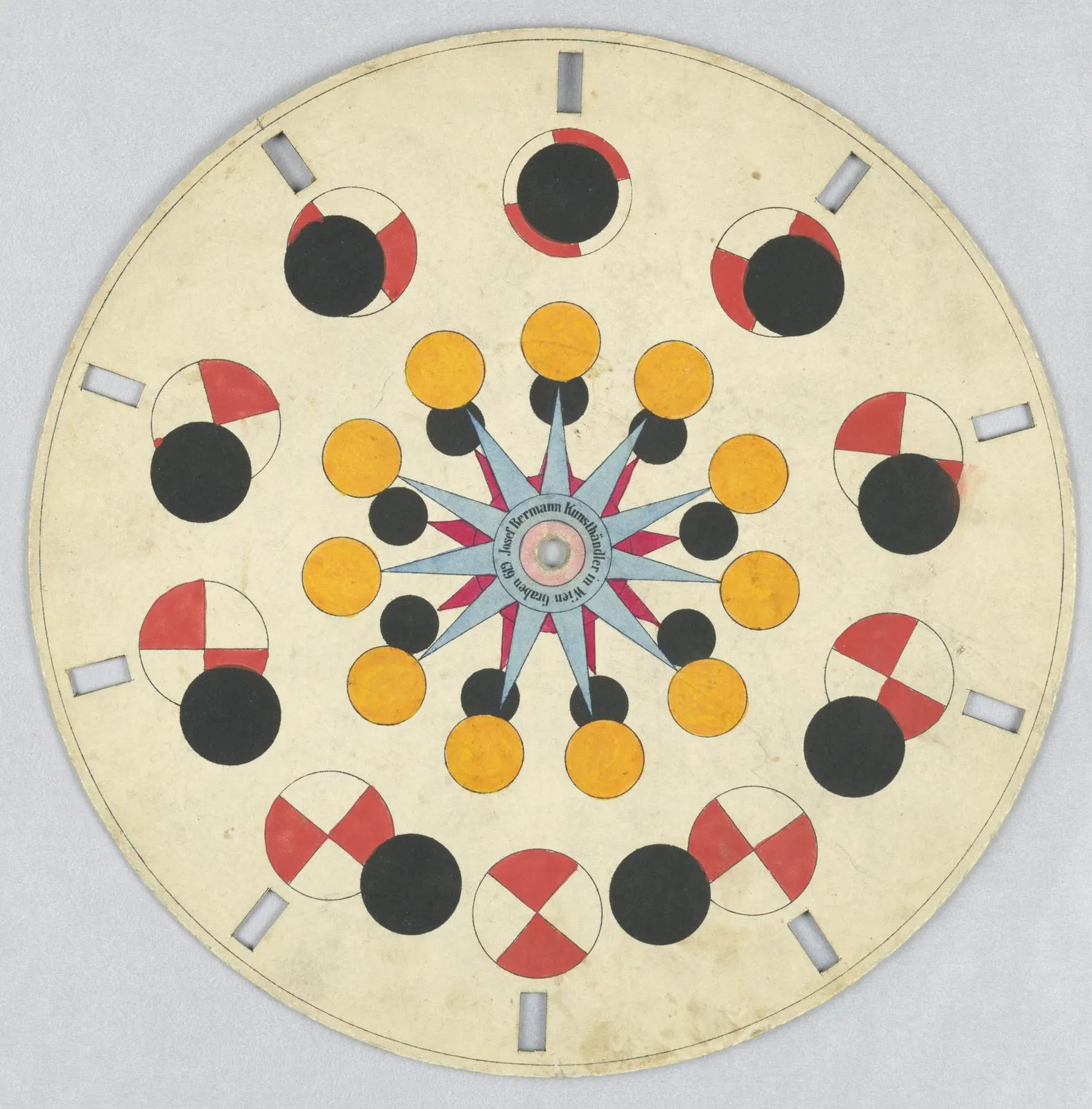
A phenakistiscope is a slotted disk spun before a mirror and watched through its slits. Count the slits and figures on a Vienna disk from about 1840.
Picture credit
"Optical Toy, Phenakistiscope Disc with Geometric Shapes, ca. 1840 (Cooper Hewitt 1948-124-4)" by Unknown author — https://commons.wikimedia.org/wiki/File:Optical_Toy,_Phenakistiscope_Disc_with_Geometric_Shapes,_ca._1840_(CH_18607983).jpg — Public domain: Public domain in the US (published about 1840) and in the EU (anonymous work published in Vienna about 1840; the 70-year term from publication expired long ago); faithful reproduction of a two-dimensional work (Commons PD-Art); modified: scaled from 3390 x 3444 to 1575 x 1600 px; whole disk, not cropped
Animation Loops
The Horse in Motion: Two Frames With No Hoof on the Track
Muybridge’s 1878 Sallie Gardner card, frame by frame: in frames 2 and 3 no hoof touches the track, and the legs are gathered under the body, not stretched out.
Picture credit
"The Horse in Motion: “Sallie Gardner,” owned by Leland Stanford, card of 12 photographs (1878)" by Eadweard Muybridge — https://commons.wikimedia.org/wiki/File:Eadweard_Muybridge-Sallie_Gardner_1878.jpg — Public domain: Public domain in the US (published 1878; card marked Copyright, 1878, by Muybridge) and in the EU (Eadweard Muybridge died 1904); copy: Library of Congress 97502309, record not consulted directly; scan as uploaded to Wikimedia Commons; modified: scaled from 4352 to 1600 px wide
 Illustration
Animation Loops
Bouncing Ball Animation: In This Model, Most Frames Sit High
How to space a bouncing ball animation: in this free-fall model, 9 of 12 falling frames sit above halfway and the gaps grow from 2 to 42 pixels.
Picture credit
Illustration: Flickers & Tintypes. Generated schematic image — not a photograph, film frame or historical record. No copyright is claimed in this generated imagery; you may reuse it, and a credit to Flickers & Tintypes is appreciated.