Bouncing Ball Animation: In This Model, Most Frames Sit High
Frame card
In one line In this free-fall model, a 24-frame loop at 12 fps spends frames 1–12 falling, frame 13 squashed on the floor and frames 14–24 rising. The gap between falling frames grows by 4 pixels a frame, from 2 to 42.
Source, Year, Format, Length or Size, Access, License
- Source
- This site's free-fall model, air resistance ignored
- Year
- Model built for this page in 2026; not a historical film
- Format
- Loop of one ball on a floor line: 24 frames at 12 frames per second, 2 seconds
- Length or Size
- 200 x 340 pixel drawing area; ball radius 12 px; drop of 288 px
- Access
- Both loops, every frame side by side, and the frame data as CSV on this page
- License
- CC BY 4.0, Flickers & Tintypes
Card data (CSV) bouncing-ball-frame-card.csv Source and license notes
Shot list · 5 sections
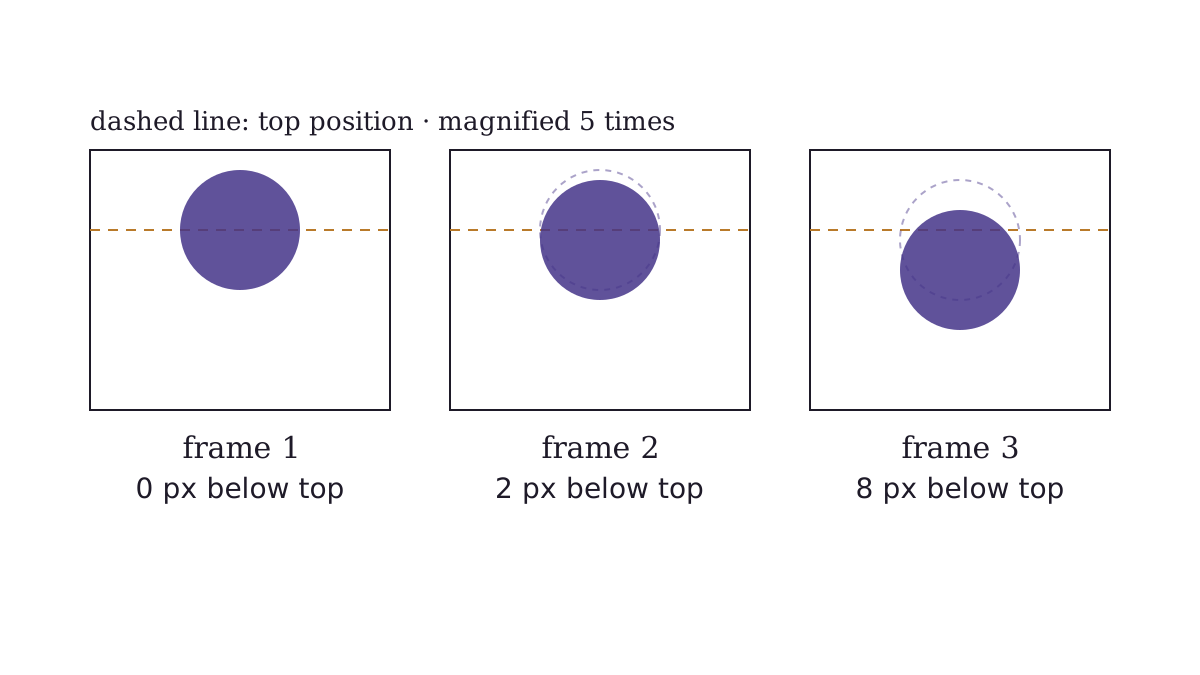
Frames 1–3 of 24 in this site’s free-fall model: the ball’s center sits 0, 2 and 8 pixels below the top position.
"Bouncing ball loop, frames 1 to 3, magnified 5 times" by Flickers & Tintypes, https://flickersandtintypes.com/animation-loops/bouncing-ball/ — CC BY 4.0, https://creativecommons.org/licenses/by/4.0/
Frame 1 puts the ball at the top; frame 3 has moved it only 8 pixels down. That slow start is the central lesson of bouncing ball animation. In this site’s model, a 24-frame loop at 12 frames per second, the ball falls in frames 1 to 12, squashes on the floor in frame 13 and rises in frames 14 to 24.
At 12 frames per second each frame lasts about 83 milliseconds, so the whole loop takes 2 seconds. The model is a simple free fall with air resistance ignored; every number on this page comes from it, and the frame data can be downloaded.
How the 24 frames are spent
A bouncing ball, 24 frames
Every frame, side by side
- 1top
- 2
- 3
- 4
- 5
- 6
- 7
- 8
- 9
- 10
- 11
- 12
- 13squash
- 14
- 15
- 16
- 17
- 18
- 19
- 20
- 21
- 22
- 23
- 24
24 frames at 12 frames per second: a 2-second loop.
Frame data (CSV) bouncing-ball-loop.csv Source and license notes
Credits for this loop
- "A bouncing ball, 24 frames" by Flickers & Tintypes, https://flickersandtintypes.com/animation-loops/bouncing-ball/ — CC BY 4.0, https://creativecommons.org/licenses/by/4.0/
Watch where the ball spends its time: it hovers near the top, then crosses the lower half of the drawing area in a few quick frames. The fall from the top to the floor takes 12 frame steps, 1 second, and the climb back is its mirror image.
The floor gets a single frame. Frame 12 is still 46 pixels above the touch, frame 13 squashes on the floor and frame 14 is 46 pixels back up, so the contact lasts one frame, about 83 milliseconds. In frame 13 the ball keeps its bottom on the floor, shrinks to 0.7 of its height and widens to 1.43 times its width. Those two numbers multiply to about 1, so the ball keeps its area and still reads as the same solid object.
That squash is not the held frame, a frame that deliberately does not move; frame 13 changes shape, its center sinks 3.6 pixels, and it lasts a single frame.
Why most falling frames sit up high
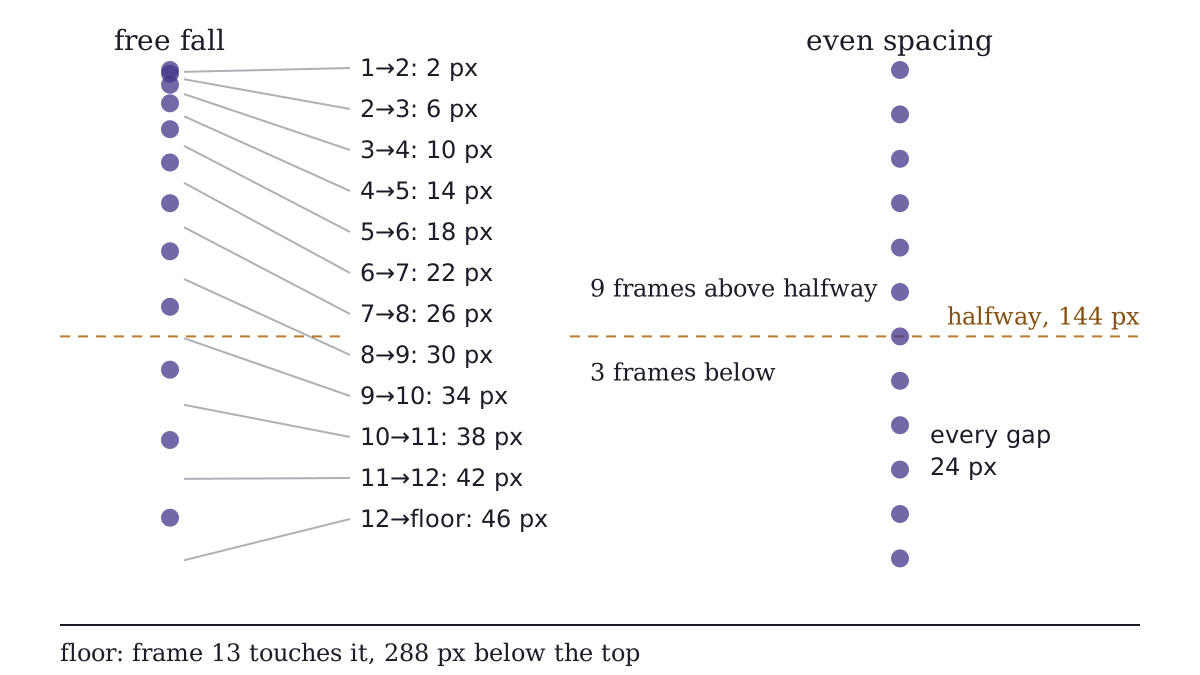
Frames 1–12 of the drop: each gap to the next frame is 4 pixels wider than the one before; the even column uses 24 pixels throughout.
"Falling-ball spacing, frames 1 to 12: free fall against even spacing" by Flickers & Tintypes, https://flickersandtintypes.com/animation-loops/bouncing-ball/ — CC BY 4.0, https://creativecommons.org/licenses/by/4.0/
In this free-fall model, the ball’s distance below the top is 2 × n² pixels, where n counts the frames since the top. The gaps between frames go 2, 6, 10 and on up to 42 pixels, each one 4 pixels wider than the last. That steady growth is constant acceleration, translated into spacing.
The halfway mark is 144 pixels down. Frames 1 to 9 all sit above it, and only frames 10 to 12 sit below. In time, the top half of the drop takes about 0.71 seconds and the bottom half about 0.29 seconds, so in this model a falling ball spends most of its drawings in the region where it moves slowest.
| Frame | Distance below the top | Gap to the next frame |
|---|---|---|
| 1 | 0 px | 2 px |
| 2 | 2 px | 6 px |
| 3 | 8 px | 10 px |
| 4 | 18 px | 14 px |
| 5 | 32 px | 18 px |
| 6 | 50 px | 22 px |
| 7 | 72 px | 26 px |
| 8 | 98 px | 30 px |
| 9 | 128 px | 34 px |
| 10 | 162 px | 38 px |
| 11 | 200 px | 42 px |
| 12 | 242 px | 46 px to the touch; frame 13’s squashed center is 49.6 px lower |
Animators call this bunching of drawings near a pose slow in and slow out. The ball eases out of the top as it falls and eases back into it as it rises, but it gets no easing at the floor, where the gaps are widest. The 12 principles of animation page shows the same bunching on a move between two poses.
Download the bouncing ball frame data (CSV) source and license notes
Even spacing: the same drop without the fall
Free-fall spacing against even spacing
Free-fall spacing
Even spacing
Every frame, side by side
Free-fall spacing
- 1top
- 2
- 3
- 4
- 5
- 6
- 7
- 8
- 9
- 10
- 11
- 12
- 13squash
- 14
- 15
- 16
- 17
- 18
- 19
- 20
- 21
- 22
- 23
- 24
Even spacing
- 1top
- 2
- 3
- 4
- 5
- 6
- 7
- 8
- 9
- 10
- 11
- 12
- 13squash
- 14
- 15
- 16
- 17
- 18
- 19
- 20
- 21
- 22
- 23
- 24
24 frames at 12 frames per second: a 2-second loop, 2 versions side by side.
Frame data (CSV) bouncing-ball-even-pair.csv Source and license notes
Credits for this loop
- "Free-fall spacing against even spacing" by Flickers & Tintypes, https://flickersandtintypes.com/animation-loops/bouncing-ball/ — CC BY 4.0, https://creativecommons.org/licenses/by/4.0/
Both balls in this pair start at the same top position and squash on the same floor in frame 13, so only the spacing differs. The left ball follows the free-fall gaps, while the right ball drops 24 pixels a frame on its way to the touch: 288 pixels split into 12 equal steps.
At full speed the even ball looks lowered and lifted rather than dropped, and it reverses direction at the top as abruptly as at the floor. Between frames 24, 1 and 2 it moves 24 pixels up and then 24 down, where the free-fall ball moves 2 up and 2 down. Only 6 of its 12 falling frames sit above halfway, against 9 for the free-fall ball.
Drawing a bounce that travels
 Illustration
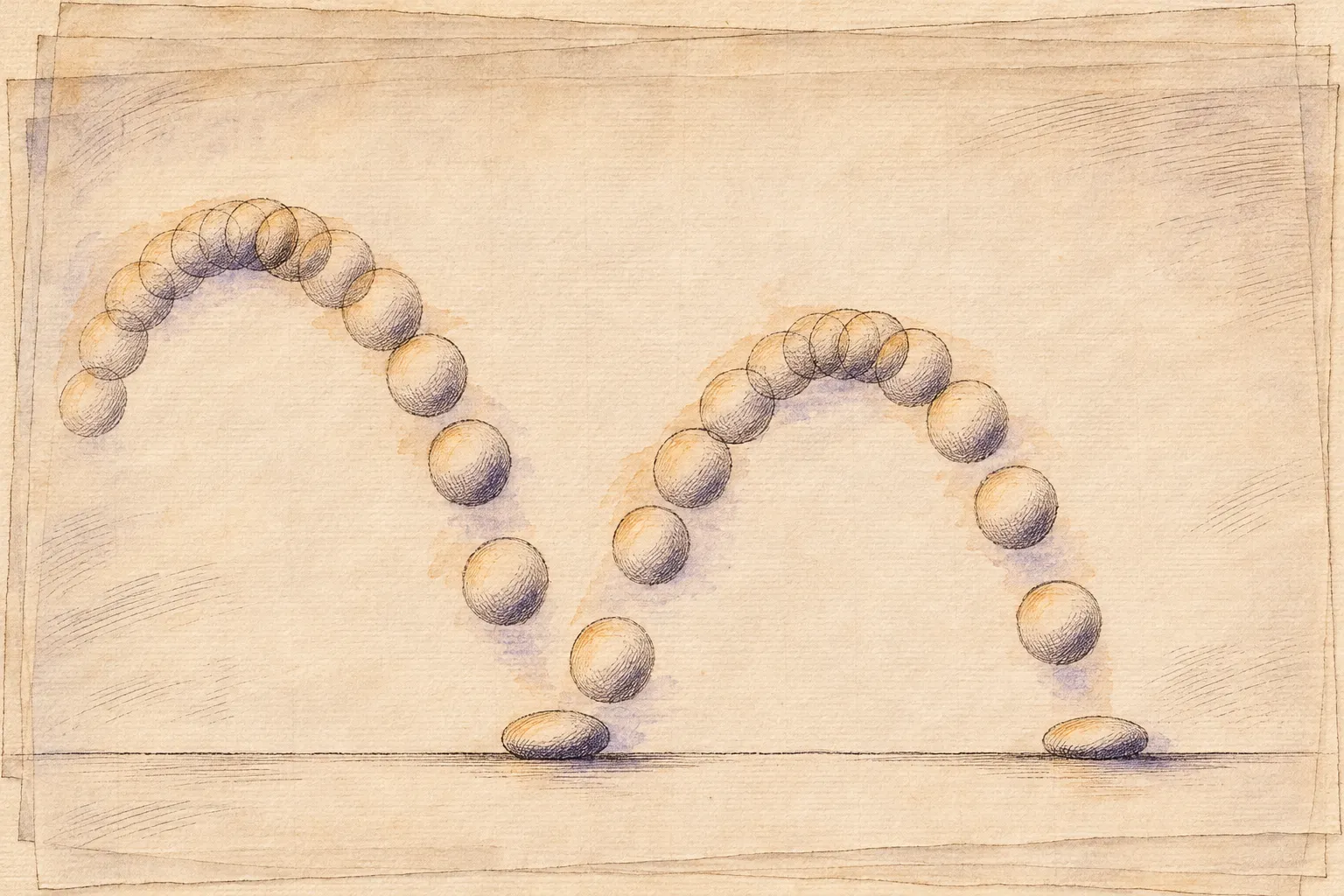
With growing vertical gaps, the drawings crowd near each peak and flatten on the floor.
Illustration: Flickers & Tintypes. Generated schematic image — not a photograph, film frame or historical record. No copyright is claimed in this generated imagery; you may reuse it, and a credit to Flickers & Tintypes is appreciated.
The loops above bounce in place, which keeps the vertical spacing easy to compare. To send the ball across the screen, the same model gives a short recipe:
- Pick the frame count and rate first. This loop uses 24 frames at 12 frames per second.
- Place the two key positions: the top, and the touch on the floor.
- Space the falling frames so that each gap is a fixed amount wider than the last. In this model that amount is 4 pixels.
- Mirror the falling frames for the climb, so the top is reached as gently as it was left.
- Add one squash frame on the floor, keeping the ball’s area about the same.
- Move the ball the same sideways distance in every frame.
Even sideways steps plus growing vertical gaps trace an arch, with the drawings crowded near each peak. In a hand-drawn film such as Gertie the Dinosaur, each of those positions has to be drawn on paper. A comic strip has no frame rate at all, yet Dream of the Rarebit Fiend still has to show how far things move from one panel to the next.
Checking the seam
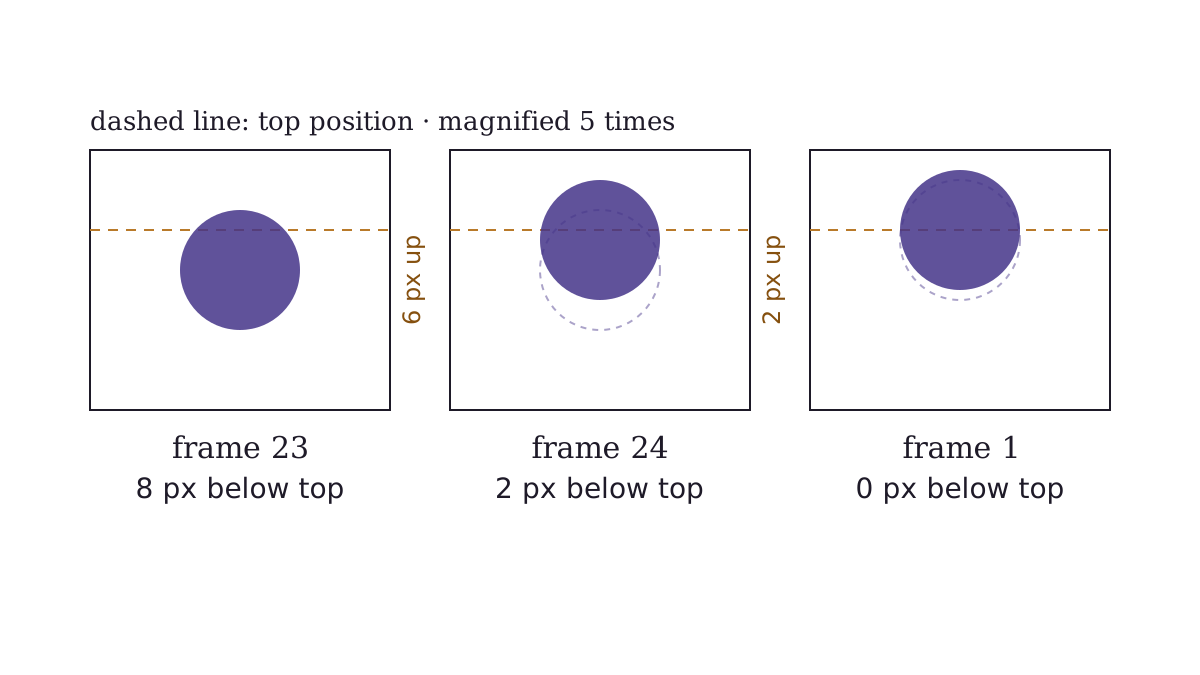
Frames 23, 24 and 1, where the loop joins: steps of 6 and 2 pixels up, then 2 pixels down into frame 2.
"Bouncing ball loop, the seam: frames 23, 24 and 1" by Flickers & Tintypes, https://flickersandtintypes.com/animation-loops/bouncing-ball/ — CC BY 4.0, https://creativecommons.org/licenses/by/4.0/
A short loop repeats every mistake on each pass, and the seam is an easy place for a spacing mistake to hide. Here the last two frames climb 6 pixels and then 2, frame 1 is the top, and frame 2 drops 2 pixels again. Read backward, the seam is the opening strip: 8, 2 and 0 on the way up, then 0, 2 and 8 on the way down.
Across the seam, each step differs from the one before by 4 pixels, the same as everywhere else in the flight. Frame 24 is not a copy of frame 1, so the ball never stalls at the top of this model.
Prints consulted
- 1Frank Thomas and Ollie Johnston, Disney Animation: The Illusion of Life. New York: Abbeville Press, 1981. https://libcat.library.tamu.edu/Record/in00003583217Read: bibliography only
Next reel:
- 12 principles of animation: the same bunched spacing on a move between two poses, played beside an evenly spaced copy.
- Zoetrope: twelve drawings in a slotted drum, and the arithmetic that turns slits and turns into pictures per second.
- Public-domain original to view: Gertie the dinosaur standing on a cliff edge looking at a mastodon, 1914 ink drawing (Wikimedia Commons)

Cite this page
Flickers & Tintypes. “Bouncing Ball Animation: In This Model, Most Frames Sit High.” Flickers & Tintypes. Published November 12, 2026. https://flickersandtintypes.com/animation-loops/bouncing-ball/. Accessed [the date you read it].
Same sectionAlso in Animation Loops
Animation Loops
Phenakistiscope: A Spinning Disk You Watched in a Mirror
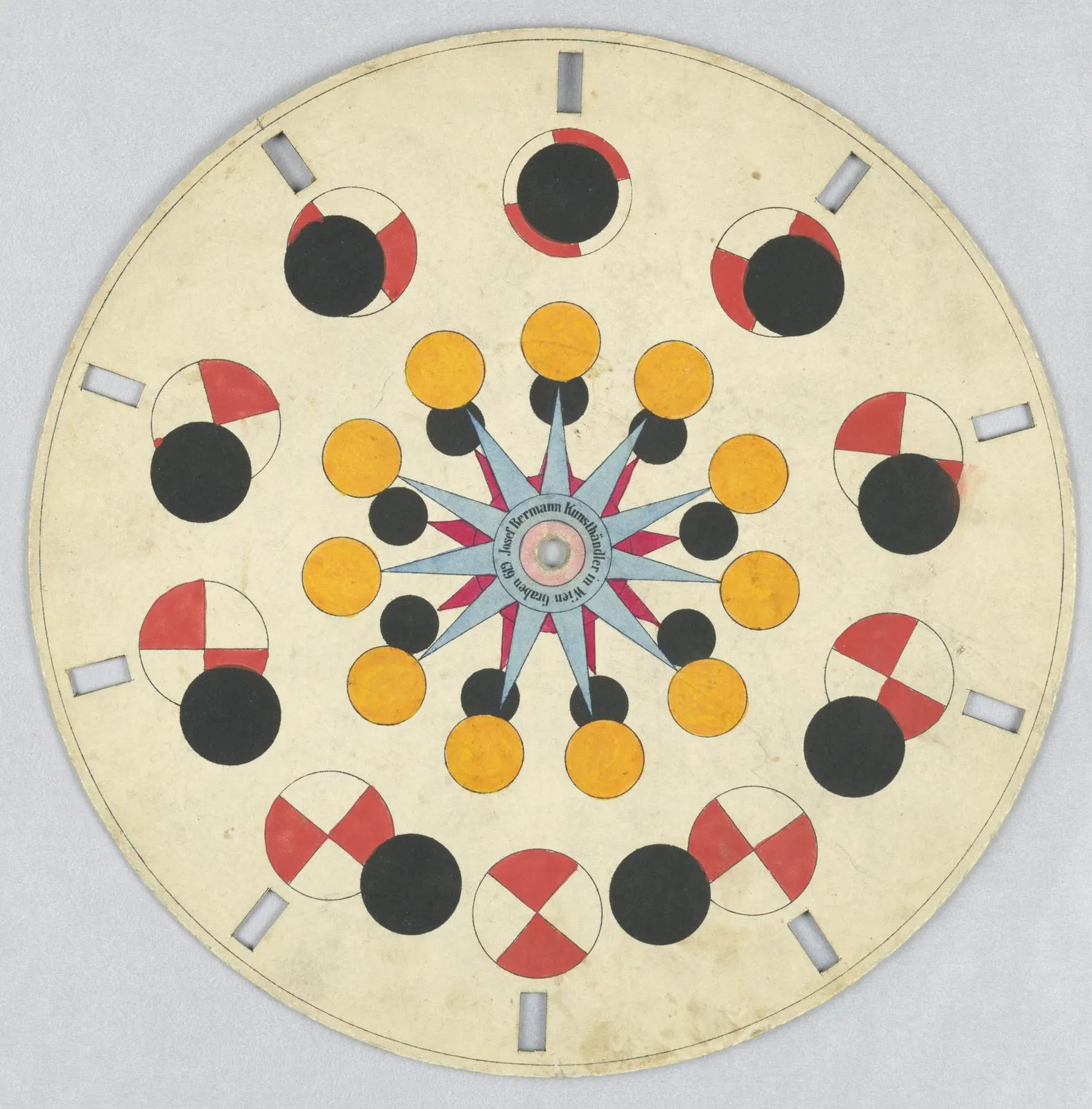
A phenakistiscope is a slotted disk spun before a mirror and watched through its slits. Count the slits and figures on a Vienna disk from about 1840.
Picture credit
"Optical Toy, Phenakistiscope Disc with Geometric Shapes, ca. 1840 (Cooper Hewitt 1948-124-4)" by Unknown author — https://commons.wikimedia.org/wiki/File:Optical_Toy,_Phenakistiscope_Disc_with_Geometric_Shapes,_ca._1840_(CH_18607983).jpg — Public domain: Public domain in the US (published about 1840) and in the EU (anonymous work published in Vienna about 1840; the 70-year term from publication expired long ago); faithful reproduction of a two-dimensional work (Commons PD-Art); modified: scaled from 3390 x 3444 to 1575 x 1600 px; whole disk, not cropped
Animation Loops
Zoetrope: An 1834 Paper Said a Whole Room Could Watch It
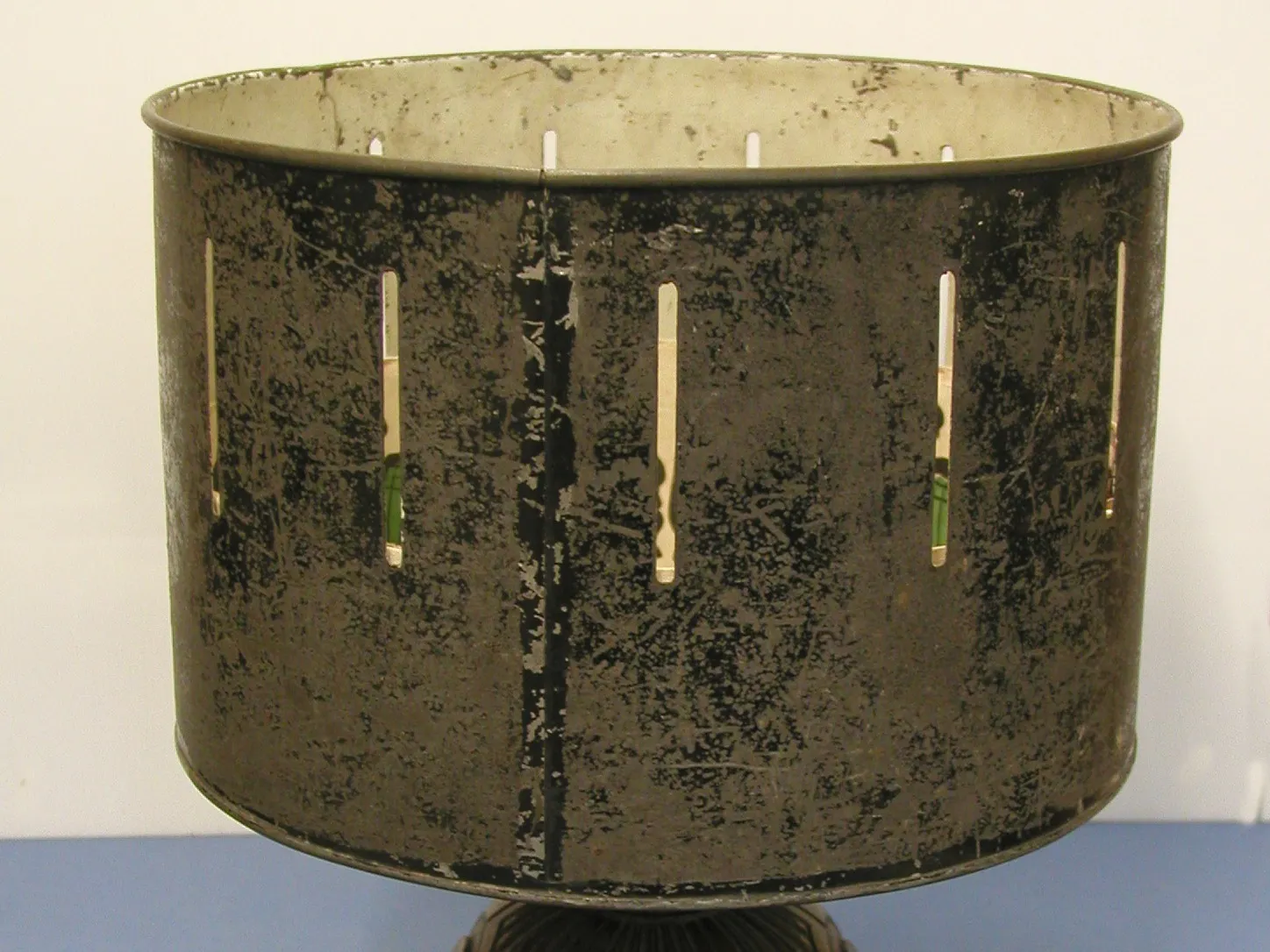
How a zoetrope works: slits times turns per second gives images per second. Horner named the open drum the Dædaleum in 1834; later patents are dated per Lutz.
Picture credit
"Zoetrope (wheel of life) optical toy, Auckland Museum 2001.6.1, photo AM_2001.6.1-1" by Auckland Museum — https://commons.wikimedia.org/wiki/File:Zoetrope_(AM_2001.6.1-1).jpg — CC BY 4.0 (https://creativecommons.org/licenses/by/4.0/); modified: cropped to the drum and the top of its stand, removing the measuring scale and the museum's copyright line
Animation Loops
The Horse in Motion: Two Frames With No Hoof on the Track
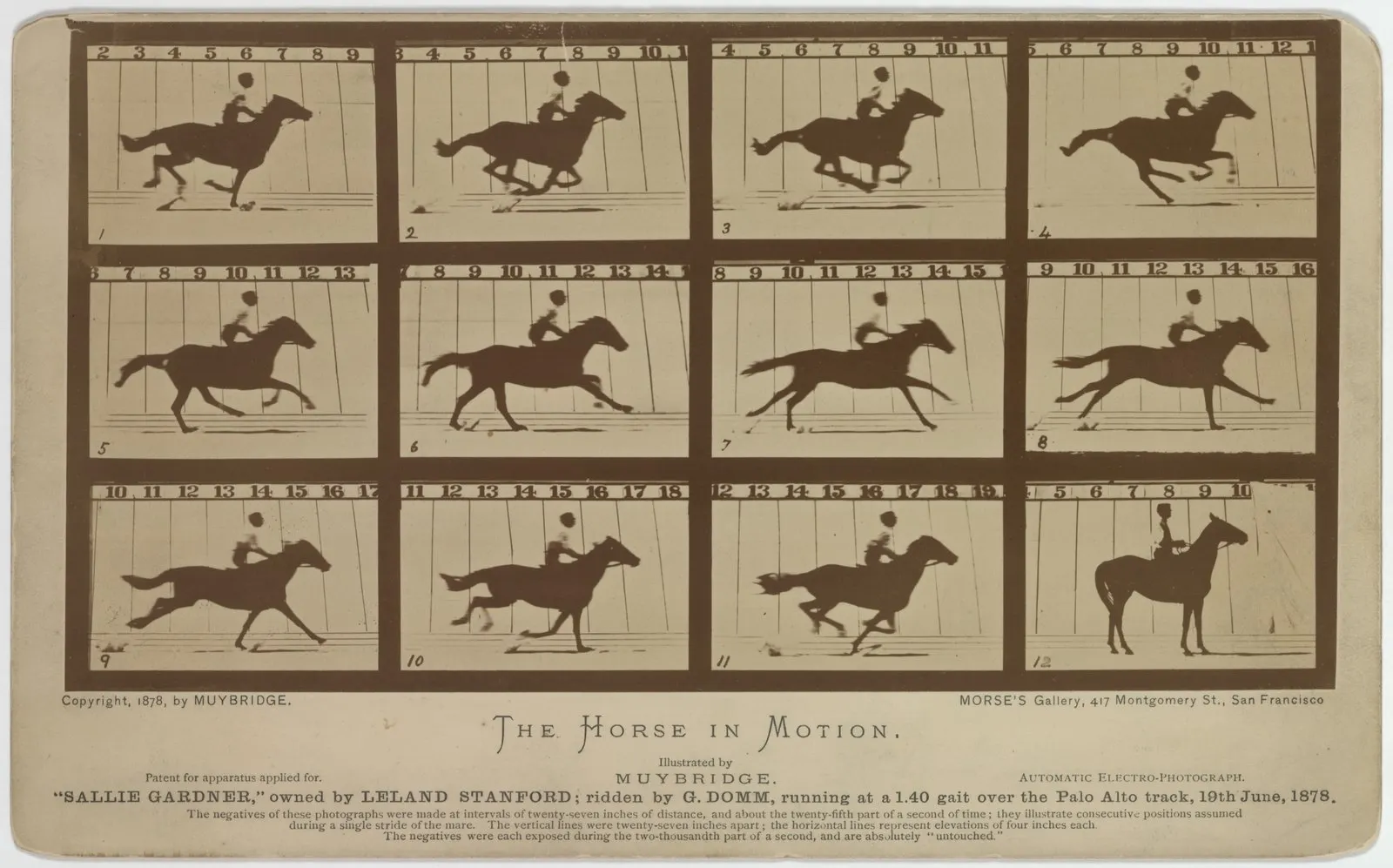
Muybridge’s 1878 Sallie Gardner card, frame by frame: in frames 2 and 3 no hoof touches the track, and the legs are gathered under the body, not stretched out.
Picture credit
"The Horse in Motion: “Sallie Gardner,” owned by Leland Stanford, card of 12 photographs (1878)" by Eadweard Muybridge — https://commons.wikimedia.org/wiki/File:Eadweard_Muybridge-Sallie_Gardner_1878.jpg — Public domain: Public domain in the US (published 1878; card marked Copyright, 1878, by Muybridge) and in the EU (Eadweard Muybridge died 1904); copy: Library of Congress 97502309, record not consulted directly; scan as uploaded to Wikimedia Commons; modified: scaled from 4352 to 1600 px wide