Gertie the Dinosaur: A 1914 Trade Notice Says ‘Dinosaurus’
Frame card
In one line Per Moving Picture World of November 14, 1914, Gertie the Dinosaur was Winsor McCay’s hand-drawn one-reel film, to be marketed as “Gertie,” the Dinosaurus. One surviving drawing puts Gertie, a mastodon and the hills on a single sheet.
Source, Year, Format, Length or Size, Access, License
- Source
- The Moving Picture World 22, no. 7 (November 14, 1914), p. 914; drawing LCCN 2002706759 as copied on Wikimedia Commons (Library of Congress record not consulted directly)
- Year
- 1914: the trade-paper notice, and the date given for the drawing
- Format
- Hand-drawn one-reel film, per the trade paper; the drawing is ink on rice paper, per the catalog text copied on Commons
- Length or Size
- One reel, per Moving Picture World; the notice gives no footage or running time
- Access
- https://commons.wikimedia.org/wiki/File:Gertie_the_dinosaur_standing_on_a_cliff_edge_looking_at_a_mastodon_LCCN2002706759.jpg
- License
- Drawing and trade-paper page: public domain in the US and the EU (details in each image credit)
Card data (CSV) gertie-the-dinosaur-frame-card.csv Source and license notes
Shot list · 4 sections
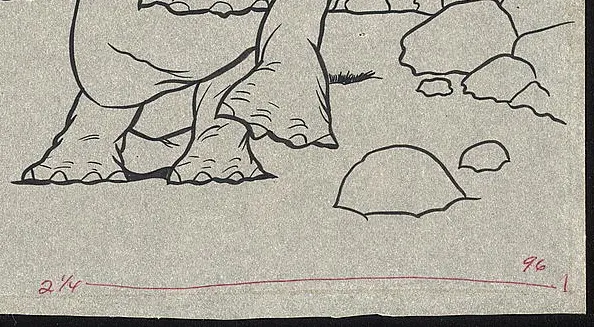
LCCN 2002706759, lower right of the sheet: a red 96 above the end of a red line, with a red 2 1/4 farther left.
“Gertie the dinosaur standing on a cliff edge looking at a mastodon (Library of Congress LCCN 2002706759), lower right corner” — Winsor McCay — public domain full credit
"Gertie the dinosaur standing on a cliff edge looking at a mastodon (Library of Congress LCCN 2002706759), lower right corner" by Winsor McCay — https://commons.wikimedia.org/wiki/File:Gertie_the_dinosaur_standing_on_a_cliff_edge_looking_at_a_mastodon_LCCN2002706759.jpg — Public domain: Public domain in the US and in the EU (Winsor McCay died in 1934, per the Commons category data; life plus 70 years ended in 2004, which covers the drawing whether or not it counts as published); the Commons file page marks it public domain (Library of Congress record not consulted directly); modified: cropped to the lower right corner with the margin marks
A red 96 is written in the lower right margin of this sheet, under the rocks. The sheet is one surviving drawing for Gertie the Dinosaur, the hand-drawn film by Winsor McCay. Farther left, a red 2 1/4 breaks a red line that runs along the bottom edge. Nothing on the sheet says what either number counts, so this page describes them and stops there.
The film itself turns up in print in the trade paper Moving Picture World, whose issue of November 14, 1914 reported that McCay’s “one-reel comedy” would be marketed as “Gertie,” the Dinosaurus. No copy of the film could be traced well enough for a frame-by-frame breakdown. This page works instead from three things you can check yourself: that notice, this drawing, and a how-to book from 1920.
A Trip to the Moon is the other early film on this site read from period print instead of a copy. Where a traceable copy does exist, as with The Great Train Robbery, frames come with timecodes tied to one file.
What is Gertie the Dinosaur?
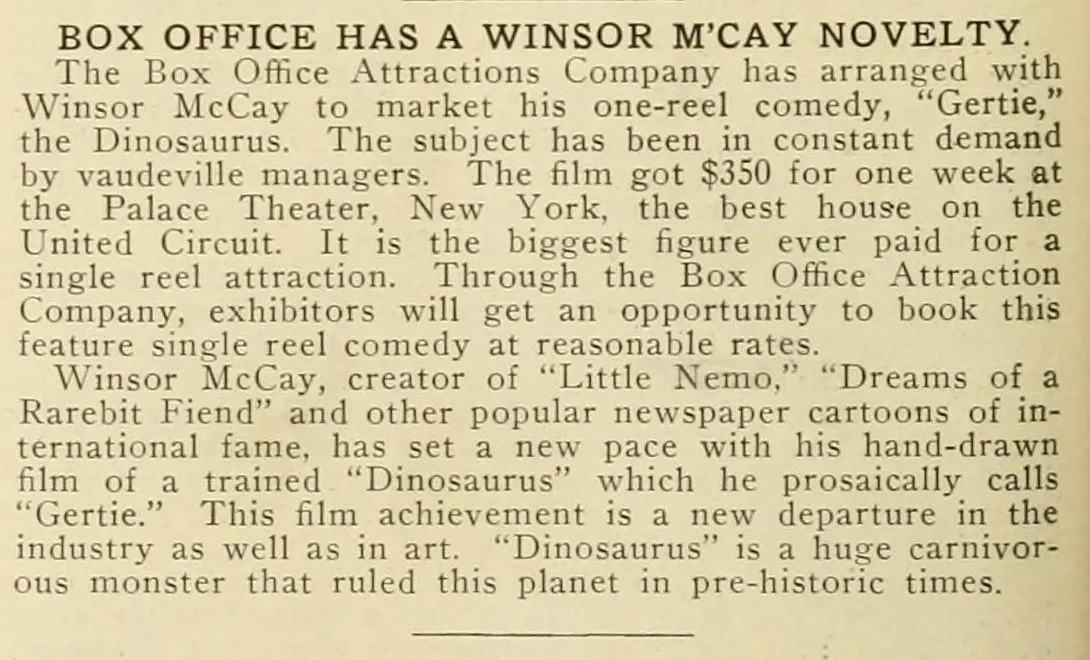
Page 914, right column, Moving Picture World of November 14, 1914: the notice about Gertie, as printed.
“The Moving Picture World 22, no. 7 (November 14, 1914), p. 914: Box Office Has a Winsor M’Cay Novelty” — The Moving Picture World (Chalmers Publishing Company) — public domain full credit
"The Moving Picture World 22, no. 7 (November 14, 1914), p. 914: Box Office Has a Winsor M’Cay Novelty" by The Moving Picture World (Chalmers Publishing Company) — https://archive.org/details/movingpicturewor22newy — Public domain: Public domain in the US (published 1914) and in the EU (unsigned trade-paper notice in a 1914 periodical issued by the Chalmers Publishing Company; anonymous work, 70 years from publication ended in 1984); modified: cropped from the page image of p. 914 to the Gertie notice
The notice runs two short paragraphs under the headline “Box Office Has a Winsor M’Cay Novelty.” It says the Box Office Attractions Company “has arranged with Winsor McCay to market his one-reel comedy, ‘Gertie,’ the Dinosaurus.” The issue is volume 22, number 7, and its date line reads Saturday, November 14, 1914.
The second paragraph says who made the film and how, naming McCay as “creator of ‘Little Nemo,’ ‘Dreams of a Rarebit Fiend’ and other popular newspaper cartoons.”
Those strips are covered on this site under Little Nemo and Dream of the Rarebit Fiend. The notice calls Gertie “his hand-drawn film of a trained ‘Dinosaurus.’” Hand-drawn is the notice’s own word for how the film was made.
The money comes next. “The film got $350 for one week at the Palace Theater, New York,” the notice says, calling the Palace “the best house on the United Circuit.” It adds: “It is the biggest figure ever paid for a single reel attraction.”
The sum is the paper’s report, and calling it the biggest is the paper’s own claim. No theater record or contract was checked for this page, so the $350 stays a reported figure.
The notice also explains why a film company wanted it. “The subject has been in constant demand by vaudeville managers,” it says. Vaudeville managers ran theaters with mixed stage acts. Through the Box Office Attractions Company, film exhibitors “will get an opportunity to book this feature single reel comedy at reasonable rates.”
The last sentence is the one to read with care: “‘Dinosaurus’ is a huge carnivorous monster that ruled this planet in pre-historic times.” That is the paper’s 1914 wording, quoted as printed, and this page does not use it as a fact about the animal Gertie was drawn to be.
One sheet holds Gertie, a mastodon and the hills
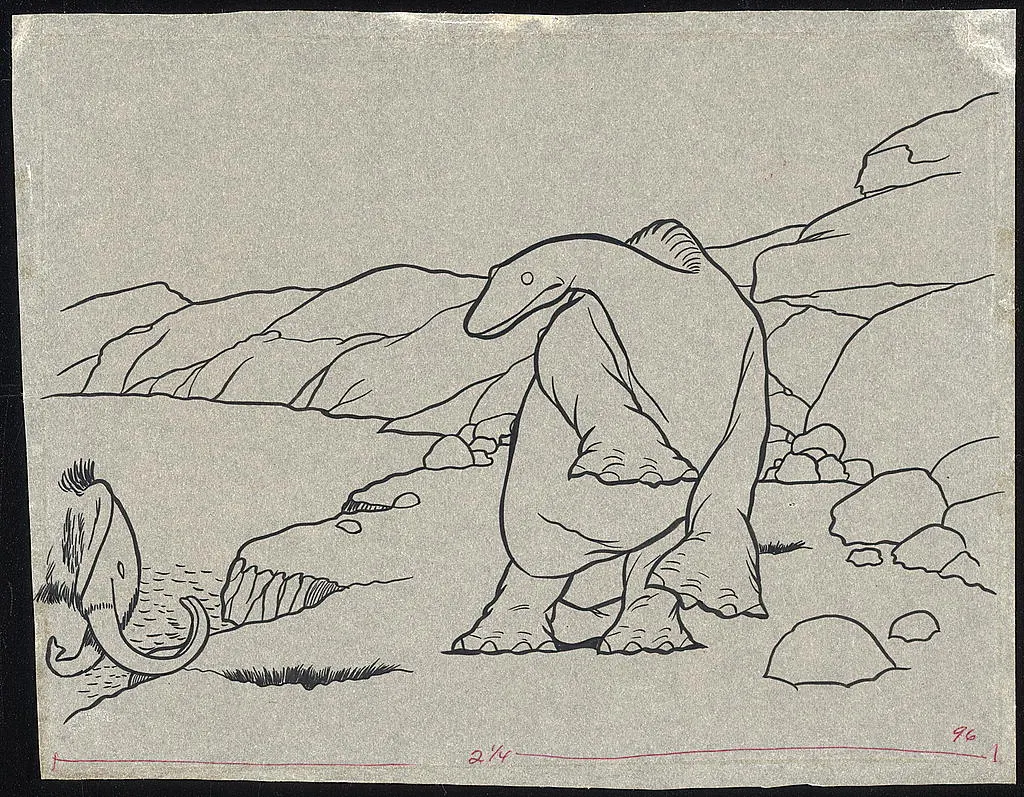
LCCN 2002706759, full sheet: Gertie, the mastodon, the hills and the red margin marks, all on the one sheet.
“Gertie the dinosaur standing on a cliff edge looking at a mastodon (Library of Congress LCCN 2002706759)” — Winsor McCay — public domain full credit
"Gertie the dinosaur standing on a cliff edge looking at a mastodon (Library of Congress LCCN 2002706759)" by Winsor McCay — https://commons.wikimedia.org/wiki/File:Gertie_the_dinosaur_standing_on_a_cliff_edge_looking_at_a_mastodon_LCCN2002706759.jpg — Public domain: Public domain in the US and in the EU (Winsor McCay died in 1934, per the Commons category data; life plus 70 years ended in 2004, which covers the drawing whether or not it counts as published); the Commons file page marks it public domain (Library of Congress record not consulted directly)
Look at the whole sheet and the layout is plain. Gertie stands at center right, her head turned back over her shoulder. At the far left edge, cut off by the edge of the sheet, a shaggy mastodon stands by a patch of water. Hills fill the middle distance; rocks lie scattered in the foreground.
All of it is in the same black ink line. On this sheet the animals and the scenery share a single piece of paper rather than separate layers.
The catalog text copied on the Commons file page gives the title “Gertie the dinosaur standing on a cliff edge looking at a mastodon” and dates it 1914. It describes the sheet as “1 drawing (animation cel) on rice paper : ink.” The Library of Congress record itself was not consulted for this page.
That catalog line uses two words that pull against each other. In his 1920 how-to book Animated Cartoons, Edwin G. Lutz explained that a sheet of transparent celluloid was “known in the craft as ‘a celluloid’ or shortened sometimes to ‘cell.’” The same catalog line calls this sheet rice paper. On the scan you can see black ink on a pale, grainy sheet, and nothing more than that can be confirmed from the image.
Lutz also describes the other way to handle scenery. In his account, the scenery was drawn once on a transparent celluloid sheet and laid over each drawing of a moving figure. Tracing the scenery onto every sheet instead was, in his words, “a feasible way but not labor-saving.”
This one Gertie sheet carries its own hills. Whether every drawing for the film did cannot be told from a single sheet.
What do the 96 and the 2 1/4 on the margin mean?
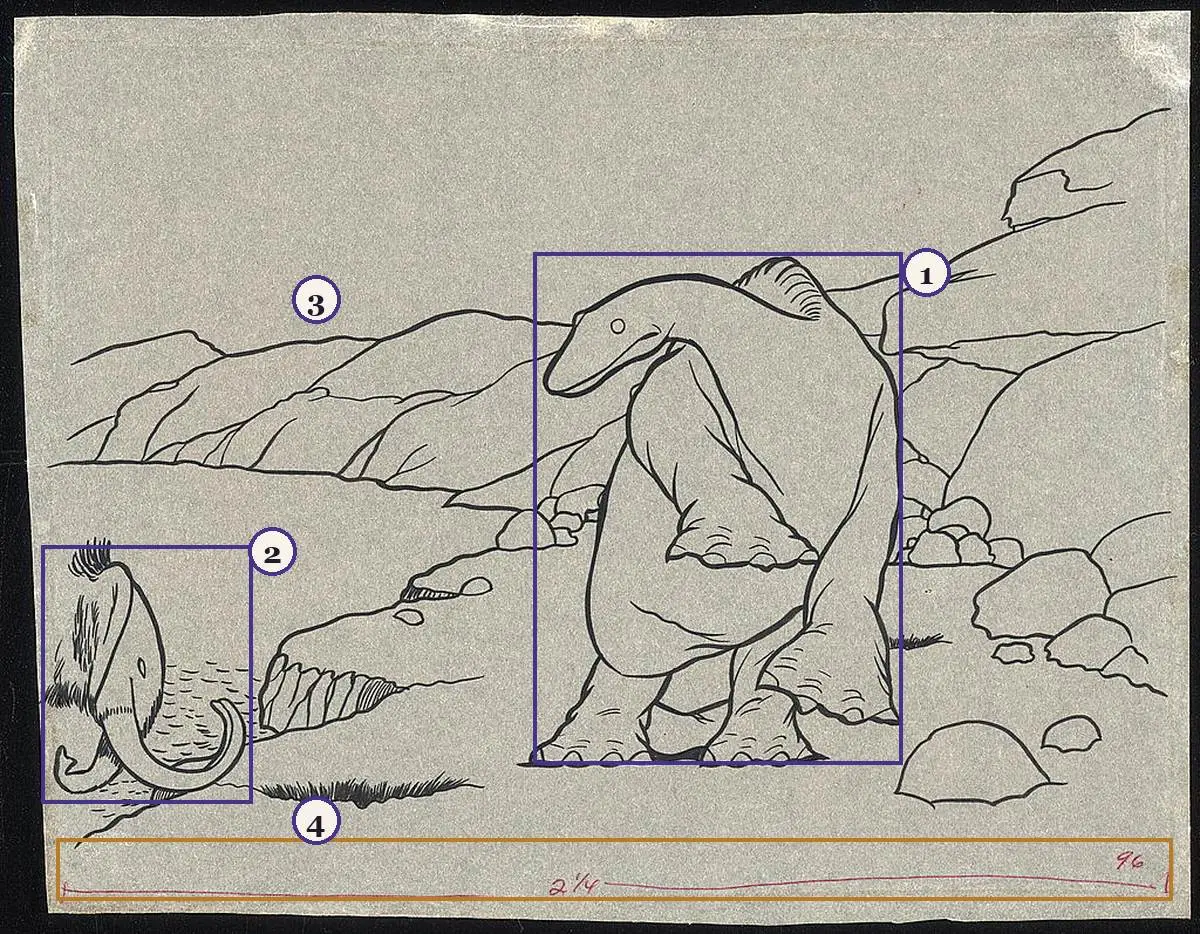
The same sheet with this page’s key: 1 Gertie, 2 the mastodon, 3 the hills, rocks and water, 4 the red marks.
“Gertie drawing LCCN 2002706759 with a numbered key” — Flickers & Tintypes — CC BY 4.0 full credit
"Gertie drawing LCCN 2002706759 with a numbered key" by Flickers & Tintypes, https://flickersandtintypes.com/early-cinema/gertie-the-dinosaur/ — CC BY 4.0, https://creativecommons.org/licenses/by/4.0/. Underlying image: "Gertie the dinosaur standing on a cliff edge looking at a mastodon (Library of Congress LCCN 2002706759)" by Winsor McCay — https://commons.wikimedia.org/wiki/File:Gertie_the_dinosaur_standing_on_a_cliff_edge_looking_at_a_mastodon_LCCN2002706759.jpg — Public domain: Public domain in the US and in the EU (Winsor McCay died in 1934, per the Commons category data; life plus 70 years ended in 2004, which covers the drawing whether or not it counts as published); the Commons file page marks it public domain (Library of Congress record not consulted directly); modified: scaled to 1200 px wide; numbered circles and outlines added over the public-domain drawing.
The key on the sheet above, in words:
- Gertie, center right, in black ink.
- The mastodon, at the left edge, in the same ink.
- Hills, rocks and water, in the same ink, around and between the animals.
- Red marks in the bottom margin, outside the drawing: a line, a 2 1/4 and a 96.
The red marks are the only things on the sheet in a second color. A thin red line runs nearly the full width of the bottom edge, with a short upright stroke at each end.
About halfway along, the line breaks for a handwritten 2 1/4. Above its right end, close to the edge of the paper, sits the 96.
Neither number is explained anywhere on the sheet or in the catalog text on Commons. A 96 could be read in several ways, and nothing visible here settles which reading is right. It is a number written on one sheet, with nothing to show that it counts Gertie’s drawings. The 2 1/4 is just as open.
The data file below lists every mark with its position in pixels on the Commons file, each with the note that its meaning is not established.
Download the notice’s claims and the drawing’s marks, with sources (CSV) source and license notes
How many drawings does one second of film need?
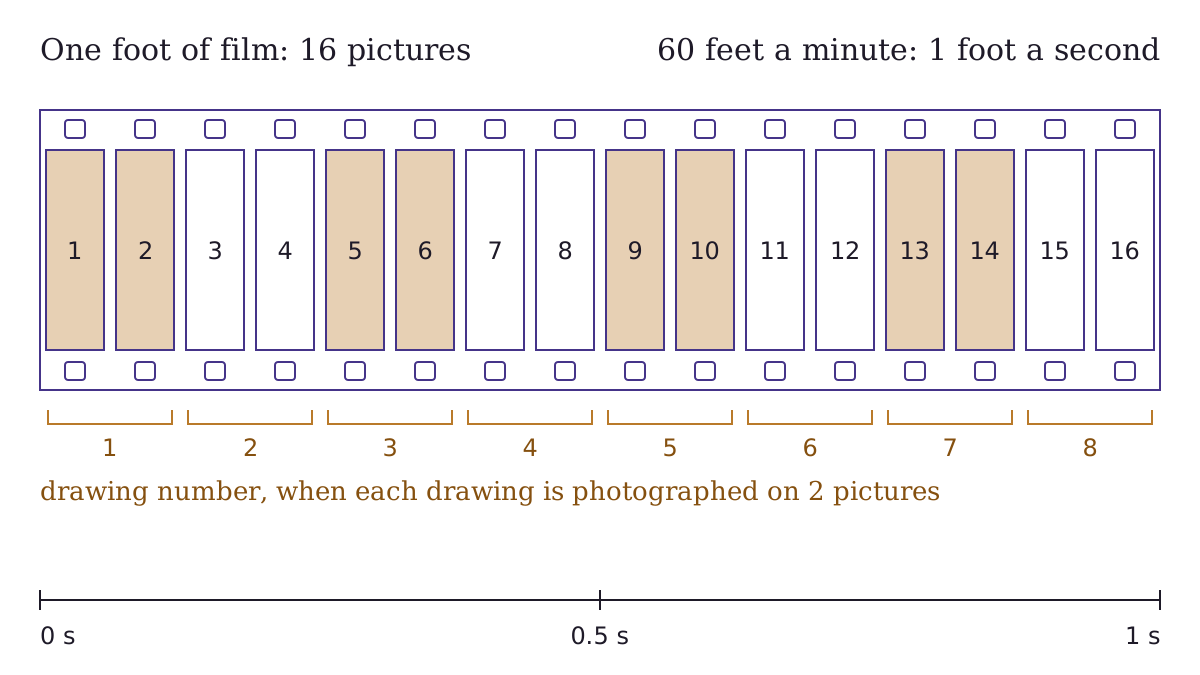
Lutz’s 1920 figures drawn out: one foot holds 16 pictures and passes in 1 second at 60 feet a minute; at 2 pictures a drawing, that is 8 drawings.
"One foot of film by Lutz’s 1920 figures" by Flickers & Tintypes, https://flickersandtintypes.com/early-cinema/gertie-the-dinosaur/ — CC BY 4.0, https://creativecommons.org/licenses/by/4.0/
Lutz gives the basic numbers for film in general, and he offers the first as the usual reckoning: “sixty feet of film pass through the projecting machine every minute.” He adds that one foot of film holds sixteen pictures. At that rate one foot passes in 1 second, and 1 second at 16 pictures a second is 16 pictures.
“One reel,” the length the 1914 notice gives, is looser than it sounds. Lutz notes that any single film subject was called a reel, while “in strict trade usage the word means a length of one thousand feet.” At his rate of sixty feet a minute, a full thousand-foot reel would run about seventeen minutes, and Lutz himself rounds it that way. The notice gives no footage, so it does not say which use of the word it meant.
A drawing does not have to fill only one of those pictures. In a worked example on pages 76 and 77, Lutz has each drawing photographed on two pictures, by two turns of the handle. At that rate one second of screen time takes 8 drawings; the arithmetic is this page’s, worked from his figures. How far a shape moves from one drawing to the next is a separate question, taken up in bouncing ball animation.
| Lutz’s figure (1920) | Value | Page |
|---|---|---|
| Film through the projector | 60 feet a minute, as generally reckoned | 52 |
| Pictures in one foot | 16 | 52 |
| Pictures in a half reel of 500 feet | eight thousand, exactly | 58 |
| Pictures per drawing in his worked example | 2 | 76–77 |
| Drawings for one second at that rate | 8 (this page’s arithmetic) | — |
Lutz also warns against the obvious leap. A half reel holds eight thousand pictures, he says, but an artist “doesn’t make anywhere near as many drawings as that.” His numbers describe practice in 1920, six years after the notice, and they say nothing about how McCay shot Gertie.
For Gertie itself, a figure of about ten thousand drawings is often repeated. This page found no period source for that figure, so it is not used here. The 96 on the sheet does not help either way.
Gertie the Dinosaur: quick answers
Who made Gertie the Dinosaur?
Moving Picture World of November 14, 1914 credits Winsor McCay, “creator of ‘Little Nemo,’ ‘Dreams of a Rarebit Fiend’ and other popular newspaper cartoons,” and calls Gertie “his hand-drawn film.”
How much did Gertie the Dinosaur earn?
Per the same notice, “The film got $350 for one week at the Palace Theater, New York.” That is a reported figure; no theater record was checked for this page.
How many drawings were made for Gertie the Dinosaur?
A figure of about ten thousand drawings is often repeated, but this page found no period source for it. Nothing shows that the 96 written on the surviving sheet is a count of the drawings.
Why does this page show no frames from Gertie the Dinosaur?
No copy found for this site has a record of where it came from and how it was treated. Frames from such a copy could not show what the 1914 prints looked like, so this page uses the notice and the drawing instead.
Prints consulted
- 1“Box Office Has a Winsor M’Cay Novelty,” The Moving Picture World 22, no. 7 (November 14, 1914): 914. https://archive.org/details/movingpicturewor22newyRead: page 914, with the cover and the date line on page 901 of the same issue, checked against the page images
- 2Winsor McCay, Gertie the dinosaur standing on a cliff edge looking at a mastodon, 1914, ink drawing, Library of Congress Prints and Photographs Division, LCCN 2002706759 (digital ID ppmsc.02839); catalog data as given on the Wikimedia Commons file page. https://commons.wikimedia.org/wiki/File:Gertie_the_dinosaur_standing_on_a_cliff_edge_looking_at_a_mastodon_LCCN2002706759.jpgRead: file page and full-size original image
- 3E. G. Lutz, Animated Cartoons: How They Are Made, Their Origin and Development. New York: Charles Scribner's Sons, 1920. https://archive.org/details/cu31924075701304Read: pages 15, 20–26, 44, 52, 58, 68–69, 76–78, 174–175, 179–181 and 256, checked against the page images

Next reel:
- A Trip to the Moon: another early film read through the print of its own time, here a seller’s catalog of thirty scene titles.
- The Great Train Robbery: a film with a traceable copy, where one close-up could open or close the show.
- Public-domain original to view: Gertie the dinosaur standing on a cliff edge looking at a mastodon (Wikimedia Commons)
Cite this page
Flickers & Tintypes. “Gertie the Dinosaur: A 1914 Trade Notice Says ‘Dinosaurus’.” Flickers & Tintypes. Published November 12, 2026. https://flickersandtintypes.com/early-cinema/gertie-the-dinosaur/. Accessed [the date you read it].
Same sectionAlso in Early Cinema
 Illustration
Early Cinema
A Trip to the Moon: Méliès’s 1903 Catalog Lists 30 Scenes
Per the Star Films catalog dated 1903, A Trip to the Moon ran about 845 feet in 30 listed scenes for $130. Scene 9 reads “Landed Right in the Eye!!!”
Picture credit
Illustration: Flickers & Tintypes. Generated schematic image — not a photograph, film frame or historical record. No copyright is claimed in this generated imagery; you may reuse it, and a credit to Flickers & Tintypes is appreciated.
Early Cinema
The Great Train Robbery (1903): Edison’s Movable Close-Up
Edison’s 1903 catalog let the operator put the bandit’s close-up at the start or the end. One public-domain copy, walked scene by scene with timecodes.
Picture credit
"Frame at 13:14.5 of this copy, from The Great Train Robbery (1903)" by Edison Manufacturing Company — https://commons.wikimedia.org/wiki/File:The_Great_Train_Robbery_(1903).webm — Public domain: Public domain in the US (published 1903; Edison catalog of 1903 marked Copyright 1903) and in the EU (director Edwin S. Porter died 1941, per the Commons creator record; no later-dying author identified); copy: Library of Congress 00694220, record not consulted directly; WebM conversion by the Commons uploader; modified: single frame extracted and scaled to 1200 px wide
 Illustration
Early Cinema
Tinting and Toning: A Tone Alone Leaves the Highlights Clear
Tinting vs toning, per Kodak’s 1918 handbook: a tint dyes the whole frame, highlights too; a tone colors only the silver image, so the highlights stay clear.
Picture credit
Illustration: Flickers & Tintypes. Generated schematic image — not a photograph, film frame or historical record. No copyright is claimed in this generated imagery; you may reuse it, and a credit to Flickers & Tintypes is appreciated.