The Great Train Robbery (1903): Edison’s Movable Close-Up
Frame card
In one line Edison’s 1903 catalog let the projectionist run the close-up of the outlaw Barnes firing at the audience either at the start or at the end. In this copy, a Commons file credited to the Library of Congress, it comes last, at 13:09.5.
Source, Year, Format, Length or Size, Access, License
- Source
- Commons WebM of Library of Congress 00694220 (record not consulted directly), checked by sha256
- Year
- 1903 (catalog marked Copyright 1903)
- Format
- Silent, black and white; this copy 1440 × 1080, 4:3, 24 frames per second with repeats
- Length or Size
- 740 feet per the catalog; this copy runs 13:27.7, with the story from 0:39.9
- Access
- Wikimedia Commons file page (WebM)
- License
- Public domain in the US (published 1903) and in the EU (director Edwin S. Porter died 1941, per the Commons creator record)
Card data (CSV) the-great-train-robbery-frame-card.csv Source and license notes
Shot list · 8 sections
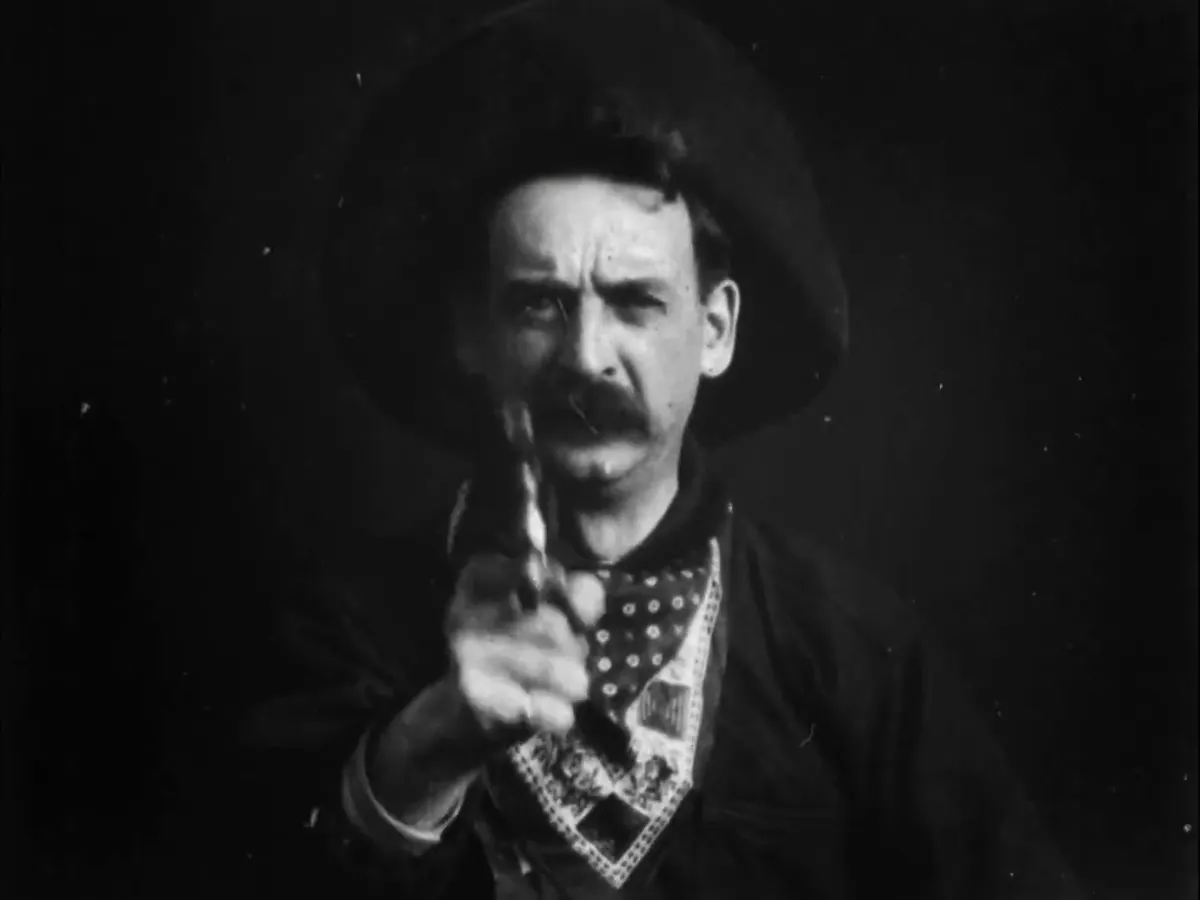
13:14.5 of this copy, file frame 19068: the outlaw the catalog calls Barnes, revolver level with the lens, a second and a half before the smoke.
“Frame at 13:14.5 of this copy, from The Great Train Robbery (1903)” — Edison Manufacturing Company — public domain full credit
"Frame at 13:14.5 of this copy, from The Great Train Robbery (1903)" by Edison Manufacturing Company — https://commons.wikimedia.org/wiki/File:The_Great_Train_Robbery_(1903).webm — Public domain: Public domain in the US (published 1903; Edison catalog of 1903 marked Copyright 1903) and in the EU (director Edwin S. Porter died 1941, per the Commons creator record; no later-dying author identified); copy: Library of Congress 00694220, record not consulted directly; WebM conversion by the Commons uploader; modified: single frame extracted and scaled to 1200 px wide
At 13:14.5 of this copy, a man in a wide hat points his revolver straight into the lens. He is not robbing anyone in this shot, and nothing around him belongs to the story. The Edison Manufacturing Company's catalog of 1903 calls him Barnes, “leader of the outlaw band,” and says the shot could go at either end of the film, “as the operator may choose.” In the copy examined here, a video file on Wikimedia Commons credited to the Library of Congress, the close-up comes last, right after the gunfight in the woods.
That single catalog line is the reason this page exists. The order of a film's shots is usually treated as settled, decided once and then printed. For this one shot, the company said in its own sales literature that the order was open. What follows is one copy, timed scene by scene; every claim is tied either to the catalog page or to a frame you can find again in the same file.
What the 1903 catalog says about Scene XIV
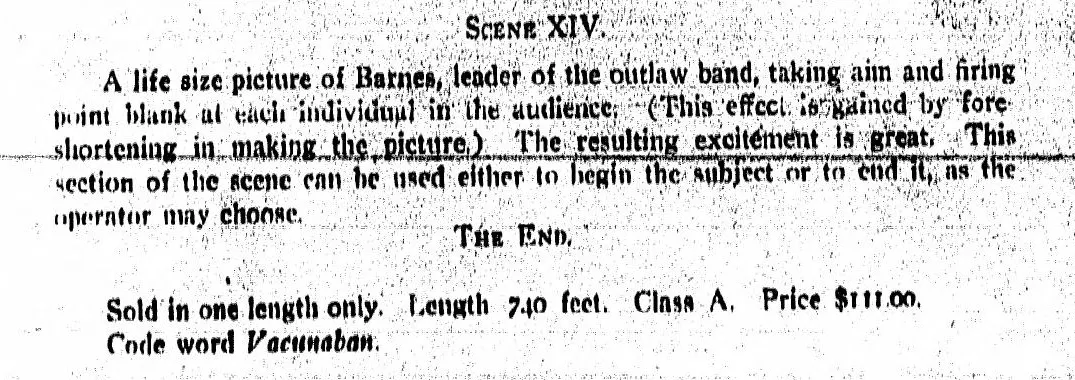
Edison catalog, 1903, last page of the synopsis: Scene XIV, The End, and the sales line.
"The Great Train Robbery, Edison Film catalog, Scene XIV and sales line" by Edison Manufacturing Company — https://archive.org/details/edisonmpc-G356 — Public domain: Public domain in the US (published 1903 with the notice Copyright 1903) and in the EU (unsigned company catalog published 1903, more than 70 years ago); modified: cropped to Scene XIV and the sales line, converted to grayscale
The catalog is a short printed sales booklet, marked “Copyright 1903,” with a “Synopsis of Scenes” numbered from Scene I to Scene XIV. Its opening paragraph promises a subject “posed and acted in faithful duplication of the genuine ‘Hold Ups’ made famous by various outlaw bands in the far West.” Its last scene, though, is not part of the hold-up at all. It reads, in full: “A life size picture of Barnes, leader of the outlaw band, taking aim and firing point blank at each individual in the audience. (This effect is gained by foreshortening in making the picture.) The resulting excitement is great. This section of the scene can be used either to begin the subject or to end it, as the operator may choose.”
The operator here means the person running the projector. So the catalog hands one editing decision to whoever showed the film, long after it left the company. The catalog offers no such choice for Scenes I to XIII; only the close-up is described as a loose piece.
The same page sets the terms of sale: “Sold in one length only. Length 740 feet. Class A. Price $111.00.” That works out to 15 cents a foot. The words “one length only” matter here: a buyer could not order a shorter version, or the robbery without its close-up. Where that one shot went was the only choice the sheet offered.
The catalog does not say which end most showmen preferred. This page does not guess. The printed page proves that the choice existed; the copy below shows only what one later copy did with it.
Close-up first or close-up last
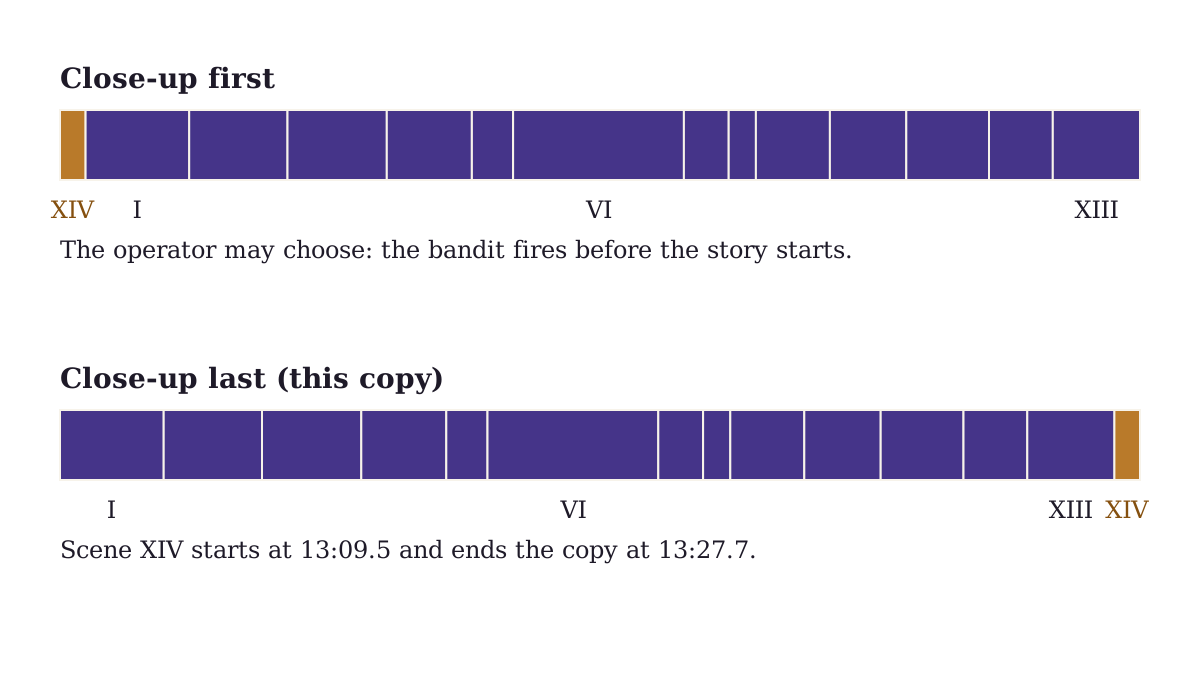
The two orders the 1903 catalog allows, drawn to the scene lengths of this copy.
"Close-up first or close-up last" by Flickers & Tintypes, https://flickersandtintypes.com/early-cinema/the-great-train-robbery/ — CC BY 4.0, https://creativecommons.org/licenses/by/4.0/
Put the close-up at the start, and the film opens with a stranger firing at you before you know who he is, so the robbery that follows plays out as the story behind that face. Put it at the end, and the shot lands after the posse has caught up with the gang, where it works more like a parting jolt than an introduction.
In this copy, scene XIV starts at 13:09.5 and runs to the end of the file at 13:27.7, a total of 18.2 seconds. That makes it the shortest of the 14 scenes. The catalog does print Scene XIV last in its list, but a numbered list has to put it somewhere, and the sentence about the operator undoes that position on the same page.
Nothing in the shot ties it to the plot. There is no train in it, no posse and no mail bag, only a plain dark background. That emptiness is what made the shot movable, because a picture with no place in the story can sit at either end without breaking anything.
The gun hand moves toward the camera rather than across the frame. The catalog's own note explains the effect: “This effect is gained by foreshortening in making the picture.” Held close to the lens, the revolver looks enormous and seems to point at every seat at once.
Fourteen scenes in one copy
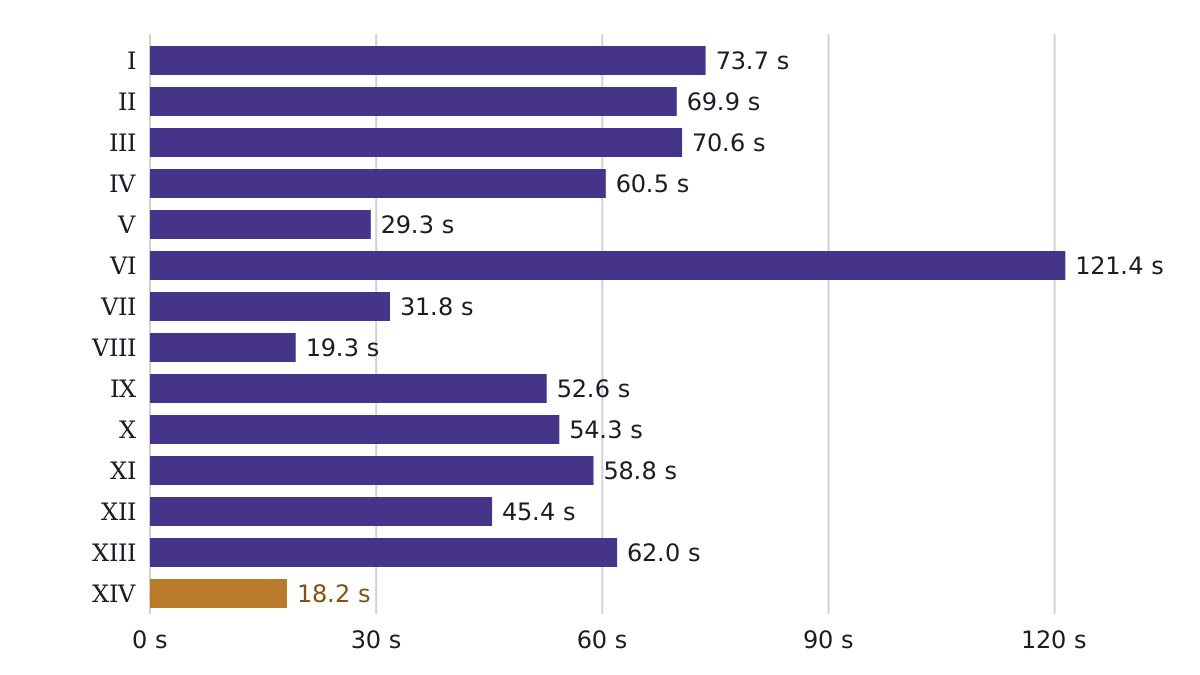
Running time of each catalog scene in this copy, in seconds; the close-up, scene XIV, is the shortest at 18.2.
"Scene lengths in this copy of The Great Train Robbery (1903)" by Flickers & Tintypes, https://flickersandtintypes.com/early-cinema/the-great-train-robbery/ — CC BY 4.0, https://creativecommons.org/licenses/by/4.0/
The copy is a WebM video file uploaded to Wikimedia Commons in 2019, where its source is given as the Library of Congress, digital ID 00694220; the library's own record was not consulted for this page. The file measures 1,440 × 1,080 pixels with square pixels, which gives a 4:3 picture. It has no sound track. Its sha256 checksum, a fingerprint of the exact file, is 5b603517655b144e2148df2f8233237408cbdacc9511f06d2aa55a3564d22499, and every timecode on this page belongs to that file and no other.
The first 39.9 seconds are not the film. They hold a library title card, a handwritten card reading “C.R. #38748,” and an Edison title card held on screen. None of those frames appear here, so the story starts at 0:39.9.
All 14 catalog scenes are present, in the catalog's order. Here they are, timed in this copy:
| Scene | Starts at | Length (seconds) | Distinct images |
|---|---|---|---|
| Scene I, telegraph office | 0:39.9 | 73.7 | 1,185 |
| Scene II, water tank | 1:53.6 | 69.9 | 1,124 |
| Scene III, express car | 3:03.5 | 70.6 | 1,134 |
| Scene IV, fight on the tender | 4:14.1 | 60.5 | 972 |
| Scene V, engine uncoupled | 5:14.5 | 29.3 | 471 |
| Scene VI, passengers robbed | 5:43.8 | 121.4 | 1,951 |
| Scene VII, escape on the engine | 7:45.2 | 31.8 | 512 |
| Scene VIII, engine stops | 8:17.1 | 19.3 | 311 |
| Scene IX, valley and horses | 8:36.4 | 52.6 | 846 |
| Scene X, telegraph office again | 9:29.0 | 54.3 | 873 |
| Scene XI, dance hall | 10:23.3 | 58.8 | 946 |
| Scene XII, chase | 11:22.2 | 45.4 | 730 |
| Scene XIII, mail bags and gunfight | 12:07.5 | 62.0 | 997 |
| Scene XIV, close-up of Barnes | 13:09.5 | 18.2 | 292 |
The longest is scene VI, at 121.4 seconds. It is a single shot of passengers lined up beside the train with their hands raised. Distinct images are the pictures left once the file's repeated frames are removed; a later section explains how. The full table, with the catalog's wording for each scene and a note on what can be seen in it, is available as a spreadsheet: Download the scene table (CSV) source and license notes.
Shots taken on a moving train
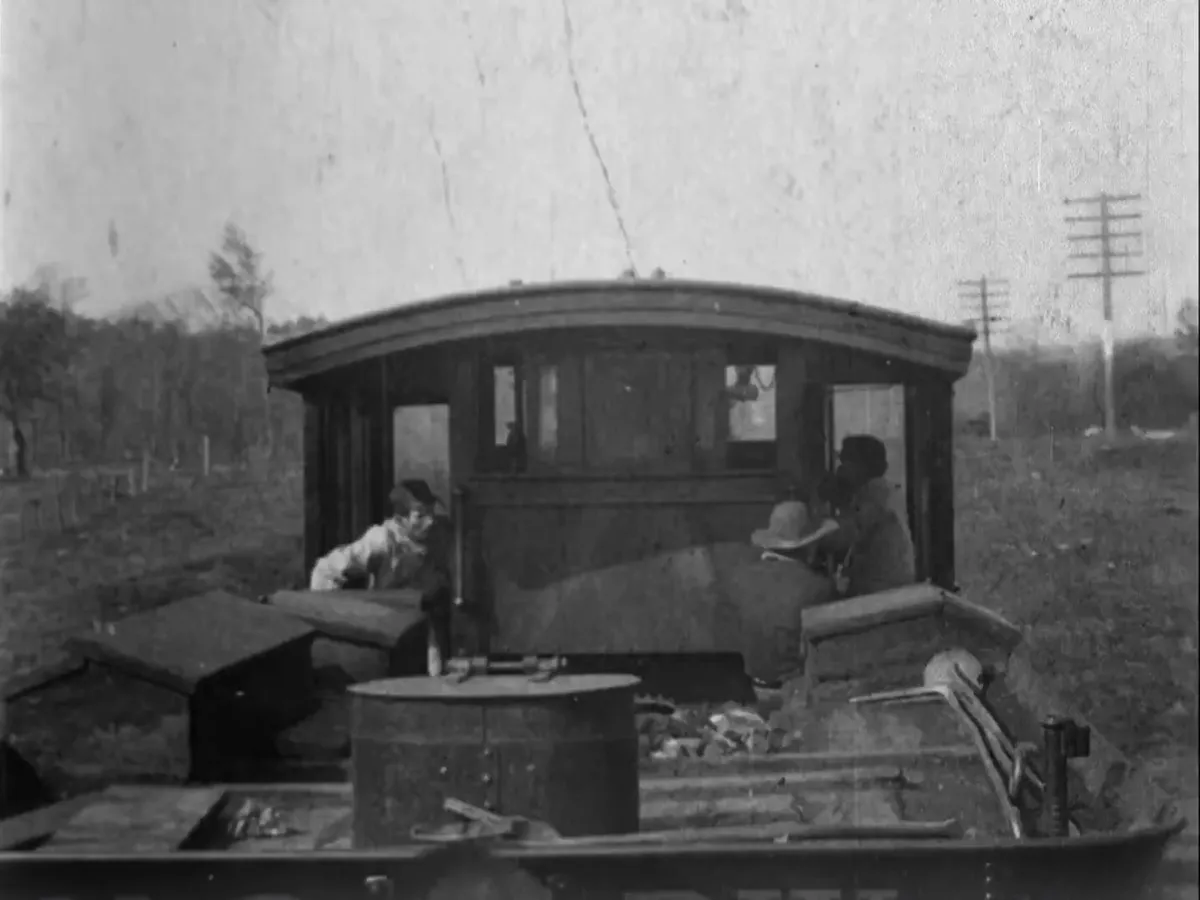
4:29.5 of this copy: scene IV, looking over the tender to the engine cab, a view the catalog says was taken from the mail car.
“Frame at 4:29.5 of this copy, from The Great Train Robbery (1903)” — Edison Manufacturing Company — public domain full credit
"Frame at 4:29.5 of this copy, from The Great Train Robbery (1903)" by Edison Manufacturing Company — https://commons.wikimedia.org/wiki/File:The_Great_Train_Robbery_(1903).webm — Public domain: Public domain in the US (published 1903; Edison catalog of 1903 marked Copyright 1903) and in the EU (director Edwin S. Porter died 1941, per the Commons creator record; no later-dying author identified); copy: Library of Congress 00694220, record not consulted directly; WebM conversion by the Commons uploader; modified: single frame extracted and scaled to 1200 px wide
The catalog takes pride in where the camera stood. Its text for Scene IV says: “This thrilling scene was taken from the mail car showing the tender and interior of locomotive cab, while the train is running forty miles an hour.” The speed is the catalog's figure, and nothing in a picture can measure it, but the view matches: the frame looks back over coal and a water tank to the cab, with fields and telegraph poles beyond.
In this copy the fight on the tender follows, and at about 4:50.5 a body is lifted and thrown over the side, as the catalog describes. Scene V then shows men working at the coupling while engine 921 pulls ahead. The catalog puts that distance at “about one hundred feet,” another figure that the picture cannot confirm.
The camera keeps working from the line: in scene VII the gang carries sacks to the engine at about 7:48, and the engine pulls away down the track toward the horizon. The catalog's Scene VIII then has the robbers “bring the engine to a stop several miles from the scene of the ‘Hold Up,’ and take to the mountains.” In this copy the engine comes to rest beside the camera, the men jump down and run, and at about 8:30 the view turns to follow them down a brushy bank instead of staying fixed on the track.
What the frames show, scene by scene
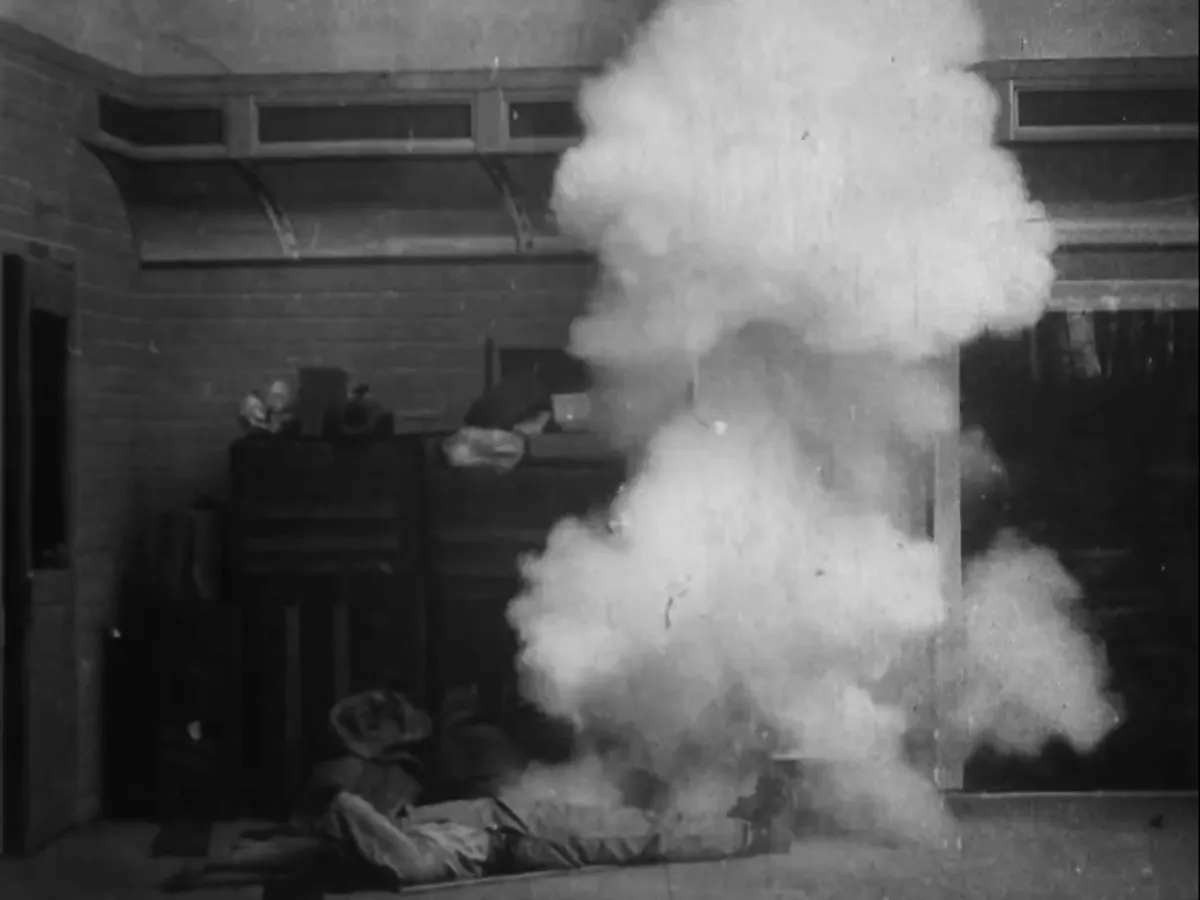
4:04.5 of this copy: scene III, the safe blown open, with the messenger stretched on the floor at lower left.
“Frame at 4:04.5 of this copy, from The Great Train Robbery (1903)” — Edison Manufacturing Company — public domain full credit
"Frame at 4:04.5 of this copy, from The Great Train Robbery (1903)" by Edison Manufacturing Company — https://commons.wikimedia.org/wiki/File:The_Great_Train_Robbery_(1903).webm — Public domain: Public domain in the US (published 1903; Edison catalog of 1903 marked Copyright 1903) and in the EU (director Edwin S. Porter died 1941, per the Commons creator record; no later-dying author identified); copy: Library of Congress 00694220, record not consulted directly; WebM conversion by the Commons uploader; modified: single frame extracted and scaled to 1200 px wide
Most of what the catalog describes can be found in the frames. In Scene I, two men overpower the telegraph operator and tie him up on the floor. In Scene II, men wait behind the legs of the water tank as the train pulls in. At 4:04.5 in scene III, a column of smoke rises from the safe, and through the car's open door at right, trees can be seen outside.
Some catalog details do not show up in this copy. The catalog's scene VI ends with the gang firing “their revolvers in the air,” which is not visible in this copy. A passenger does break from the line at about 6:45 and falls, as the catalog says. In scene XI the dance floor is crowded, but the forced dance and the beaten operator's entrance are not visible in this copy in the frames checked.
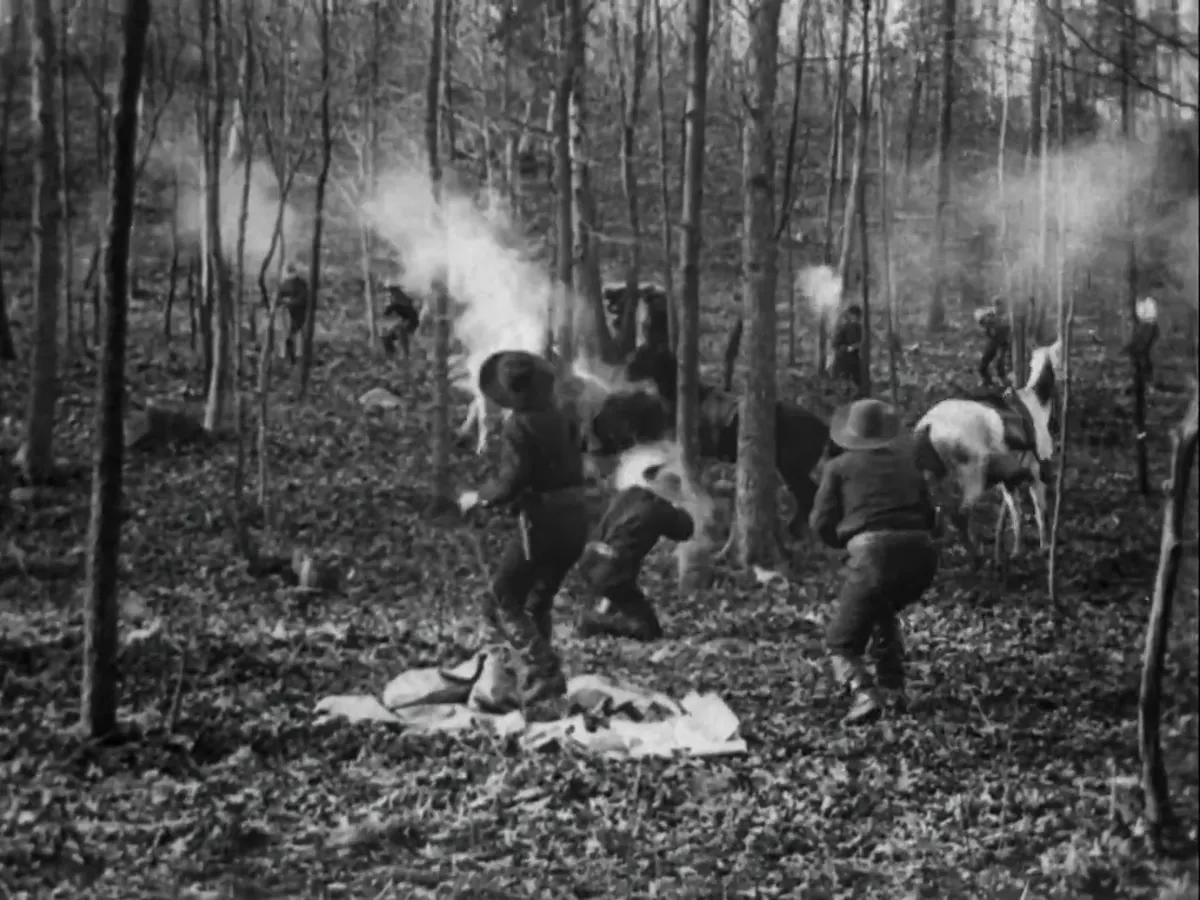
12:37.0 of this copy: scene XIII, the gunfight around the mail bags, 32.5 seconds before the close-up begins.
“Frame at 12:37.0 of this copy, from The Great Train Robbery (1903)” — Edison Manufacturing Company — public domain full credit
"Frame at 12:37.0 of this copy, from The Great Train Robbery (1903)" by Edison Manufacturing Company — https://commons.wikimedia.org/wiki/File:The_Great_Train_Robbery_(1903).webm — Public domain: Public domain in the US (published 1903; Edison catalog of 1903 marked Copyright 1903) and in the EU (director Edwin S. Porter died 1941, per the Commons creator record; no later-dying author identified); copy: Library of Congress 00694220, record not consulted directly; WebM conversion by the Commons uploader; modified: single frame extracted and scaled to 1200 px wide
Scene XII follows its catalog line closely. The catalog says one of the robbers “is shot and plunges head first from his horse.” At about 11:44 a rider leaves a white horse and lands in the road, gets up, and is down again by 11:49; in the catalog's next sentence he staggers to his feet and is shot dead. Whether he went head first is not visible in this copy.
In scene XIII, three men crouch over the mail bags, the catalog's “remaining three bandits,” and from 12:37 gunsmoke drifts through the trees.
No frames from scene X appear on this page. A real child, the operator's daughter, appears in it. Frames showing real children are not used here. Its timing is in the table, but its content is not described frame by frame.
Six frames of the close-up
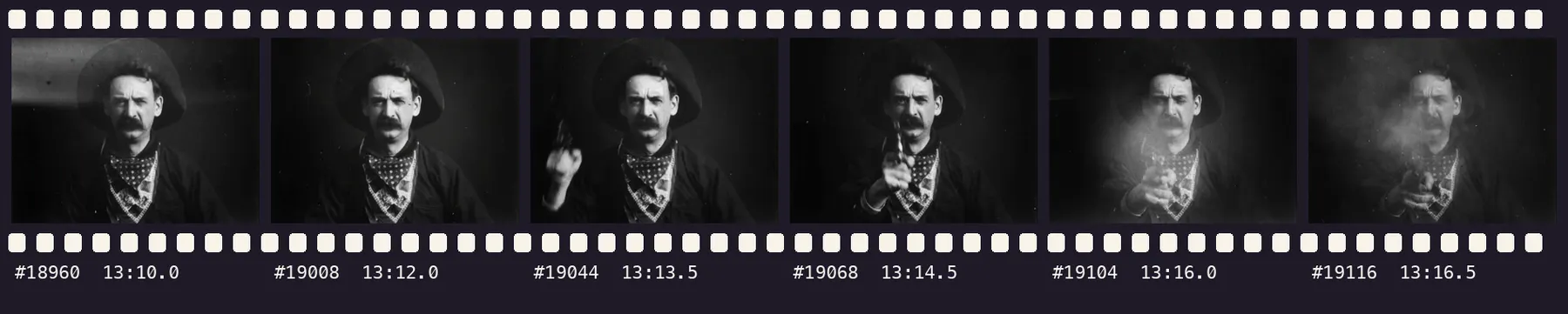
File frames 18960 to 19116, 13:10.0 to 13:16.5 of this copy: the close-up from first stare to gunsmoke, in six steps.
“The close-up of scene XIV in six frames” — Flickers & Tintypes — CC BY 4.0 full credit
"The close-up of scene XIV in six frames" by Flickers & Tintypes, https://flickersandtintypes.com/early-cinema/the-great-train-robbery/ — CC BY 4.0, https://creativecommons.org/licenses/by/4.0/. Underlying image: "Frame at 13:10.0 of this copy, from The Great Train Robbery (1903)" by Edison Manufacturing Company — https://commons.wikimedia.org/wiki/File:The_Great_Train_Robbery_(1903).webm — Public domain: Public domain in the US (published 1903; Edison catalog of 1903 marked Copyright 1903) and in the EU (director Edwin S. Porter died 1941, per the Commons creator record; no later-dying author identified); copy: Library of Congress 00694220, record not consulted directly; WebM conversion by the Commons uploader; modified: single frame extracted and scaled to 1200 px wide, six frames scaled to 300 px wide and set side by side with sprocket holes, file frame numbers and timecodes. Underlying image: "Frame at 13:12.0 of this copy, from The Great Train Robbery (1903)" by Edison Manufacturing Company — https://commons.wikimedia.org/wiki/File:The_Great_Train_Robbery_(1903).webm — Public domain: Public domain in the US (published 1903; Edison catalog of 1903 marked Copyright 1903) and in the EU (director Edwin S. Porter died 1941, per the Commons creator record; no later-dying author identified); copy: Library of Congress 00694220, record not consulted directly; WebM conversion by the Commons uploader; modified: single frame extracted and scaled to 1200 px wide, six frames scaled to 300 px wide and set side by side with sprocket holes, file frame numbers and timecodes. Underlying image: "Frame at 13:13.5 of this copy, from The Great Train Robbery (1903)" by Edison Manufacturing Company — https://commons.wikimedia.org/wiki/File:The_Great_Train_Robbery_(1903).webm — Public domain: Public domain in the US (published 1903; Edison catalog of 1903 marked Copyright 1903) and in the EU (director Edwin S. Porter died 1941, per the Commons creator record; no later-dying author identified); copy: Library of Congress 00694220, record not consulted directly; WebM conversion by the Commons uploader; modified: single frame extracted and scaled to 1200 px wide, six frames scaled to 300 px wide and set side by side with sprocket holes, file frame numbers and timecodes. Underlying image: "Frame at 13:14.5 of this copy, from The Great Train Robbery (1903)" by Edison Manufacturing Company — https://commons.wikimedia.org/wiki/File:The_Great_Train_Robbery_(1903).webm — Public domain: Public domain in the US (published 1903; Edison catalog of 1903 marked Copyright 1903) and in the EU (director Edwin S. Porter died 1941, per the Commons creator record; no later-dying author identified); copy: Library of Congress 00694220, record not consulted directly; WebM conversion by the Commons uploader; modified: single frame extracted and scaled to 1200 px wide, six frames scaled to 300 px wide and set side by side with sprocket holes, file frame numbers and timecodes. Underlying image: "Frame at 13:16.0 of this copy, from The Great Train Robbery (1903)" by Edison Manufacturing Company — https://commons.wikimedia.org/wiki/File:The_Great_Train_Robbery_(1903).webm — Public domain: Public domain in the US (published 1903; Edison catalog of 1903 marked Copyright 1903) and in the EU (director Edwin S. Porter died 1941, per the Commons creator record; no later-dying author identified); copy: Library of Congress 00694220, record not consulted directly; WebM conversion by the Commons uploader; modified: single frame extracted and scaled to 1200 px wide, six frames scaled to 300 px wide and set side by side with sprocket holes, file frame numbers and timecodes. Underlying image: "Frame at 13:16.5 of this copy, from The Great Train Robbery (1903)" by Edison Manufacturing Company — https://commons.wikimedia.org/wiki/File:The_Great_Train_Robbery_(1903).webm — Public domain: Public domain in the US (published 1903; Edison catalog of 1903 marked Copyright 1903) and in the EU (director Edwin S. Porter died 1941, per the Commons creator record; no later-dying author identified); copy: Library of Congress 00694220, record not consulted directly; WebM conversion by the Commons uploader; modified: single frame extracted and scaled to 1200 px wide, six frames scaled to 300 px wide and set side by side with sprocket holes, file frame numbers and timecodes.
Read the strip from left to right. At 13:10.0 and again at 13:12.0 the man only stares into the lens, and at 13:13.5 his hand swings the revolver up, blurred by the speed of the movement. At 13:14.5, the frame at the top of this page, the barrel points straight out of the screen. At 13:16.0 white smoke spreads from the muzzle, and by 13:16.5 his face shows through a cloud.
The first shot comes about six and a half seconds into the close-up. A fresh puff of smoke at the muzzle around 13:20 looks like another shot. Through the smoke and after it, he keeps the gun on the lens, firing at “each individual in the audience,” in the catalog's words, and the copy ends at 13:27.7 with the close-up still running.
The whole shot holds 292 distinct images in this copy: a few seconds of performance built around one effect. The catalog's word for that effect was excitement.
Sixteen images a second, stored as 24
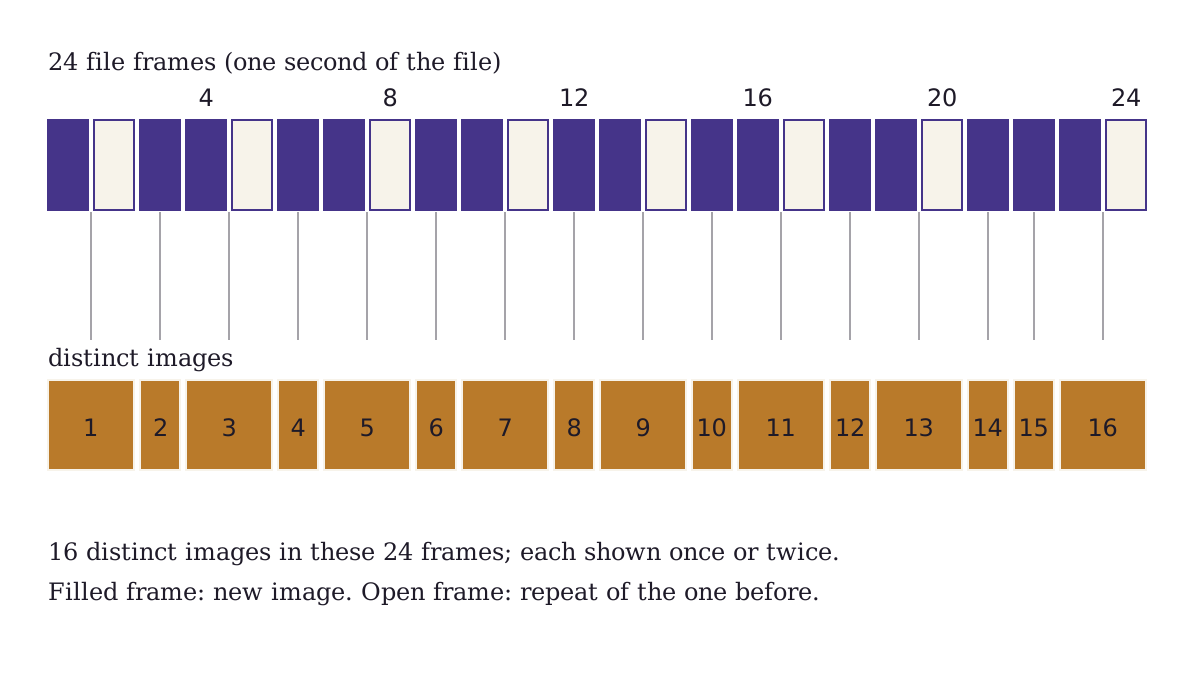
File frames 18973 to 18996, 13:10.5 to 13:11.5 of this copy: 24 frames carry 16 distinct images, each shown for one frame or two.
"One second of file frames and the images behind them" by Flickers & Tintypes, https://flickersandtintypes.com/early-cinema/the-great-train-robbery/ — CC BY 4.0, https://creativecommons.org/licenses/by/4.0/
The file plays at 24 frames per second. Many of those frames repeat the one before. Comparing every frame with the next, by this site's count the story section from 0:39.9 to 13:27.7 holds 18,426 file frames and 12,344 distinct images, an average of 16.08 distinct images per second.
The repeats follow a steady beat. Of the 12,344 images, 6,265 fill one file frame, 6,076 fill two, and only 3 fill three. Single and double mostly alternate, so on average every two images take three frames. That is how 16 images a second are spread across 24 frames: one second at 16 images per second becomes 24 frames, 8 of them repeats.
This tells you how the file was made, not how fast the film was projected in 1903. A transfer set up for 16 images a second could reflect the source, a laboratory choice or a standard setting, and this copy offers no way to tell those apart. This page makes no claim about the original speed. A spinning phenakistiscope disc raises the same question of how many pictures pass the eye each second.
Looking for the splice scar
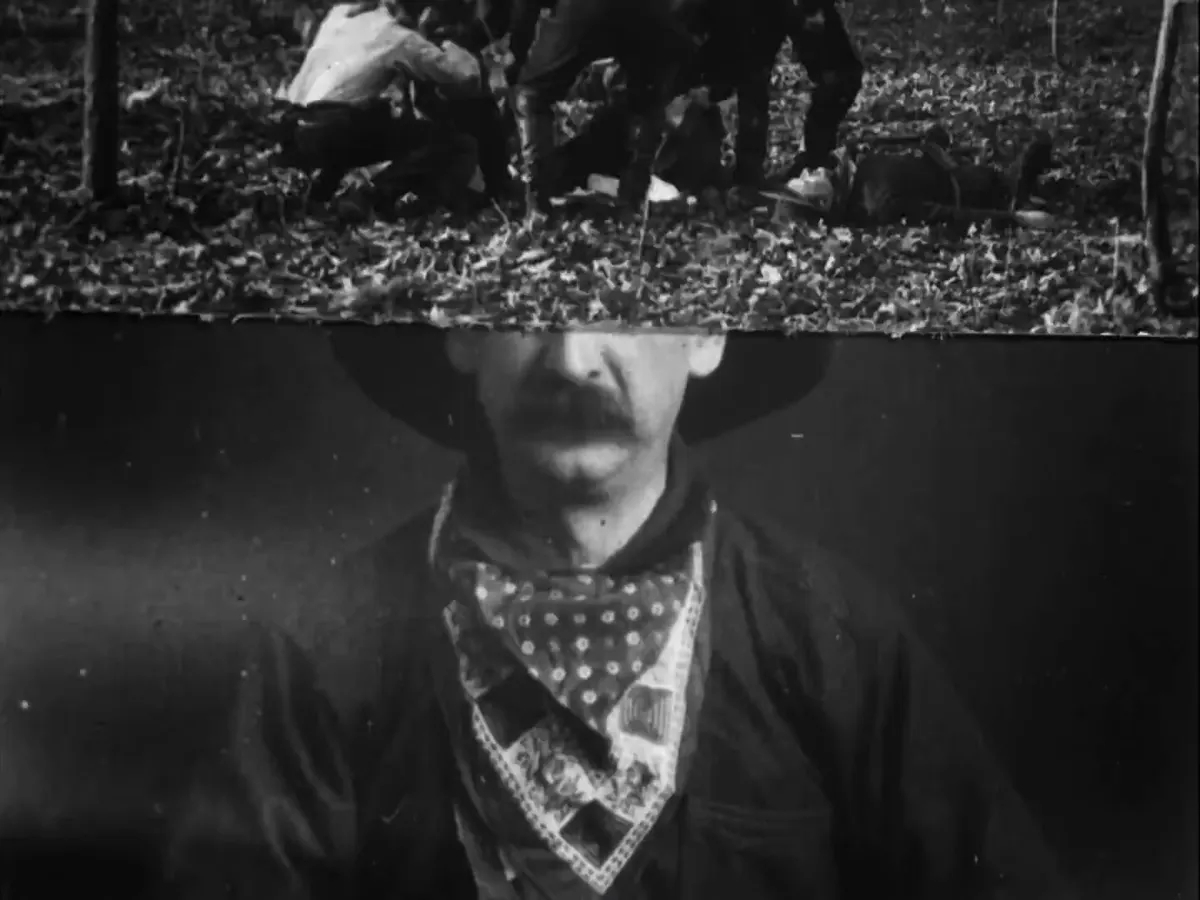
13:09.6 of this copy, file frame 18950: the end of scene XIII above the start of the close-up, divided by a ragged line; the frame before looks the same.
“Frame at 13:09.6 of this copy, from The Great Train Robbery (1903)” — Edison Manufacturing Company — public domain full credit
"Frame at 13:09.6 of this copy, from The Great Train Robbery (1903)" by Edison Manufacturing Company — https://commons.wikimedia.org/wiki/File:The_Great_Train_Robbery_(1903).webm — Public domain: Public domain in the US (published 1903; Edison catalog of 1903 marked Copyright 1903) and in the EU (director Edwin S. Porter died 1941, per the Commons creator record; no later-dying author identified); copy: Library of Congress 00694220, record not consulted directly; WebM conversion by the Commons uploader; modified: single frame extracted and scaled to 1200 px wide
The splice scar is a physical join in a film copy, from editing, repair or added titles; it counts as an original editing choice only when version comparison or records support that reading. On a print, you could hold the join up to the light. In a video file, only its traces remain.
The obvious place to look is file frame 18950, at 13:09.6, and the frame before it, which looks the same. The top third shows the forest floor from scene XIII, the rest shows the close-up from the nose down, and a ragged edge runs between them. Two pieces of film meeting out of line can look like this. So can damage, or a fault in copying or scanning.
The same kind of frame sits at four other scene changes in this copy: 8:17.0, 8:36.4, 11:22.1 to 11:22.2 and 12:07.5. Faults inside scenes turn up too, at 8:13.8 and from 12:59.1, where part of the picture goes dark.
None of these marks can be dated from this file alone, so none shows whether a join was made in 1903, in a later print, or during transfer. No splice scar is confirmed in this copy, and none is read here as an editing choice. The split at 13:09.6 does sit where the close-up meets the story, but with the same mark at four other cuts, its place says nothing about how the close-up was attached.
The catalog promised a choice that this copy cannot settle. The 1903 booklet gave the operator either end; this file shows one answer, made at some point between 1903 and its upload, by someone it does not name. Sequence photographs raise a similar question about order and time, and The Horse in Motion takes it up with a row of still frames.
Prints consulted
- 1Edison Manufacturing Co., The Great Train Robbery (Edison Film catalog), Orange, N.J., 1903. https://archive.org/details/edisonmpc-G356Read: pages 2–4 of the scan (synopsis of Scenes I to XIV and the sales line), checked against the page images
- 2The Great Train Robbery (1903), WebM file on Wikimedia Commons, source given as Library of Congress digital ID 00694220, uploaded 8 July 2019. https://commons.wikimedia.org/wiki/File:The_Great_Train_Robbery_(1903).webmRead: file page and the complete video file (sha256 5b603517655b144e2148df2f8233237408cbdacc9511f06d2aa55a3564d22499)
Next reel:
- A Trip to the Moon: another maker's catalog from the same year, read scene by scene where no reliable copy can be checked.
- Tinting and Toning: what the color on a silent print can show, and what it cannot prove about the first audiences.
- Public-domain original to view: The Great Train Robbery (1903), WebM on Wikimedia Commons
Cite this page
Flickers & Tintypes. “The Great Train Robbery (1903): Edison’s Movable Close-Up.” Flickers & Tintypes. Published November 12, 2026. https://flickersandtintypes.com/early-cinema/the-great-train-robbery/. Accessed [the date you read it].
Same sectionAlso in Early Cinema
 Illustration
Early Cinema
A Trip to the Moon: Méliès’s 1903 Catalog Lists 30 Scenes
Per the Star Films catalog dated 1903, A Trip to the Moon ran about 845 feet in 30 listed scenes for $130. Scene 9 reads “Landed Right in the Eye!!!”
Picture credit
Illustration: Flickers & Tintypes. Generated schematic image — not a photograph, film frame or historical record. No copyright is claimed in this generated imagery; you may reuse it, and a credit to Flickers & Tintypes is appreciated.
 Illustration
Early Cinema
Tinting and Toning: A Tone Alone Leaves the Highlights Clear
Tinting vs toning, per Kodak’s 1918 handbook: a tint dyes the whole frame, highlights too; a tone colors only the silver image, so the highlights stay clear.
Picture credit
Illustration: Flickers & Tintypes. Generated schematic image — not a photograph, film frame or historical record. No copyright is claimed in this generated imagery; you may reuse it, and a credit to Flickers & Tintypes is appreciated.
Early Cinema
Gertie the Dinosaur: A 1914 Trade Notice Says ‘Dinosaurus’
Per Moving Picture World of November 14, 1914, Winsor McCay’s hand-drawn Gertie was to be marketed as “the Dinosaurus” and reportedly got $350 for a week.
Picture credit
"Gertie the dinosaur standing on a cliff edge looking at a mastodon (Library of Congress LCCN 2002706759)" by Winsor McCay — https://commons.wikimedia.org/wiki/File:Gertie_the_dinosaur_standing_on_a_cliff_edge_looking_at_a_mastodon_LCCN2002706759.jpg — Public domain: Public domain in the US and in the EU (Winsor McCay died in 1934, per the Commons category data; life plus 70 years ended in 2004, which covers the drawing whether or not it counts as published); the Commons file page marks it public domain (Library of Congress record not consulted directly)