Phenakistiscope: A Spinning Disk You Watched in a Mirror
Frame card
In one line A phenakistiscope is a slotted disk with rings of drawings, spun in front of a mirror and watched through the slits. Per Plateau 1833 and Lutz 1920, as many drawings as slits stay in place; one slot more sends them round.
Source, Year, Format, Length or Size, Access, License
- Source
- Cooper Hewitt 1948-124-4, Optical Toy, Phenakistiscope Disc with Geometric Shapes
- Year
- circa 1840 (museum record); the name was in print by 1833
- Format
- Hand-colored lithograph on paperboard; 10 slits; figure sets of 10 and 9 (outer ring), 11 and 9 (inner ring)
- Length or Size
- 25 cm across (museum record)
- Access
- Cooper Hewitt catalog photo on Wikimedia Commons
- License
- Public domain: published about 1840, author unknown; faithful reproduction (PD-Art)
Card data (CSV) phenakistiscope-frame-card.csv Source and license notes
Entry fields
- Name
- Phenakistiscope; spelled phénakisticope by Plateau (1833) and phenakistoscope by Lutz (1920); Horner (1834) calls the disk the magic disk
- Date range and evidence
- Named in print by 1833; example disk circa 1840 (Cooper Hewitt record)
- Size or running time
- Example disk 25 cm across; one turn shows each ring of drawings once
- Process or material
- Optical toy: a cardboard disk with slits near the rim and drawings on one face, spun before a mirror and watched with one eye through the slits
- How to recognize it
- Flat round card with a center hole, a ring of evenly spaced slits near the edge, and rings of drawings on one face
- Often confused with
- Zoetrope: an open drum with slits and drawings inside, watched without a mirror
- Where to see one
- Cooper Hewitt 1948-124-4 (Josef Bermann, Vienna, circa 1840)
Card data (CSV) phenakistiscope-entry.csv Source and license notes
Shot list · 5 sections
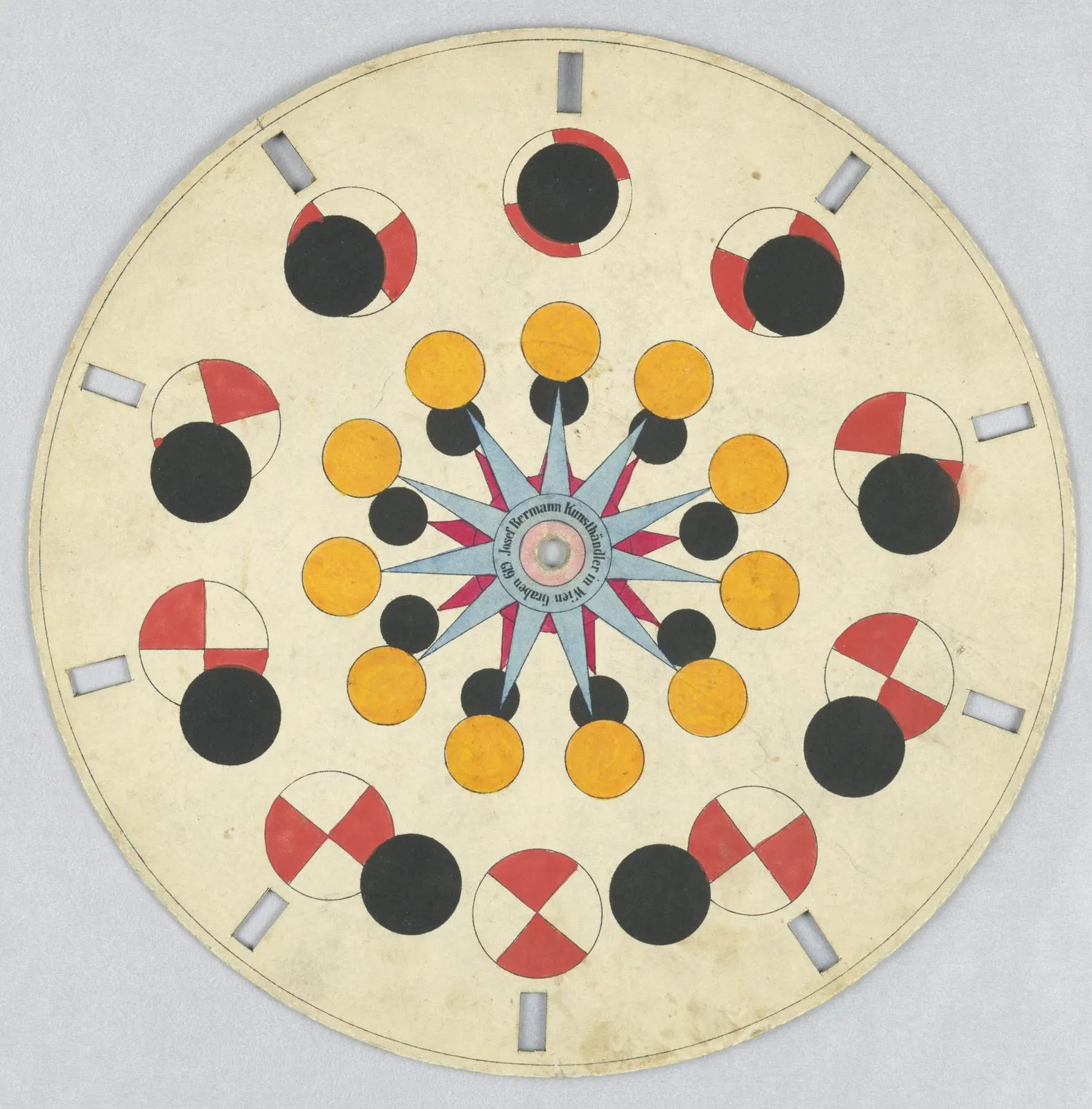
Cooper Hewitt 1948-124-4, about 1840: ten slits near the rim, and two rings of circles inside them.
“Optical Toy, Phenakistiscope Disc with Geometric Shapes, ca. 1840 (Cooper Hewitt 1948-124-4)” — Unknown author — public domain full credit
"Optical Toy, Phenakistiscope Disc with Geometric Shapes, ca. 1840 (Cooper Hewitt 1948-124-4)" by Unknown author — https://commons.wikimedia.org/wiki/File:Optical_Toy,_Phenakistiscope_Disc_with_Geometric_Shapes,_ca._1840_(CH_18607983).jpg — Public domain: Public domain in the US (published about 1840) and in the EU (anonymous work published in Vienna about 1840; the 70-year term from publication expired long ago); faithful reproduction of a two-dimensional work (Commons PD-Art); modified: scaled from 3390 x 3444 to 1575 x 1600 px; whole disk, not cropped
Count the slits on Cooper Hewitt disk 1948-124-4 and you get 10, spaced evenly near the rim. The disk is a phenakistiscope: a card printed with rings of drawings on one face, spun in front of a mirror. You turn the printed side toward the glass and look with one eye through the slits. What you watch is the reflection, and in it the drawings move.
Then count the drawings. Their number decides what they appear to do, and only one set of figures on this disk matches the 10 slits. In an 1833 paper the Belgian physicist Plateau explained the rule: with as many figures as slits, they perform their action on the spot; with slightly more or fewer, they travel in one direction or the other.
How do you look at a phenakistiscope?
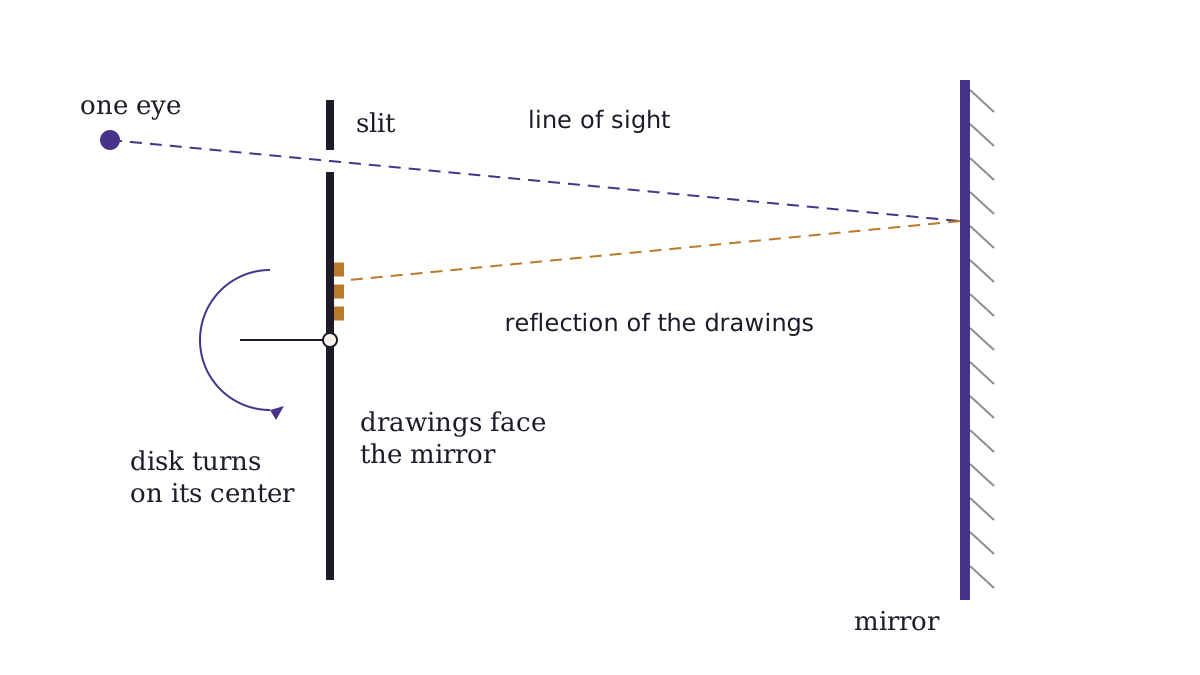
Side view: the sight line passes through a slit to the mirror, which shows the drawn face of the same disk.
"How a phenakistiscope is watched: eye, slit, disk and mirror" by Flickers & Tintypes, https://flickersandtintypes.com/animation-loops/phenakistiscope/ — CC BY 4.0, https://creativecommons.org/licenses/by/4.0/
Plateau described the setup in French, in the Annales de chimie et de physique; the English renderings of his words on this page are this site’s translations. A cardboard disk is pierced near its edge with small openings, and figures are painted on one face. You turn it about its center “vis-à-vis d’un miroir,” facing a mirror, and look with one eye through the openings. The figures then stop sharing the turn of the disk and make movements of their own.
Lutz’s 1920 handbook, Animated Cartoons, gives the same description in English: in his account the toy is a big cardboard disk with pictures on one face, held in front of a mirror and viewed through its slots. Lutz spells it phenakistoscope; Plateau’s title has phénakisticope. This page follows the Cooper Hewitt object title: phenakistiscope.
The slits do the essential work. Plateau explained that each opening lets the eye see the disk for only a very short time. In that moment the disk turns so little that it looks as if it stood still, so each glimpse is sharp. Lutz compared the plan to a film projector: the slits match the open parts of a turning shutter, and the solid card between them matches the parts that block the light.
Same count stays put, one slot more travels
Plateau’s own examples show the rule at work. For dancers doing pirouettes, he wrote, set “un nombre de figures égal à celui des fentes,” as many figures as slits, each a little further into the turn. The dancers then seem to spin in place. For men walking, use a number of figures “un peu plus grand ou un peu moindre,” a little greater or a little less than the openings, depending on which way they should go.
Lutz put the same idea in terms of slots. With equal numbers, he says, the figures stay where they are drawn. With “one slot more,” and the disk turned in the proper direction, the row of drawings appears to be “going around a circle.”
The loop below models both situations with a single dot. Each frame is one glimpse through a slit. The speed is an assumed 3 turns a second, so 10 slits give 30 glimpses a second. Each drawing shows the dot a little further round a small circle of its own, which stands in for an action like a pirouette.
Ten slits: ten drawings stay put, nine travel round
10 slots, 10 drawings
10 slots, 9 drawings
Every frame, side by side
10 slots, 10 drawings
- 1drawing 1 at the top
- 2
- 3
- 4
- 5
- 6
- 7
- 8
- 9
- 10
- 11
- 12
- 13
- 14
- 15
- 16
- 17
- 18
- 19
- 20
- 21
- 22
- 23
- 24
- 25
- 26
- 27
- 28
- 29
- 30
- 31
- 32
- 33
- 34
- 35
- 36
- 37
- 38
- 39
- 40
- 41
- 42
- 43
- 44
- 45
- 46
- 47
- 48
- 49
- 50
- 51
- 52
- 53
- 54
- 55
- 56
- 57
- 58
- 59
- 60
- 61
- 62
- 63
- 64
- 65
- 66
- 67
- 68
- 69
- 70
- 71
- 72
- 73
- 74
- 75
- 76
- 77
- 78
- 79
- 80
- 81
- 82
- 83
- 84
- 85
- 86
- 87
- 88
- 89
- 90
10 slots, 9 drawings
- 1drawing 1 at the top
- 2
- 3
- 4
- 5
- 6
- 7
- 8
- 9
- 10
- 11
- 12
- 13
- 14
- 15
- 16
- 17
- 18
- 19
- 20
- 21
- 22
- 23
- 24
- 25
- 26
- 27
- 28
- 29
- 30
- 31
- 32
- 33
- 34
- 35
- 36
- 37
- 38
- 39
- 40
- 41
- 42
- 43
- 44
- 45
- 46
- 47
- 48
- 49
- 50
- 51
- 52
- 53
- 54
- 55
- 56
- 57
- 58
- 59
- 60
- 61
- 62
- 63
- 64
- 65
- 66
- 67
- 68
- 69
- 70
- 71
- 72
- 73
- 74
- 75
- 76
- 77
- 78
- 79
- 80
- 81
- 82
- 83
- 84
- 85
- 86
- 87
- 88
- 89
- 90
90 frames at 30 frames per second: a 3-second loop, 2 versions side by side.
Frame data (CSV) phenakistiscope-slot-loop.csv Source and license notes
Credits for this loop
- "Ten slits: ten drawings stay put, nine travel round" by Flickers & Tintypes, https://flickersandtintypes.com/animation-loops/phenakistiscope/ — CC BY 4.0, https://creativecommons.org/licenses/by/4.0/
On the left, 10 drawings meet 10 slits, so every glimpse finds a drawing in the same spot and the dot circles in place. On the right, 9 drawings sit 40 degrees apart while the disk turns 36 degrees between glimpses. Each glimpse lands 4 degrees short, so the dot works its way round the disk: 360 degrees in 90 glimpses, or 3 seconds.
Counting the Vienna disk
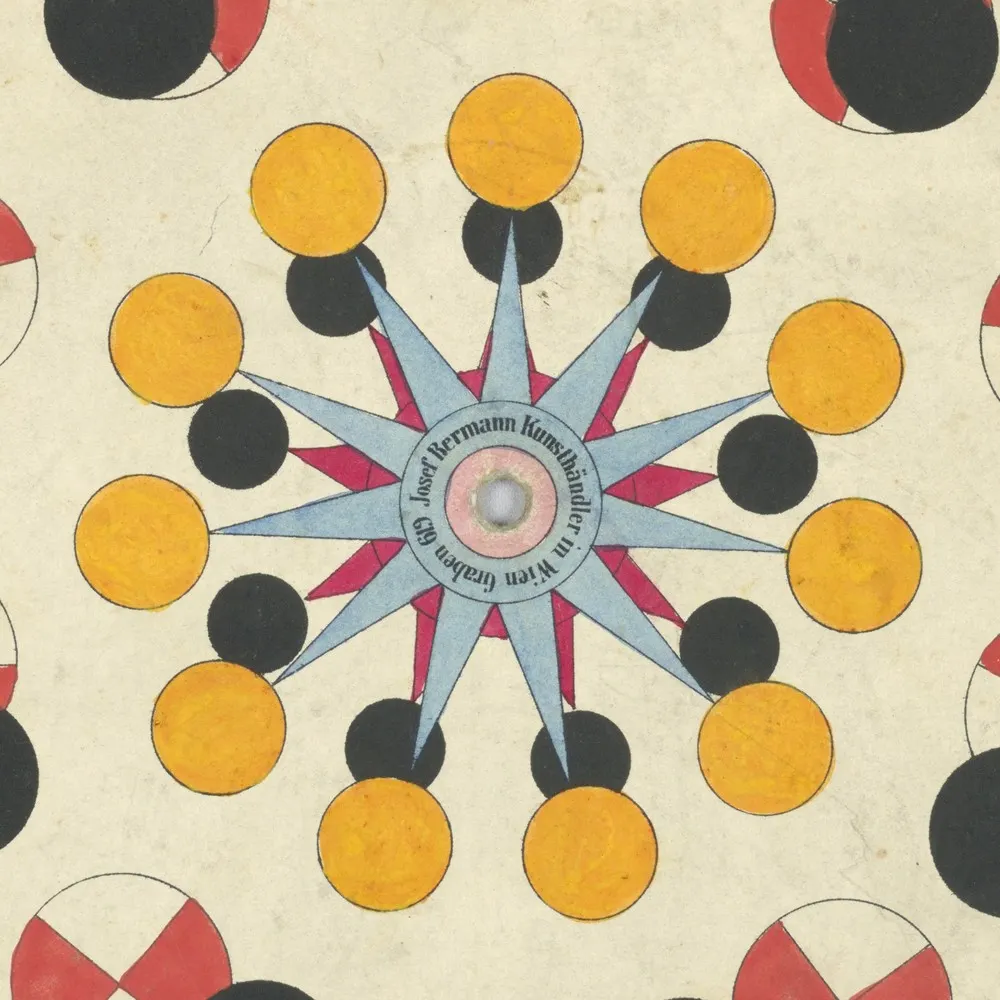
Cooper Hewitt 1948-124-4, center: 11 yellow and 9 black circles by this site’s count, and the dealer’s name and address printed round the hole.
“Optical Toy, Phenakistiscope Disc with Geometric Shapes, ca. 1840 (Cooper Hewitt 1948-124-4), center detail” — Unknown author — public domain full credit
"Optical Toy, Phenakistiscope Disc with Geometric Shapes, ca. 1840 (Cooper Hewitt 1948-124-4), center detail" by Unknown author — https://commons.wikimedia.org/wiki/File:Optical_Toy,_Phenakistiscope_Disc_with_Geometric_Shapes,_ca._1840_(CH_18607983).jpg — Public domain: Public domain in the US (published about 1840) and in the EU (anonymous work published in Vienna about 1840; the 70-year term from publication expired long ago); faithful reproduction of a two-dimensional work (Commons PD-Art); modified: cropped to the center of the disk and scaled to 1000 x 1000 px
Back to the disk itself. The printed ring around the center hole reads “Josef Bermann Kunsthändler in Wien Graben 619,” German for Josef Bermann, art dealer in Vienna, Graben 619 (this site’s translation). The museum record dates the disk to about 1840 and gives it as 25 cm across, a hand-colored lithograph on paperboard.
This site’s count, made on the full-size museum photograph, finds 10 slits and four sets of figures. The table sets each one against the slits.
| Figures on the disk | This site’s count | Against 10 slits | By Plateau’s rule |
|---|---|---|---|
| Red-and-white circles, outer ring | 10 | equal | stay in place |
| Black circles, outer ring | 9 | one slot more | travel round |
| Yellow circles, inner ring | 11 | one slot fewer | travel round the other way |
| Black circles, inner ring | 9 | one slot more | travel round |
The museum description on the Commons file page agrees with that result. It says a small black circle passes forward over a red-and-white circle, and that black and yellow circles rotate around a star. The disk was not spun for this page, so the last column applies the rule to a count. It is not something seen in motion.
Download the disk count and the slot rule (CSV) source and license notes
Who made the phenakistiscope?
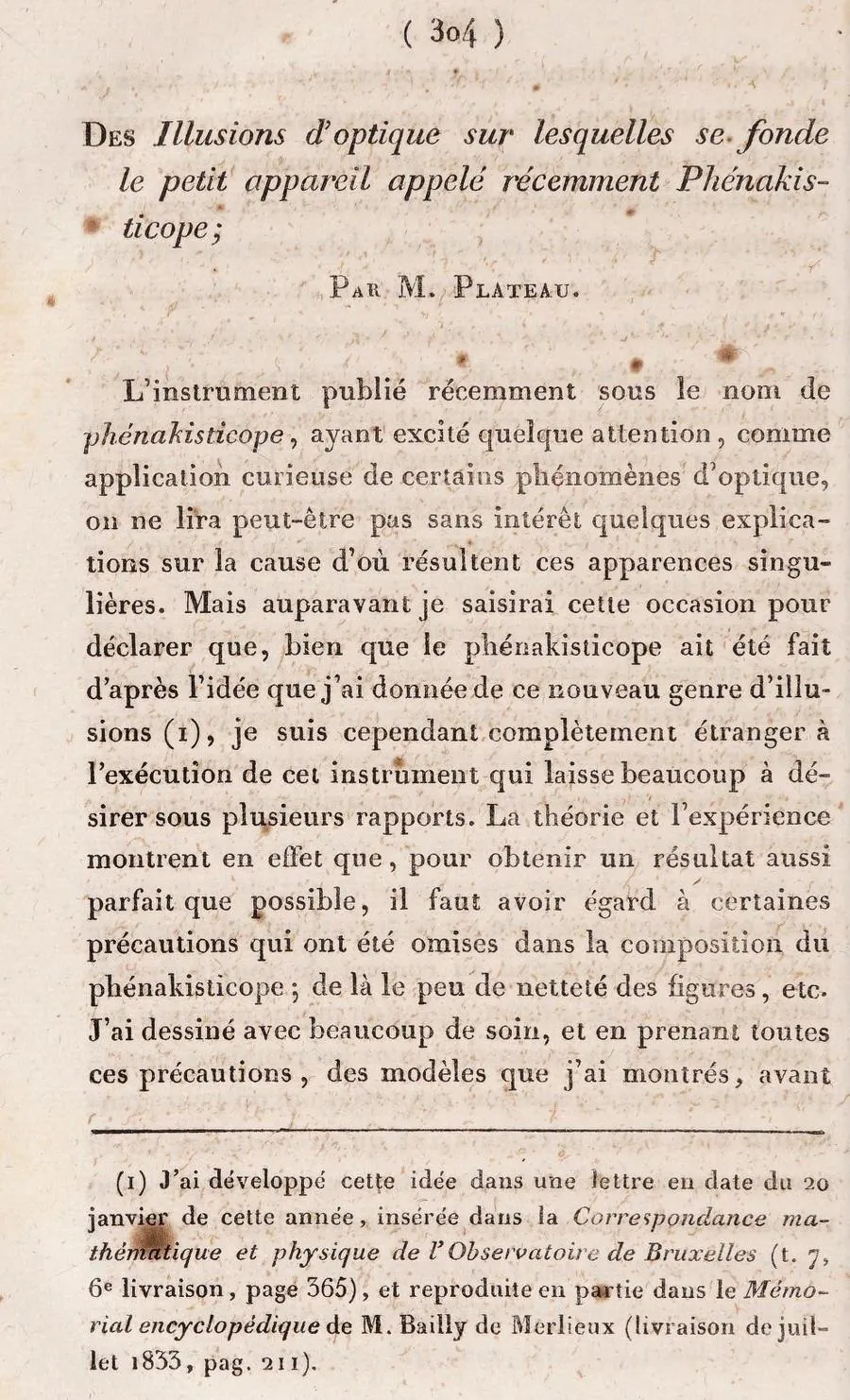
Annales de chimie et de physique, vol. 53 (1833), p. 304: Plateau’s paper on the phénakisticope, with his footnote on a letter of 20 January.
“Des Illusions d’optique sur lesquelles se fonde le petit appareil appelé récemment Phénakisticope, Annales de chimie et de physique, vol. 53 (1833), page 304” — Plateau — public domain full credit
"Des Illusions d’optique sur lesquelles se fonde le petit appareil appelé récemment Phénakisticope, Annales de chimie et de physique, vol. 53 (1833), page 304" by Plateau — https://archive.org/details/s3id13208220 — Public domain: Public domain in the US (published 1833) and in the EU (Plateau died in 1883, per Lutz 1920; life+70 expired); scan marked Public Domain Mark by the Wellcome Library; modified: cropped to the title, the opening paragraph and the footnote, and scaled to 900 px wide
Plateau’s paper opens with a disclaimer. The phénakisticope, he wrote, had been made from the idea he had given for this new kind of illusion. Yet he was “complètement étranger à l’exécution,” a complete stranger to the making of an instrument that left much to be desired. His own carefully drawn models, he added, were being published in London as the fantascope.
His footnote says he developed the idea in a letter of 20 January that year, printed by the Brussels observatory’s Correspondance mathématique et physique. That letter was not read for this page.
Other published writers gave him the credit. In 1834 W. G. Horner opened a paper in the Philosophical Magazine with “the ingenious and amusing invention of M. Plateau.” In 1920 Lutz wrote that the toy’s invention “has been credited to the Belgian physicist, Plateau (1801–1883).”
So the three sources consulted here all point to Plateau, and Plateau himself separates the original idea from the commercial object. That is a record of who was credited, not a ruling on priority. Any rival claim would need its own source.
One viewer at a time
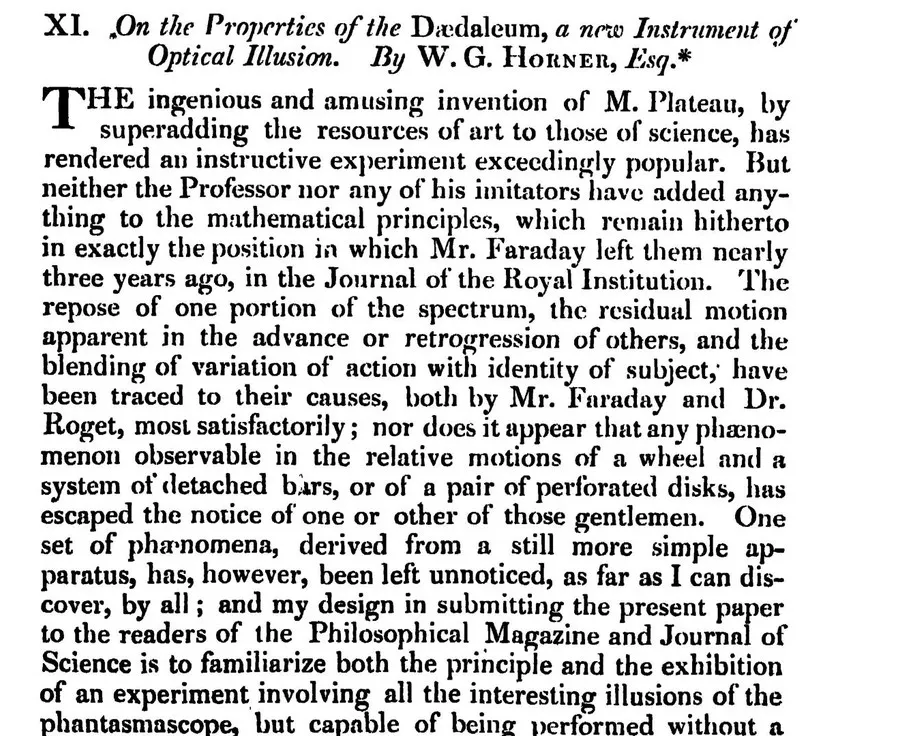
Philosophical Magazine, vol. 4 (1834), p. 36: Horner opens by crediting Plateau, then proposes a toy that needs no mirror.
“On the Properties of the Dædaleum, The London and Edinburgh Philosophical Magazine, vol. 4 (1834), page 36” — W. G. Horner — public domain full credit
"On the Properties of the Dædaleum, The London and Edinburgh Philosophical Magazine, vol. 4 (1834), page 36" by W. G. Horner — https://archive.org/details/in.ernet.dli.2015.21327 — Public domain: Public domain in the US (published 1834) and in the EU (published in London in 1834 under the author’s name; life+70 has expired for any author publishing in 1834); modified: cropped to heading XI and Horner’s opening paragraph, and scaled to 900 px wide
The mirror had a practical limit. Lutz observed that “one person at a time could view conveniently the reflected pictures,” so people tried to project the disk. One version added a lens, a light and mirrors; another put the pictures on a glass disk turning behind a magic-lantern lens.
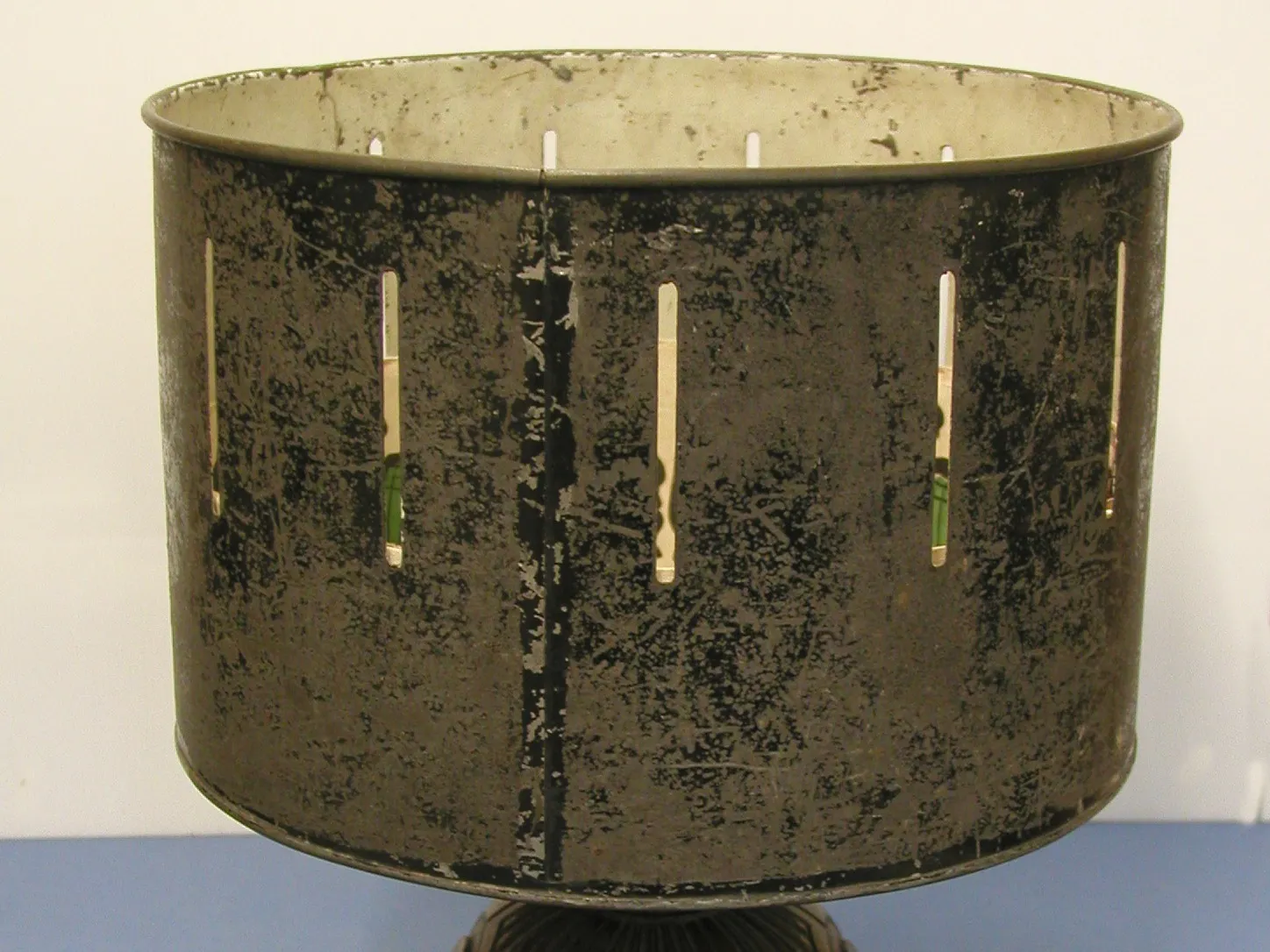
Horner’s answer was a drum. Drawings inside it, he wrote, would produce “the same surprising play of relative motions as the common magic disk does when spun before a mirror.” His drum needed no “mirror or any second instrument,” and he claimed it could be shown “to unlimited numbers at once.” He named it the Dædaleum; the same open drum is better known as the zoetrope.
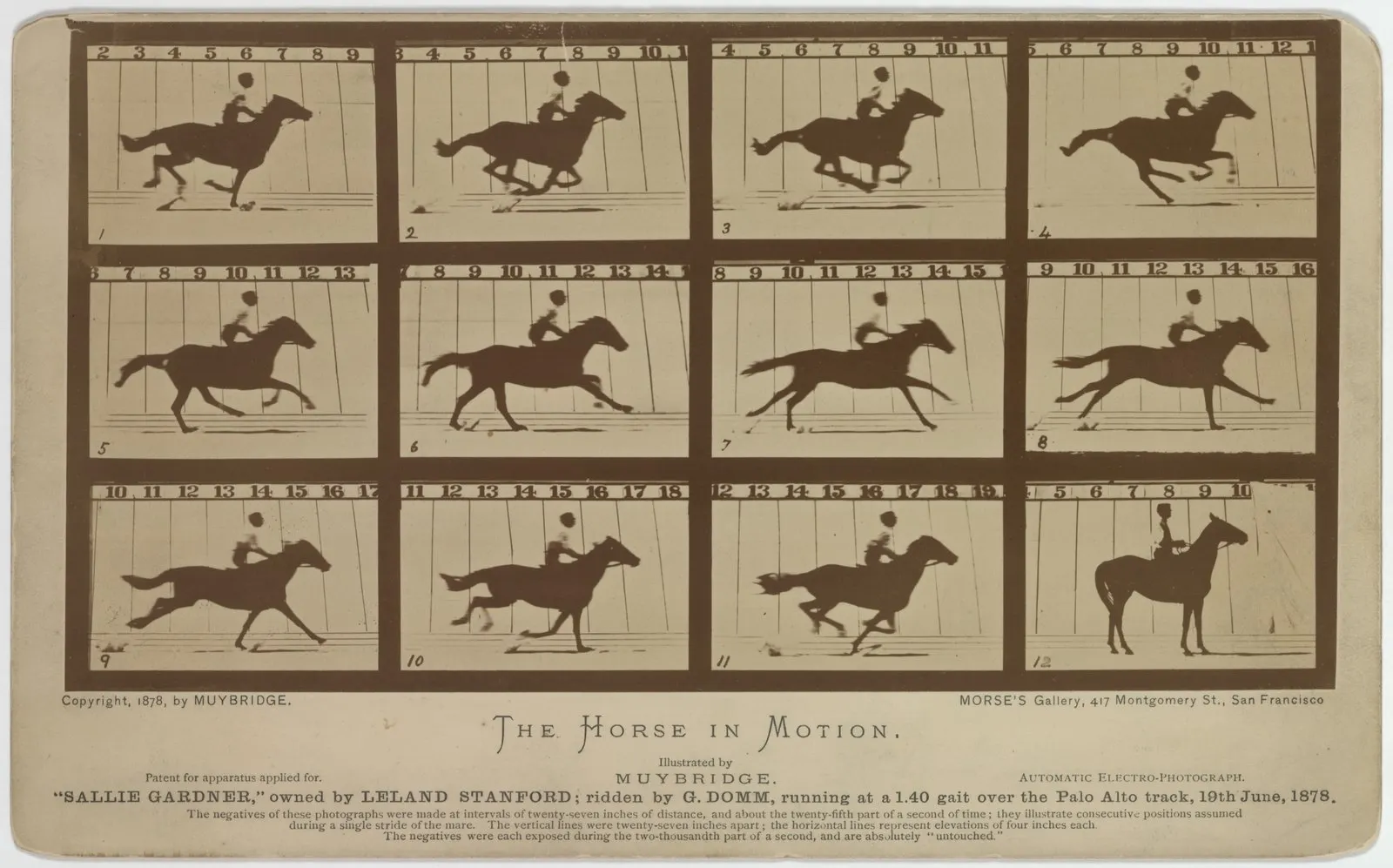
The rotating disk did not disappear from later experiments. Lutz writes that Muybridge built his zoöpraxiscope on the same rotating-disk plan, to project some of his animal photographs, the kind of series shown in The Horse in Motion. Lutz’s shutter comparison points the same way, toward projected film such as The Great Train Robbery.
The disk and the stereograph are both cards that do nothing until they meet an eye. One makes motion from a ring of drawings, the other depth from two photographs.
Prints consulted
- 1Plateau (printed as M. Plateau), “Des Illusions d’optique sur lesquelles se fonde le petit appareil appelé récemment Phénakisticope,” Annales de chimie et de physique, vol. 53 (1833), pp. 304–308. https://archive.org/details/s3id13208220Read: pages 304–308, checked against the page images
- 2E. G. Lutz, Animated Cartoons: How They Are Made, Their Origin and Development. New York: Charles Scribner's Sons, 1920. https://archive.org/details/cu31924075701304Read: pages 15, 20–26, 44, 52, 58, 68–69, 76–78, 174–175, 179–181 and 256, checked against the page images
- 3W. G. Horner, “On the Properties of the Dædaleum, a new Instrument of Optical Illusion,” The London and Edinburgh Philosophical Magazine and Journal of Science, 3rd series, vol. 4 (January–June 1834), pp. 36–40. https://archive.org/details/in.ernet.dli.2015.21327Read: pages 36–37, checked against the page images
- 4Cooper Hewitt, Smithsonian Design Museum, Optical Toy, Phenakistiscope Disc with Geometric Shapes, ca. 1840, accession 1948-124-4; museum data as given on the Wikimedia Commons file page. https://commons.wikimedia.org/wiki/File:Optical_Toy,_Phenakistiscope_Disc_with_Geometric_Shapes,_ca._1840_(CH_18607983).jpgRead: file page and original image

Next reel:
- Zoetrope: the same slits moved from a flat disk to an open drum, which Horner said a whole audience could watch.
- The Horse in Motion: twelve photographs instead of drawings, from the photographer whose projector Lutz puts on the rotating-disk plan.
- Public-domain original to view: Cooper Hewitt phenakistiscope disk 1948-124-4 (Wikimedia Commons)

Cite this page
Flickers & Tintypes. “Phenakistiscope: A Spinning Disk You Watched in a Mirror.” Flickers & Tintypes. Published November 12, 2026. https://flickersandtintypes.com/animation-loops/phenakistiscope/. Accessed [the date you read it].
Same sectionAlso in Animation Loops
Animation Loops
Zoetrope: An 1834 Paper Said a Whole Room Could Watch It
How a zoetrope works: slits times turns per second gives images per second. Horner named the open drum the Dædaleum in 1834; later patents are dated per Lutz.
Picture credit
"Zoetrope (wheel of life) optical toy, Auckland Museum 2001.6.1, photo AM_2001.6.1-1" by Auckland Museum — https://commons.wikimedia.org/wiki/File:Zoetrope_(AM_2001.6.1-1).jpg — CC BY 4.0 (https://creativecommons.org/licenses/by/4.0/); modified: cropped to the drum and the top of its stand, removing the measuring scale and the museum's copyright line
Animation Loops
The Horse in Motion: Two Frames With No Hoof on the Track
Muybridge’s 1878 Sallie Gardner card, frame by frame: in frames 2 and 3 no hoof touches the track, and the legs are gathered under the body, not stretched out.
Picture credit
"The Horse in Motion: “Sallie Gardner,” owned by Leland Stanford, card of 12 photographs (1878)" by Eadweard Muybridge — https://commons.wikimedia.org/wiki/File:Eadweard_Muybridge-Sallie_Gardner_1878.jpg — Public domain: Public domain in the US (published 1878; card marked Copyright, 1878, by Muybridge) and in the EU (Eadweard Muybridge died 1904); copy: Library of Congress 97502309, record not consulted directly; scan as uploaded to Wikimedia Commons; modified: scaled from 4352 to 1600 px wide
 Illustration
Animation Loops
Bouncing Ball Animation: In This Model, Most Frames Sit High
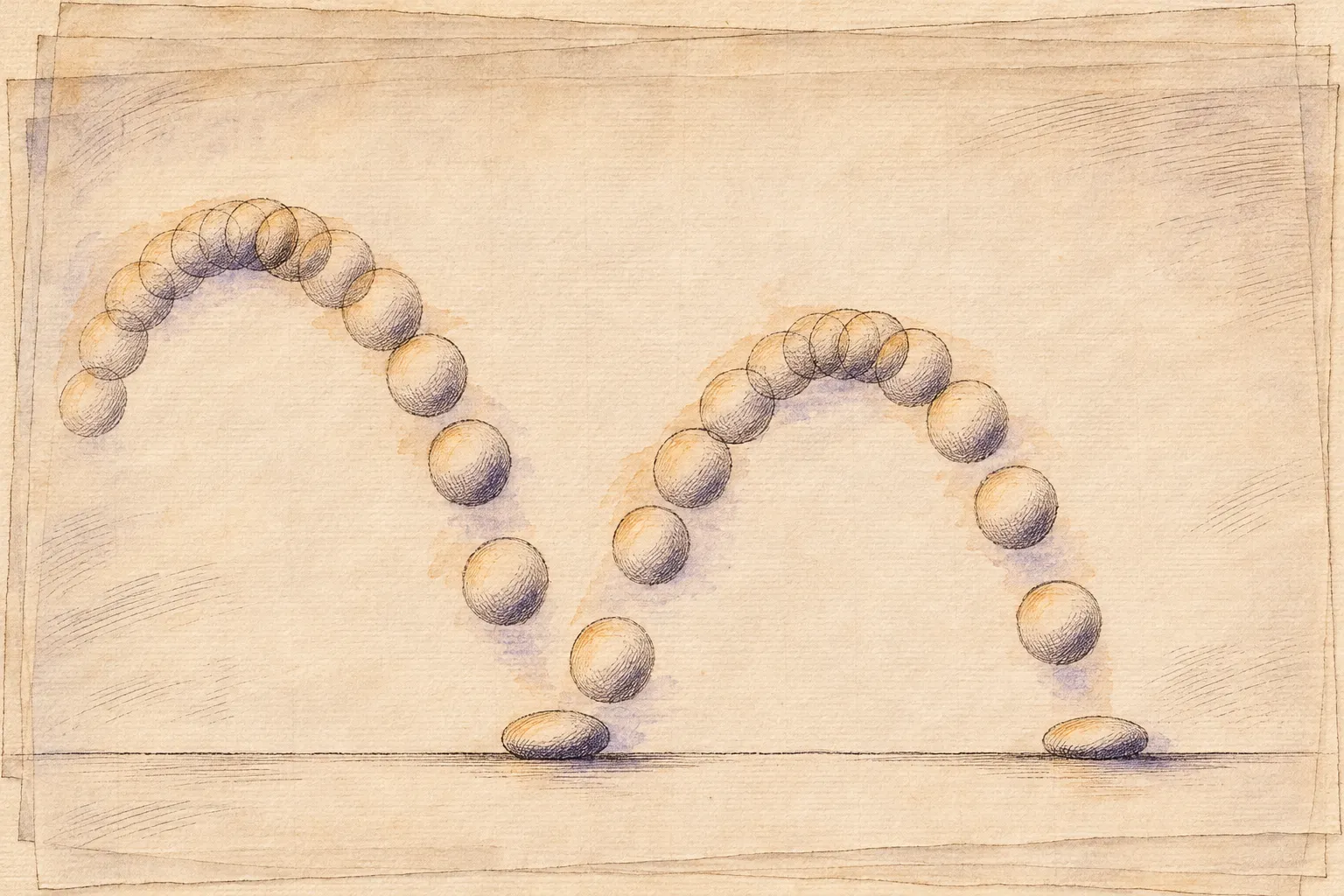
How to space a bouncing ball animation: in this free-fall model, 9 of 12 falling frames sit above halfway and the gaps grow from 2 to 42 pixels.
Picture credit
Illustration: Flickers & Tintypes. Generated schematic image — not a photograph, film frame or historical record. No copyright is claimed in this generated imagery; you may reuse it, and a credit to Flickers & Tintypes is appreciated.