The Horse in Motion: Two Frames With No Hoof on the Track
Frame card
In one line In this series, a galloping horse does leave the ground. On Muybridge’s 1878 Sallie Gardner card, frames 2 and 3 show all four hooves off the track, with the legs gathered under the body, not stretched out front and back as in racing prints.
Source, Year, Format, Length or Size, Access, License
- Source
- Eadweard Muybridge, The Horse in Motion: “Sallie Gardner,” card of 12 photographs; Library of Congress 97502309 via Wikimedia Commons, record not consulted directly
- Year
- Photographed 19 June 1878, per the card; card marked Copyright, 1878, by Muybridge
- Format
- Mounted card with 12 photographs in three rows of four, and printed captions
- Length or Size
- 11 frames of one stride, about 1/25 second and 27 inches apart per the card; in frame 12 the mare appears to stand
- Access
- Wikimedia Commons file page (4352 × 2713 scan)
- License
- Public domain in the US (published 1878) and in the EU (Eadweard Muybridge died 1904)
Card data (CSV) the-horse-in-motion-frame-card.csv Source and license notes
Shot list · 6 sections
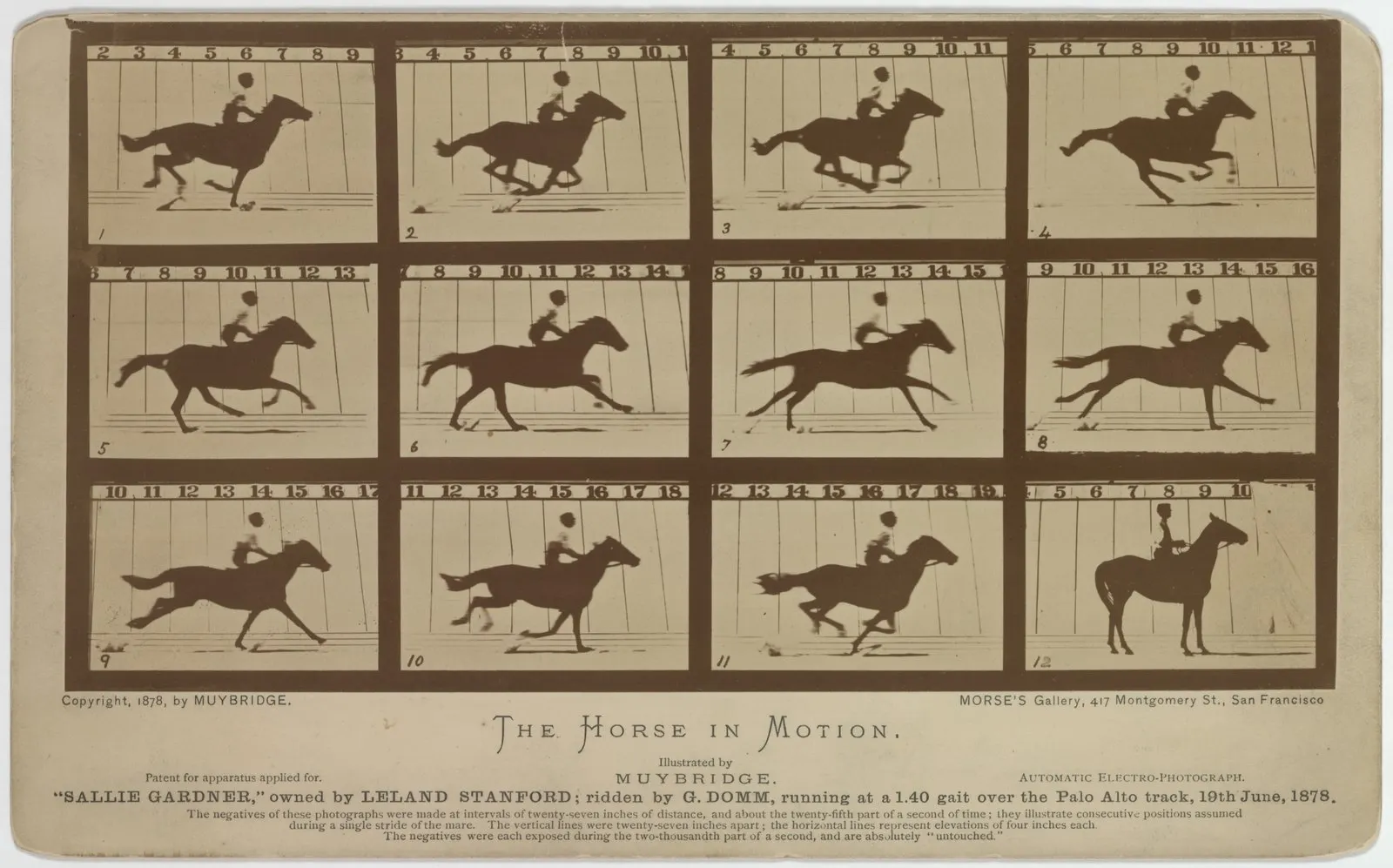
Frames 2 and 3 of 12, top row: the mare is clear of the track, with her legs folded under her body.
“The Horse in Motion: “Sallie Gardner,” owned by Leland Stanford, card of 12 photographs (1878)” — Eadweard Muybridge — public domain full credit
"The Horse in Motion: “Sallie Gardner,” owned by Leland Stanford, card of 12 photographs (1878)" by Eadweard Muybridge — https://commons.wikimedia.org/wiki/File:Eadweard_Muybridge-Sallie_Gardner_1878.jpg — Public domain: Public domain in the US (published 1878; card marked Copyright, 1878, by Muybridge) and in the EU (Eadweard Muybridge died 1904); copy: Library of Congress 97502309, record not consulted directly; scan as uploaded to Wikimedia Commons; modified: scaled from 4352 to 1600 px wide
In frames 2 and 3 of this card, not one of Sallie Gardner’s four hooves touches the track. Look at the legs in those two frames. They are not reaching out in front and stretching out behind. They are folded up under the belly, with the hooves bunched close together.
The card is one of Eadweard Muybridge’s 1878 series titled The Horse in Motion. Its printed caption says the mare was “running at a 1.40 gait over the Palo Alto track, 19th June, 1878,” ridden by G. Domm. So, in this series, a galloping horse does leave the ground. It does so in a pose unlike the stretched-out horses of the racing print further down this page, and frame 12 is not part of the gallop at all: in it the mare appears to stand still.
Which frames show the mare off the ground?
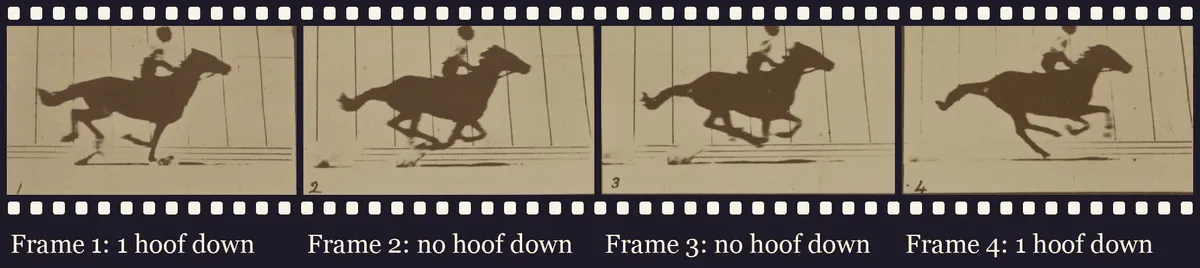
Frames 1 to 4 of the card: one fore foot down, two frames in the air, then a hind foot that appears to meet the track.
“The Horse in Motion, card frames 1 to 4, with hooves on the track” — Flickers & Tintypes — CC BY 4.0 full credit
"The Horse in Motion, card frames 1 to 4, with hooves on the track" by Flickers & Tintypes, https://flickersandtintypes.com/animation-loops/the-horse-in-motion/ — CC BY 4.0, https://creativecommons.org/licenses/by/4.0/. Underlying image: "The Horse in Motion: “Sallie Gardner,” owned by Leland Stanford, card of 12 photographs (1878)" by Eadweard Muybridge — https://commons.wikimedia.org/wiki/File:Eadweard_Muybridge-Sallie_Gardner_1878.jpg — Public domain: Public domain in the US (published 1878; card marked Copyright, 1878, by Muybridge) and in the EU (Eadweard Muybridge died 1904); copy: Library of Congress 97502309, record not consulted directly; scan as uploaded to Wikimedia Commons; modified: scaled from 4352 to 1600 px wide, frames 1 to 4 cut from the card without the numbered scale strip, set on a filmstrip with frame numbers and hoof counts.
Run your eye along the top row. In frame 1 one foreleg is planted under the shoulder. In frames 2 and 3 every hoof sits above the line of the track, and the legs are tucked in so tight they almost form a ring. In frame 4 a hind leg reaches down and appears to meet the track again.
Frames 2 and 3 are the only ones on the card that show the mare unsupported. Every other frame from 4 to 11 is read as one or two hooves on the track, three of them as probable. The count below comes from looking at each frame of the high-resolution scan, one by one.
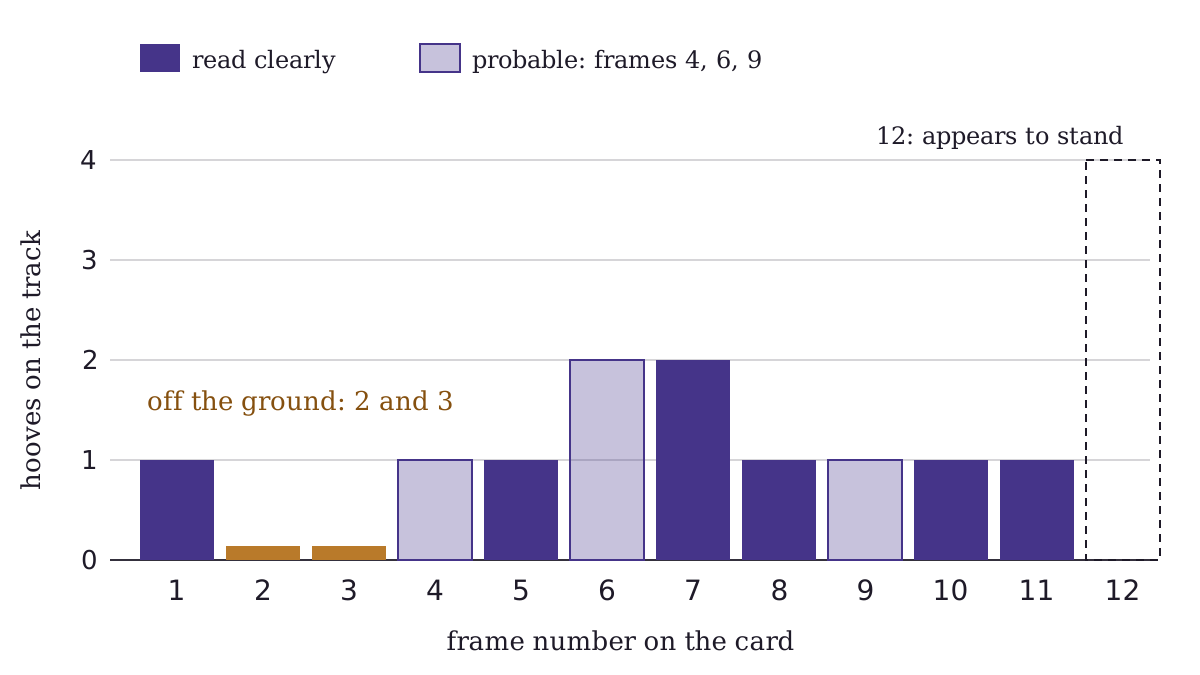
Hooves on the track, card frames 1 to 12: zero in frames 2 and 3; in frame 12 the mare appears to stand.
"Hooves on the track, frame by frame, Sallie Gardner card (1878)" by Flickers & Tintypes, https://flickersandtintypes.com/animation-loops/the-horse-in-motion/ — CC BY 4.0, https://creativecommons.org/licenses/by/4.0/
| Frame | Hooves on the track | Which feet, as read |
|---|---|---|
| 1 | 1 | one fore foot |
| 2 | 0 | none, legs gathered under the body |
| 3 | 0 | none, legs gathered under the body |
| 4 | 1 | one hind foot, just meeting the track (probable) |
| 5 | 1 | one hind foot |
| 6 | 2 | both hind feet (probable) |
| 7 | 2 | one hind foot and one fore foot |
| 8 | 1 | one fore foot |
| 9 | 1 | one fore foot; the other is close above the track (probable) |
| 10 | 1 | one fore foot |
| 11 | 1 | one fore foot |
| 12 | 4 | all four, appears to stand still |
These are readings, not measurements. The horse is a dark silhouette against a white wall, so left and right legs cannot be told apart, and three frames are marked probable. Muybridge had the same trouble with his early pictures. In his 1893 book he wrote that “it was difficult to distinguish, except by inference, the right feet from the left.”
Download the hoof count, frame by frame (CSV) source and license notes
Eleven frames, one stride: the card as a loop
The card says its photographs “illustrate consecutive positions assumed during a single stride of the mare.” Frames 1 to 11 do follow on from one another, and frame 11 runs back into frame 1 without an obvious jump. Frame 12 does not belong. Put it into the loop and the galloping mare would stop dead for one frame and then race on.
So the loop below uses frames 1 to 11 only, played twice. The numbered scale along the top of each photograph is trimmed off, because its numbers change from frame to frame.
Sallie Gardner at a gallop, frames 1 to 11 twice
Every frame, side by side
- 1card frame 1
- 2card frame 2: no hoof on the track
- 3card frame 3: no hoof on the track
- 4
- 5
- 6
- 7
- 8
- 9
- 10
- 11
- 12
- 13card frame 2: no hoof on the track
- 14card frame 3: no hoof on the track
- 15
- 16
- 17
- 18
- 19
- 20
- 21
- 22
22 frames at 10 frames per second.
Frame list (CSV) the-horse-in-motion-gallop-loop.csv Source and license notes
Credits for this loop
- "Sallie Gardner at a gallop, frames 1 to 11 twice" by Flickers & Tintypes, https://flickersandtintypes.com/animation-loops/the-horse-in-motion/ — CC BY 4.0, https://creativecommons.org/licenses/by/4.0/
- "The Horse in Motion: “Sallie Gardner” card (1878), frames 1 to 8 for the loop" by Eadweard Muybridge — https://commons.wikimedia.org/wiki/File:Eadweard_Muybridge-Sallie_Gardner_1878.jpg — Public domain: Public domain in the US (published 1878; card marked Copyright, 1878, by Muybridge) and in the EU (Eadweard Muybridge died 1904); copy: Library of Congress 97502309, record not consulted directly; scan as uploaded to Wikimedia Commons; modified: card frames 1 to 8 cut from the 4352-px original (901 x 466 px each, numbered scale strip and frame numbers trimmed), each scaled down to 619 x 320 px and set in 2 columns and 4 rows, for the loop
- "The Horse in Motion: “Sallie Gardner” card (1878), frames 9 to 11 for the loop" by Eadweard Muybridge — https://commons.wikimedia.org/wiki/File:Eadweard_Muybridge-Sallie_Gardner_1878.jpg — Public domain: Public domain in the US (published 1878; card marked Copyright, 1878, by Muybridge) and in the EU (Eadweard Muybridge died 1904); copy: Library of Congress 97502309, record not consulted directly; scan as uploaded to Wikimedia Commons; modified: card frames 9 to 11 cut from the 4352-px original (901 x 466 px each, numbered scale strip and frame numbers trimmed), each scaled down to 619 x 320 px and set in one column of 3, for the loop
The card gives the time between pictures as “about the twenty-fifth part of a second.” At that pace the 11 positions would pass in under half a second. The loop runs at 10 frames per second instead, two and a half times slower, so frames 2 and 3 stay on screen long enough to see. At full speed they would fill only about 0.08 second: 2 frames at 25 a second.
The background behaves strangely when it moves. The card says the negatives were made at intervals of 27 inches, and the painted lines on the wall behind the track were also 27 inches apart. The numbers along the top of the photographs go up by one from each frame to the next, so each picture was taken about one line further along than the last. The lines barely shift, the mare stays in about the same place, and the legs do all the moving.
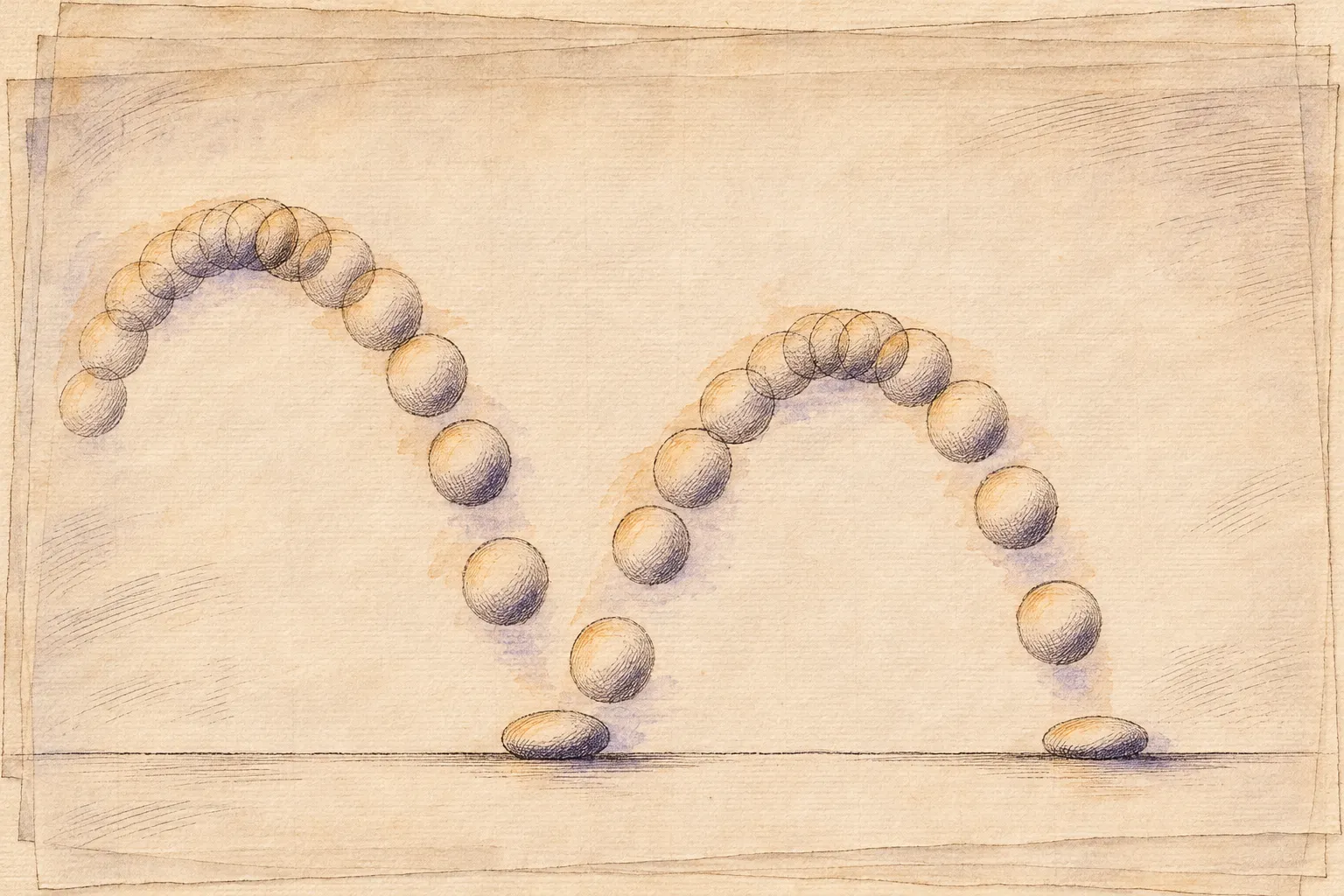
Spacing between pictures does the same work in bouncing ball animation, where even gaps and growing gaps tell the eye two different stories.
What the card itself says it measured

Card foot, below frames 9 to 12: the printed title, the 19th June, 1878 date and the notes on how the negatives were made.
“The Horse in Motion: “Sallie Gardner” card (1878), printed captions” — Eadweard Muybridge — public domain full credit
"The Horse in Motion: “Sallie Gardner” card (1878), printed captions" by Eadweard Muybridge — https://commons.wikimedia.org/wiki/File:Eadweard_Muybridge-Sallie_Gardner_1878.jpg — Public domain: Public domain in the US (published 1878; card marked Copyright, 1878, by Muybridge) and in the EU (Eadweard Muybridge died 1904); copy: Library of Congress 97502309, record not consulted directly; scan as uploaded to Wikimedia Commons; modified: cropped to the printed text below the photographs (box 60,2110,4352,2713 of the 4352-px original); scaled to 1600 px wide
The small type at the foot of the card explains how the pictures were made. It calls the whole thing an “Automatic Electro-Photograph,” and it notes that a “Patent for apparatus” had been applied for. Then it gives the numbers:
- the negatives were made “at intervals of twenty-seven inches of distance, and about the twenty-fifth part of a second of time”
- the vertical lines on the wall were 27 inches apart, and the horizontal lines “represent elevations of four inches each”
- the negatives “were each exposed during the two-thousandth part of a second, and are absolutely ‘untouched’”
- the card is marked “Copyright, 1878, by Muybridge” and printed for “Morse’s Gallery, 417 Montgomery St., San Francisco”
The card does not say how a camera knew when to fire. Scientific American, writing about another set in the same year, said only that Muybridge “employed a series of cameras, operated by electricity,” placed to fix “the several phases in the continuous action of the horse while making one stride.” That is as far as these two sources go, so this page leaves the trigger at that.
Checking the card’s numbers
Some of the card’s numbers can be checked against each other. Read “a 1.40 gait” as a mile in 1 minute 40 seconds, the same pace Muybridge’s 1893 book gives in words for a galloping Kentucky horse, “a mile in a hundred seconds.” That is 52.8 feet per second. At that speed, 27 inches takes about 0.043 second, or one twenty-third of a second, close to the card’s “about the twenty-fifth part.”
Frames 1 to 11 sit 10 intervals apart. At 27 inches an interval, that is 270 inches, or 22.5 feet of track, covered in about 0.4 second at the card’s stated interval. For comparison, the trotter in Scientific American had a stride “over 18 feet” at his own pace, a different horse and a different gait.
The exposure figure is harder to test. Nothing on the card shows how one two-thousandth of a second was measured, so this page treats it as a claim printed on Muybridge’s card. The sharp legs in most frames fit a very short exposure. They do not prove the number.
How Scientific American saw the series in 1878
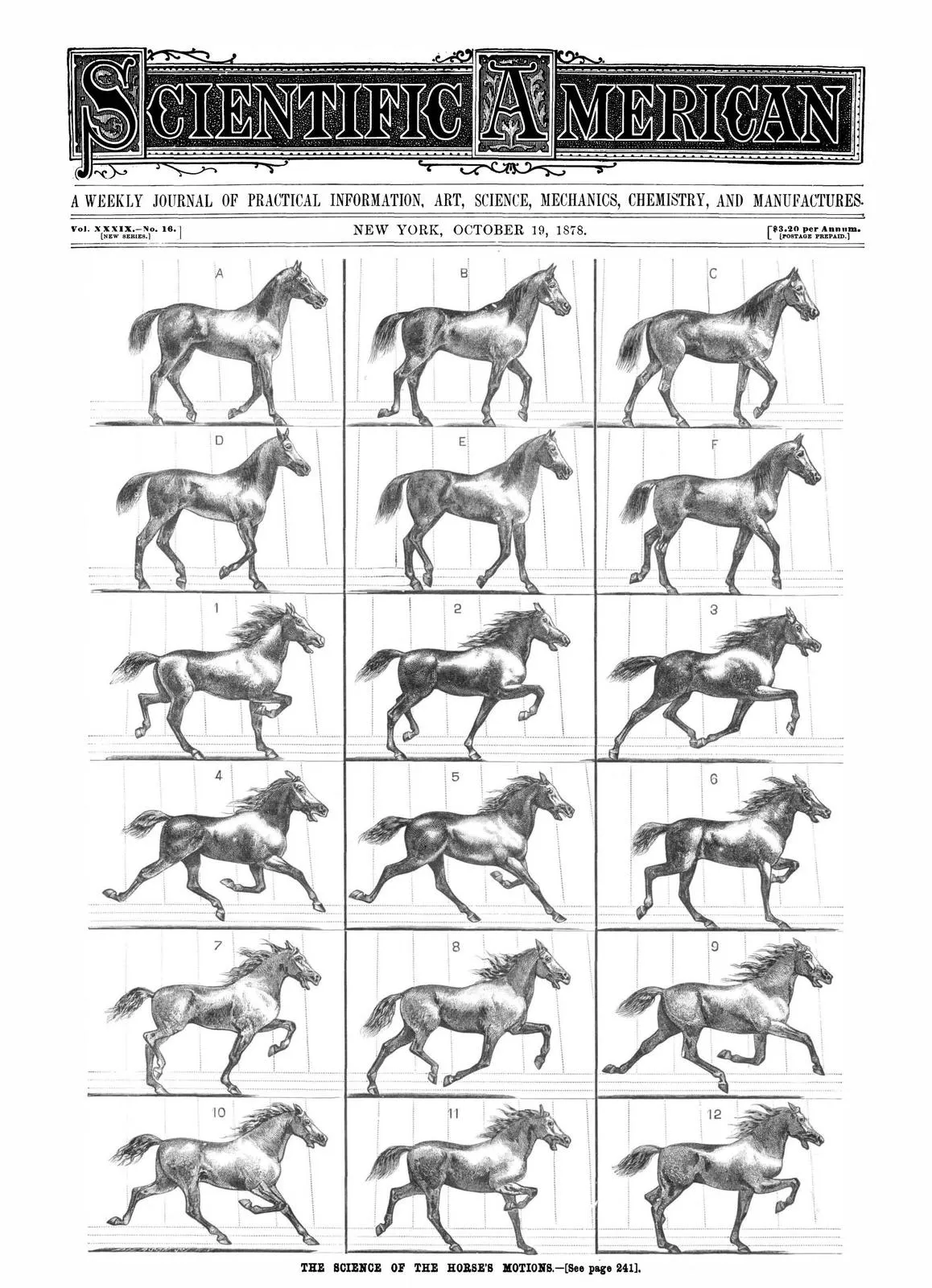
Scientific American front page, October 19, 1878: engravings after Muybridge photographs of the trotter Abe Edgington.
“The Science of the Horse’s Motions, Scientific American, vol. 39, no. 16 (October 19, 1878), front page” — Unknown author — public domain full credit
"The Science of the Horse’s Motions, Scientific American, vol. 39, no. 16 (October 19, 1878), front page" by Unknown author — https://archive.org/details/scientific-american-1878-10-19 — Public domain: Public domain in the US (published 1878) and in the EU (anonymous engravings in a periodical published in 1878; the 70-year term from publication expired long ago); modified: cropped to the masthead, the engravings and the caption, leaving out a modern stamp line at the foot of the scan; scaled to 1600 px high
Scientific American put Muybridge’s horses on its front page on October 19, 1878. These are engravings, not photographs. The horse is a different one: the trotter Abe Edgington, shown walking (A to F) and trotting (1 to 12). The magazine said it had dropped “the driver and his sulky” and had the pictures “enlarged and skillfully engraved.”
The article on page 241 states that “the exposure for each negative was about the two thousandth part of a second.” That figure, per Scientific American, belongs to the Abe Edgington set. It matches the number printed on the Sallie Gardner card, but neither source shows the measurement.
The magazine counted hooves the same way this page does. The walking horse, it said, “always has two feet on the ground, and, for a brief interval in each stride, three feet.” The trotting horse leaves the ground too. “In Figs. 4 and 5, and again in 9 and 10,” the article says, “the horse is entirely off the ground, literally flying through the air.”
Then it turned to painters. At first, it predicted, an artist would say of many positions “that there is absolutely no ‘motion’ at all in them.”
Six series of cards, and a zoetrope
The same page says that “six series of cards have been published, with from eight to twelve positions each,” of trotting, cantering, running and walking horses. They could be bought from Muybridge at 417 Montgomery St., San Francisco. The Sallie Gardner card carries that address too, under the name “Morse’s Gallery.”
The article ends with a suggestion: mount the photographs “on strips for use in the zoetrope.” A zoetrope was a slotted drum that showed a ring of drawings one after another. Put photographs in place of drawings, and the strides on the cards would move again.
The stretched-out gallop of the racing prints
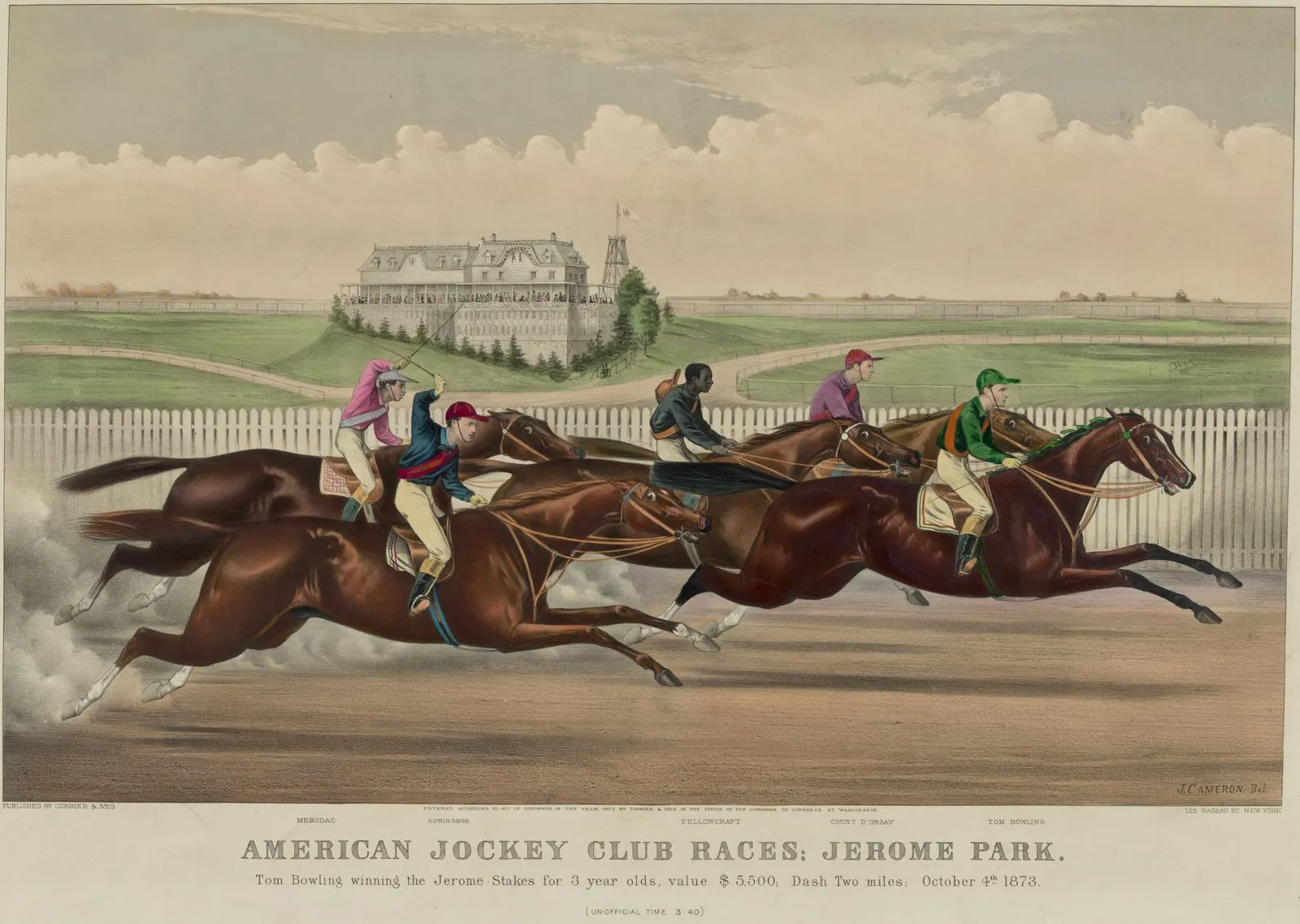
Currier & Ives, American Jockey Club Races, Jerome Park, 1873: every horse flies with its legs stretched fore and aft.
“American Jockey Club Races; Jerome Park: Tom Bowling winning the Jerome Stakes, October 4th 1873 (hand-colored lithograph)” — Currier & Ives — public domain full credit
"American Jockey Club Races; Jerome Park: Tom Bowling winning the Jerome Stakes, October 4th 1873 (hand-colored lithograph)" by Currier & Ives — https://commons.wikimedia.org/wiki/File:American_Jockey_Club_Races;_Jerome_Park-_Tom_Bowling_Winning_the_Jerome_Stakes_for_3_Year_Olds,_Value_$5,500;_Dash_Two_Miles;_October_4th_1873._(Un-official_Time_3-40)_LCCN90708559.jpg — Public domain: Public domain in the US (published 1873, entered according to act of Congress by Currier & Ives) and in the EU (published 1873; drawn by J. Cameron, death year unverified, presumed to have died more than 70 years ago); copy: Library of Congress 90708559, record not consulted directly; modified: cropped to the picture, the artist line and the title, leaving out the margins and a library stamp; scaled to 1600 px wide
Here is a racing print from five years before the card. In the Currier & Ives lithograph of Tom Bowling winning the Jerome Stakes on October 4, 1873, all five horses sail over the track. Each one has its forelegs thrust out in front and its hind legs stretched out behind, like a rocking horse.
No frame of the Sallie Gardner card shows that pose in the air. The frames where the legs are stretched farthest, 7 and 8, have hooves on the track. The frames in the air, 2 and 3, have the legs folded in.
Muybridge had a name for the pose. Describing a greyhound in flight, his 1893 book compares its “elongated body and extended legs” to “the conventional galloping horse.” By his account the dog does fly that way. For the horse, his gallop analysis found only one phase without support, and it is not that one.
What Muybridge said the photographs settled
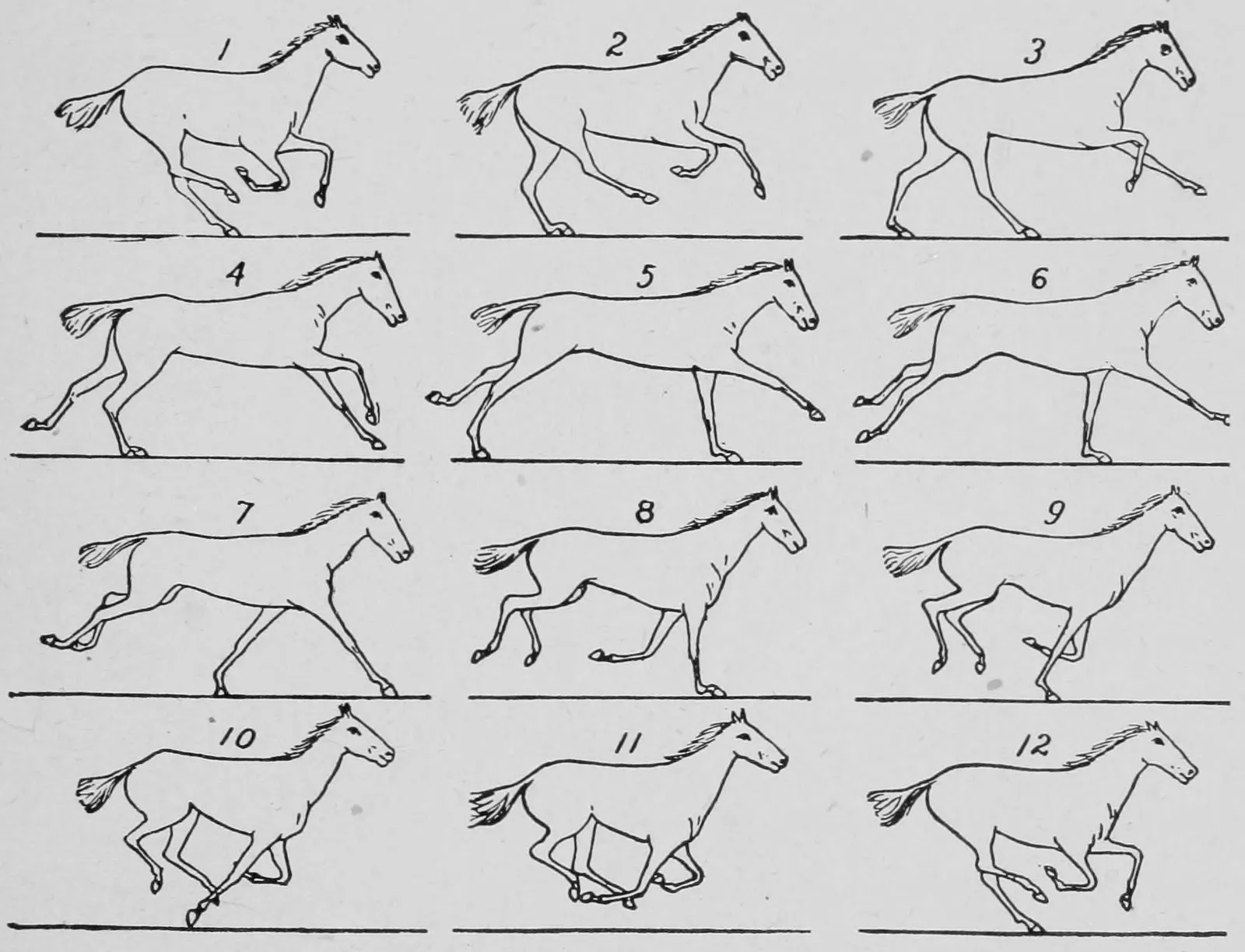
Twelve phases of the gallop, traced from later photographs for Muybridge’s 1893 book; phase 11 is the airborne one.
"Some consecutive phases of the gallop, from Eadweard Muybridge, Descriptive Zoopraxography (1893)" by Eadweard Muybridge — https://www.gutenberg.org/ebooks/40215 — Public domain: Public domain in the US (published 1893) and in the EU (Eadweard Muybridge died 1904); modified: scaled from 1803 to 1600 px wide
In his own account, the question that started it all was not about galloping. Writing in 1893, Muybridge said that in 1872 a “particular dispute” arose in San Francisco about “the possibility of a horse having all of his feet free of contact with the ground at the same instant, while trotting.” His first answer came from about a dozen negatives of the trotter Occident, made with a single camera at Sacramento in May 1872.
Six years later the camera line at Palo Alto gave whole strides. The book says results showing horses “walking, trotting, galloping, &c., were published in 1878, with the title of ‘The Horse in Motion,’” and that copies went to the Library of Congress the same year.
For the gallop, the 1893 book is specific. It lists the order in which the feet carry the horse, then adds that “the only phase in which he has been discovered without support is one when the legs are flexed under the body.” It also allows that a second moment in the air, between the lifting of one fore foot and the descent of the other, is probable but “has not yet been demonstrated.”
The tracings above come from his later photographs, so they are another horse on another day. Even so, phase 11 shows the same tucked pose as frames 2 and 3.
Off the card and onto a wall
Muybridge also took the pictures off the card. He wrote that at the Royal Institution in 1882 he used his Zoöpraxiscope and a lantern to project “a synthesis of many of the actions he had photographed.” That is his own account of the event.
A film copy such as The Great Train Robbery also shows single pictures in a row, but there they come off one camera at a steady rate. Muybridge’s came from a line of cameras, one picture each. A stereograph works the other way round: two lenses side by side catch one instant from two points of view, while Muybridge’s pictures caught many instants, each from about 27 inches further along the track than the one before.
Prints consulted
- 1Eadweard Muybridge, The Horse in Motion: “Sallie Gardner,” owned by Leland Stanford; ridden by G. Domm, running at a 1.40 gait over the Palo Alto track, 19th June, 1878. Card of 12 photographs, San Francisco: Morse’s Gallery, 1878. Library of Congress 97502309, as given on the Wikimedia Commons file page. https://commons.wikimedia.org/wiki/File:Eadweard_Muybridge-Sallie_Gardner_1878.jpgRead: file page and the full card, including its printed text
- 2“A Horse’s Motion Scientifically Determined,” Scientific American, vol. 39, no. 16 (October 19, 1878), p. 241, with front-page engravings “The Science of the Horse’s Motions.” https://archive.org/details/scientific-american-1878-10-19Read: page 241 and the front page, checked against the page images
- 3Eadweard Muybridge, Descriptive Zoopraxography, or the Science of Animal Locomotion Made Popular. University of Pennsylvania, 1893. https://www.gutenberg.org/ebooks/40215Read: sections: the Introduction, The Gallop and the passage on the dog’s gallop, in full; gallop figure
- 4Currier & Ives (J. Cameron, del.), American Jockey Club Races; Jerome Park: Tom Bowling winning the Jerome Stakes for 3 year olds, October 4th 1873. Hand-colored lithograph, 1873. Library of Congress 90708559, as given on the Wikimedia Commons file page. https://commons.wikimedia.org/wiki/File:American_Jockey_Club_Races;_Jerome_Park-_Tom_Bowling_Winning_the_Jerome_Stakes_for_3_Year_Olds,_Value_$5,500;_Dash_Two_Miles;_October_4th_1873._(Un-official_Time_3-40)_LCCN90708559.jpgRead: file page and the full print


Next reel:
- Zoetrope: the slotted drum Scientific American wanted these photographs mounted in, and the arithmetic of slits and turns.
- Bouncing ball animation: a falling ball drawn frame by frame, where the gaps between frames carry the speed.
- Public-domain original to view: The Horse in Motion, “Sallie Gardner,” 1878 (Wikimedia Commons)
Cite this page
Flickers & Tintypes. “The Horse in Motion: Two Frames With No Hoof on the Track.” Flickers & Tintypes. Published November 12, 2026. https://flickersandtintypes.com/animation-loops/the-horse-in-motion/. Accessed [the date you read it].
Same sectionAlso in Animation Loops
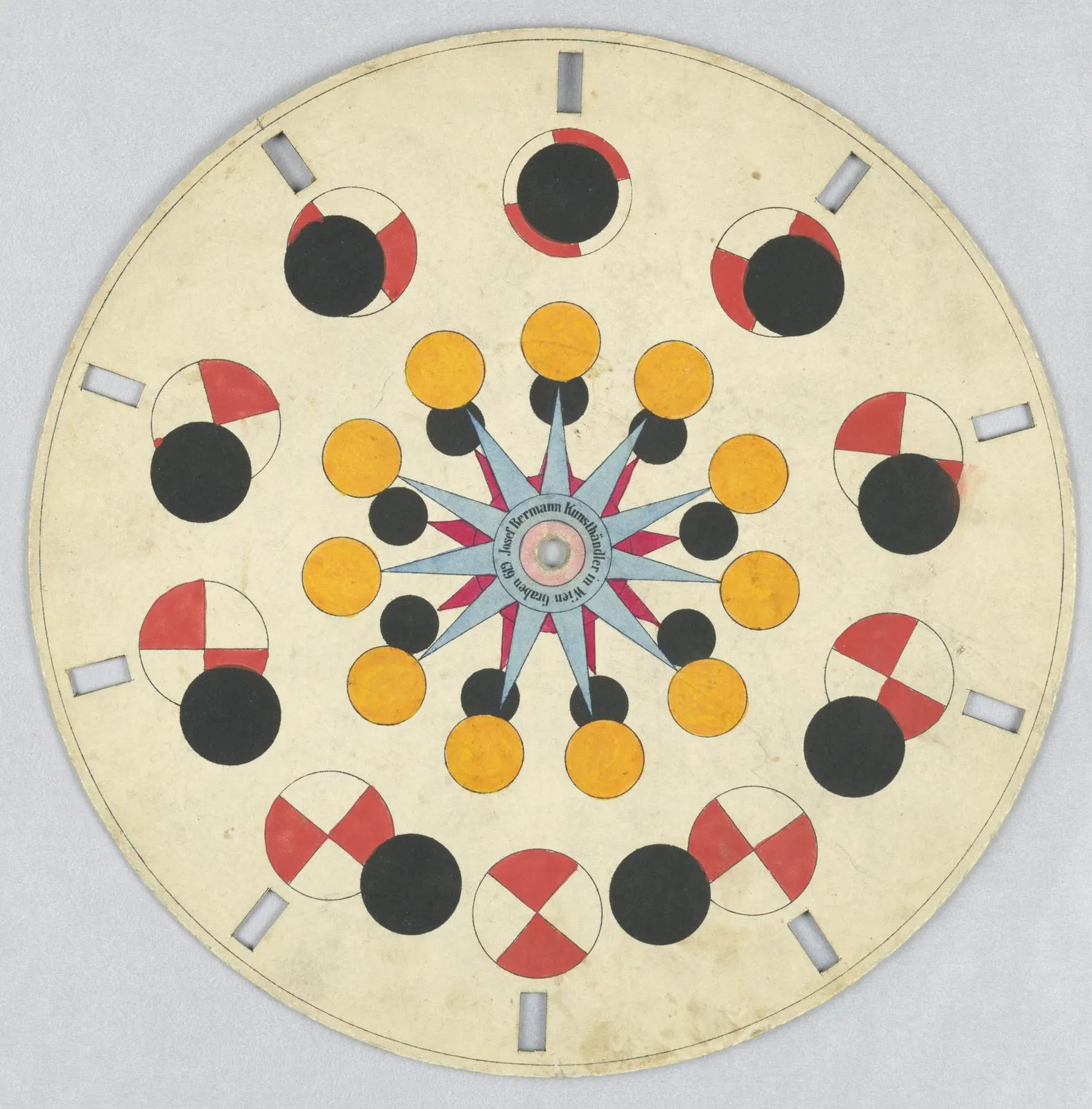
Animation Loops
Phenakistiscope: A Spinning Disk You Watched in a Mirror
A phenakistiscope is a slotted disk spun before a mirror and watched through its slits. Count the slits and figures on a Vienna disk from about 1840.
Picture credit
"Optical Toy, Phenakistiscope Disc with Geometric Shapes, ca. 1840 (Cooper Hewitt 1948-124-4)" by Unknown author — https://commons.wikimedia.org/wiki/File:Optical_Toy,_Phenakistiscope_Disc_with_Geometric_Shapes,_ca._1840_(CH_18607983).jpg — Public domain: Public domain in the US (published about 1840) and in the EU (anonymous work published in Vienna about 1840; the 70-year term from publication expired long ago); faithful reproduction of a two-dimensional work (Commons PD-Art); modified: scaled from 3390 x 3444 to 1575 x 1600 px; whole disk, not cropped
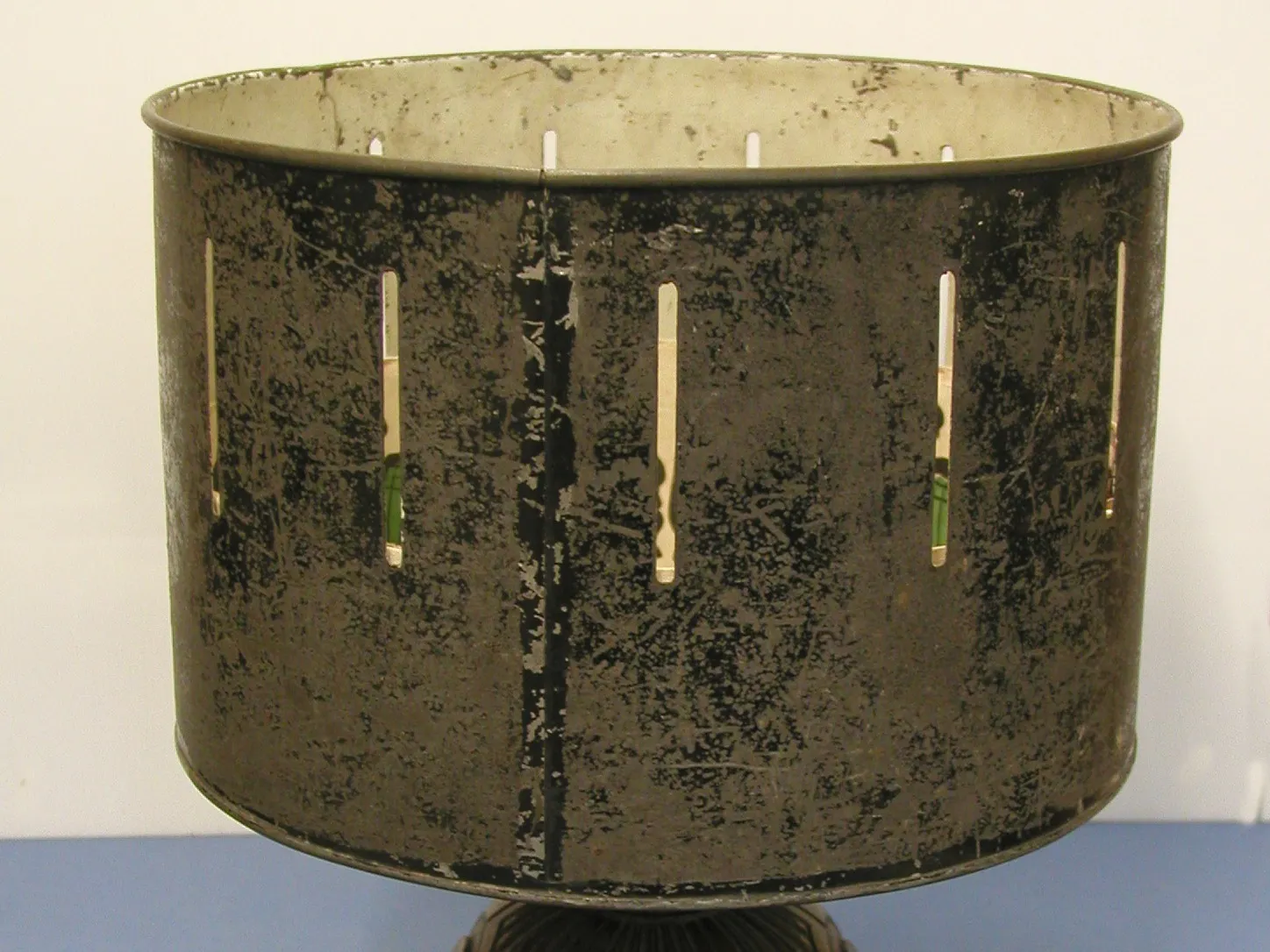
Animation Loops
Zoetrope: An 1834 Paper Said a Whole Room Could Watch It
How a zoetrope works: slits times turns per second gives images per second. Horner named the open drum the Dædaleum in 1834; later patents are dated per Lutz.
Picture credit
"Zoetrope (wheel of life) optical toy, Auckland Museum 2001.6.1, photo AM_2001.6.1-1" by Auckland Museum — https://commons.wikimedia.org/wiki/File:Zoetrope_(AM_2001.6.1-1).jpg — CC BY 4.0 (https://creativecommons.org/licenses/by/4.0/); modified: cropped to the drum and the top of its stand, removing the measuring scale and the museum's copyright line
 Illustration
Animation Loops
Bouncing Ball Animation: In This Model, Most Frames Sit High
How to space a bouncing ball animation: in this free-fall model, 9 of 12 falling frames sit above halfway and the gaps grow from 2 to 42 pixels.
Picture credit
Illustration: Flickers & Tintypes. Generated schematic image — not a photograph, film frame or historical record. No copyright is claimed in this generated imagery; you may reuse it, and a credit to Flickers & Tintypes is appreciated.