Stereograph: Twin Photos Shot a Couple of Inches Apart
Frame card
In one line A stereograph is a pair of photographs of one scene, taken from two points a couple of inches apart, per an 1859 Atlantic Monthly essay; the small differences between the halves are what a stereoscope turns into depth.
Source, Year, Format, Length or Size, Access, License
- Source
- Met 1980.1056.3, Broadway, New York City, in the rain; Metropolitan Museum of Art upload on Wikimedia Commons (DP218027)
- Year
- circa 1860, per the museum record as given on the file page (no range stated); Broadway, New York City; evidence: strong (museum record)
- Format
- Stereograph: two albumen silver prints on one card
- Length or Size
- Scan 3871 x 2123 px; the halves sit 1934 px apart at the far buildings and 1905 px apart at the nearest building
- Access
- Wikimedia Commons file page, Metropolitan Museum of Art upload
- License
- CC0 1.0 (Metropolitan Museum of Art Open Access upload)
Card data (CSV) stereograph-frame-card.csv Source and license notes
Entry fields
- Name
- Stereograph (stereo card, stereoview)
- Date range and evidence
- Name proposed in the Atlantic Monthly, June 1859; this card about 1860 per the museum record (no range stated), Broadway, New York City; evidence: strong (museum record)
- Size or running time
- One card holding two pictures side by side; this scan is 3871 x 2123 px
- Process or material
- Two photographs of one scene from points a couple of inches apart; this card: albumen silver prints
- How to recognize it
- Two nearly identical pictures side by side; near objects sit at a different spacing from far ones
- Often confused with
- Stereoscope (the viewer, not the card)
- Where to see one
- Met 1980.1056.3, Broadway, New York City, in the rain
Card data (CSV) stereograph-entry.csv Source and license notes
Shot list · 6 sections
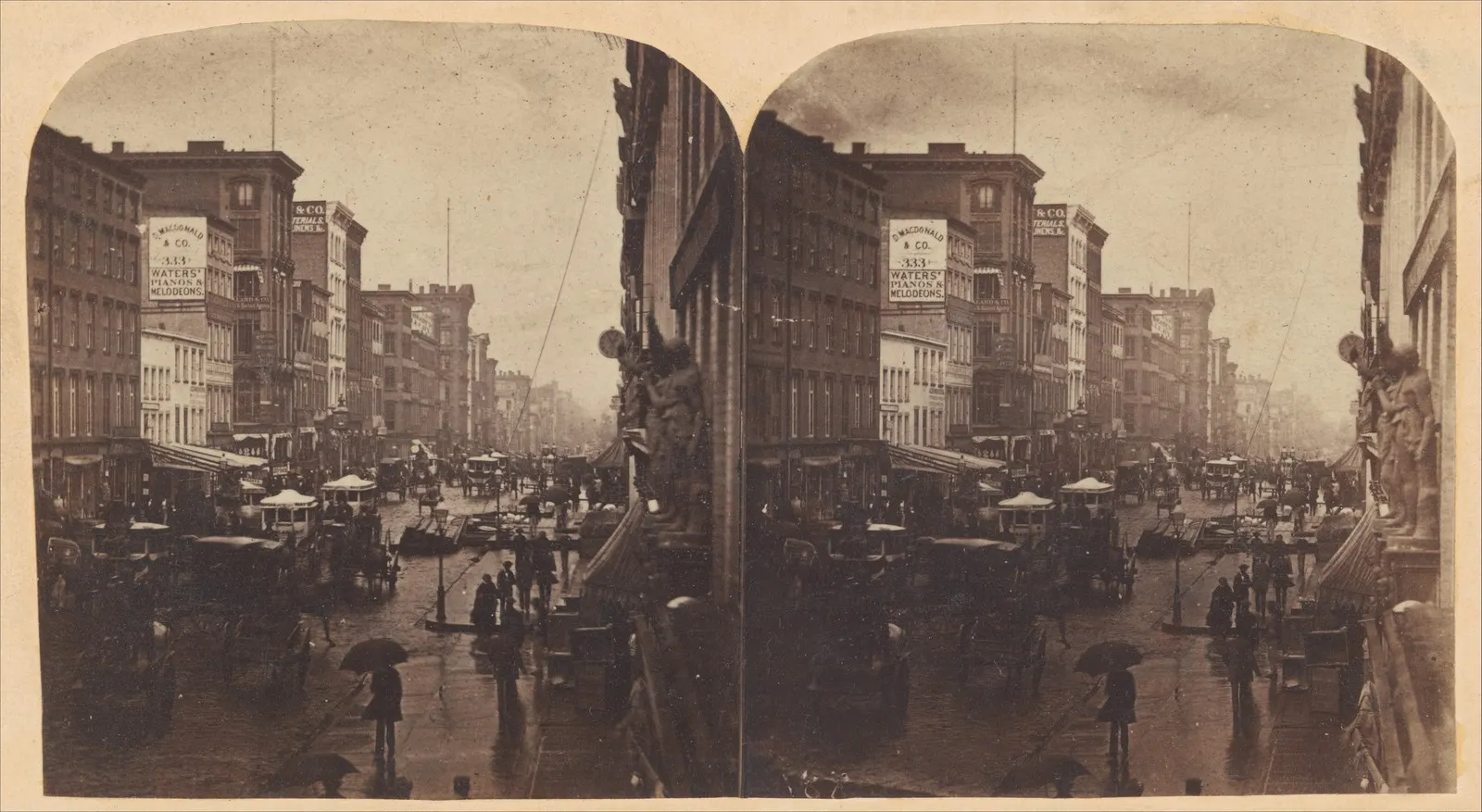
Met 1980.1056.3, Broadway, New York City, in the rain, about 1860: both halves of one stereo card, shown whole.
"[Broadway, New York City, in the rain], stereograph, Metropolitan Museum of Art 1980.1056.3" by Edward Anthony and Henry T. Anthony — https://commons.wikimedia.org/wiki/File:-Broadway,_New_York_City,_in_the_rain-_MET_DP218027.jpg — CC0 1.0 (https://creativecommons.org/publicdomain/zero/1.0/); modified: scaled from 3871 to 1600 pixels wide; nothing else changed
Lay the two halves of Met 1980.1056.3 over each other, and the nearest pillar shifts 29 pixels. Line the halves up on the buildings far down Broadway, where the shift is zero, and everything nearer the camera slides sideways by its own amount. That sliding is the point of a stereograph: two photographs of one scene, taken from two points a couple of inches apart and mounted side by side on one card. In a stereoscope each eye sees one half, and the small differences between them read as depth.
At a glance the two halves look like copies of one print. They are not. The museum's record, as given on Wikimedia Commons, dates this card to about 1860 and credits it to Edward Anthony and Henry T. Anthony; it is two albumen silver prints, the record's name for this kind of photograph on paper, mounted under arched tops.
A name and a method from 1859
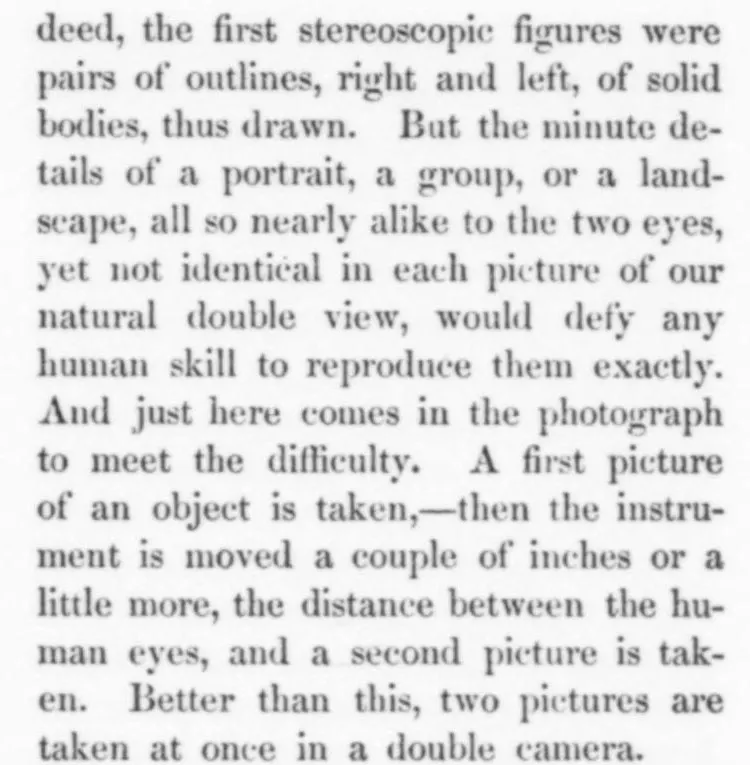
Atlantic Monthly, June 1859, p. 743: a second picture taken a couple of inches to one side, or both at once in a double camera.
“The Stereoscope and the Stereograph, The Atlantic Monthly, vol. 3, no. 20 (June 1859), page 743” — The Atlantic Monthly — public domain full credit
"The Stereoscope and the Stereograph, The Atlantic Monthly, vol. 3, no. 20 (June 1859), page 743" by The Atlantic Monthly — https://archive.org/details/sim_atlantic_1859-06_3_20 — Public domain: Public domain in the US (published 1859) and in the EU (published without an author's name in 1859; protection for anonymous works ends 70 years after publication); modified: cropped to the paragraph from "deed, the first stereoscopic figures" to "a double camera"
The name stereograph appears in an essay in the Atlantic Monthly of June 1859, titled “The Stereoscope and the Stereograph.” The magazine printed it without an author's name. On page 743 the essay calls the pair “the double-eyed or twin pictures, or Stereograph, if we may coin a name.” A page later it says “the stereograph, as we have called the double picture designed for the stereoscope.”
So the essay proposed the name, and said so. Whether anyone had used the word earlier is a separate question that this page does not try to settle.
The same page gives the method in one sentence. “A first picture of an object is taken,—then the instrument is moved a couple of inches or a little more, the distance between the human eyes, and a second picture is taken.” The next sentence offers the better way: “two pictures are taken at once in a double camera.” Either way, the two halves start from two different points.
Why two points a couple of inches apart give depth
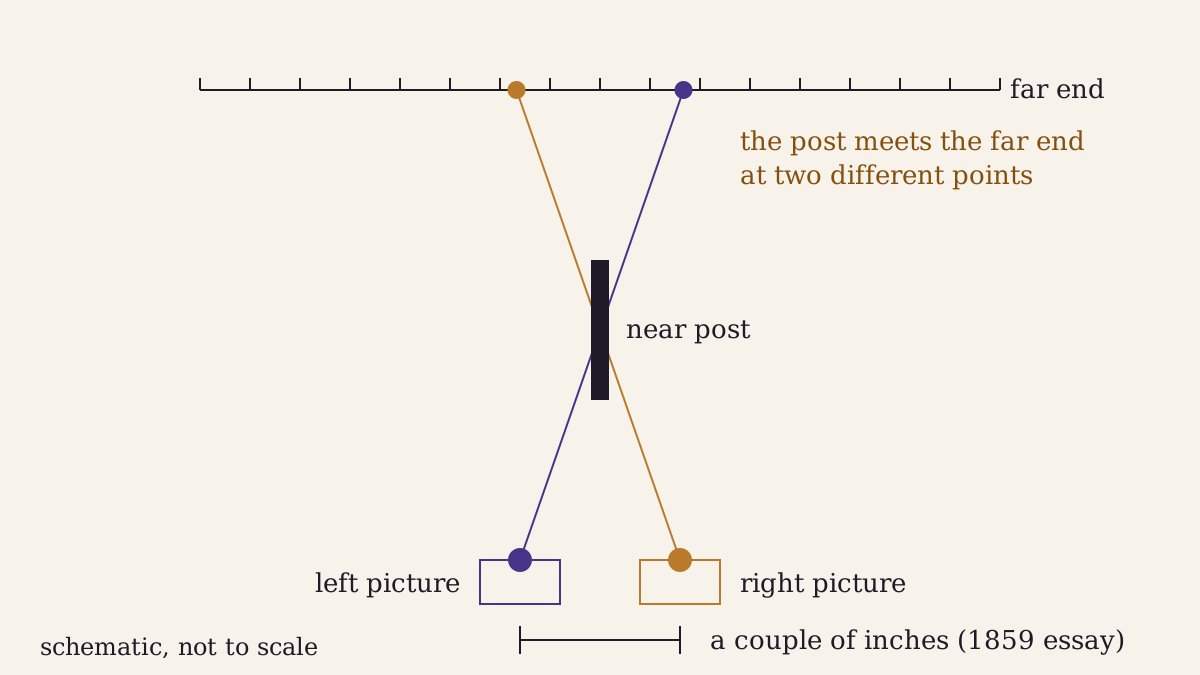
Schematic, not to scale: from two points a couple of inches apart, one near post covers two different parts of the background.
"Two lenses, one near post, two different backgrounds" by Flickers & Tintypes, https://flickersandtintypes.com/photo-objects/stereograph/ — CC BY 4.0, https://creativecommons.org/licenses/by/4.0/
Hold up a finger and close one eye, then the other. The finger jumps against the wall behind it, while the wall stays put. The 1859 essay puts the same fact plainly on page 742: the two eyes see different pictures “for the obvious reason that they look from points two or three inches apart.”
A camera moved by that distance records the same jump. Far objects land in almost the same place in both pictures; near objects land in different places, and the nearer they are, the bigger the difference. The diagram shows one near post in front of a far wall: from the left lens it covers one part of the wall, from the right lens another.
David Brewster's 1856 book, The Stereoscope, gives numbers for the same idea. He takes the distance between the eyes as 2½ inches. For pictures made for his lens viewer, he writes that “the distance between similar points in the two pictures” varies “from 2.30 inches to 2.57, according to the different distances of the foreground and the remotest object in the picture.” In other words, the spacing on the card itself carries the depth.
Laying one half over the other
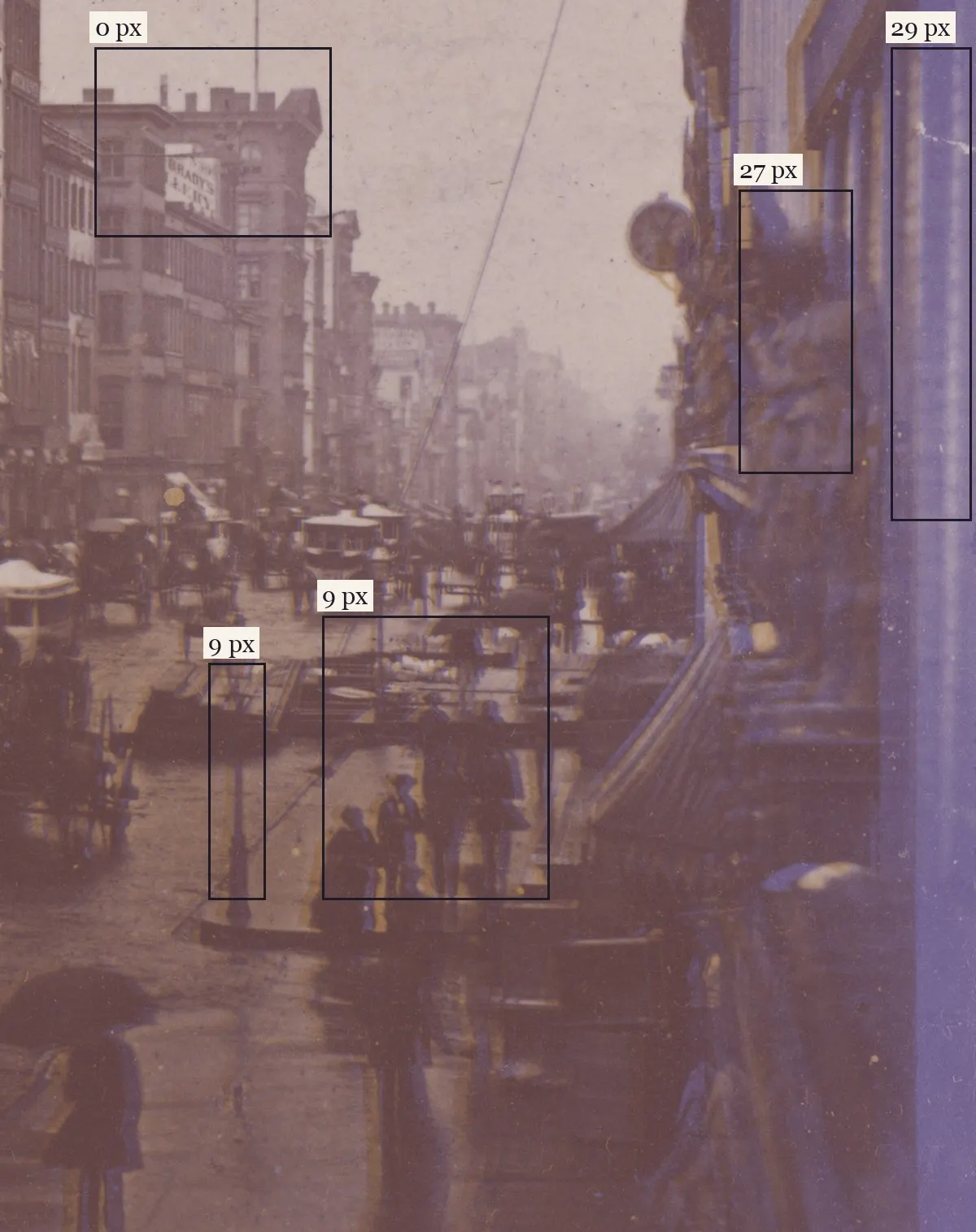
Left half in violet, right half in amber, lined up on the far buildings: 0 px of shift there, 9 px at the lamp and the walkers, 27 to 29 px at the corner building.
“Broadway in the rain, left and right halves overlaid” — Flickers & Tintypes — CC BY 4.0 full credit
"Broadway in the rain, left and right halves overlaid" by Flickers & Tintypes, https://flickersandtintypes.com/photo-objects/stereograph/ — CC BY 4.0, https://creativecommons.org/licenses/by/4.0/. Underlying image: "[Broadway, New York City, in the rain], stereograph, Metropolitan Museum of Art 1980.1056.3" by Edward Anthony and Henry T. Anthony — https://commons.wikimedia.org/wiki/File:-Broadway,_New_York_City,_in_the_rain-_MET_DP218027.jpg — CC0 1.0 (https://creativecommons.org/publicdomain/zero/1.0/); modified: scaled from 3871 to 1600 pixels wide; nothing else changed, left half (x 900–1930, y 650–1950 of the 3871-pixel scan) printed in violet, right half shifted back by 1934 px across and 9 px down and printed in amber, scaled to 1200 px wide, measured boxes and shifts added.
Here the left half is printed in violet and the right half in amber, then laid one over the other. Where the halves agree, the colors cancel into one plain picture. Where they disagree, an edge splits into a violet copy and an amber copy.
The far buildings sit together, while the carved figures on the corner building and the fluted pilaster beside them split wide. A pilaster is a flat pillar set into a wall, and this one is the nearest of the measured points.
The shifts come from a measurement on the Commons scan of the card, which is 3,871 pixels wide. For each box drawn on the left half, a program cut the box into small squares, 48 pixels on a side. For each square it searched the right half for the best match and kept only strong matches. The middle value of those offsets is the number for that box.
The far buildings matched at an offset of 1,934 pixels, and every other shift is counted against that offset. The scan gives no physical size for the card, so the numbers stay in pixels and are not turned into inches. Squares of other sizes move some figures by about a pixel, so read each one as a whole-pixel estimate.
How much each part of the street moves
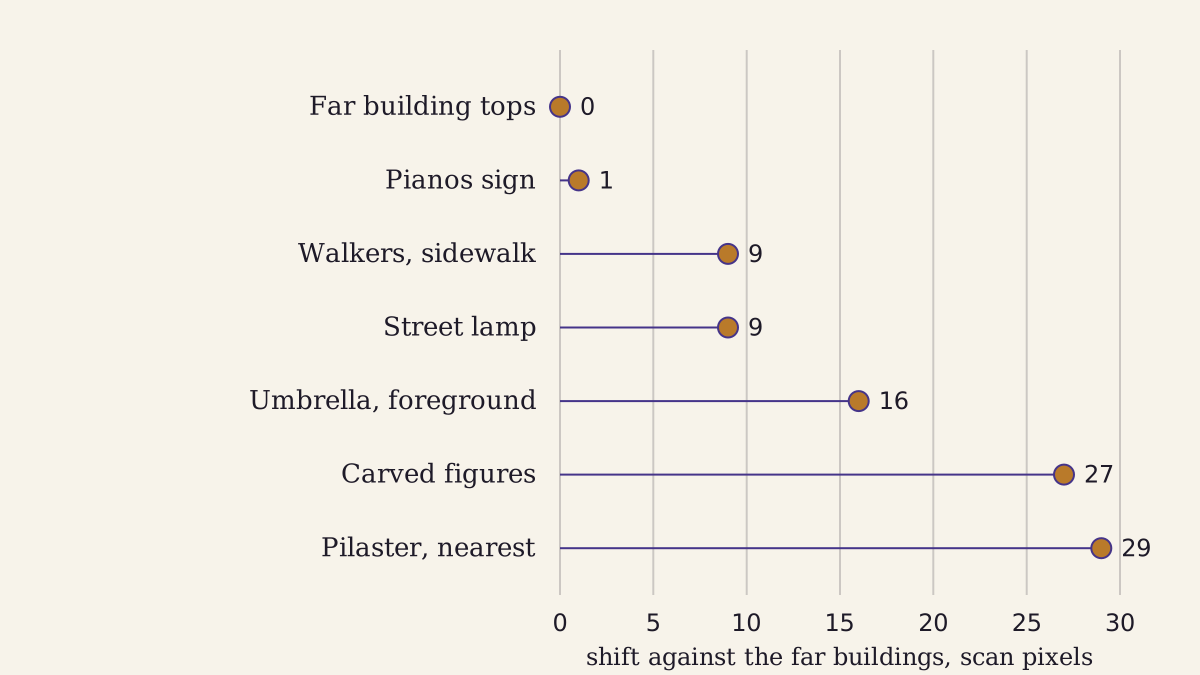
Seven points on the scan of this card: the nearer the object to the camera, the larger the shift between the two halves.
"Shift between the halves of the Broadway card, seven points" by Flickers & Tintypes, https://flickersandtintypes.com/photo-objects/stereograph/ — CC BY 4.0, https://creativecommons.org/licenses/by/4.0/
Data: Metropolitan Museum of Art 1980.1056.3, Wikimedia Commons file DP218027, CC0 1.0; shifts measured on this page
| Point on the card | Offset between halves | Shift against the far buildings |
|---|---|---|
| Far building tops | 1,934 px | 0 px |
| Painted sign for pianos | 1,933 px | 1 px |
| Walkers on the sidewalk | 1,925 px | 9 px |
| Street lamp at the curb | 1,925 px | 9 px |
| Walker with an umbrella, foreground | 1,918 px | 16 px |
| Carved figures on the corner building | 1,907 px | 27 px |
| Fluted pilaster, nearest | 1,905 px | 29 px |
The order matches the layout of the street: distance grows from the corner building to the walkers and out to the far end, and the shift shrinks the same way. The lamp's figure rests on only 3 strong matches, because the post is thin, so treat it as rougher than the rest.
On this card the whole spread is 29 pixels out of 1,934, about 1.5 percent. Brewster's range for his own pictures, 2.30 to 2.57 inches, spans about 10.5 percent. He was writing about other pictures, made at other distances, so the two figures show the same pattern rather than the same amount.
The 1859 essay warns about one trap. “It is common to find an object in one of the twin pictures which we miss in the other,” it says on page 745, because “the person or the vehicle” moved between the two photographs. A moving walker would add a shift of its own. On this card the median for the walkers matches the lamp beside them, but that box holds several walkers and its matches spread from 1,921 to 1,927 pixels, so this measurement cannot say whether any one of them moved.
Download the shift measurements for this card (CSV) source and license notes
Seeing the two halves in turn
You can watch the depth without a viewer by showing the halves one after the other. The loop below holds the left half for 3 frames, then the right half for 3 frames, at 3 frames per second. Each half stays up for 1 second, so the loop runs 2 seconds and the picture changes once a second.
Broadway in the rain, left half and right half in turn
Every frame, side by side
- 1left half
- 2left half
- 3left half
- 4right half
- 5right half
- 6right half
6 frames at 3 frames per second.
Frame list (CSV) stereograph-wiggle.csv Source and license notes
Credits for this loop
- "Broadway in the rain, left half and right half in turn" by Flickers & Tintypes, https://flickersandtintypes.com/photo-objects/stereograph/ — CC BY 4.0, https://creativecommons.org/licenses/by/4.0/
- "[Broadway, New York City, in the rain], stereograph, Metropolitan Museum of Art 1980.1056.3, left and right crops for the loop" by Edward Anthony and Henry T. Anthony — https://commons.wikimedia.org/wiki/File:-Broadway,_New_York_City,_in_the_rain-_MET_DP218027.jpg — CC0 1.0 (https://creativecommons.org/publicdomain/zero/1.0/); modified: cut the same 860 x 1150 px box from each half of the 3871 px original (left at 980,650; right at 2914,659, lined up on the far buildings), each scaled down to 478 x 640 px and stacked, for the loop
Both crops are lined up on the far buildings, so the end of the street stays still. The walkers move a little and the carved figures on the corner swing farther. If you see no movement at all, look at the right edge first, where the shift is largest. The right half is lighter in this scan, so the picture brightens when the right half comes up and darkens when the left returns; that change is one of tone, not depth.
Lining the crops up on a near object instead would flip the effect: the corner would hold still and the far street would slide. The depth is the same either way. Only the point you hold still changes.
The cards of The Horse in Motion turn this around. There, a line of cameras spaced along the track catches many moments of one horse, one picture each; here, two points a couple of inches apart catch one scene. Spinning drawings in a zoetrope makes motion from flat pictures; a stereograph makes depth from flat pictures.
Stereograph or stereoscope?
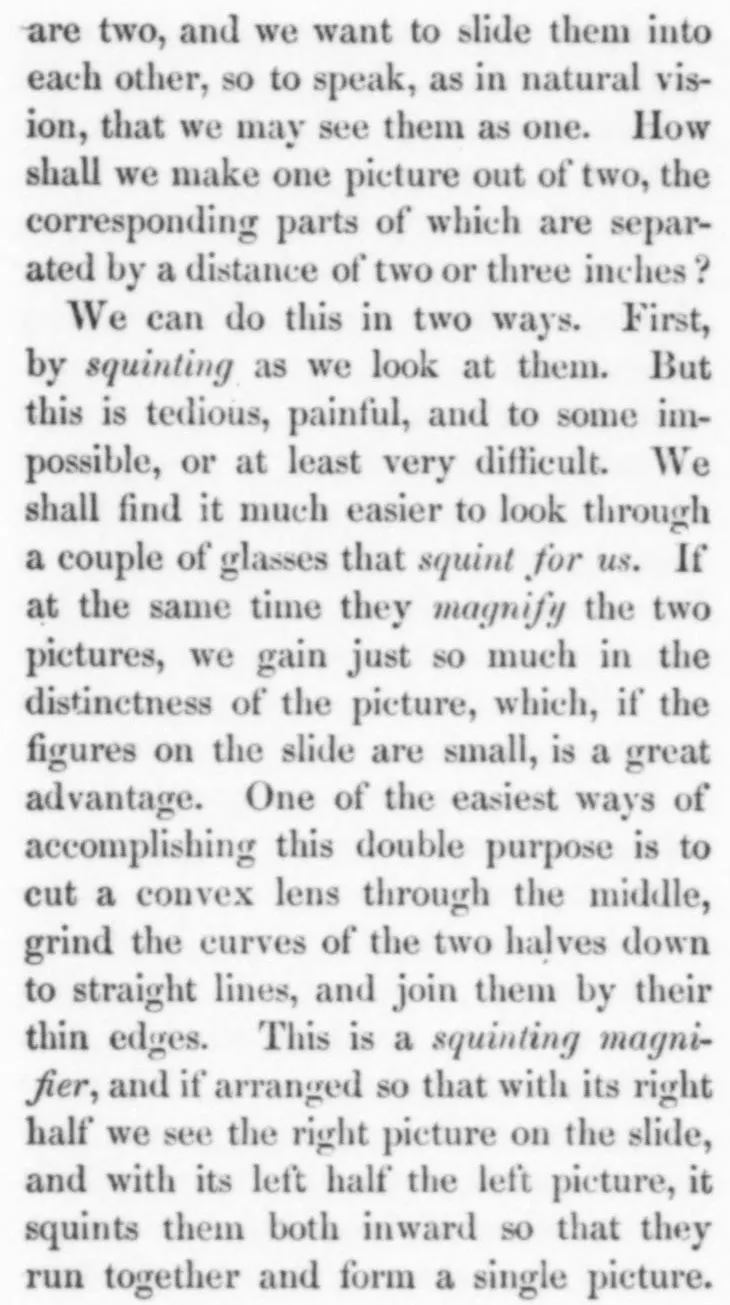
Atlantic Monthly, June 1859, p. 744: two half lenses that squint the two pictures together into one.
“The Stereoscope and the Stereograph, The Atlantic Monthly, vol. 3, no. 20 (June 1859), page 744” — The Atlantic Monthly — public domain full credit
"The Stereoscope and the Stereograph, The Atlantic Monthly, vol. 3, no. 20 (June 1859), page 744" by The Atlantic Monthly — https://archive.org/details/sim_atlantic_1859-06_3_20 — Public domain: Public domain in the US (published 1859) and in the EU (published without an author's name in 1859; protection for anonymous works ends 70 years after publication); modified: cropped to the passage from "are two, and we want to slide them" to "form a single picture"
The stereograph is the card; the stereoscope is the viewer. The 1859 essay keeps the two apart in its title and its text. It asks how to “make one picture out of two,” when the matching parts are “separated by a distance of two or three inches.”
One answer is to cross your eyes, which the essay calls “tedious, painful, and to some impossible.” The other is a viewer with two half lenses joined at their thin edges. The essay names it “a squinting magnifier.” With the right half you see the right picture and with the left half the left picture, and the two run together into one.
Who devised the viewer is a crowded question. The 1859 essay credits the instrument to Professor Wheatstone and says he described it in 1838. Brewster's 1856 book names two men working on binocular pictures at that time, Wheatstone and an Edinburgh mathematics teacher named Elliot.
Brewster also describes the lens viewer he built himself, which he calls the lenticular stereoscope. This page leaves those claims side by side, since none of the sources read here settles which came first.
Prints consulted
- 1“The Stereoscope and the Stereograph,” The Atlantic Monthly, vol. 3, no. 20 (June 1859), pp. 738–748; published without an author's name. https://archive.org/details/sim_atlantic_1859-06_3_20Read: pages 742–745, checked against the page images
- 2David Brewster, The Stereoscope: Its History, Theory, and Construction. London: John Murray, 1856. https://www.gutenberg.org/ebooks/71483Read: chapters 1, 2 and 8
- 3Edward Anthony and Henry T. Anthony, [Broadway, New York City, in the rain], stereograph, albumen silver prints, circa 1860. Metropolitan Museum of Art, accession 1980.1056.3; museum data as given on the Wikimedia Commons file page (DP218027). https://commons.wikimedia.org/wiki/File:-Broadway,_New_York_City,_in_the_rain-_MET_DP218027.jpgRead: file page and original image

Next reel:
- Tintype: another photograph made to be held in the hand, read here from its label as well as its face.
- Real photo postcards: card photographs that went through the mail, and what the back of a card can date.
- Public-domain original to view: Broadway, New York City, in the rain, Met 1980.1056.3 (Wikimedia Commons)
Cite this page
Flickers & Tintypes. “Stereograph: Twin Photos Shot a Couple of Inches Apart.” Flickers & Tintypes. Published November 12, 2026. https://flickersandtintypes.com/photo-objects/stereograph/. Accessed [the date you read it].
Same sectionAlso in Photo Objects
Photo Objects
Tintype: A London Label Priced 36 Tiny Portraits at 2s. 6d.
A tintype is a portrait made in the camera on black-japanned iron. Labels on the backs of museum tintypes show studios selling tiny gems by the dozen.
Picture credit
"Portret van een onbekende man (Portrait of an unknown man), RP-F-F15037" by A. Brittlebank — https://commons.wikimedia.org/wiki/File:Portret_van_een_onbekende_man,_RP-F-F15037.jpg — Public domain: Public domain in the US (made in 1878: published or not, the term has run out) and presumed public domain in the EU (Rijksmuseum Public Domain Mark; A. Brittlebank was working in London in 1878, death date not found); the Commons file is the museum’s own upload under CC0 1.0
Photo Objects
Real Photo Postcard: The Back Dates the Card, Not the Photo
How to date a real photo postcard from its back: what the postmark, the stamp and a divided back can date, read against the 1907 US postal rules for post cards.
Picture credit
"Real photo postcard, December 1905: on board the SS Parisian (photograph area)" by Unknown author — https://commons.wikimedia.org/wiki/File:1905-12-22_RPPC_On_board_the_SS_Parisian_A.jpg — Public domain: Public domain in the US (anonymous work made by 1905: more than 120 years since creation, whether or not it was published; mailed December 23, 1905) and in the EU (anonymous work; 70 years from creation or from first making available have run out); modified: cropped to a 4:3 area of the photograph (box 653,3485,7516,8627 of the 8551 x 13068 original), removing the handwriting above and below; scaled to 1600 px wide
Photo Objects
Hand-Colored Photographs: The Color Came After the Picture
A hand-colored photograph is a one-color picture with color added by hand. An 1872 tintype manual says to color the plate once dry, ordinarily cheeks and lips.
Picture credit
"Mensen in een veld met irissen in Horikiri bij Tokyo (Iris Flowers Horikiri Tokio.), Rijksmuseum RP-F-F01206-H, cropped" by Unknown author — https://commons.wikimedia.org/wiki/File:Mensen_in_een_veld_met_irissen_in_Horikiri_bij_Tokyo_Iris_Flowers_Horikiri_Tokio._(titel_op_object),_RP-F-F01206-H.jpg — Public domain: Public domain in the US (made about 1870–1900: published before 1931, or if unpublished, an anonymous work more than 120 years old) and in the EU (presumed: anonymous photographer per the Rijksmuseum record, and any 70-year term from making or publication expired long ago); Rijksmuseum Public Domain Mark 1.0, Commons file CC0 1.0; modified: cropped at the top, at the left margin, at the right edge and above the printed title strip to a 4:3 view (3475 x 2606 px of the 4364 x 3462 original); scaled to 1600 px wide