A Trip to the Moon: Méliès’s 1903 Catalog Lists 30 Scenes
Frame card
In one line Per Star Films’ own catalog, dated 1903 in the Edison Papers record, A Trip to the Moon ran about 845 feet in thirty listed scenes, priced at $130, and scene 9 is titled “Landed Right in the Eye!!!”
Source, Year, Format, Length or Size, Access, License
- Source
- Complete Catalogue of Genuine and Original “Star” Films, Geo. Méliès, New York branch: entry 399–411, page 25
- Year
- Catalog dated 1903 in the Edison Papers record; no date appears on its title page
- Format
- Catalog entry: number range 399–411 and a list of 30 scene titles, without scene descriptions
- Length or Size
- 845 feet (length about) and sixteen minutes (duration of exhibit), per the catalog
- Access
- https://archive.org/details/edisonmpc-L003
- License
- Catalog pages: public domain in the US and the EU; the CAUTION notice, signed by Gaston Méliès, is presumed public domain in the EU (details in each image credit)
Card data (CSV) a-trip-to-the-moon-frame-card.csv Source and license notes
Shot list · 5 sections
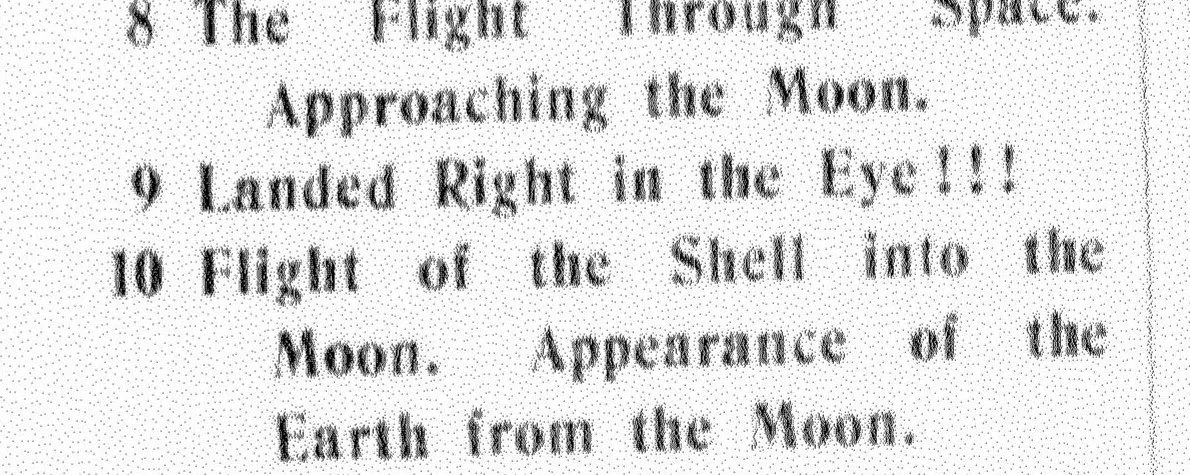
Page 25, scene 9, catalog numbers 399–411: the title the Star Films catalog gives the landing, between scenes 8 and 10.
“Star Films catalog, page 25: A Trip to the Moon, scenes 8 to 10” — Star Films, Geo. Méliès, New York branch — public domain full credit
"Star Films catalog, page 25: A Trip to the Moon, scenes 8 to 10" by Star Films, Geo. Méliès, New York branch — https://archive.org/details/edisonmpc-L003 — Public domain: Public domain in the US (published 1903, per the Edison Papers record of the catalog) and in the EU (unsigned company catalog of Star Films: as a collective or anonymous work, 70 years from publication ended in 1973; Geo. Méliès, named on the title page, died in 1938); scan of a photocopy credited to the Edison National Historic Site and the Museum of Modern Art, their records not consulted directly; modified: cropped from the page image of catalog page 25 to scene titles 8 to 10
Page 25 of the Star Films catalog gives scene 9 a five-word title with three exclamation marks. The title “Landed Right in the Eye!!!” sits in a list of thirty scene titles for A Trip to the Moon, sold under catalog numbers 399–411. The catalog comes from the company of Georges Méliès, and the Edison Papers record dates it to 1903. It gives the film’s length as about 845 feet and its price as $130.
No copy of the film could be traced well enough for a frame-by-frame breakdown. The versions found online are restorations, reposts and files of unknown origin. So this page reads the film the way a buyer in New York could order it: through its maker’s catalog. Every scene described below is per the 1903 catalog, not from any copy.
What does the 1903 catalog list for A Trip to the Moon?
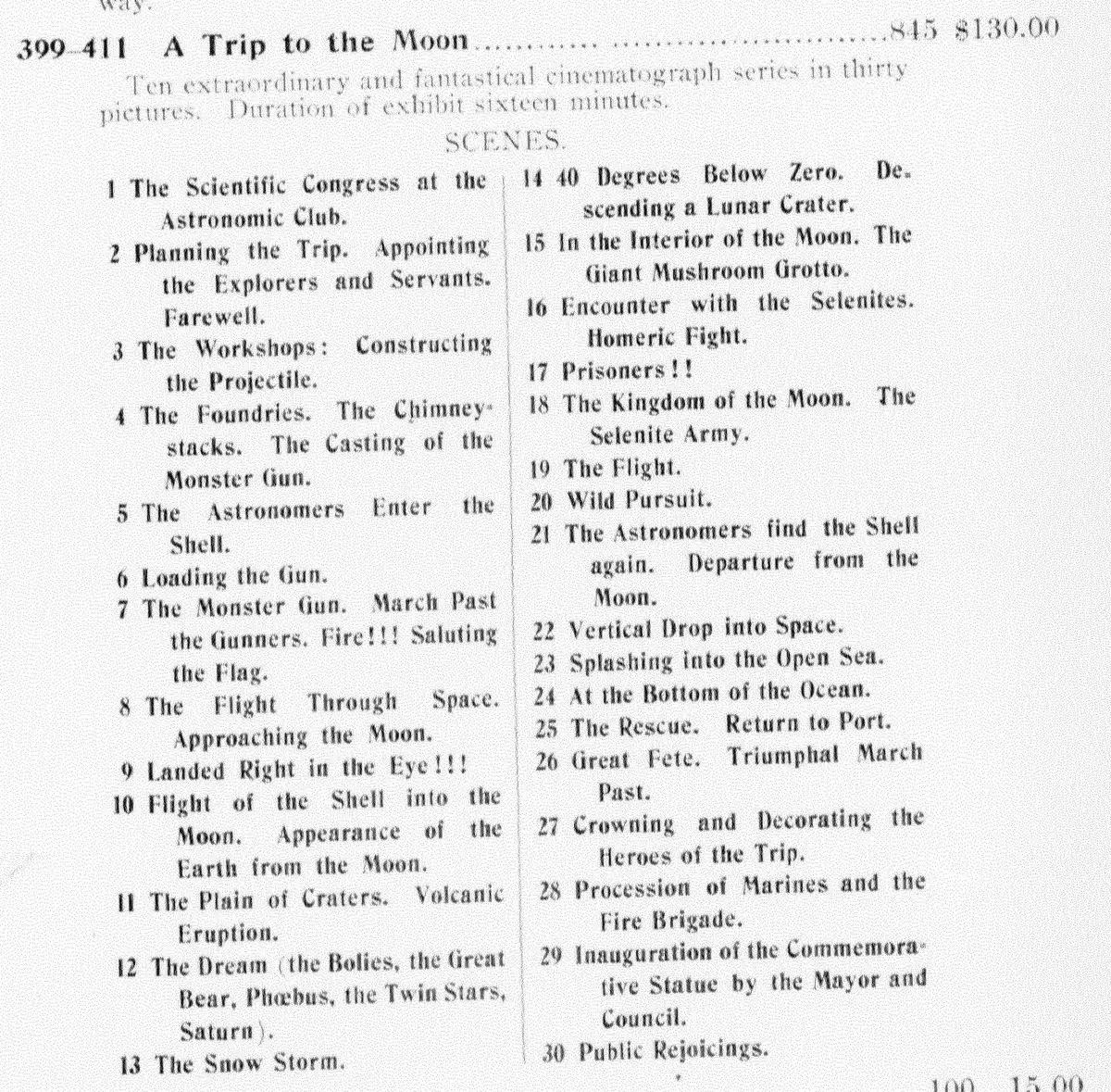
Page 25: the full entry, with length about 845 feet, price $130.00 and the thirty scene titles in two columns.
“Star Films catalog, page 25: entry 399–411, A Trip to the Moon” — Star Films, Geo. Méliès, New York branch — public domain full credit
"Star Films catalog, page 25: entry 399–411, A Trip to the Moon" by Star Films, Geo. Méliès, New York branch — https://archive.org/details/edisonmpc-L003 — Public domain: Public domain in the US (published 1903, per the Edison Papers record of the catalog) and in the EU (unsigned company catalog of Star Films: as a collective or anonymous work, 70 years from publication ended in 1973; Geo. Méliès, named on the title page, died in 1938); scan of a photocopy credited to the Edison National Historic Site and the Museum of Modern Art, their records not consulted directly; modified: cropped from the page image of catalog page 25 to the A Trip to the Moon entry, then scaled to 1200 px
A film catalog was a printed price list for exhibitors, the people who bought prints and showed them. This one is the Complete Catalogue of Genuine and Original “Star” Films, issued by the New York branch at 204 East 38th Street, and its entry for A Trip to the Moon has one heading line, two sentences and a numbered list.
The heading gives the numbers 399–411, a length of about 845 feet and a price of $130.00. The two sentences call it “Ten extraordinary and fantastical cinematograph series in thirty pictures” and give the “Duration of exhibit” as “sixteen minutes.” The thirty “pictures” line up with the scenes: the list under the word SCENES numbers them 1 to 30. The “ten” series match neither the thirty scenes nor the 13 catalog numbers. The page does not say what they were.
The entry sits in the catalog’s Class II. The terms page says Class I holds subjects made before the company “decided to open a factory in the United States,” with negatives in Paris and about a fortnight to fill orders. Class II negatives were kept in New York, “so that orders for any of the Films will be promptly filled.”
The list gives titles only. Two pages later, the same catalog prints a sentence or more for each of the 25 scenes of Robinson Crusoe. Its first scene, “Shipwrecked,” explains that the vessel “has just been wrecked, and is seen in the distance being tossed about by the angry seas.” For A Trip to the Moon, a buyer got thirty short headings and nothing more. Scene 12 even names “the Bolies” among the figures of a dream, spelled that way on the page.
Thirty titles, read in order
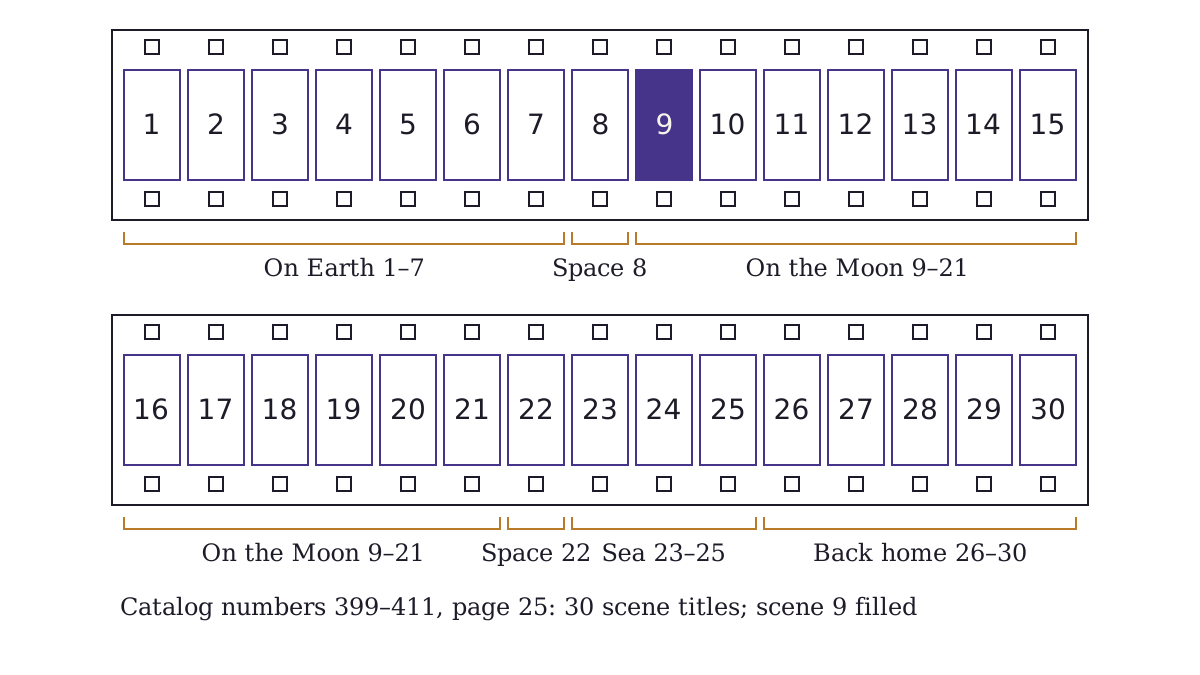
The thirty titles in printed order. The grouping by Earth, space, Moon, sea and home is this page’s reading of the titles, not a catalog heading.
"A Trip to the Moon: the 30 catalog scene titles in order" by Flickers & Tintypes, https://flickersandtintypes.com/early-cinema/a-trip-to-the-moon/ — CC BY 4.0, https://creativecommons.org/licenses/by/4.0/
Read top to bottom, the titles tell the story as a timeline. Scenes 1 to 7 stay on Earth: a scientific congress, the planning, the workshops, the foundries casting the “Monster Gun,” and the firing (“Fire!!!”). Scene 8 is the flight through space. Scene 9 is the landing.
On this page’s reading, scenes 9 to 21 take place on the Moon, so 13 of the 30 titles are lunar. They pass through craters, a dream, a snow storm, a mushroom grotto, a fight with the Selenites and an escape. Scene 22 is a “Vertical Drop into Space,” scenes 23 to 25 put the shell in the sea, and scenes 26 to 30 are celebrations at home. The landing comes ninth of thirty, before the one-third mark.
The punctuation carries the catalog’s voice. Three exclamation marks follow “Fire” in scene 7 and “Eye” in scene 9, and two follow “Prisoners” in scene 17. No other title on the list has them. They read as a seller’s nudge toward the big moments, and they are the closest the catalog comes to describing what happens.
Scene 10 follows with “Flight of the Shell into the Moon. Appearance of the Earth from the Moon.” How scenes 9 and 10 look on screen is a question only a traceable copy could answer, and none was used here. A newspaper comics page also carries a story through pictures in a fixed order; Little Nemo shows how one page orders its panels.
| No. | Catalog title (page 25) |
|---|---|
| 1 | The Scientific Congress at the Astronomic Club. |
| 2 | Planning the Trip. Appointing the Explorers and Servants. Farewell. |
| 3 | The Workshops: Constructing the Projectile. |
| 4 | The Foundries. The Chimney-stacks. The Casting of the Monster Gun. |
| 5 | The Astronomers Enter the Shell. |
| 6 | Loading the Gun. |
| 7 | The Monster Gun. March Past the Gunners. Fire!!! Saluting the Flag. |
| 8 | The Flight Through Space. Approaching the Moon. |
| 9 | Landed Right in the Eye!!! |
| 10 | Flight of the Shell into the Moon. Appearance of the Earth from the Moon. |
| 11 | The Plain of Craters. Volcanic Eruption. |
| 12 | The Dream (the Bolies, the Great Bear, Phœbus, the Twin Stars, Saturn). |
| 13 | The Snow Storm. |
| 14 | 40 Degrees Below Zero. Descending a Lunar Crater. |
| 15 | In the Interior of the Moon. The Giant Mushroom Grotto. |
| 16 | Encounter with the Selenites. Homeric Fight. |
| 17 | Prisoners!! |
| 18 | The Kingdom of the Moon. The Selenite Army. |
| 19 | The Flight. |
| 20 | Wild Pursuit. |
| 21 | The Astronomers find the Shell again. Departure from the Moon. |
| 22 | Vertical Drop into Space. |
| 23 | Splashing into the Open Sea. |
| 24 | At the Bottom of the Ocean. |
| 25 | The Rescue. Return to Port. |
| 26 | Great Fete. Triumphal March Past. |
| 27 | Crowning and Decorating the Heroes of the Trip. |
| 28 | Procession of Marines and the Fire Brigade. |
| 29 | Inauguration of the Commemorative Statue by the Mayor and Council. |
| 30 | Public Rejoicings. |
Download the 30 scene titles (CSV) source and license notes
About 845 feet, sixteen minutes, $130
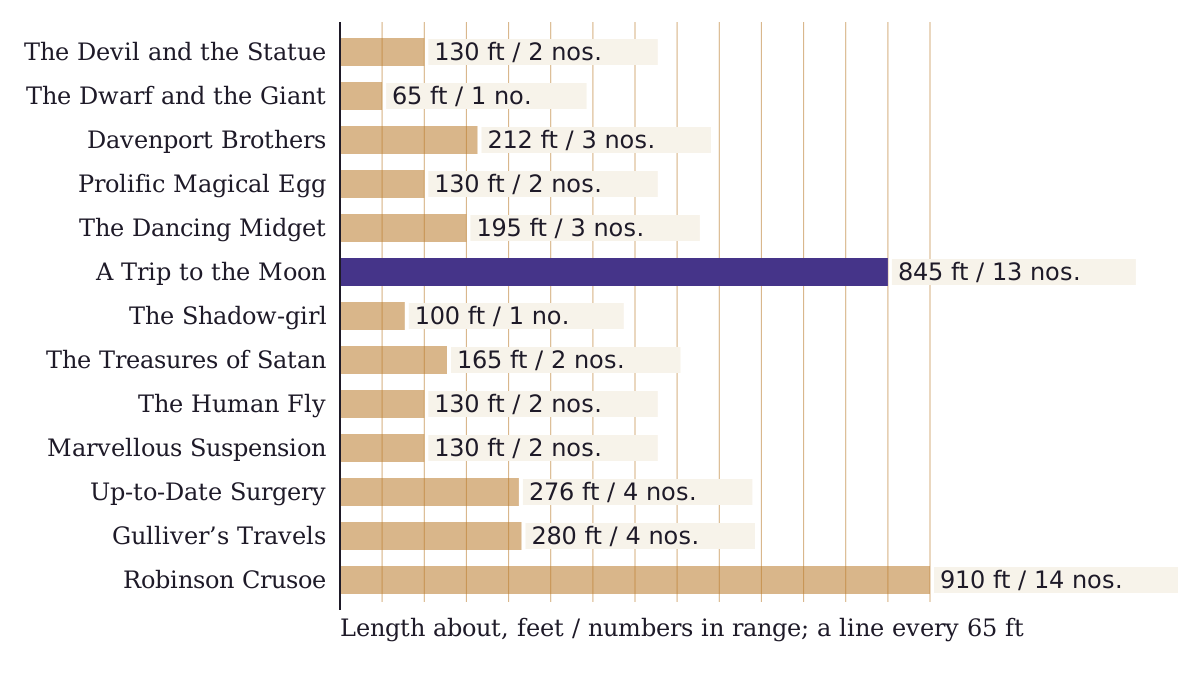
Thirteen films on catalog pages 24 to 27, by approximate printed length and size of number range. Each vertical line marks 65 feet.
"Star Films catalog pages 24–27: length and number range" by Flickers & Tintypes, https://flickersandtintypes.com/early-cinema/a-trip-to-the-moon/ — CC BY 4.0, https://creativecommons.org/licenses/by/4.0/
The range 399–411 covers 13 catalog numbers, and 845 feet divided by 13 is exactly 65 feet. That figure recurs. On Class I pages 9 to 13, every film with a single number is listed at 65 feet, though pages 14 and 15 also list single numbers at 82 and 100 feet. On pages 24 to 27, 8 of 13 entries come out at their count of numbers times 65 feet.
The other five do not. The Shadow-girl has one number and 100 feet, and Up-to-Date Surgery has four numbers and 276 feet. So the numbers behave like 65-foot units on these pages, a pattern counted here rather than a rule the catalog states. A Trip to the Moon and Robinson Crusoe hold the two longest runs on these pages, 13 and 14 numbers.
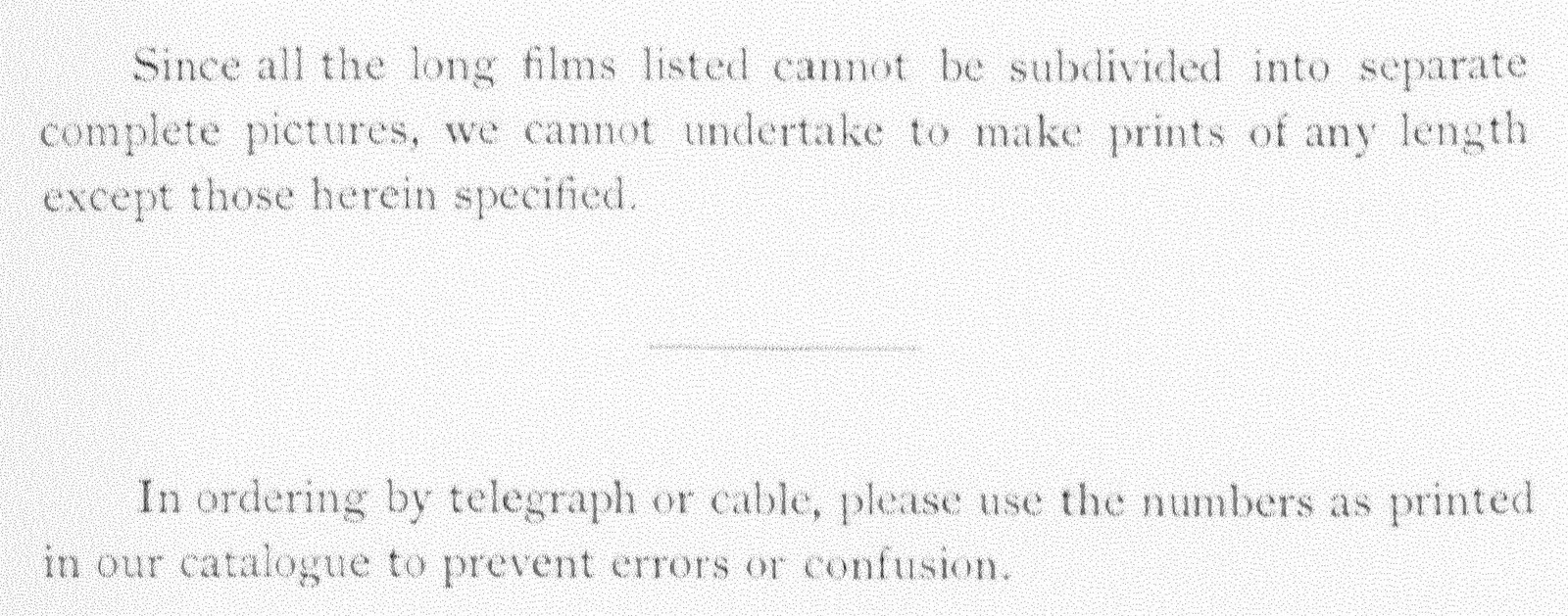
From the catalog’s terms page: long films could not be subdivided, and orders by telegraph or cable were to use the printed numbers.
“Star Films catalog, terms page: long films and ordering by number” — Star Films, Geo. Méliès, New York branch — public domain full credit
"Star Films catalog, terms page: long films and ordering by number" by Star Films, Geo. Méliès, New York branch — https://archive.org/details/edisonmpc-L003 — Public domain: Public domain in the US (published 1903, per the Edison Papers record of the catalog) and in the EU (unsigned company catalog of Star Films: as a collective or anonymous work, 70 years from publication ended in 1973; Geo. Méliès, named on the title page, died in 1938); scan of a photocopy credited to the Edison National Historic Site and the Museum of Modern Art, their records not consulted directly; modified: cropped from the page image of the terms page to the last two notices, then scaled to 1600 px
The terms page explains what a buyer could not do. “Since all the long films listed cannot be subdivided into separate complete pictures, we cannot undertake to make prints of any length except those herein specified.” A Trip to the Moon came as one print of about 845 feet or not at all.
The price works out to about 15.4 cents a foot. Across the 13 films on pages 24 to 27, the rate runs from about 13.8 to 16.8 cents a foot, so the film cost more mainly because it was longer.
The “sixteen minutes” is the catalog’s own show time. Robinson Crusoe, at 910 feet, is listed at “about 20 minutes,” which works out to a different rate (about 45.5 feet a minute against 52.8). Neither figure is used here to work out a projection speed.
| Numbers | Title | Feet (about) | Price | Numbers × 65 ft |
|---|---|---|---|---|
| 384–385 | The Devil and the Statue | 130 | $18.00 | 130 |
| 386 | The Dwarf and the Giant | 65 | $9.00 | 65 |
| 387–389 | The Cabinet Trick of the Davenport Brothers | 212 | $30.00 | 195 |
| 392–393 | Prolific Magical Egg | 130 | $18.00 | 130 |
| 394–396 | The Dancing Midget | 195 | $30.00 | 195 |
| 399–411 | A Trip to the Moon | 845 | $130.00 | 845 |
| 412 | The Shadow-girl | 100 | $15.00 | 65 |
| 413–414 | The Treasures of Satan | 165 | $23.00 | 130 |
| 415–416 | The Human Fly | 130 | $20.00 | 130 |
| 417–418 | Marvellous Suspension and Evolution | 130 | $20.00 | 130 |
| 422–425 | Up-to-Date Surgery | 276 | $43.00 | 260 |
| 426–429 | Gulliver’s Travels among the Liliputians and the Giants | 280 | $47.00 | 260 |
| 430–443 | Robinson Crusoe | 910 | $140.00 | 910 |
Download the 13 catalog entries with this page’s arithmetic (CSV) source and license notes
The same year, Edison’s catalog for The Great Train Robbery told exhibitors where one shot could go in their print.
Who claimed to have made A Trip to the Moon?
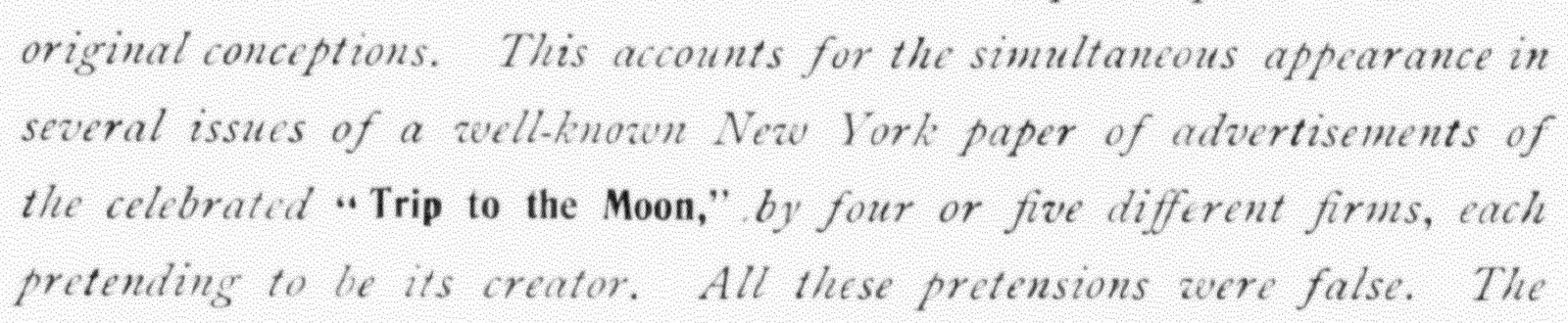
From the catalog’s opening notice, signed by Gaston Méliès as general manager: the complaint about four or five firms.
“Star Films catalog, CAUTION notice: four or five firms” — Star Films, Geo. Méliès, New York branch — public domain full credit
"Star Films catalog, CAUTION notice: four or five firms" by Star Films, Geo. Méliès, New York branch — https://archive.org/details/edisonmpc-L003 — Public domain: Public domain in the US (published 1903, per the Edison Papers record of the catalog); in the EU presumed public domain (notice signed by Gaston Méliès as general manager of Star Films, published 1903; his death year not verified here); scan of a photocopy credited to the Edison National Historic Site and the Museum of Modern Art, their records not consulted directly; modified: cropped from the page image of the CAUTION notice to four lines, then scaled to 1600 px
The catalog opens with a notice headed “CAUTION:” and signed by Gaston Méliès, General Manager. It complains of advertisements, in “a well-known New York paper,” for “the celebrated ‘Trip to the Moon,’ by four or five different firms, each pretending to be its creator.” Then it answers them: “All these pretensions were false.”
The notice names neither the paper nor the firms, and those advertisements were not traced for this page. It credits George Méliès, as the notice spells him, with having “conceived the ideas, painted the backgrounds, devised the accessories and acted on the stage.” The same notice calls him “the originator” of films “made from artificially arranged scenes.” That is a seller describing its own goods, so this page reports it as the company’s claim, not as settled film history.
The notice ends with a threat. The company says that in opening “a factory and office in New York” it is ready “to pursue all counterfeiters and pirates,” and closes: “We will not speak twice; we will act.”
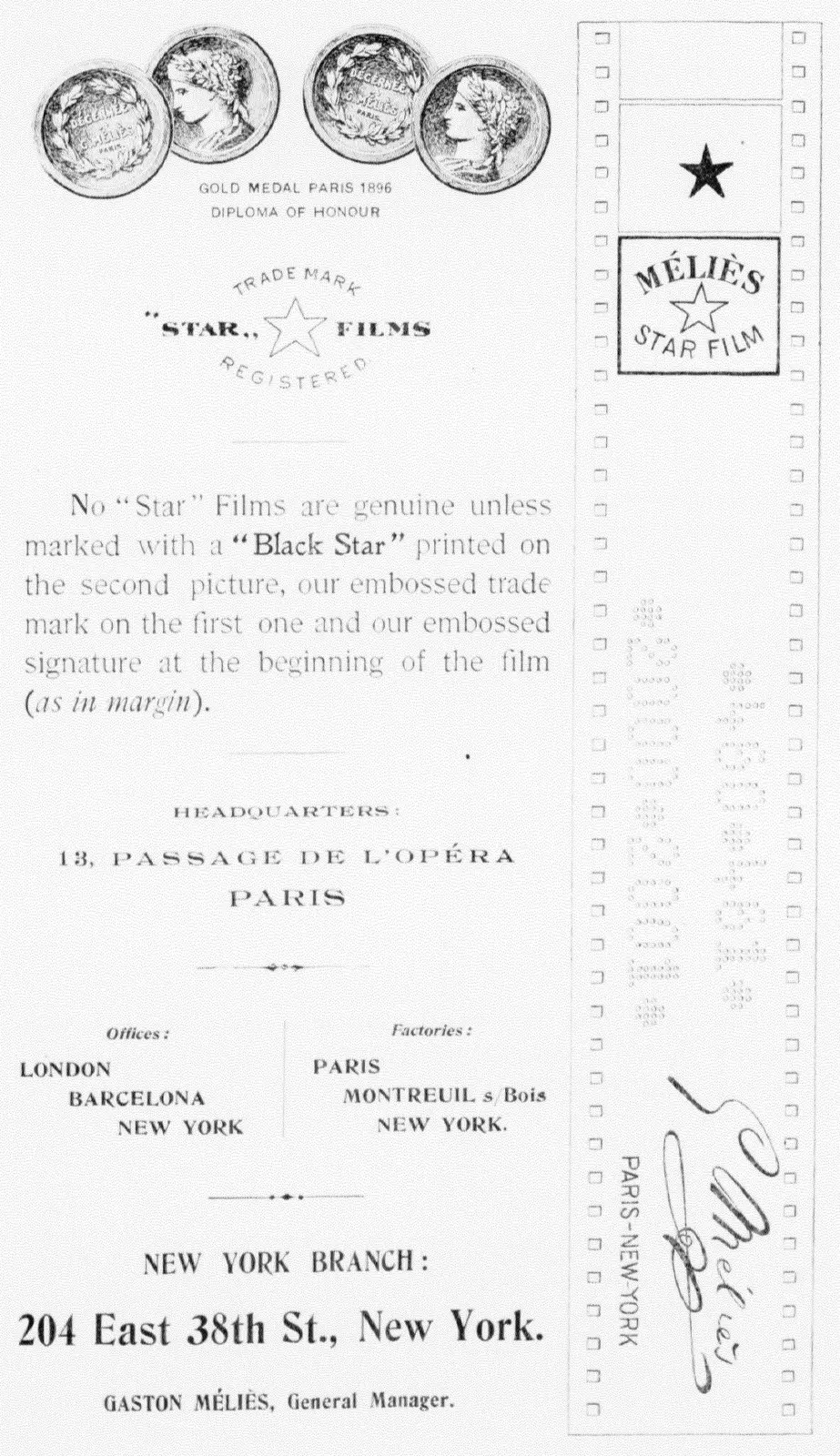
The catalog’s mark of a genuine Star film: a black star on the second picture, the trade mark on the first, the signature at the start.
“Star Films catalog: the Black Star notice and margin strip” — Star Films, Geo. Méliès, New York branch — public domain full credit
"Star Films catalog: the Black Star notice and margin strip" by Star Films, Geo. Méliès, New York branch — https://archive.org/details/edisonmpc-L003 — Public domain: Public domain in the US (published 1903, per the Edison Papers record of the catalog) and in the EU (unsigned company catalog of Star Films: as a collective or anonymous work, 70 years from publication ended in 1973; Geo. Méliès, named on the title page, died in 1938); scan of a photocopy credited to the Edison National Historic Site and the Museum of Modern Art, their records not consulted directly; modified: cropped from the page image to the notice, medals, addresses and margin film strip, then scaled to 1600 px tall
The company’s answer to copying was printed on the film itself. “No ‘Star’ Films are genuine unless marked with a ‘Black Star’ printed on the second picture,” the catalog says, with an embossed trade mark on the first picture and an embossed signature at the start. A strip drawn in the margin shows where each mark goes. Whether a surviving copy still carries those marks is again a question for a traced copy.
What the catalog cannot show
 Illustration
The catalog gives A Trip to the Moon thirty scene titles; what those scenes looked like on screen is not on the page.
Illustration: Flickers & Tintypes. Generated schematic image — not a photograph, film frame or historical record. No copyright is claimed in this generated imagery; you may reuse it, and a credit to Flickers & Tintypes is appreciated.
A catalog line is a promise to a buyer. It cannot show framing, sets, how fast it was projected, or what the Moon looked like. It cannot even say whether the thirty titles ever appeared on screen as written words. They are printed for the buyer, and the entry gives no sign either way.
Those questions need a copy whose history is on record, and this page says “per the catalog” wherever it relies on the printed list instead.
Color is a good example. The entry for A Trip to the Moon says nothing about color. On page 29, The Marvellous Wreath is billed as an “excellent view especially in color.” Any colored copy seen today raises a separate version question, set out in tinting and toning.
Gertie the Dinosaur is another film on this site written from period print rather than from a copy. If a copy with a traceable record turns up, this entry can be checked scene by scene against the thirty titles above.
To check the catalog entry yourself, the scan is free to read at the Internet Archive:
- Open the catalog (linked under Next reel) and turn to printed page 25. The entry is on the right-hand page under 399–411.
- Read the heading line across: number range, title, then the columns headed “Length about, feet” and “Price.”
- Read the scene list in its two columns, scenes 1 to 13 on the left and 14 to 30 on the right.
- For the warnings, turn back to the front pages: the CAUTION notice, the Black Star page and the terms.
A Trip to the Moon: quick answers
How long is A Trip to the Moon?
Per the Star Films catalog dated 1903, about 845 feet, with a “Duration of exhibit” of sixteen minutes. Those are the seller’s figures, not a measurement of any surviving copy.
What is scene 9 of A Trip to the Moon called?
In the Star Films catalog, scene 9 is “Landed Right in the Eye!!!” It follows scene 8, “The Flight Through Space. Approaching the Moon,” and comes before scene 10, “Flight of the Shell into the Moon. Appearance of the Earth from the Moon.”
How many scenes does A Trip to the Moon have?
The catalog lists 30 numbered scene titles, from “The Scientific Congress at the Astronomic Club” to “Public Rejoicings.”
Why does this page show no frames from A Trip to the Moon?
No copy found for this site has a record that traces where it came from and how it was treated. Frames from such a copy could not show what the 1903 prints looked like, so this page uses only the catalog pages.
Who made A Trip to the Moon?
The catalog, from Geo. Méliès’s Star Films, calls the film one of “the personal creations of Mr. George Méliès.” It also complains that four or five other firms advertised it as their own.
Prints consulted
- 1Star Films (Geo. Méliès), Complete Catalogue of Genuine and Original “Star” Films (Moving Pictures), New York branch, 204 East 38th Street; dated 1903 in the Edison Papers record. https://archive.org/details/edisonmpc-L003Read: pages 9–30 and the front matter (title page, CAUTION notice, Black Star page, terms), checked against the page images
Next reel:
- The Great Train Robbery: Edison’s catalog lets the exhibitor choose where one close-up goes, and a traced copy shows what that meant.
- Gertie the Dinosaur: another early film read through the print of its own time, with no traceable copy to lean on.
- Public-domain original to view: Complete Catalogue of Genuine and Original “Star” Films (Internet Archive)
Cite this page
Flickers & Tintypes. “A Trip to the Moon: Méliès’s 1903 Catalog Lists 30 Scenes.” Flickers & Tintypes. Published November 12, 2026. https://flickersandtintypes.com/early-cinema/a-trip-to-the-moon/. Accessed [the date you read it].
Same sectionAlso in Early Cinema
Early Cinema
The Great Train Robbery (1903): Edison’s Movable Close-Up
Edison’s 1903 catalog let the operator put the bandit’s close-up at the start or the end. One public-domain copy, walked scene by scene with timecodes.
Picture credit
"Frame at 13:14.5 of this copy, from The Great Train Robbery (1903)" by Edison Manufacturing Company — https://commons.wikimedia.org/wiki/File:The_Great_Train_Robbery_(1903).webm — Public domain: Public domain in the US (published 1903; Edison catalog of 1903 marked Copyright 1903) and in the EU (director Edwin S. Porter died 1941, per the Commons creator record; no later-dying author identified); copy: Library of Congress 00694220, record not consulted directly; WebM conversion by the Commons uploader; modified: single frame extracted and scaled to 1200 px wide
 Illustration
Early Cinema
Tinting and Toning: A Tone Alone Leaves the Highlights Clear
Tinting vs toning, per Kodak’s 1918 handbook: a tint dyes the whole frame, highlights too; a tone colors only the silver image, so the highlights stay clear.
Picture credit
Illustration: Flickers & Tintypes. Generated schematic image — not a photograph, film frame or historical record. No copyright is claimed in this generated imagery; you may reuse it, and a credit to Flickers & Tintypes is appreciated.
Early Cinema
Gertie the Dinosaur: A 1914 Trade Notice Says ‘Dinosaurus’
Per Moving Picture World of November 14, 1914, Winsor McCay’s hand-drawn Gertie was to be marketed as “the Dinosaurus” and reportedly got $350 for a week.
Picture credit
"Gertie the dinosaur standing on a cliff edge looking at a mastodon (Library of Congress LCCN 2002706759)" by Winsor McCay — https://commons.wikimedia.org/wiki/File:Gertie_the_dinosaur_standing_on_a_cliff_edge_looking_at_a_mastodon_LCCN2002706759.jpg — Public domain: Public domain in the US and in the EU (Winsor McCay died in 1934, per the Commons category data; life plus 70 years ended in 2004, which covers the drawing whether or not it counts as published); the Commons file page marks it public domain (Library of Congress record not consulted directly)