Dream of the Rarebit Fiend: 18 Panels of One Bucking Car
Frame card
In one line Dream of the Rarebit Fiend is a newspaper comic strip; this 1907 board, National Gallery of Art 142155, is signed Silas, a pseudonym of Winsor McCay per a Library of Congress catalog note. In its 18 panels, a car bucks against a nearly still street.
Source, Year, Format, Length or Size, Access, License
- Source
- National Gallery of Art 142155 (accession 2008.128.1), original drawing for a Dream of the Rarebit Fiend strip, titled Bucking Automobile
- Year
- 1907: “COPYRIGHT, 1907. BY THE NEW YORK EVENING TELEGRAM. (NEW YORK HERALD CO.).” on the board; the date it ran in the paper is not on it
- Format
- Pen and brush and black ink over graphite, with printed overlay, on paperboard; 18 panels in 3 rows of 6, one balloon each
- Length or Size
- Sheet 44.13 x 66.36 cm (17 3/8 x 26 1/8 in)
- Access
- Full-size image on Wikimedia Commons, uploaded by the National Gallery of Art
- License
- CC0 1.0, National Gallery of Art; cropped for this page
Card data (CSV) dream-of-the-rarebit-fiend-frame-card.csv Source and license notes
Shot list · 6 sections
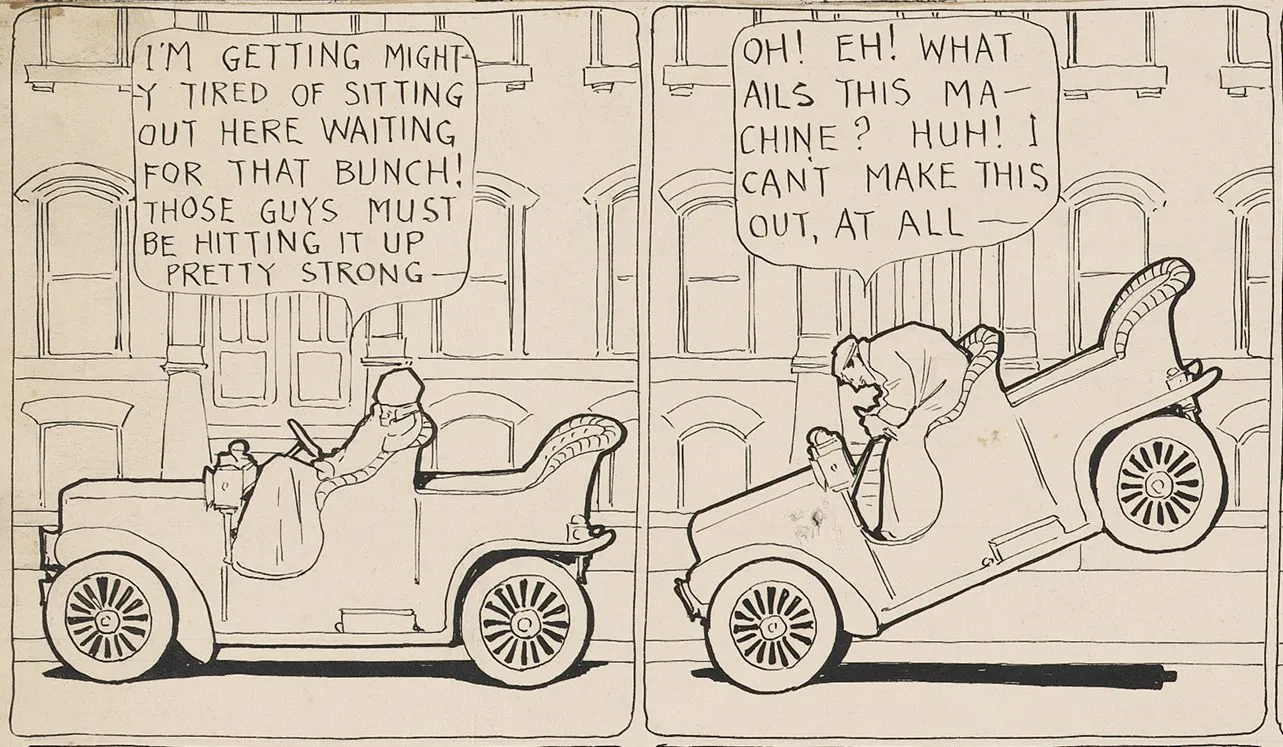
Panels 1 and 2, top left of NGA 142155: the car waits at the curb, then its rear wheel rises while the street stays put.
"Dream of the Rarebit Fiend: Bucking Automobile, 1907 (National Gallery of Art 142155), panels 1 and 2" by Winsor McCay — https://commons.wikimedia.org/wiki/File:Winsor_McCay,_Dream_of_the_Rarebit_Fiend_-_Bucking_Automobile,_1907,_NGA_142155.jpg — CC0 1.0 (https://creativecommons.org/publicdomain/zero/1.0/); modified: cropped to panels 1 and 2 with a narrow margin
Between panels 1 and 2 of this drawing, the car’s rear wheel leaves the street and climbs about 2.3 cm. The building behind it stays where it was: its sill and street lines sit at the same height in both panels. That is how the whole strip works: within each row the street barely shifts, and the car bucks against it like a horse.
The drawing is an original pen-and-ink board for a Dream of the Rarebit Fiend newspaper strip. The National Gallery of Art holds it as object 142155, accession 2008.128.1, titles it Bucking Automobile, dates it 1907, and has released the image under CC0. The name signed in the lower right corner is SILAS. A Library of Congress catalog note calls Silas a pseudonym of Winsor McCay, and the museum lists McCay as the artist.
What happens in the 18 panels?
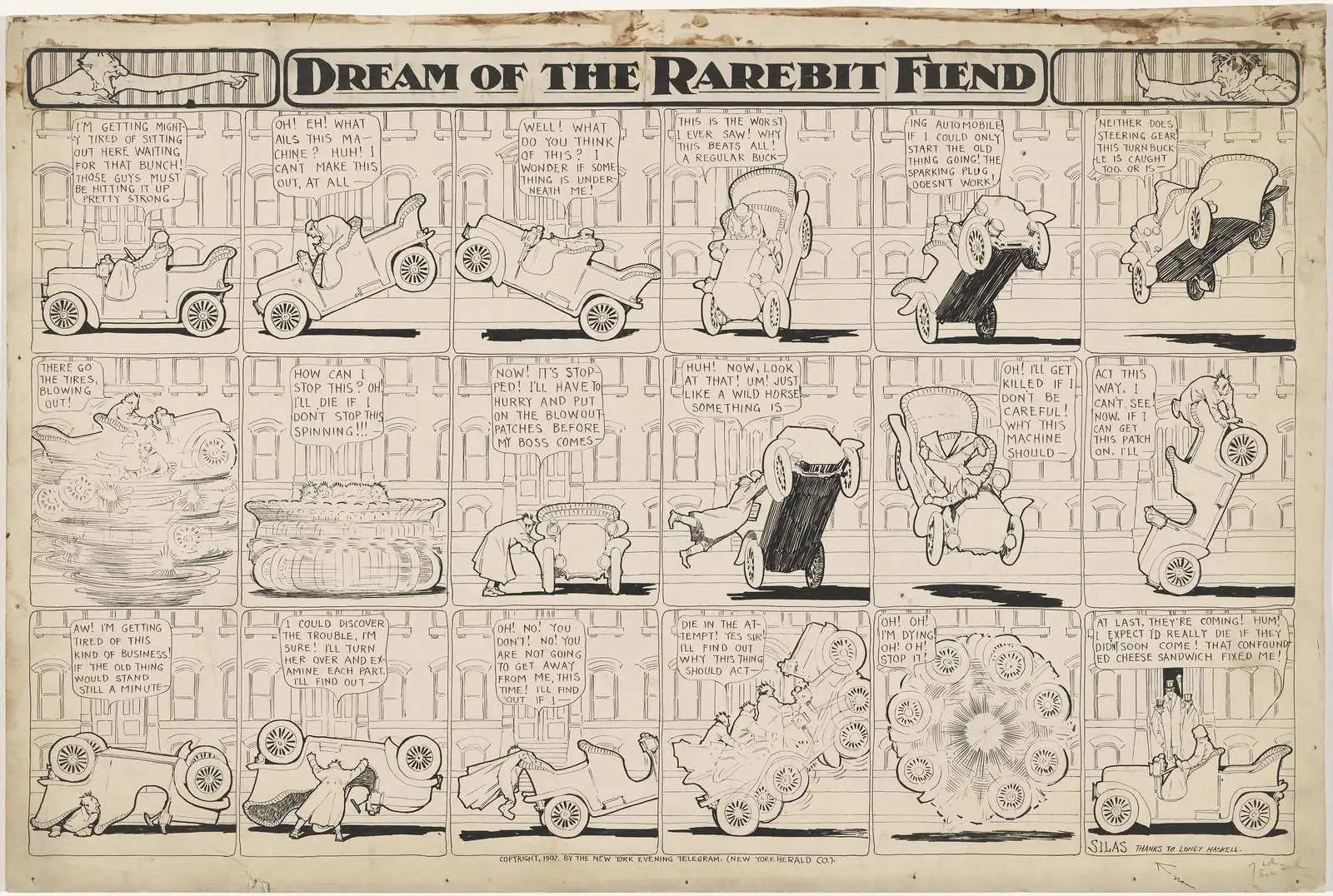
NGA 142155, Dream of the Rarebit Fiend: Bucking Automobile, 1907: 18 panels in 3 rows of 6, one balloon in each.
"Dream of the Rarebit Fiend: Bucking Automobile, 1907 (National Gallery of Art 142155)" by Winsor McCay — https://commons.wikimedia.org/wiki/File:Winsor_McCay,_Dream_of_the_Rarebit_Fiend_-_Bucking_Automobile,_1907,_NGA_142155.jpg — CC0 1.0 (https://creativecommons.org/publicdomain/zero/1.0/); modified: scaled from 4000 x 2690 to 1600 x 1076 px
The board holds 18 panels in three rows of six, under a title band with a drawn figure at each end. Every panel has a single balloon, and all of them seem to belong to one speaker, a driver in a long coat. In panel 1 he sits in an open car at the curb, complaining that he is “GETTING MIGHTY TIRED OF SITTING OUT HERE WAITING FOR THAT BUNCH!”
Then the car starts to act on its own. It tips onto its front wheels, then its rear wheels, and by panel 4 it stands on end. The driver calls it “A REGULAR BUCK-” and finishes the word in panel 5: “-ING AUTOMOBILE!”
The middle row gets worse. The tires blow out in panel 7, and in panel 8 the car is a squashed ring of flat tires. In panel 10 the car throws him off, and his balloon compares it to a wild horse.
In the bottom row the car lands upside down, and he tries to “TURN HER OVER AND EXAMINE EACH PART.” In panel 17 it bursts into a ring of loose wheels while he cries, “OH! OH! I’M DYING!”
Panel 18 puts the car back at the curb, whole, as three men in top hats come out of a doorway. His last balloon begins “AT LAST, THEY’RE COMING!” and ends “THAT CONFOUNDED CHEESE SANDWICH FIXED ME!” Taken with the title, the bucking reads as his dream.
How far does the car jump between panels?
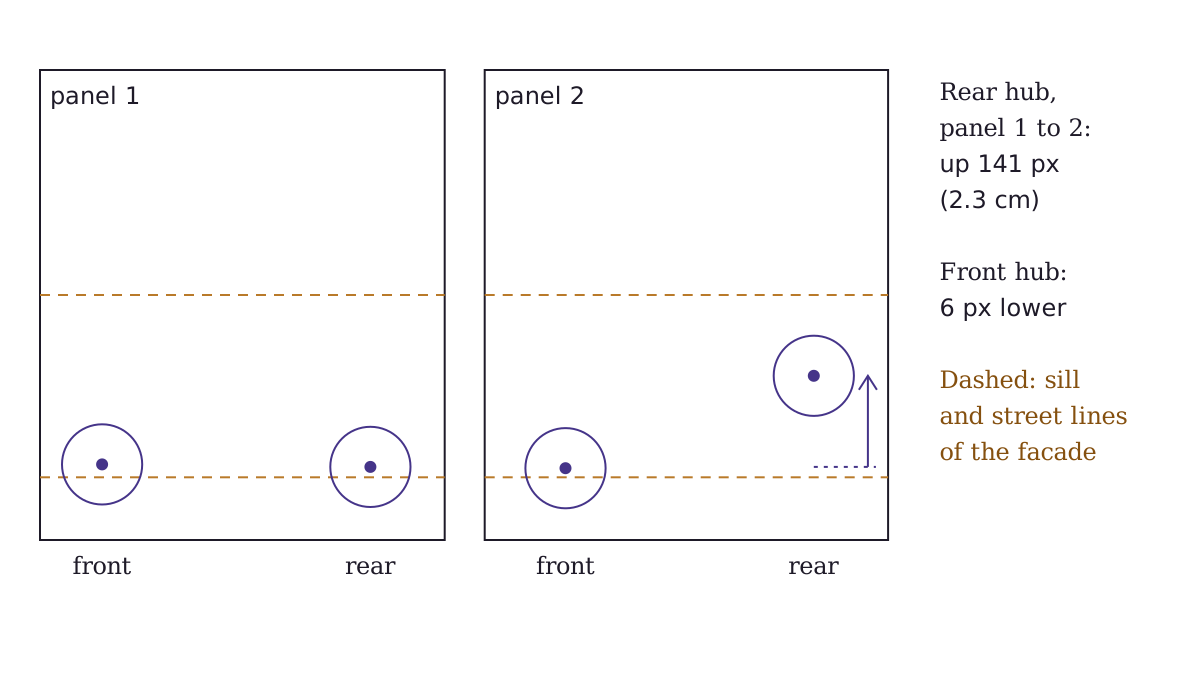
Panels 1 and 2 of NGA 142155 to scale: wheel hubs marked on the scan; the dashed lines are the facade’s sill and street lines.
"Panels 1 and 2 of NGA 142155 to scale: wheel hubs and facade lines" by Flickers & Tintypes, https://flickersandtintypes.com/comics-panels/dream-of-the-rarebit-fiend/ — CC BY 4.0, https://creativecommons.org/licenses/by/4.0/
The jump can be measured. The scan on Wikimedia Commons is 4,000 pixels wide, and the museum gives the sheet as 44.13 × 66.36 cm. That works out to about 60.6 pixels per centimeter, and the scales across and down the sheet agree to within about 1 percent.
In panel 1, the hub of the rear wheel sits 614 pixels below the top of the panel. In panel 2 it sits 473 pixels down, so it has risen 141 pixels, about 2.3 cm on the board. That is about a fifth of the panel’s height, in a single step.
Sideways, the rear hub moves only 2 pixels. The front hub ends up 6 pixels lower and 29 pixels to the right, about half a centimeter. So the car pivots on its front wheel, and nothing is drawn between the two positions.
The reader is left to supply that missing motion. In drawn animation, an animator would usually add drawings for the positions in between, as the Bouncing Ball Animation page shows with frame-by-frame spacing. Here McCay drew only the two ends of the move.
The street holds still while the car bucks
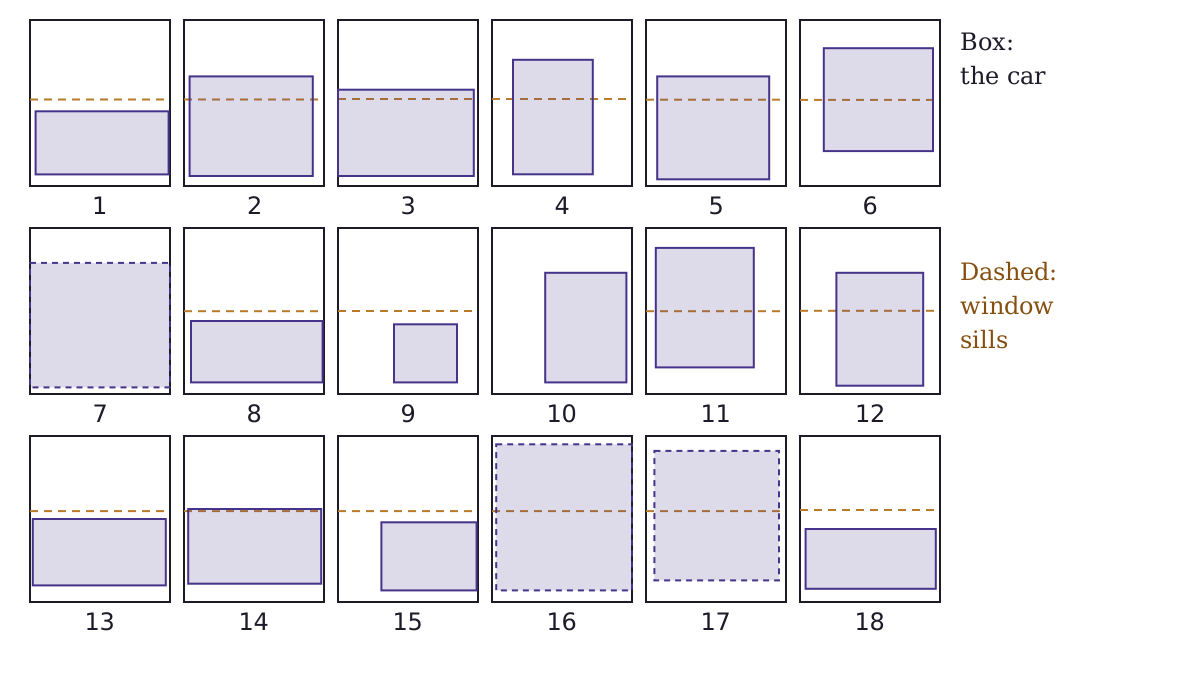
Where the car is drawn in each of the 18 panels of NGA 142155 (boxes), with the facade’s window-sill line where it could be found (dashed).
"Where the car is drawn in the 18 panels of NGA 142155" by Flickers & Tintypes, https://flickersandtintypes.com/comics-panels/dream-of-the-rarebit-fiend/ — CC BY 4.0, https://creativecommons.org/licenses/by/4.0/
The facade behind the car is drawn again in every panel. It is not a copy, and its details shift from panel to panel: a doorway with a peaked top shows up in panel 3, for one. Its horizontal lines, though, stay at nearly the same height.
In this site’s measurements, the window-sill line could be traced in 16 of the 18 panels. In panels 7 and 10, the spinning blur and the thrown driver cover the edges of the panel where the line is measured. Within each row of six, the sill line sits at the same height to within 5 pixels, about 0.08 cm. So within each row the point of view holds still, and the big movements belong to the car and its driver.
The car, by contrast, goes almost everywhere. The table gives the approximate center of the box this site marked around the car in each panel, as a percentage of the panel’s width (x) and height (y).
| Panel | What the car is doing | Center, about (x %, y %) |
|---|---|---|
| 1 | On four wheels at the curb; the driver sits waiting | 52, 74 |
| 2 | Rear wheel off the street, front wheel still down | 48, 64 |
| 3 | Front end up, rear wheel down | 49, 68 |
| 4 | Standing on end | 44, 58 |
| 5 | Reared up, dark underside toward the street | 48, 65 |
| 6 | In the air, tilted, underside showing | 56, 48 |
| 7 | Spinning as the tires blow out; drawn as a blur of wheels | 50, 58 |
| 8 | Squashed into a ring of flattened tires | 52, 75 |
| 9 | Back on four wheels, seen head-on; the driver bends over a front tire | 63, 75 |
| 10 | Reared up on its back wheels; the driver thrown off to the left | 67, 60 |
| 11 | In the air on end, nose down; the driver upside down inside | 42, 48 |
| 12 | Standing on end on one wheel; the driver on top, holding a wheel | 57, 61 |
| 13 | Upside down on the street; the driver underneath at the left | 49, 70 |
| 14 | Upside down; the driver pushes at the body | 51, 66 |
| 15 | Upright; the driver thrown across the back | 65, 72 |
| 16 | Crumpling, drawn as several overlapping cars and drivers | 51, 49 |
| 17 | Burst into a ring of loose wheels | 50, 48 |
| 18 | On four wheels at the curb as in panel 1; three men in top hats come out of the doorway | 51, 74 |
Panel 18 puts the car back about where panel 1 had it. The two centers differ by about 1 percent of the panel’s width, less than the marking error: the boxes are marked on the scan to about 15 pixels, roughly 0.25 cm or 2 percent of a panel’s width. So the table is a map of where the car goes, not a precise track.
Download the panel measurements and balloon text (CSV) source and license notes
Reading the strip panel to panel
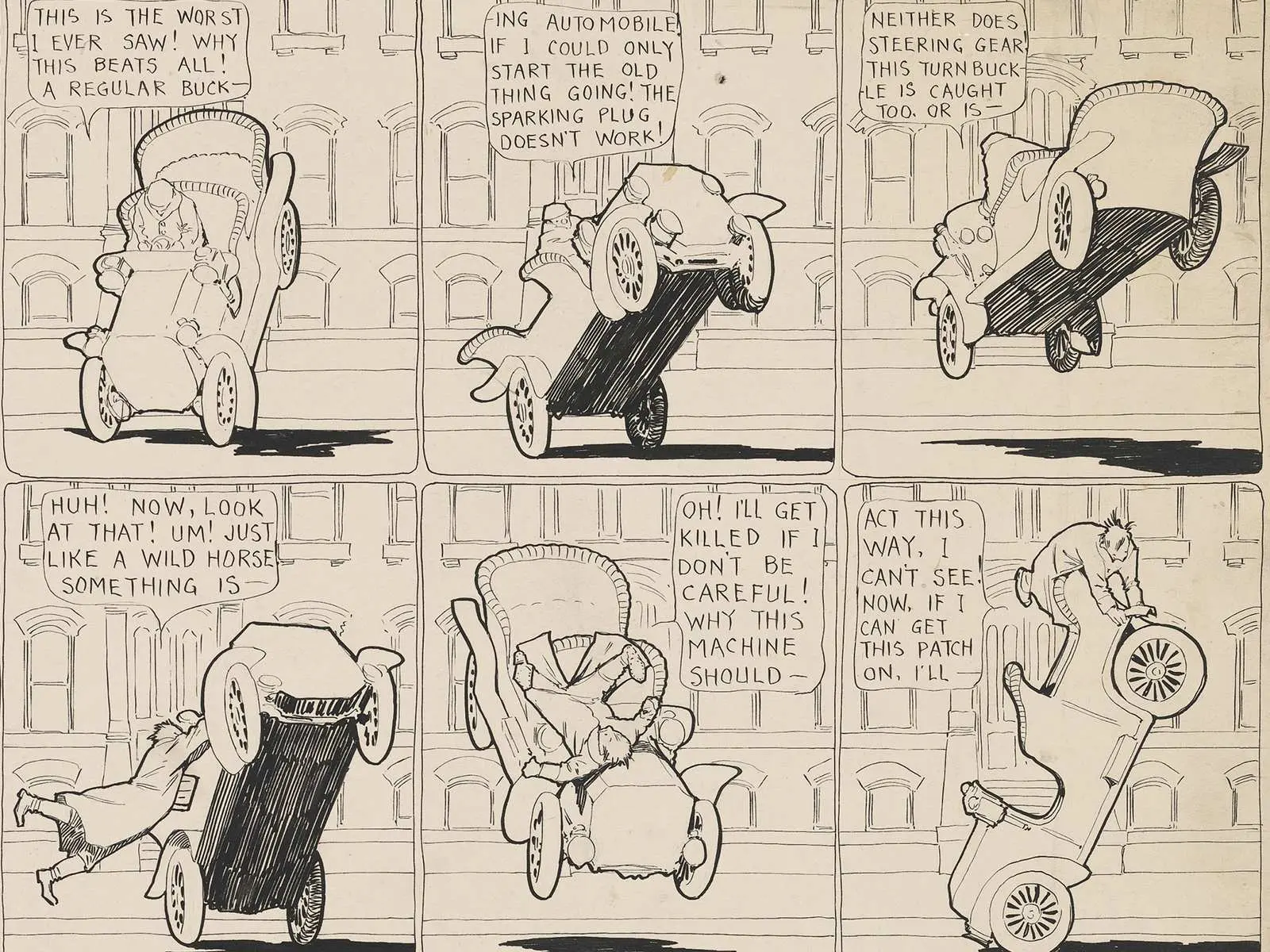
Panels 4 to 6 and 10 to 12 of NGA 142155: the car stands on end, rears and leaves the street, then rears again, hangs nose down and balances on one wheel.
"Dream of the Rarebit Fiend: Bucking Automobile, 1907 (National Gallery of Art 142155), panels 4 to 6 and 10 to 12" by Winsor McCay — https://commons.wikimedia.org/wiki/File:Winsor_McCay,_Dream_of_the_Rarebit_Fiend_-_Bucking_Automobile,_1907,_NGA_142155.jpg — CC0 1.0 (https://creativecommons.org/publicdomain/zero/1.0/); modified: cropped to panels 4 to 6 and 10 to 12, 4:3, trimming the foot of panels 10 to 12, and scaled from 1916 to 1600 px wide
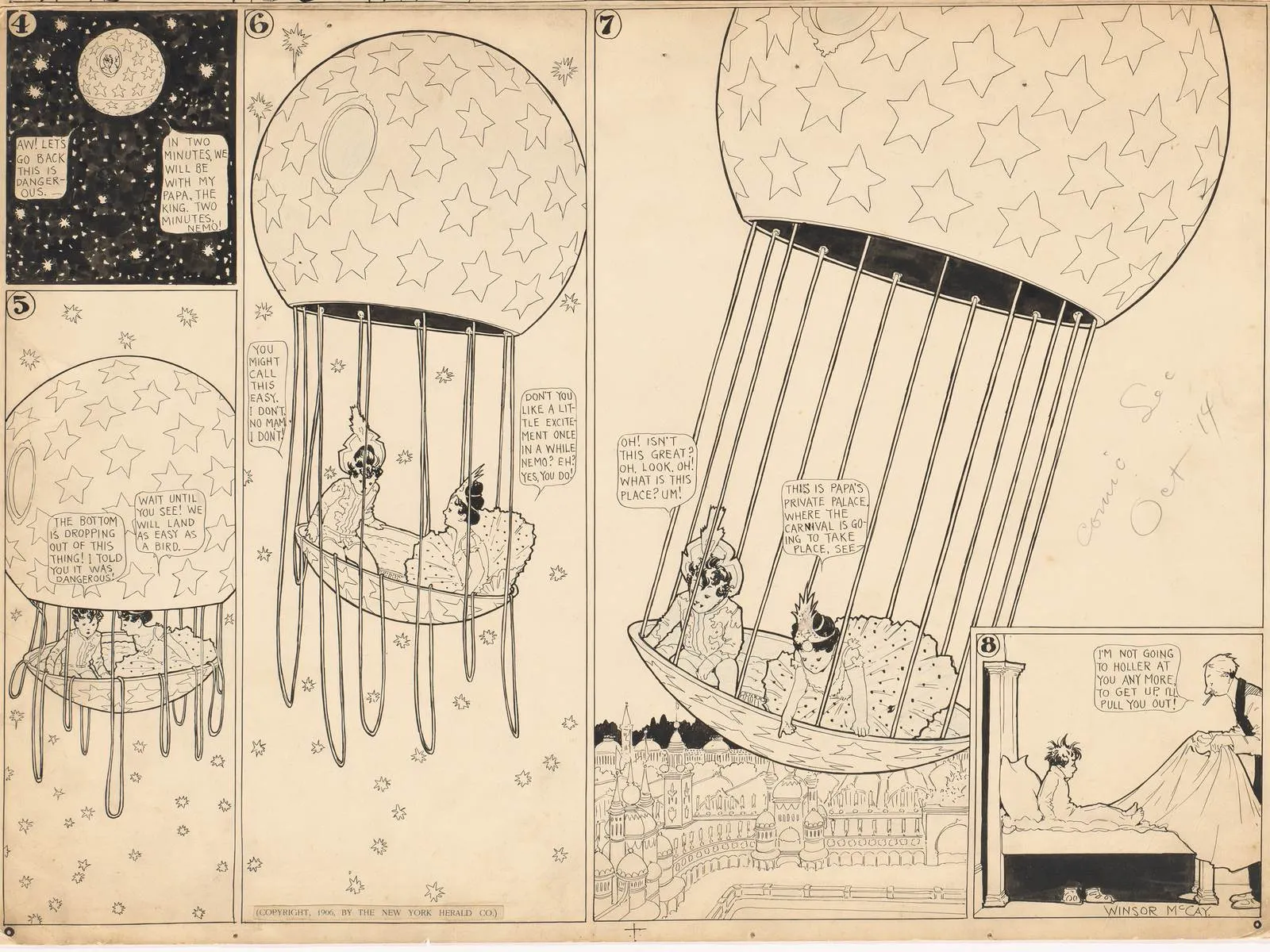
This board is a plain grid. Unlike the 1906 Little Nemo board, it has no numbers on its panels. Its three even rows of six point to the usual order: left to right, then down.
The words do something the pictures do not. Four times, by this site’s count, a sentence starts in one panel and ends in the next. Panel 4 ends “A REGULAR BUCK-” and panel 5 begins “-ING AUTOMOBILE!”
Panel 11 ends “WHY THIS MACHINE SHOULD-” and panel 12 begins “ACT THIS WAY, I CAN’T SEE.” The other two breaks fall between panels 13 and 14 and between panels 15 and 16, where “I’LL FIND OUT IF I-” runs on into “DIE IN THE ATTEMPT!”
Each break splits a thought across a gutter, the blank strip between two panels, so the sentence finishes in the next picture. With one speaker and one balloon per panel, the balloons carry the strip’s only voice. For how a balloon’s tail points to its speaker, see Speech Bubbles.
Who was Silas?
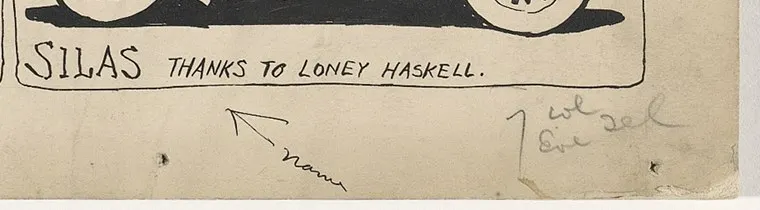
Lower right corner of NGA 142155: SILAS and a line of thanks in ink, with a handwritten arrow and two pencil notes in the margin below.
"Dream of the Rarebit Fiend: Bucking Automobile, 1907 (National Gallery of Art 142155), signature corner" by Winsor McCay — https://commons.wikimedia.org/wiki/File:Winsor_McCay,_Dream_of_the_Rarebit_Fiend_-_Bucking_Automobile,_1907,_NGA_142155.jpg — CC0 1.0 (https://creativecommons.org/publicdomain/zero/1.0/); modified: cropped to the lower right corner
The signature reads “SILAS” and is followed by “THANKS TO LONEY HASKELL.” The board does not say what Haskell contributed, and this page does not guess. Below it, a handwritten arrow points up toward the signature, next to a word that seems to read “name.” Farther right, two fainter pencil lines seem to read “7 col” and “Eve Tel.”
McCay’s name comes in from outside the board. The museum’s data on Commons lists the artist as Winsor McCay. A Library of Congress catalog note for another Silas drawing, dated 1906 (LCCN 2005680624), says “Silas was the pseudonym of Winsor McCay.” That note reached this page as it appears on Wikimedia Commons; the Library’s own record was not consulted directly.
The same note reports McCay’s own story of the name. According to the note, he said Silas was the name of an old man who drove a garbage cart outside the New York Herald office. It adds that he used it to keep these strips apart from his strips for children. For this the note credits a biography of McCay by John Canemaker, which was not read for this page.
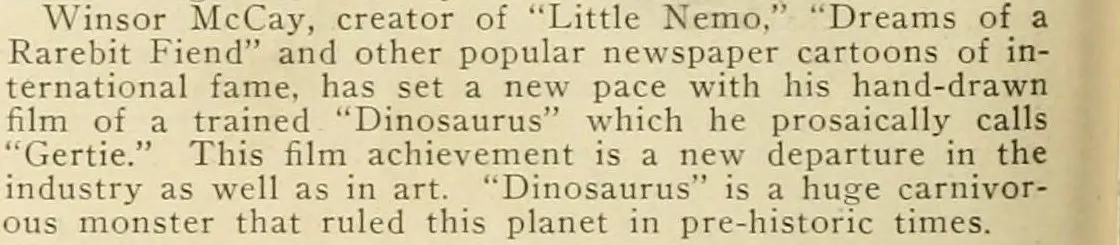
Page 914, right column, Moving Picture World of November 14, 1914: the paragraph that credits McCay with the strip.
“The Moving Picture World 22, no. 7 (November 14, 1914), p. 914: Box Office Has a Winsor M’Cay Novelty, second paragraph” — The Moving Picture World — public domain full credit
"The Moving Picture World 22, no. 7 (November 14, 1914), p. 914: Box Office Has a Winsor M’Cay Novelty, second paragraph" by The Moving Picture World — https://archive.org/details/movingpicturewor22newy — Public domain: Public domain in the US (published 1914) and in the EU (unsigned trade-paper notice in a 1914 periodical issued by the Chalmers Publishing Company; anonymous work, 70 years from publication ended in 1984); modified: cropped to the second paragraph of the notice in the right column
A trade paper made the same link in print. Moving Picture World, in its issue of November 14, 1914, described “Winsor McCay, creator of ‘Little Nemo,’ ‘Dreams of a Rarebit Fiend’ and other popular newspaper cartoons of international fame.” The paper’s title differs from the board’s by a plural and an article. The notice was about his hand-drawn film Gertie the Dinosaur.
What does the board date?

Bottom edge of NGA 142155, under panels 15 and 16: the copyright line that gives the board its year.
"Dream of the Rarebit Fiend: Bucking Automobile, 1907 (National Gallery of Art 142155), copyright line" by Winsor McCay — https://commons.wikimedia.org/wiki/File:Winsor_McCay,_Dream_of_the_Rarebit_Fiend_-_Bucking_Automobile,_1907,_NGA_142155.jpg — CC0 1.0 (https://creativecommons.org/publicdomain/zero/1.0/); modified: cropped to the bottom edge under panels 15 and 16
The year comes from one line along the bottom edge: “COPYRIGHT, 1907. BY THE NEW YORK EVENING TELEGRAM. (NEW YORK HERALD CO.).” It names the newspaper and, in parentheses, the company behind it. The pencil “Eve Tel” in the corner may point the same way, but it is only a pencil note.
The board gives no day. It shows no month, day or issue number, and the newspaper page it was drawn for was not read for this page. So the day this strip ran in print is left open here, and the board is dated by its year alone.
The museum describes the medium as pen and black ink and brush and black ink over graphite, “with printed overlay,” on paperboard. The record does not say which part is the printed overlay, and the board itself does not settle it.
Prints consulted
- 1Winsor McCay (signed Silas), Dream of the Rarebit Fiend: Bucking Automobile, 1907, pen and ink over graphite with printed overlay on paperboard, National Gallery of Art, Washington, accession 2008.128.1 (object 142155); museum data as given on the Wikimedia Commons file page. https://commons.wikimedia.org/wiki/File:Winsor_McCay,_Dream_of_the_Rarebit_Fiend_-_Bucking_Automobile,_1907,_NGA_142155.jpgRead: file page and full-size original image
- 2“Box Office Has a Winsor M’Cay Novelty,” The Moving Picture World 22, no. 7 (November 14, 1914): 914. https://archive.org/details/movingpicturewor22newyRead: page 914, with the cover and the date line on page 901 of the same issue, checked against the page images
- 3Winsor McCay, Dream of a rarebit fiend. "I always like to sit in the corner of a car then I don't have people trampling all over me" / Silas, 1906, ink drawing, Library of Congress Prints and Photographs Division, LCCN 2005680624 (digital ID ppmsca.07860); catalog notes as given on the Wikimedia Commons file page. https://commons.wikimedia.org/wiki/File:Dream_of_a_rarebit_fiend._%22I_always_like_to_sit_in_the_corner_of_a_car_then_I_don%27t_have_people_trampling_all_over_me%22_-_Silas._LCCN2005680624.jpgRead: file page (catalog notes)


Next reel:
- Speech Bubbles: the device that carries every line of this strip, and how a balloon’s tail picks out a speaker.
- Little Nemo: a 1906 McCay board that numbers its panels, and where the reading path splits.
- Public-domain original to view: Dream of the Rarebit Fiend: Bucking Automobile, NGA 142155 (Wikimedia Commons)
Cite this page
Flickers & Tintypes. “Dream of the Rarebit Fiend: 18 Panels of One Bucking Car.” Flickers & Tintypes. Published November 12, 2026. https://flickersandtintypes.com/comics-panels/dream-of-the-rarebit-fiend/. Accessed [the date you read it].
Same sectionAlso in Comics Panels
Comics Panels
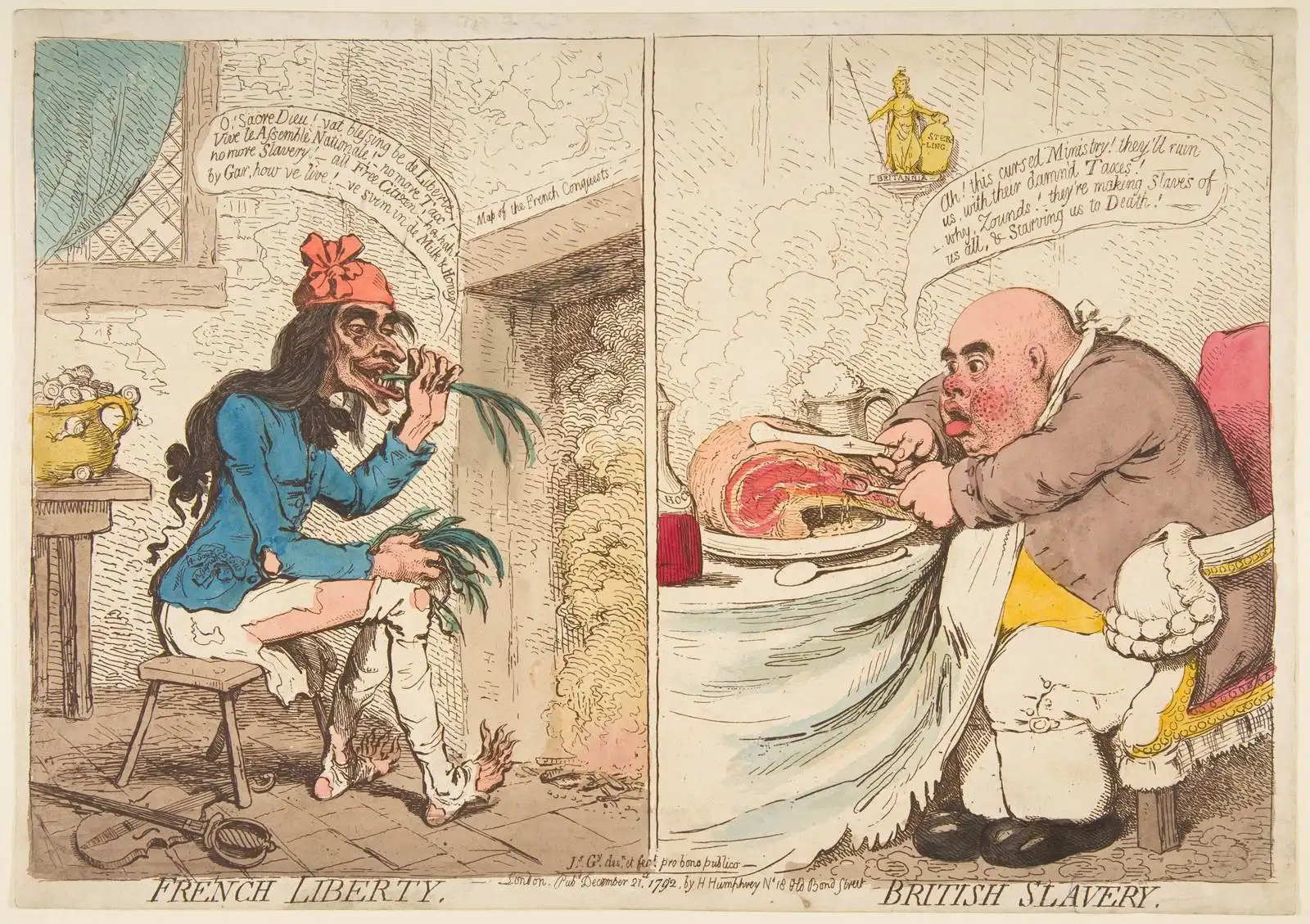
Speech Bubbles: Gillray Was Drawing Them in 1792
A speech bubble holds spoken words in an outline that points to the speaker. A Gillray print of 21 December 1792 has two by this site’s count, one per panel.
Picture credit
"French Liberty – British Slavery, hand-colored etching, published 21 December 1792 (Metropolitan Museum of Art 1976.602.27)" by James Gillray — https://commons.wikimedia.org/wiki/File:French_Liberty_%E2%80%93_British_Slavery_MET_DP818494.jpg — CC0 1.0 (https://creativecommons.org/publicdomain/zero/1.0/); modified: scaled from 3645 to 1600 px wide; nothing else changed
Comics Panels
Little Nemo: A 1906 Board Numbered Out of Row Order
How to read a Little Nemo in Slumberland page: McCay’s board dated Oct. 14, 1906 numbers its 8 panels. After panel 4 they send you down to 5, not across to 6.
Picture credit
"Little Nemo in Slumberland: "I don't like this, one little tiny bit, not one tiny weenie bit", 1906 (National Gallery of Art 142153), panels 4 to 8" by Winsor McCay — https://commons.wikimedia.org/wiki/File:Winsor_McCay,_Little_Nemo_in_Slumberland_-_%22I_don%27t_like_this,_one_little_tiny_bit,_not_one_tiny_weenie_bit%22,_1906,_NGA_142153.jpg — CC0 1.0 (https://creativecommons.org/publicdomain/zero/1.0/); modified: cropped to panels 4 to 8 (the bottom tier), 4:3, and scaled from 3000 to 1600 px wide